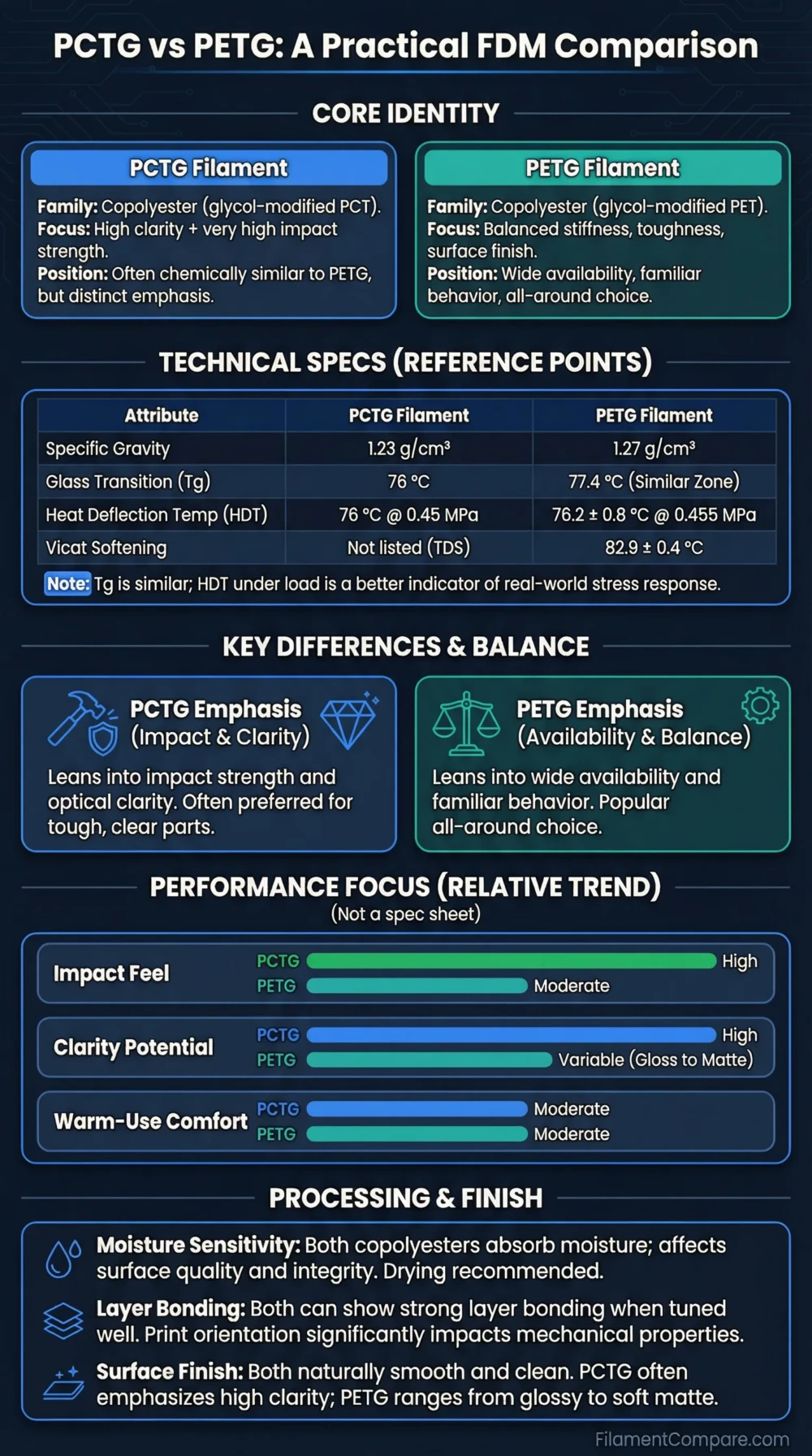
| Attribute | PCTG Filament | PETG Filament |
|---|---|---|
| Polymer Family | Copolyester (often positioned as chemically similar to PETG) | Copolyester (glycol-modified PET family) |
| Specific Gravity | 1.23 g/cm³ | 1.27 g/cm³ |
| Glass Transition (Tg) | 76 °C | 77.4 °C |
| Heat Deflection Temperature (under load) | 76 °C @ 0.45 MPa; 64 °C @ 1.8 MPa | 76.2 ± 0.8 °C @ 0.455 MPa |
| Vicat Softening | Not listed in this TDS | 82.9 ± 0.4 °C |
| Tensile Modulus (printed part data) | 1.71–1.86 GPa (orientation-dependent) | Not listed on the thermal page; varies by print orientation in this TDS |
| Impact (Notched Izod) | 4.7–7.5 kJ/m² (orientation-dependent) | Not listed in this TDS |
| Published Nozzle Range (example TDS) | 250–270 °C | Not listed in this TDS |
| How To Read These Numbers | Treat values as reference points, not a universal rule. Filament blends, colorants, and print conditions change outcomes, especially for impact and layer direction. | |
If you see PCTG filament and PETG filament marketed as “close cousins,” that’s fair.
Both sit in the copolyester space and often aim for a clean look with solid toughness.
The real difference is usually the balance: one leans into impact and clarity, the other leans into wide availability and familiar behavior.
- Material Identity and Chemistry
- What “PCTG” Usually Means in Plastics
- What “PETG” Means in Filament Branding
- Thermal Behavior and Key Temperatures
- Mechanical Behavior in Printed Parts
- What Usually Stays Consistent Across Brands
- Surface Finish, Clarity, and Visual Style
- Clarity Notes That Matter
- Chemical Resistance and Moisture Behavior
- Processing Notes That Affect Data Quality
PCTG vs PETG is a practical comparison because both materials are widely used as 3D printing filament in FDM/FFF and are often discussed alongside other engineering-grade 3D printing filaments.
They are copolyesters, so they share a similar “feel” in many prints: good layer bonding, smooth surfaces, and a naturally clean look.
Still, PCTG filament is often chosen when makers want an extra push toward impact strength and optical clarity, while PETG filament remains a popular all-around choice.
- Copolyester family
- Tg around mid-70 °C
- Clear-part friendly
- Impact-focused options
- Orientation matters
Material Identity and Chemistry
What “PCTG” Usually Means in Plastics
In plastics terminology, PCT-G is commonly described as a glycol-modified version of PCT and is known by the chemical name
polycyclohexylene dimethylene terephthalate.
It is frequently associated with high clarity and very high impact strength in engineering plastics descriptions
✅Source.
- Family: copolyester (amorphous-style behavior is common in many grades)
- Positioning: often discussed as chemically similar to PETG, with a different emphasis
- Typical theme: clarity + toughness + stable appearance
What “PETG” Means in Filament Branding
PETG filament is typically presented as a glycol-modified polyester aimed at easy processing and consistent results.
In practice, many PETG spools are tuned for a balanced mix of stiffness, toughness, and surface finish.
The most important detail is that PETG can vary widely by formulation, so the “same” PETG label can still hide real differences in flow and feel.
- Base family stays similar, yet additives can shift results
- Color and fillers can change gloss and impact
- Brand-to-brand ranges are normal, even for Tg and HDT
Thermal Behavior and Key Temperatures
- Glass Transition (Tg)
-
The “softening shift” region where an amorphous plastic moves from glassy to rubbery behavior. ISO 11357-2 is an established DSC method reference for determining Tg in plastics
✅Source. - Heat Deflection Temperature (HDT)
-
A load-based temperature indicator that helps compare how a plastic responds when warmed under a defined stress. ISO 75-2 covers determination of the temperature of deflection under load for plastics
✅Source. - Vicat Softening
- Another softening indicator, often used as a quick comparison point for “when the surface starts to give” under a defined needle load.
The table at the top shows Tg for both materials landing in a very similar zone.
That means PCTG filament and PETG filament can behave alike when a part is sitting near warm air, electronics, or indirect heat.
The better lens is to look at HDT and the test load, because it’s closer to “real stress” than Tg alone.
Relative Emphasis (Generic Trend)
(not a spec sheet)
Mechanical Behavior in Printed Parts
With PETG filament and PCTG filament, the big mechanical story is rarely “the polymer alone.”
It’s the printed structure: layer lines, infill angles, and wall paths.
That’s why technical sheets often show multiple orientations for tensile and impact.
What Usually Stays Consistent Across Brands
- Both often deliver a tough feel compared to brittle plastics
- Both can show strong layer bonding when tuned well
- PCTG is commonly positioned toward impact-heavy applications
- PETG is commonly positioned as a reliable all-rounder
When a datasheet lists multiple values for the same test, it is not “messy data.”
It is the honest part of FDM reality: printed parts behave differently along different axes.
For PCTG and PETG, that axis sensitivity is often the biggest reason two prints can feel very different even if they look identical.
Surface Finish, Clarity, and Visual Style
If your project cares about looks, PCTG filament and PETG filament are both in a good place.
Copolyesters often deliver a naturally smooth surface and a clean shine.
Many PCTG descriptions lean heavily on high clarity, while PETG is known for a broad range of finishes from glossy to soft matte.
Clarity Notes That Matter
- Geometry can change perceived clarity more than the label on the spool
- Layer interfaces scatter light; fewer internal boundaries usually looks clearer
- Colorants can shift transparency even inside the same polymer family
Chemical Resistance and Moisture Behavior
PETG filament and PCTG filament are often chosen for everyday environments because copolyesters tend to handle many common exposures well.
Still, “chemical resistance” is not a single switch.
One PETG technical sheet presents a simple rating approach (Good, Fair, Poor) across broad chemical groups, and it also reports a maximum water absorption rate in a controlled humidity setting
✅Source.
- What “Chemical Resistance” Usually Means on Filament Sheets
-
It is typically a comparative rating for short contact vs longer storage contact, not a promise of universal compatibility.
Most sheets keep it broad on purpose, because concentration and time change everything. - Moisture Is Part of the Story
-
Copolyesters can absorb moisture from air, and that moisture can influence surface quality and consistency.
Some manufacturers show moisture curves and drying guidance to keep outcomes stable.
Processing Notes That Affect Data Quality
A big reason PETG filament and PCTG filament feel “different” across brands is that copolyesters are sensitive to moisture and thermal history.
One copolyester technical document highlights a practical target moisture level before processing and notes that moisture can contribute to hydrolysis-related degradation if not controlled
✅Source.
If you are comparing datasheets, try to compare like with like:
test standard, sample type, and print orientation.
That’s where the real meaning is, especially for impact and deflection under load.
