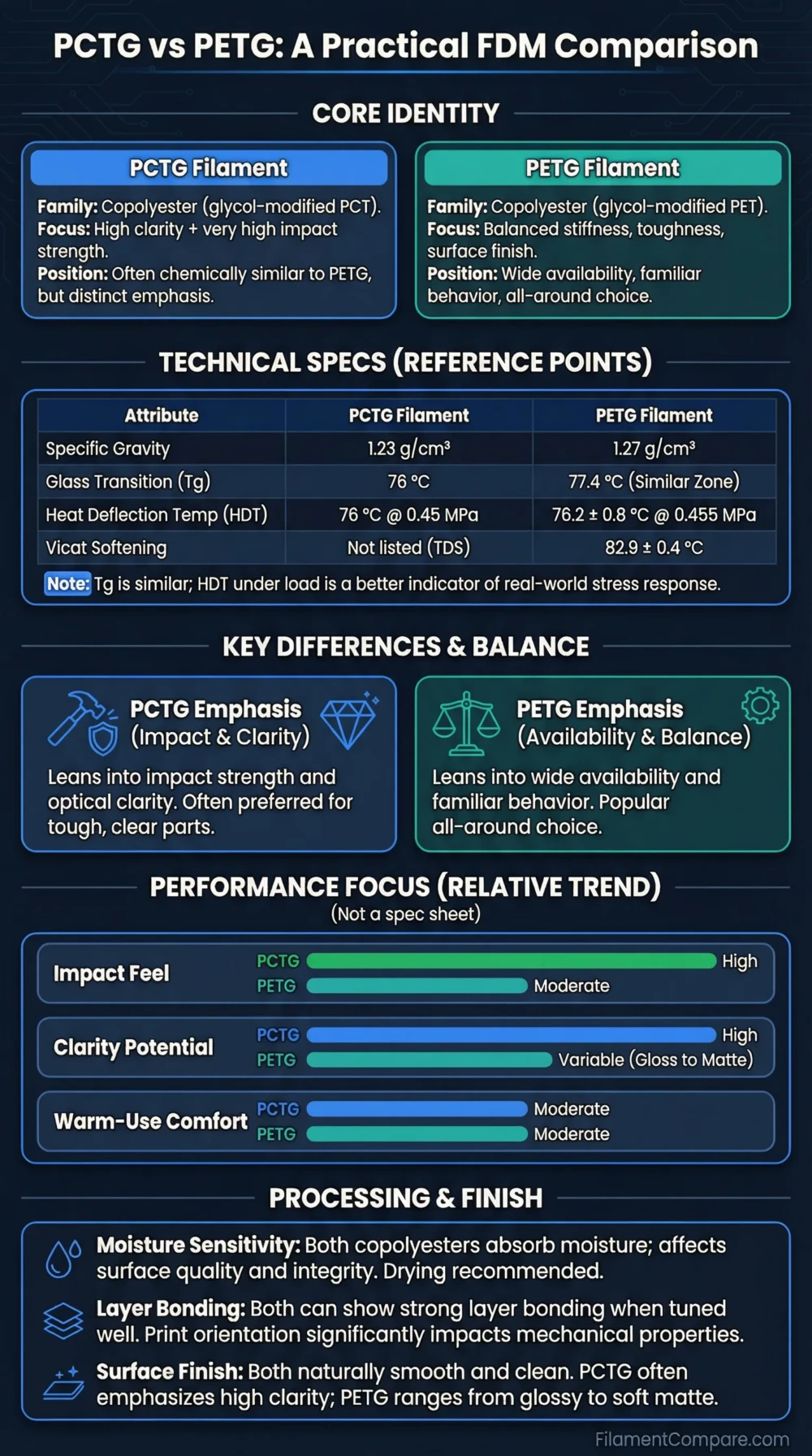
PCTG is usually the tougher and more impact-tolerant copolyester, while PETG is the easier material to source, tune, and use for everyday functional printing. Their heat performance is often closer than their names suggest, so PCTG should not be treated as an automatic high-temperature upgrade. Choose by failure mode: impact and repeated flex favor PCTG; cost, color choice, and established printer profiles favor PETG.
The Practical Choice
Choose PCTG for protective housings, clips, guards, handles, fixtures, and other parts that may be dropped, bent, or struck. Choose PETG for general brackets, organizers, printer parts, containers, and larger prints where broad availability and simpler profile setup matter more than maximum ductility.
Better Impact Absorption
PCTG usually deforms farther before cracking and is the better fit for parts exposed to drops or sudden loads.
Easier First Profile
PETG has more ready-made slicer profiles, wider community support, and a slightly lower typical nozzle range.
Better for Snap Features
PCTG is often preferred when clips, tabs, or living-style hinges need more strain tolerance (geometry still matters).
Better Color and Brand Choice
PETG is usually available in more colors, finishes, spool sizes, and locally stocked brands.
Better Chemical Fit
PCTG commonly offers stronger resistance to cleaners and household chemicals, though each grade needs verification.
Better Budget Fit
PETG normally costs less and makes more sense for prototypes, storage parts, and high-volume noncritical prints.
Better Clear-Part Potential
PCTG can provide very good clarity and ductile behavior in suitable natural grades, with tuned flow and thick walls.
Similar Heat Class
Neither material should be selected for sustained high heat without checking the exact filament datasheet and part load.
| Decision Area | PCTG | PETG | Better Choice |
|---|---|---|---|
| Material family | Amorphous glycol-modified copolyester; exact chemistry varies by grade | Glycol-modified PET-family copolyester | Application-dependent |
| Print difficulty | Moderate; higher hotend temperature and flow tuning are common | Easy to moderate; widely supported by printer and slicer presets | PETG |
| Typical nozzle temperature | Usually about 250–270°C for standard unfilled filament | Usually about 230–260°C for standard unfilled filament | Printer-dependent |
| Typical bed temperature | Usually about 70–90°C | Usually about 60–90°C | Similar |
| Enclosure need | Normally not required; draft control can help large parts | Normally not required | PETG by a small margin |
| Heat resistance | Moderate and grade-dependent; not automatically above PETG | Moderate and grade-dependent | Check the grade |
| Impact toughness | Usually higher, with more ductile failure behavior | Good, but commonly less impact-tolerant than PCTG | PCTG |
| Stiffness | Moderate; may flex more before failure | Moderate; exact modulus varies by formulation | Similar by grade |
| Layer adhesion | Usually very good when printed hot enough | Usually very good and well documented | Similar |
| Warping | Low for a technical filament | Low | Similar |
| Stringing and oozing | Possible; moisture and high nozzle temperature make it more visible | Common tuning concern | PETG is easier to troubleshoot |
| Moisture behavior | Drying is useful when surface quality or strength declines | Drying is useful when popping, fuzz, or stringing appears | Both need dry storage |
| Surface and clarity | Often clearer in natural grades, with ductile behavior under bending | Glossy; transparent colors are common but true optical clarity needs tuned geometry | PCTG for clear functional parts |
| Outdoor suitability | Suitable for mild outdoor use when the grade supports it; long UV exposure remains formulation-dependent | Often used outdoors, but long-term UV stability is not guaranteed for every grade | Check UV-stabilized options |
| Chemical resistance | Often broader than standard PETG | Good against many household substances, but grade and chemical concentration matter | PCTG |
| Availability and price | Fewer brands and colors; usually higher cost | Widely stocked and usually less expensive | PETG |
| Typical uses | Guards, clips, handles, durable housings, jigs, protective parts | Brackets, organizers, printer parts, containers, fixtures, larger models | Use-case based |
| Main limitation | Higher print temperature, narrower availability, and no guaranteed heat gain | More stringing and less impact ductility than many PCTG grades | Different tradeoffs |
This PCTG and PETG comparison combines official technical data sheets, filament settings, and producer material guidance; actual results can shift with brand, pigment, modifiers, moisture, print orientation, wall design, and slicer settings.
Material Profiles for FDM Printing
PCTG Material Profile
- Polymer type: Amorphous glycol-modified copolyester
- Print difficulty: Moderate
- Nozzle range: Commonly 250–270°C
- Bed range: Commonly 70–90°C
- Enclosure: Usually optional
- Drying: A typical producer starting point is 65°C for 4 hours[a]
- Typical behavior: Low warp, high ductility, strong layer bonding, good clarity in natural grades
- Best uses: Impact-prone housings, clips, guards, handles, fixtures, and durable transparent parts
PETG Material Profile
- Polymer type: Glycol-modified PET-family copolyester
- Print difficulty: Easy to moderate
- Nozzle range: Commonly 230–260°C
- Bed range: Commonly 60–90°C
- Enclosure: Usually unnecessary
- Drying: A typical producer starting point is 65°C for 4 hours[b]
- Typical behavior: Low warp, good toughness, strong interlayer bonding, glossy surface, possible stringing
- Best uses: General functional parts, brackets, organizers, printer components, cases, and containers
Relative Printing and Part Performance
PCTG
PETG
The bars are relative indicators for common printing use, not fixed laboratory ratings. Brand, color, additives, absorbed moisture, layer direction, wall thickness, cooling, and slicer choices can move the result.
Toughness Is the Main PCTG Advantage
PCTG is most useful when a part must absorb energy without cracking. A dropped enclosure, a clip opened many times, or a guard hit from the side benefits from ductility and impact tolerance. PETG is already tougher than many easy-print materials, but standard PCTG grades commonly extend farther before fracture.
This does not mean PCTG always has higher tensile strength or stiffness. Two parts can show similar tensile numbers while behaving very differently during impact. PETG may hold a static bracket load well, while PCTG may survive a fall or repeated deflection better. Wall thickness, fillets, print direction, and stress concentration often matter as much as the material name.
What “Stronger” Means Here
For a rigid alignment fixture, compare modulus and creep. For a clip or protective cover, compare elongation and impact behavior. A single “strength” label cannot answer both jobs.
Heat Performance Is Often Closer Than Expected
PCTG usually needs a hotter nozzle, but higher processing temperature does not automatically mean higher service temperature. Many PCTG and PETG filaments occupy a similar moderate heat class. A PCTG part may be tougher yet still soften or creep under a sustained load in a warm enclosure.
For brackets near motors, lighting, appliances, or vehicle glazing, check the exact heat-deflection or Vicat data for the selected grade. Also check whether the value was measured on molded specimens or printed samples (the two are not interchangeable). When the operating temperature is close to the material limit, PC, ASA, ABS, or a heat-focused copolyester grade may be a better candidate.
A matched-format producer dataset shows why the choice should not be reduced to a single temperature or strength number. The MAX-G PCTG sheet lists 45 MPa tensile strength at break, 1,755 MPa tensile modulus, 24% elongation at break, a 78°C glass-transition temperature, and a 76°C deflection temperature at 0.45 MPa[e]. The corresponding PETG sheet lists 45 MPa, 1,650 MPa, 24%, 80°C, and 70°C under the stated methods[f]. This pair shows similar tensile behavior, a slightly higher listed PETG glass-transition value, and a higher listed PCTG deflection temperature; it does not establish a rule for every brand.
| Property | MAX-G PCTG | 3DXMAX PETG | How to Read It |
|---|---|---|---|
| Density | 1.23 g/cc | 1.24 g/cc | Part weight is nearly identical at the same printed volume |
| Tensile strength at break | 45 MPa | 45 MPa | No tensile-strength advantage appears in this matched pair |
| Tensile modulus | 1,755 MPa | 1,650 MPa | PCTG is slightly stiffer in this dataset, not by a large margin |
| Elongation at break | 24% | 24% | The listed tensile elongation is the same; impact behavior still needs its own test |
| Flexural strength | 72 MPa | 72 MPa | The listed bending strength is equal |
| Flexural modulus | 1,600 MPa | 1,600 MPa | The listed bending stiffness is equal |
| Notched Izod impact | 8 kJ/m² | Not listed on the compared sheet | Do not invent a PETG comparison value when the sheet omits it |
| Glass-transition temperature | 78°C | 80°C | PCTG does not lead this thermal measure in the compared grades |
| Deflection temperature at 0.45 MPa | 76°C | 70°C | PCTG retains shape better under this specific low-load test |
| Printed specimen setup | 0.4 mm nozzle, 0.25 mm layers, 100% infill, ±45°, XY flat; 275°C nozzle and 90°C bed | 0.4 mm nozzle, 0.25 mm layers, 100% infill, ±45°, XY flat; 245°C nozzle and 70°C bed | The geometry and orientation match, while processing temperatures follow each material |
Printability, Stringing, and Build-Surface Release
PETG is the simpler starting point because most printers include a tested profile. It prints with low shrinkage, usually without an enclosure, and tolerates large footprints well. Its familiar problem is oozing: excess temperature, wet filament, slow travel, and unsuitable retraction can leave fine strings between features.
PCTG behaves similarly but asks more from the hotend. Start with the filament maker’s temperature, then tune flow, cooling, retraction, and maximum volumetric speed. Printing too cool can reduce interlayer bonding; printing too hot can increase gloss, ooze, and fine hairs. Clear grades often look better with slower outer walls, stable extrusion, and fewer internal travel moves.
Both materials can grip some smooth build surfaces very strongly. A satin or textured sheet is often easier to release for PETG, and the same cautious approach is sensible for PCTG[c]. Follow the plate maker’s instructions and use a compatible release layer when required. Do not force a cold part from glass or smooth PEI.
PCTG Tuning Priorities
- Verify that the hotend can hold the required temperature safely
- Use enough heat for full layer fusion
- Reduce flow or speed if corners bulge
- Dry the spool when gloss, bubbles, or stringing become uneven
- Use moderate cooling rather than maximum fan by default
PETG Tuning Priorities
- Start from the printer maker’s PETG profile
- Lower nozzle temperature in small steps when stringing is excessive
- Keep travel moves efficient
- Avoid over-squashing the first layer
- Use a surface and release method approved for PETG
Moisture, Clarity, and Surface Behavior
Neither filament should be assumed dry because the spool is new. Moisture can cause popping, rough extrusion, haze, small voids, weak-looking perimeters, and extra stringing. Dry storage in a sealed container with desiccant helps both materials, while a controlled dryer is useful before appearance-sensitive or load-bearing prints.
PCTG often has the advantage for clear guards, inspection windows, and illuminated housings. The broader copolyester family is associated with clarity, toughness, hydrolytic stability, and chemical resistance[d]. Printed transparency still depends on part geometry: thick continuous walls, low internal gaps, consistent extrusion, and limited surface texture matter more than the word “transparent” on the spool.
PETG offers more translucent colors and decorative finishes. It can produce attractive glossy parts, though fine text, bridges, and tiny overhangs may look softer than with a lower-flow material. Matte, high-speed, recycled, carbon-fiber, and glass-fiber versions should be treated as separate materials because additives can alter stiffness, impact response, nozzle wear, temperature needs, and layer bonding.
Chemical and Outdoor Exposure
PCTG is often selected when parts meet cleaning agents, oils, skin products, or household chemicals. That advantage is useful for tool handles, dispensers, lab organizers, and reusable fixtures. It is not universal chemical immunity. Concentration, temperature, contact time, residual stress, and the exact color formulation can change the result, so exposure testing with the finished printed part is the safer approach.
Both materials can serve in mild outdoor conditions, but neither name alone proves long-term UV durability. Dark pigments and stabilizer packages may help, while clear or brightly colored grades can age differently. For long exposure to sun and weather, compare a UV-stabilized grade or ASA rather than assuming PCTG automatically replaces an outdoor-focused polymer.
| Use Case | More Suitable Material | Reason |
|---|---|---|
| First functional filament after PLA | PETG | More built-in profiles, broader community support, and lower entry cost |
| Protective electronics housing | PCTG | Better fit when drops and impact are more likely than sustained high heat |
| Printer bracket or cable guide | PETG | Reliable layer bonding and easy replacement at low material cost |
| Repeatedly flexed clip | PCTG | Higher ductility can reduce brittle cracking at the hinge root |
| Large storage bin or organizer | PETG | Low warp, wide color choice, and better spool availability |
| Clear machine guard | PCTG | Good clarity and impact behavior in suitable natural grades |
| Workshop jig exposed to cleaners | PCTG | Often broader chemical resistance, subject to grade testing |
| Decorative translucent part | PETG | More transparent colors and established visual profiles |
| Moderate outdoor mounting plate | UV-rated grade of either | Weathering depends more on stabilizers and pigment than the acronym |
| Warm loaded bracket | Check another material | Both can creep; use service-temperature data rather than nozzle temperature |
| Low-cost production fixture | PETG | Lower material cost and easier repeat ordering |
| Impact-resistant handle | PCTG | Ductile behavior is useful around screw holes and dropped tools |
Where Each Material Fits Better
Choose PCTG When
- The part may be dropped, struck, bent, or repeatedly clipped
- Crack resistance matters more than maximum stiffness
- Clear functional parts need good impact behavior
- Household cleaners or mild chemicals are part of the use case
- A higher material price is acceptable for longer part life
PCTG Is Less Suitable When
- The printer cannot safely reach the maker’s nozzle range
- A low-cost spool with many color choices is the main priority
- The part needs verified high-temperature shape retention
- A tested, one-click slicer profile is required
Choose PETG When
- The project needs a dependable general-purpose functional filament
- Large parts must print with little warping on an open printer
- Cost, local availability, and color selection matter
- Existing PETG profiles reduce setup time
- The part needs good layer adhesion without high-end hardware
PETG Is Less Suitable When
- Repeated impact or flex is the main failure risk
- Cleaner exposure exceeds the selected grade’s resistance
- Very crisp bridges and tiny unsupported details are required
- Long-term heat under load is expected
Best Choice by Priority
Material Selection Matrix
Choose PCTG if the part must survive impact, repeated deflection, or more demanding chemical contact. It is the more specialized choice and earns its price when PETG parts crack rather than merely bend.
Choose PETG if the project needs low warp, strong layers, broad printer support, more colors, and lower cost. For most brackets, organizers, printer accessories, cases, and household functional parts, PETG remains the more practical default.
Do not choose by nozzle temperature alone. PCTG’s hotter print profile does not guarantee better heat resistance. When heat under load is the deciding condition, use grade-specific thermal data and consider a different polymer family.
PCTG vs PETG Questions
Is PCTG always stronger than PETG?
No. PCTG is usually tougher and more ductile, but tensile strength and stiffness can be similar or vary by grade. Define whether the part needs impact resistance, rigidity, creep resistance, or layer strength.
Does PCTG handle more heat than PETG?
Not necessarily. Many standard PCTG and PETG filaments have comparable moderate thermal limits. Check the exact heat-deflection, Vicat, or glass-transition data for the selected grade.
Can PCTG use a PETG slicer profile?
It can be a starting point only when the printer has no PCTG profile. Raise temperature toward the filament maker’s range, then retune flow, cooling, retraction, and volumetric speed.
Does PCTG need an enclosure?
Most standard PCTG filament can print without a heated chamber. An enclosure or draft shield may still improve consistency on large parts or in a cold room.
Which material strings less?
Either can string when wet or overheated. PETG is easier to troubleshoot because tested profiles are common; PCTG may need more careful temperature and flow tuning.
Are PCTG and PETG food-safe?
A resin or filament compliance statement does not make every printed object suitable for food contact. Pigments, additives, nozzle material, contamination, layer gaps, cleaning method, and local rules all need consideration.
Technical Sources and Producer Guidance
- [a] MAX-G™ PCTG (Official product page used for the stated nozzle, bed, chamber, drying, low-shrinkage, impact, and chemical-resistance guidance. Values apply to this producer’s grade and are not universal PCTG specifications.)
- [b] MAX-G PETG (Official product page used for the stated PETG nozzle, bed, chamber, and drying ranges. Other PETG blends may need different temperatures.)
- [c] Prusament PETG filament (Producer guidance used for PETG’s low-warp behavior, stringing tendency, common 250°C and 80°C setup, and satin or textured build-surface recommendation.)
- [d] Eastman Tritan TX1001 copolyester (Official resin page used for copolyester clarity, impact, hydrolytic, chemical, and heat-behavior context. Molded-resin properties should not be treated as direct printed-filament test results.)
- [e] Technical Data Sheet: MAX-G™ PCTG 3D Printing Filament (Official producer PDF used for the printed-specimen density, tensile, flexural, impact, glass-transition, deflection-temperature, and test-condition values. The sheet warns that its data should not be used alone as a design specification.)
- [f] Technical Data Sheet: 3DXMAX™ PETG 3D Printing Filament (Official producer PDF used for the matched PETG density, tensile, flexural, glass-transition, deflection-temperature, and specimen-condition values. The missing impact value is left unfilled rather than estimated.)
