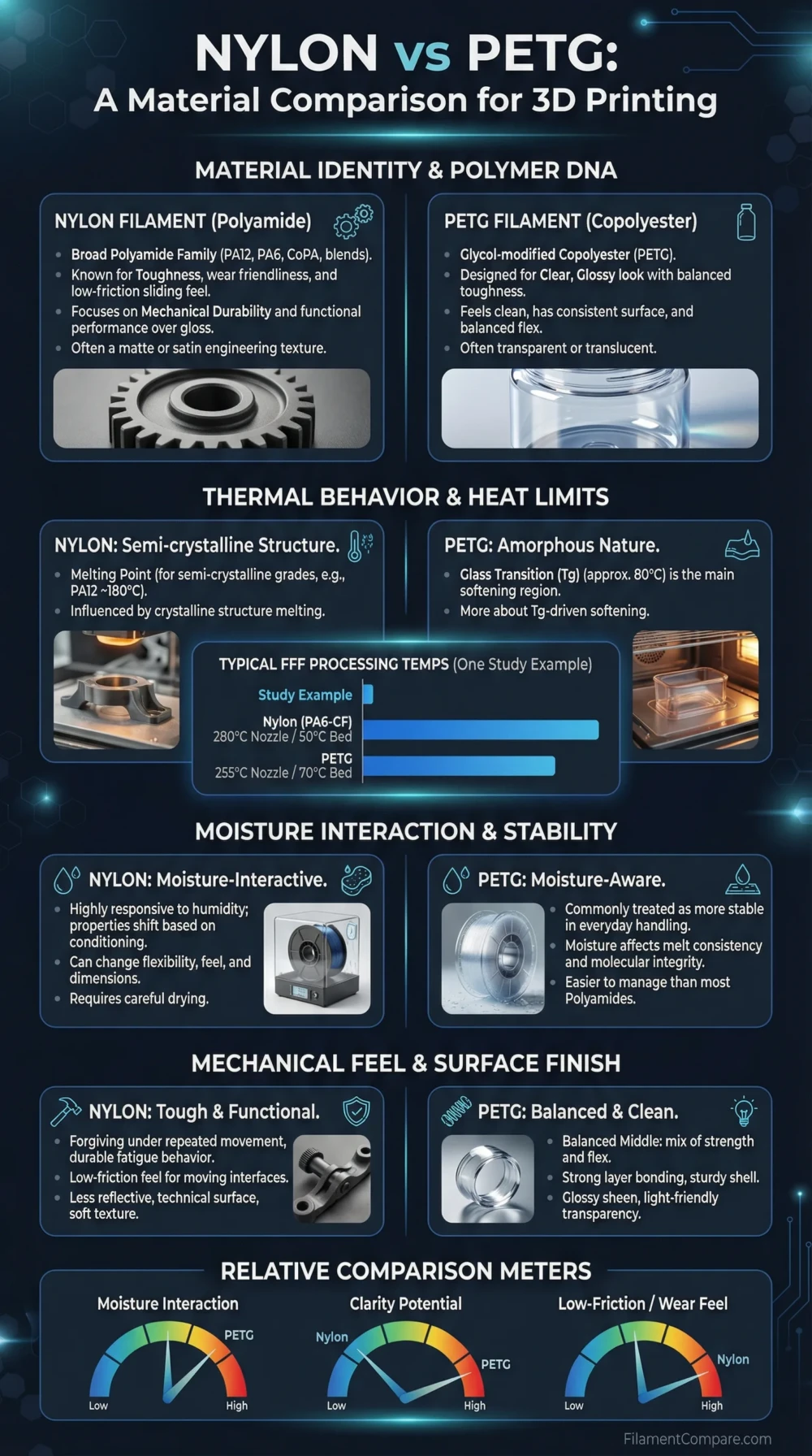
| Attribute | Nylon Filament | PETG Filament |
|---|---|---|
| Material Family | Polyamide (often PA12, PA6, or CoPA in filament form) | Copolyester (glycol-modified PET, commonly called PETG) |
| Typical Look and Feel | Engineering texture, often a satin surface; can feel low-friction and “smooth to the touch” | Often glossy; many grades can be clear or translucent with a “glassier” look |
| Thermal Marker (Baseline Polymer Data) | One PA12 reference lists melting temperature: 180 °C and provides moisture uptake values under defined conditions ✅Source | Eastman’s Eastar™ 6763 notes Tg ≈ 80 °C and emphasizes the grade’s amorphous nature; it also specifies a typical drying target of <0.04% moisture (with a listed drying condition of 65 °C for 6 hours) ✅Source |
| Moisture Interaction | Moisture-interactive by nature; material behavior can shift with humidity history (dry vs conditioned) | Moisture-aware too, but commonly treated as more “steady” in everyday handling compared to many polyamides |
| Published FFF Dataset Snapshot (One Study, One Setup) | Study printing parameters for the “nylon” sample (a PA6-CF material): 280 °C nozzle, 50 °C bed, 30 mm/s, 0.2 mm layer. The same study reports long-immersion mass gain around 12.7% at the equilibrium region. ✅Source | Same study parameters for PETG: 255 °C nozzle, 70 °C bed, 30 mm/s, 0.2 mm layer. The same study reports long-immersion mass gain around 9.3% at the equilibrium region. |
| What This Table Means | Numbers vary with grade, fillers (like CF/GF), manufacturing, and conditioning. The goal here is a clean comparison frame, not a “one number fits all” claim. | |
When people say Nylon filament and PETG filament, they’re usually talking about two very different polymer “personalities,” both commonly discussed within the broader category of engineering-grade 3D printing filaments. Nylon is a polyamide family with a reputation for tough, functional parts. PETG is a copolyester known for a clean surface, balanced toughness, and a stable feel across many everyday prints.
- Material Identity and Polymer DNA
- Nylon Filament as a Polyamide Family
- PETG Filament as a Copolyester Family
- Thermal Behavior and Heat Limits
- Moisture Interaction and Stability Over Time
- Mechanical Feel in Printed Parts
- Nylon Strength Style
- PETG Strength Style
- Surface, Finish, and Visual Behavior
- Chemical Contact, Wear, and Friction
- Relative Comparison Meters
- Nylon: polyamide character
- PETG: copolyester character
- Humidity can shift nylon
- Clarity is common in PETG
- Low-friction feel (common)
- Glossy surface (common)
Material Identity and Polymer DNA
Nylon Filament as a Polyamide Family
Nylon is a broad polyamide family, so “nylon filament” can mean PA12, PA6, copolyamides, or blends. That family identity shows up as a mix of toughness, wear friendliness, and a smooth sliding feel that many engineering parts benefit from. In practice, nylon filaments often lean into mechanical durability and functional performance rather than pure visual gloss.
PETG Filament as a Copolyester Family
PETG is a glycol-modified copolyester designed to keep a clear, glossy look while staying tough and impact-friendly. PETG often feels “clean” in printed parts: a consistent surface, a balanced flex, and a predictable material response that’s easy to recognize across many brands.
Thermal Behavior and Heat Limits
- Glass Transition (Tg)
- Tg is the “softening region” where a polymer shifts toward a more rubbery behavior. It’s a big deal for parts that see warm environments and steady loads.
- Melting (for semi-crystalline materials)
- Many nylons are semi-crystalline, so they have a melting point where crystals melt. Many PETG grades are described as amorphous, so the Tg zone tends to be the main thermal “edge.”
- Heat Deflection (HDT)
- HDT describes bending under a defined load at temperature. It’s a useful comparison metric for real part stiffness at heat.
Reality check: nylon and PETG both have “heat stories,” but they look different. Nylon often has a semi-crystalline structure that influences how it handles warmth, while PETG commonly leans on Tg-driven softening behavior. That difference is why a nylon part and a PETG part can feel very different in the same warm room.
Moisture Interaction and Stability Over Time
Nylon is widely treated as humidity-responsive: the same spool can behave slightly differently when it’s very dry versus when it’s conditioned by ambient air. PETG is also moisture-aware (copolyesters can be sensitive during melt processing), but it’s often described as more steady in everyday printing workflows.
In real parts, moisture shows up less like a “problem” and more like a material variable. With nylon, humidity can shift flexibility, feel, and sometimes the final dimensions by small amounts. With PETG, moisture is often discussed in terms of melt consistency and keeping the polymer’s molecular integrity stable.
- Nylon can shift between a crisp and a more ductile feel depending on conditioning history.
- PETG is often described as consistent in feel, with humidity showing up mainly as a processing variable.
- Published immersion data exists for both materials, but results depend strongly on print porosity and test geometry.
Mechanical Feel in Printed Parts
Nylon filament often reads as tough and forgiving under repeated movement. That’s why it gets attention for parts where wear, sliding, and impact energy matter. PETG filament usually feels like a balanced middle: a mix of strength and flex that’s easy to recognize across functional prints.
Nylon Strength Style
- Toughness and energy absorption are common themes in nylon discussions.
- A low-friction feel can support moving interfaces and contact surfaces.
- Many nylon grades are known for durable fatigue behavior in repeated flexing scenarios.
PETG Strength Style
- Balanced ductility with a confident feel is a common PETG trait.
- Layer bonding is often described as strong, especially on well-tuned profiles.
- A sturdy shell plus slight flex makes PETG popular for functional housings and brackets.
Surface, Finish, and Visual Behavior
If visual finish is part of the decision, PETG and nylon speak different “design languages.” PETG often delivers a clean sheen and light-friendly translucency. Nylon often delivers a professional, technical surface with a satin look that hides minor handling marks nicely.
- PETG: often glossy, can be clear or translucent depending on grade and color.
- Nylon: typically less reflective, with a functional aesthetic and soft texture.
- Both materials can look “premium” when geometry supports consistent cooling and smooth walls.
Chemical Contact, Wear, and Friction
Nylon is often selected for parts that see movement, sliding, or repeated contact because many polyamides are associated with low friction and abrasion friendliness. PETG is commonly described as chemically practical for many everyday environments, especially when the goal is a tough part with a clean surface.
Additives matter. Carbon fiber, glass fiber, and specialty modifiers can shift the wear profile, stiffness, and the surface feel of both nylon and PETG without changing their “family name.”
Relative Comparison Meters
Moisture Interaction Nylon PETG
Clarity Potential Nylon PETG
Low-Friction / Wear Feel Nylon PETG
“Balanced Everyday Toughness” Feel Nylon PETG
These meters are relative. They visualize common material tendencies for nylon filament and PETG filament. Specific brands, fillers, and conditioning can shift the “feel” in either direction.
