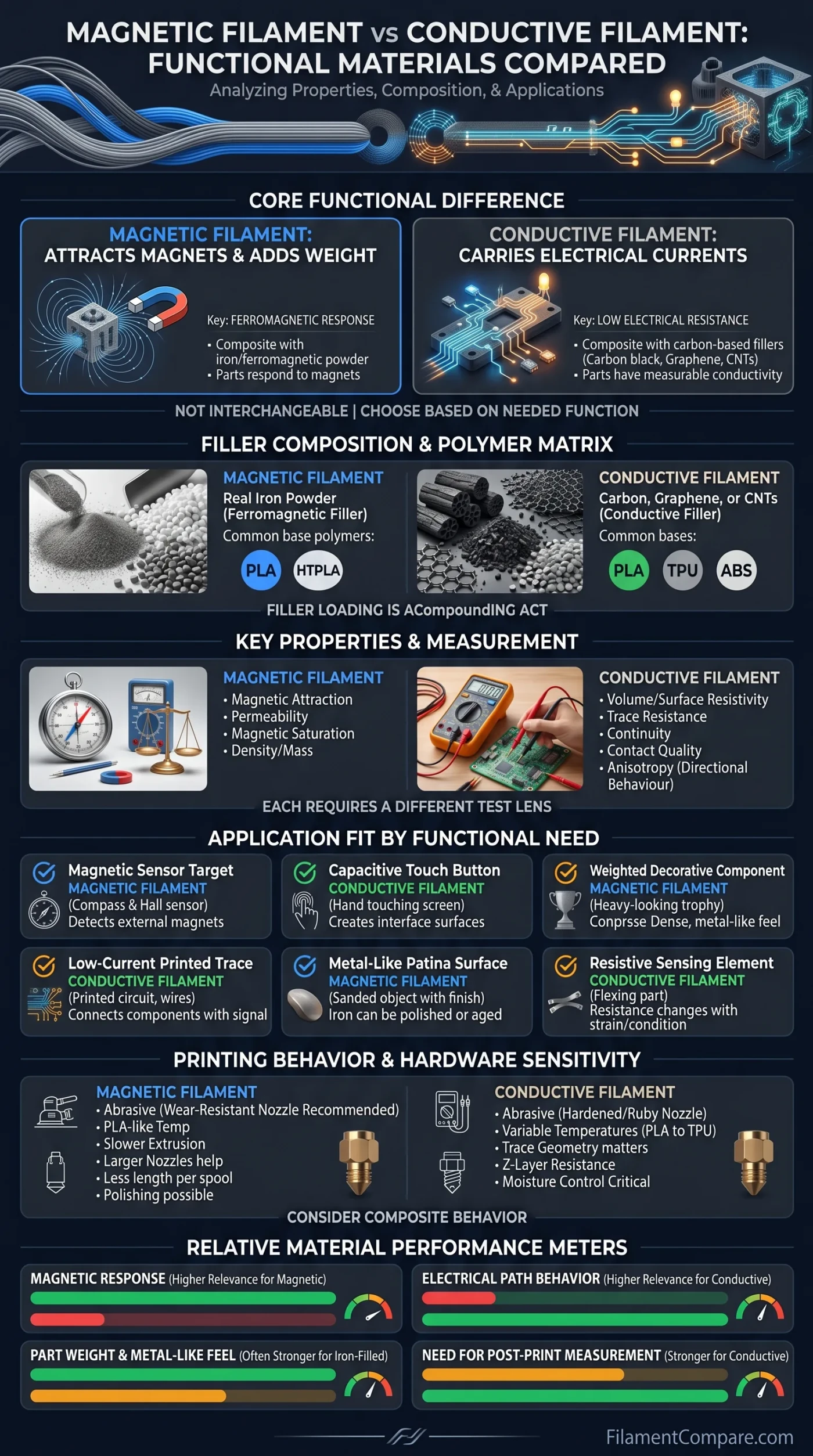
| Comparison Point | Magnetic Filament | Conductive Filament |
|---|---|---|
| Main Function | Creates parts that can respond to magnets, usually through iron powder or another ferromagnetic filler. | Creates parts that can carry a measurable electrical path, usually through carbon black, graphene, CNTs, or other conductive fillers. |
| Common Base Polymer | Most common: PLA or HTPLA composite. Some specialty versions may use flexible or engineering polymers. | Most common: PLA, TPU, or ABS-based composite, depending on whether the target is rigid traces, touch input, or flexible sensing. |
| Typical Filler | Real iron powder; one commercial iron PLA lists a maximum particle size below 250 microns and density around 1.85 g/cc.[a] | Carbon black, carbon nanotubes, graphene, or blended conductive additives dispersed through the polymer matrix. |
| Measured Functional Property | Magnetic attraction, relative permeability, and saturation behavior. One magnetic iron PLA sheet lists magnetic saturation induction around 0.15 T and relative permeability between 5 and 8.[b] | Volume resistivity, surface resistivity, resistance along a printed trace, and resistance through the Z direction. |
| Electrical Behavior | Not selected for printed circuits. Iron-filled PLA may be more thermally conductive than plain plastic, but its main identity is magnetic response. | Selected for low-current electronics, touch interfaces, sensing paths, and ESD-style parts when the specific filament data supports that use. |
| Example Resistivity Data | Usually not marketed with electrical resistivity as the primary property. | Proto-pasta Conductive PLA reports 30 ohm-cm along printed X/Y layers and 115 ohm-cm through the Z direction for printed parts.[c] |
| Density and Feel | Often noticeably heavier than standard PLA; iron-filled PLA can feel dense and metal-like in the hand. | Usually closer to normal plastic feel, though carbon-loaded formulas can be stiffer or more matte than plain PLA. |
| Printer Hardware Sensitivity | Iron particles add abrasion. A wear-resistant nozzle is often sensible for longer print runs. | Carbon or graphene additives can also be abrasive, and some formulas recommend hardened, ruby, or larger nozzles. |
| Surface Finish | Metallic matte, cast-iron-like, and sometimes rustable when the iron filler is exposed. | Usually black or dark gray, often matte, with a technical surface rather than a decorative metal look. |
| Where It Fits Better | Magnetically interactive models, weighted parts, fixtures, sensor targets, displays, educational magnetic field demos, and metal-look objects. | Capacitive touch pads, low-current traces, resistive sensors, simple continuity parts, shielding experiments, and printed interfaces. |
This comparison reads Magnetic Filament and Conductive Filament through datasheet values plus reliable material references, so the numbers show standard material trends rather than a promise that every printer, nozzle, geometry, or brand will produce the same result.
Magnetic filament and conductive filament sit in the same family of functional 3D printing materials, yet they are not interchangeable. One is built around magnetic interaction. The other is built around electrical behavior. That single difference changes the filler, the print feel, the test methods, the likely applications, and the way a finished part should be judged.
A magnetic print can feel heavy and respond to a neodymium magnet, while a conductive print may look plain but carry a measurable signal through a designed path. Both are composites. Both ask more from the printer than ordinary PLA. The useful question is not which one is “better”; it is which physical function the part needs.
Plain Material Distinction
- Magnetic filament is about attraction, permeability, magnetic targets, weight, and iron-like surface behavior.
- Conductive filament is about resistance, trace length, print orientation, contact quality, and low-current electrical paths.
- Both materials are filled polymers, not pure metal wire or machined metal.
What Magnetic Filament Is Made to Do
Most magnetic filament used on desktop FDM or FFF printers is a polymer composite with iron or another magnetically responsive powder mixed into a thermoplastic carrier. In common PLA-based versions, the plastic makes the material printable, while the iron filler gives the printed part its magnetic response.
The word “magnetic” can be slightly loose in casual product descriptions. In practical filament terms, it usually means the print is attracted to magnets or can act as a magnetic target. It does not automatically mean the part behaves like a strong permanent magnet. Small geometry, low filler continuity, and polymer encapsulation all change the final effect.
Iron-filled PLA also changes the physical feel of a print. A small part can feel unexpectedly dense because the filler raises the material density above ordinary PLA. Short parts feel solid. Thin features still need care.
Magnetic Behavior Is Not Electrical Conductivity
A magnetic filament can be useful in a magnetic assembly without being a suitable conductor. That distinction matters. Ferromagnetic response and electrical conductivity describe different material behaviors, even when both involve particles mixed into plastic.
In an iron-filled filament, the filler gives the polymer a magnetic character. In a conductive filament, the filler must form enough connected pathways for electrons to move. Those are separate design targets. Similar form, different job.
What Conductive Filament Is Made to Do
Conductive filament is designed to reduce resistance compared with normal plastic. The filler is usually carbon-based: carbon black, graphene, carbon nanotubes, or a blended conductive system. These particles form partial networks inside the polymer, turning an insulating print into a part with measurable conductivity.
This does not make the printed part equivalent to copper. Conductive filament is normally used where the electrical path can tolerate higher resistance: capacitive touch pads, short signal paths, educational circuit models, resistive sensors, and low-current prototypes. The printed shape matters as much as the material.
Some conductive formulas are much more conductive than others. A graphene-enhanced PLA filament, for example, lists volume resistivity of 0.6 ohm-cm, while other conductive PLA materials list much higher values depending on filler type and testing method.[e] One label can hide a wide range.
Resistance Changes with the Printed Geometry
A printed conductive line is not judged only by the filament spool. Trace length, cross-section, layer direction, nozzle temperature, infill, contact pressure, and electrode design all change the measured resistance. A short, thick, well-fused trace can behave very differently from a thin path printed across layer boundaries.
That is why datasheets often separate molded resin values, printed X/Y values, and Z-direction values. The material is the same, but the printed structure is not. Layer lines become part of the circuit.
Technical Data That Changes the Comparison
| Property | Magnetic Filament | Conductive Filament | Why It Matters |
|---|---|---|---|
| Density | Iron-filled PLA example: about 1.85 g/cc. | Spectrum PLA Conductive example: 1.35 g/cm³; Proto-pasta Conductive PLA example: about 1.24 g/cc.[d] | Density affects spool length, part weight, feed behavior, and the “solid” feel of a finished print. |
| Functional Measurement | Magnetic attraction, permeability, magnetic saturation, and filler content. | Volume resistivity, surface resistivity, continuity, trace resistance, and direction-dependent resistance. | Each material needs a different test lens. A magnet test cannot judge conductivity; a multimeter cannot describe magnetic response fully. |
| Print Temperature | Some iron PLA data lists a PLA-like nozzle range around 185–215°C, with larger nozzles often preferred. | Spectrum PLA Conductive lists 210–230°C and shows lower volume resistivity at 230°C than at 210°C in its test specimen. | Temperature affects flow, bonding, surface finish, and sometimes electrical behavior. |
| Nozzle Wear | Metal powder can wear brass nozzles during longer use. | Carbon and graphene fillers can also wear standard nozzles. | Composite filaments often reward a harder nozzle, especially for repeated prints. |
| Layer Direction | Layer direction mainly affects strength, surface finish, and magnetic field interaction through geometry. | Layer direction can directly alter electrical resistance, especially across Z-layer interfaces. | Conductive prints are often more sensitive to orientation than decorative or weighted prints. |
| Post-Processing | Iron-filled parts may be sanded, polished, or patinated when the formulation supports exposed iron behavior. | Conductive parts are more often evaluated by electrical contact, resistance, trace shape, and surface connection. | Magnetic filament often invites surface finishing; conductive filament invites measurement. |
Filler Chemistry and Polymer Matrix
The filler gives the material its special behavior, but the polymer matrix still controls much of the printing experience. PLA-based magnetic filament often prints like a heavy PLA composite. PLA-based conductive filament usually keeps a familiar low-warp workflow, while TPU-based conductive filament adds flexibility and strain response.
Filler loading is a balancing act. More iron can improve magnetic attraction and weight, but it can also make the filament less forgiving. More conductive carbon can lower resistance, but it can also affect flow, brittleness, surface quality, and nozzle wear. The spool is not just plastic with powder in it; it is a tuned compound.
Iron Powder in Magnetic Filament
Iron-filled PLA gets its identity from ferromagnetic filler. The particles are held inside the printed polymer, so a printed part can attract magnets while still behaving mechanically like a filled plastic. The result is useful where the part needs mass, magnetic response, and a metal-like visual surface in one printable material.
The filler also affects spool length. Because iron-filled PLA is denser than plain PLA, the same spool weight contains less filament length. This is easy to miss when comparing prices by kilogram. Weight is not length.
Carbon Fillers in Conductive Filament
Conductive filament depends on connected or near-connected carbon pathways. Carbon black, graphene, and CNTs do not all behave the same, and two “conductive PLA” spools can show very different resistance. The actual part depends on filler dispersion, nozzle temperature, bead bonding, and how the current path crosses the printed layers.
For short low-current traces, the material may be enough. For demanding electrical loads, the resistance can become the main design limit. Small changes in cross-section can matter more than they would in a copper wire.
Print Behavior: Similar Printer, Different Priorities
Both materials are normally printed on FDM or FFF machines, which belong to the broader material extrusion family defined in additive manufacturing terminology.[f] The printer melts a thermoplastic filament, pushes it through a nozzle, and builds the part layer by layer. Simple process. Not simple material behavior.
Magnetic Filament Print Behavior
Magnetic filament often prints at PLA-like temperatures, but the powder-filled nature changes handling. The filament can be less flexible on the spool, and the printed bead may prefer slower, steadier extrusion. A larger nozzle can help because the filler particles and higher composite viscosity have more room to pass smoothly.
- Nozzle choice: wear-resistant nozzles make sense for repeated iron-filled printing.
- Layer height: moderate layer heights often balance surface quality and flow reliability.
- Retraction: excessive retraction can make composite flow less steady on some machines.
- Surface work: sanding or brushing can expose more filler when the material is intended for metal-like finishing.
Conductive Filament Print Behavior
Conductive filament is judged more by the printed circuit path than by appearance. Nozzle temperature, extrusion width, and layer bonding can all move resistance up or down. In one PLA conductive datasheet, printed specimens showed lower volume resistivity at 230°C than at 210°C, under that maker’s test setup. That is a useful pattern, not a universal rule.
- Trace width: wider printed paths usually provide more conductive cross-section.
- Layer direction: current moving through Z layers often meets more resistance than current moving along X/Y roads.
- Contact design: flat pads, pressure, and clean surfaces can change measured resistance.
- Moisture control: dry storage helps preserve predictable extrusion and surface quality.
Electrical and Magnetic Properties Are Measured Differently
Magnetic filament is usually discussed through attraction, permeability, and magnetic saturation. Conductive filament is discussed through resistivity and resistance. These terms sound technical because they are technical, but the practical split is simple: magnetic filament interacts with magnetic fields; conductive filament carries current paths.
- Volume Resistivity
- The resistance of a material through a defined volume. Lower values mean easier current flow.
- Surface Resistivity
- The resistance measured across the surface of a material. It matters for touch pads, ESD-style behavior, and surface contacts.
- Relative Permeability
- A comparison of how a material responds to a magnetic field compared with air or vacuum.
- Magnetic Saturation
- The point where more magnetic field produces less extra magnetization response in the material.
- Anisotropy
- Direction-dependent behavior. In conductive prints, resistance along layers can differ from resistance through stacked layers.
Why Conductive Prints Can Be Direction-Dependent
Material extrusion creates roads, gaps, seams, and layer interfaces. Conductive materials can therefore show anisotropic electrical behavior, because current does not move through every direction equally. Research on conductive FDM structures describes this direction dependence as a result of infill and bonding conditions.[g]
This is one of the main reasons conductive filament deserves more than a simple “yes, it conducts” label. A part can pass a continuity test in one direction and show much higher resistance in another. Geometry writes part of the electrical specification.
Relative Performance by Material Behavior
Magnetic Response Higher Relevance for Magnetic Filament
Electrical Path Behavior Higher Relevance for Conductive Filament
Part Weight and Metal-Like Feel Often Stronger for Iron-Filled Filament
Need for Measurement After Printing Stronger for Conductive Parts
Application Fit by Function
The cleanest comparison is based on function. Magnetic filament belongs where the printed object needs magnet interaction, mass, or an iron-like surface. Conductive filament belongs where the printed object needs a controlled electrical path, even if that path has higher resistance than metal.
| Use Case | Better-Matched Material | Technical Reason |
|---|---|---|
| Magnetic target for a sensor or switch | Magnetic filament | The printed part can respond to magnets or act as a magnetically detectable target. |
| Capacitive touch button | Conductive filament | The part needs a conductive surface or path that can interact with a capacitive input. |
| Weighted decorative component | Magnetic filament | Iron filler raises density and creates a heavier, more metal-like feel. |
| Low-current printed trace | Conductive filament | The circuit path needs measurable conductivity through the printed geometry. |
| Metal-like patina surface | Magnetic filament | Iron-filled prints can sometimes be finished to expose and age the filler surface. |
| Resistive sensing element | Conductive filament | Resistance can change with geometry, strain, contact, or environmental exposure depending on the material and design. |
| Magnetically mounted label, token, or marker | Magnetic filament | The printed object can pair with external magnets while keeping custom geometry. |
| Shielding or conductive enclosure experiment | Conductive filament | Carbon-filled or graphene-filled materials can provide a conductive network when the formula and geometry support it. |
Mechanical and Thermal Differences
Neither material should be judged only by its headline function. Magnetic filament and conductive filament are both filled polymers, so the filler changes stiffness, surface friction, melt flow, and sometimes brittleness. The base polymer still matters too. PLA-based versions keep PLA-like heat behavior unless the maker states heat treatment or a different resin system.
Iron-filled filament often feels more rigid and dense. Conductive PLA can be fairly stiff, while conductive TPU can be flexible enough for soft sensors or wearable-style prototypes. The same word “conductive” can appear on two spools that feel nothing alike.
Heat Behavior
Magnetic and conductive fillers can change thermal conductivity, but the polymer matrix still sets much of the usable heat range. A PLA-based conductive trace may soften where PLA normally softens. An iron-filled PLA part may feel metallic, yet it is still a plastic composite, not a machined iron part.
For datasheet reading, heat deflection temperature, glass transition, melt point, and maximum use notes are more meaningful than the material name alone. If the datasheet does not give a certified use temperature, the printed part should be treated as condition-dependent.
Surface Finish and Appearance
Magnetic filament often wins the visual “material illusion” category because iron powder gives it weight, a dull metallic tone, and sometimes a surface that can be sanded or aged. It can look like cast metal without being solid metal. That is useful for display parts, tactile models, and objects where weight is part of the experience.
Conductive filament is usually more reserved visually. Most versions are black, charcoal, or dark gray because the conductive filler is carbon-based. The surface can be matte and technical-looking, but the value is mostly hidden in the measured electrical behavior.
What the Main Datasheet Numbers Mean
Datasheets for these materials are not just accessory documents. They are the map. For magnetic filament, the useful values include filler type, particle size, density, magnetic attraction notes, permeability, and nozzle guidance. For conductive filament, the useful values include volume resistivity, surface resistivity, print temperature, test specimen geometry, and direction of measurement.
Resistivity Values Need Units and Direction
Conductive filament data can be confusing because values may appear in ohm-cm, ohm-m, surface resistance, or resistance over a set filament length. Those are not identical measurements. A printed part measured along X/Y roads can read differently from the same material measured through Z layers.
A careful comparison should keep the unit attached to the number. It should also keep the print condition attached to the number: layer height, infill, sample size, nozzle temperature, and direction of measurement. Without those details, resistivity claims lose context.
Magnetic Values Need Field Context
Magnetic filament data can also be misread. A part that attracts a magnet is not automatically a strong magnet itself. Relative permeability, saturation induction, filler loading, and part shape all influence the observed behavior. A thick block and a thin sheet may feel different against the same magnet.
Geometry matters here too, just in a different way than it does for conductive traces. A large flat magnetic target can be easier for a magnet to grab than a tiny feature with little filler volume.
Material Limits Without Negative Labels
Magnetic filament has a different ceiling than conductive filament. It is helpful for magnetic response and iron-like physical qualities, yet it is not selected as a primary circuit material. Conductive filament is built for electrical paths, yet it usually has much higher resistance than metal conductors. Both are useful within their lane.
The neutral way to read these materials is by technical fit. Magnetic filament favors attraction, mass, and surface character. Conductive filament favors low-current signal paths, sensing behavior, and printed interfaces. Neither name should be stretched beyond the datasheet.
For electrical projects, conductive filament should be treated as a resistive printed material, not as a direct replacement for copper wire. For magnetic projects, magnetic filament should be treated as a filled polymer with magnetic response, not as a solid magnet unless a specific material sheet proves that behavior.
Side-by-Side Material Reading
Read the two materials through the question the part is asking. If the part must interact with magnets, carry weight, or imitate a metal-like surface, magnetic filament is the more natural category. If the part must connect pads, sense touch, create a resistive element, or test an embedded trace shape, conductive filament is the closer match.
- For magnetic interaction: check iron filler, attraction strength, density, and nozzle wear notes.
- For electrical behavior: check volume resistivity, direction of measurement, trace geometry, and contact method.
- For surface finish: magnetic iron PLA usually offers more metal-like finishing options.
- For printed electronics: conductive filament offers the relevant material behavior, provided the resistance fits the circuit.
- For repeatable results: both materials benefit from measured test parts because filled polymers react strongly to print settings.
Common Questions
Can Magnetic Filament Conduct Electricity?
Some iron-filled materials may show electrical behavior under certain contact conditions, but magnetic filament is not normally sold as a circuit filament. Its main purpose is magnetic response and metal-like weight. For planned electrical paths, conductive filament is the clearer category.
Can Conductive Filament Stick to a Magnet?
Most conductive filaments are carbon-filled, so magnet attraction is not their main property. A conductive part may carry a signal without reacting to a magnet. The two functions come from different filler systems.
Which One Is More Abrasive?
Both can be abrasive compared with plain PLA. Iron powder, carbon fiber-like additives, carbon black, graphene, or CNT systems can all increase nozzle wear. For repeated printing, a wear-resistant nozzle is often the practical material match.
Why Do Conductive Filament Values Vary So Much?
Conductive performance depends on filler type, filler loading, print temperature, bead fusion, layer direction, and contact method. Even the same filament can show different resistance when printed as a thick bar, a thin trace, or a tall Z-direction path.
Which Material Gives a More Metal-Like Object?
Iron-filled magnetic filament usually gives the more metal-like feel because it adds density and can produce a cast-metal surface. Conductive filament may look technical and matte, but its main strength is electrical function, not metal imitation.
Technical Sources Used
- [a] Proto-pasta — Iron-filled Metal Composite PLA
- [b] Proto-pasta / Vexma Technologies — Technical Data Sheet Rev. 1 Magnetic Iron PLA
- [c] Proto-pasta — Conductive PLA
- [d] Spectrum Filaments — PLA Conductive Technical Data Sheet
- [e] Black Magic 3D — Conductive Graphene Filament
- [f] ISO — ISO/ASTM 52900:2021 Additive Manufacturing Vocabulary
- [g] University of Twente / Sensors — Modelling of Anisotropic Electrical Conduction in Layered Structures 3D-Printed with Fused Deposition Modelling
