| Attribute | Hyper PLA (High-Speed PLA Family) | PLA (Standard PLA Family) |
|---|---|---|
| Material Base | PLA-based formulation tuned for high-speed extrusion | PLA formulation tuned for general-purpose printing |
| Published Print Speed | 40–600 mm/s (listed range) | Up to 200 mm/s (listed range) |
| Published Nozzle Temperature | 190–230°C | 210 ± 10°C (typical listing) |
| Published Bed Temperature | 25–60°C | 40–60°C |
| Flow Indicator | Melt index 3–5 g/10 min (190°C, 2.16 kg) | MFR 9–11 g/10 min (210°C, 2.16 kg) |
| Density | 1.24 ± 0.1 g/cm³ | 1.24 g/cm³ |
| Glass Transition (DSC) | 62°C | Not always listed (varies by datasheet) |
| Softening / Heat Indicator | Vicat softening 62.3 ± 0.5°C | HDT (0.45 MPa) 55°C |
| Tensile Signal (3D Printed) | Tensile strength (X–Y) 43.357 MPa | Tensile yield strength (horizontal) 51 ± 3 MPa |
| Impact Signal (3D Printed) | Charpy impact (X–Y) 17.586 kJ/m² | Charpy unnotched 13 ± 1 kJ/m² (typical listing) |
| Moisture Uptake Signal | Not always listed (depends on product sheet) | 24h moisture absorption 0.13% |
| Extra Feature That Sometimes Appears | Smart tag / RFID on some Hyper PLA lines | Plain spool identification (typically) |
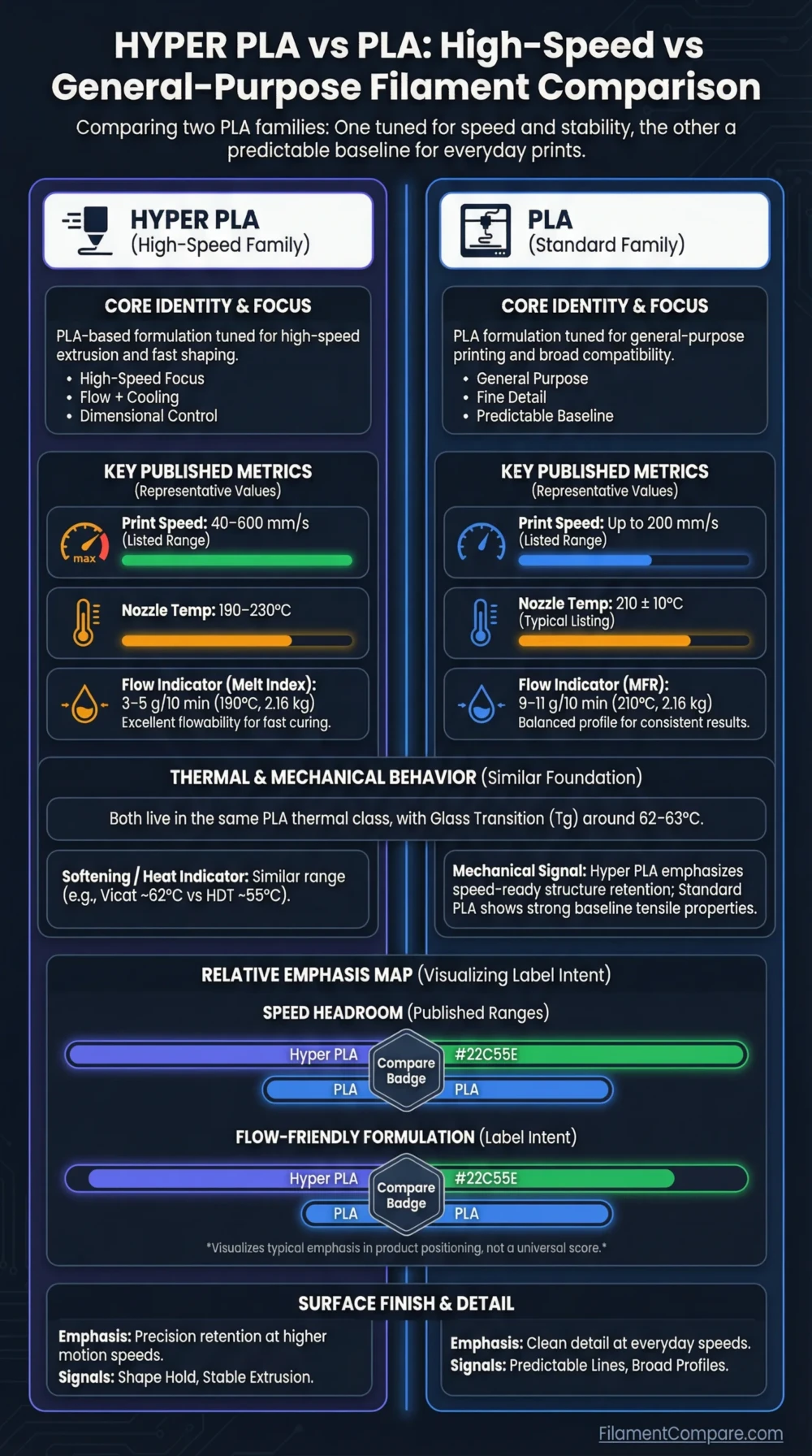
Both Hyper PLA and PLA live in the same PLA family, yet the label Hyper usually signals a formula built around high-speed stability and fast shaping. The comparison gets clearer when you look at published ranges for speed, temperature, and flow.
- Material Identity and Labeling
- Hyper PLA As a Label
- PLA As a Baseline
- PLA Baseline Signals in a Real Datasheet
- Thermal Behavior and Heat Limits
- What That Usually Implies for Hyper PLA vs PLA
- Speed, Flow, and Cooling Signals
- Relative Emphasis Map
- Mechanical Performance Signals
- Reading the Numbers Without Over-Interpreting
- Surface Finish and Detail Behavior
- Hyper PLA Finish Signals
- PLA Finish Signals
- Storage and Moisture Notes
- Terminology Box
Data Trace: The Hyper PLA values shown in the table are taken from a published Hyper-PLA RFID technical data sheet. ✅Source
Material Identity and Labeling
Hyper PLA As a Label
The name Hyper PLA is not a single global standard grade; it is a commercial label used for PLA-based filaments that highlight high-speed printing, stable extrusion, and fast curing.
- High-Speed Focus
- Flow + Cooling
- Dimensional Control
- PLA-Based
PLA As a Baseline
The label PLA usually means a general-purpose filament based on polylactide, widely used in FFF/FDM for clean detail and consistent results across many printers. For a broader explanation of how different PLA formulations behave in 3D printing—including PLA+, HT-PLA, Meta PLA, and other variants—see the Ultimate PLA Filament Guide.
- General Purpose
- Fine Detail
- Broad Compatibility
- PLA Family
Why the Same Polymer Can Feel Different: Published research reviews note that PLA properties shift with stereochemistry, molecular distribution, and formulation choices, which is why product-to-product behavior can vary inside the same PLA family. ✅Source
PLA Baseline Signals in a Real Datasheet
When a datasheet says PLA, you often see a tight window for nozzle temperature, a moderate bed range, and a clear ceiling for print speed. One example technical sheet lists 210 ± 10°C at the nozzle, 40–60°C at the bed, and up to 200 mm/s as a speed figure, alongside density around 1.24 g/cm³. ✅Source
- Speed Range is commonly stated as a single max value or a modest range, reflecting a balanced profile.
- HDT / Softening is often provided to describe temperature tolerance in a comparable way.
- Printed Specimen Metrics can appear (orientation-based), highlighting layered structure effects.
Thermal Behavior and Heat Limits
At the polymer level, PLA is typically described with a glass transition band and a melting range. A thermal analysis reference page reports a glass transition around 63°C and a melting event spanning roughly 130–180°C, with a peak near 158°C. ✅Source
What That Usually Implies for Hyper PLA vs PLA
- Hyper PLA often stays inside the same PLA thermal class, while emphasizing flow and shape hold at speed.
- PLA is commonly presented as a predictable baseline with consistent behavior across everyday print conditions.
- Datasheets may show similar softening indicators across both, because the core polymer family is still PLA.
Speed, Flow, and Cooling Signals
The biggest practical difference between Hyper PLA and PLA shows up when manufacturers publish speed windows and flow indicators. A typical Hyper PLA sheet may list a broad range like 40–600 mm/s plus language around fast curing and excellent flowability.
Relative Emphasis Map
Speed Headroom Published Ranges
Flow-Friendly Formulation Label Intent
Thermal Class Similarity PLA Family
These bars visualize typical emphasis in product positioning and published ranges, not a universal “score.”
Mechanical Performance Signals
For both Hyper PLA and PLA, mechanical behavior is strongly linked to printed structure: layer thickness, orientation, and process choices shift how strength and ductility show up. A 2025 study on 3D-printed PLA reports that layer thickness can significantly affect tensile properties, with thicker layers generally reducing multiple strength-related measures under the tested conditions. ✅Source
Reading the Numbers Without Over-Interpreting
- Filament vs Printed Specimen: some sheets list filament strength, others list printed part strength.
- X–Y vs Z: orientation matters; many sheets publish both, showing layer-to-layer behavior alongside in-plane strength.
- Hyper PLA often highlights speed-ready extrusion while keeping strong structural signals in published tests.
Surface Finish and Detail Behavior
Both Hyper PLA and PLA are known for clean detail. The difference is usually framed around how consistent that detail remains at higher motion speeds. With Hyper PLA, product positioning commonly emphasizes precision retention while running fast, while standard PLA is presented as a steady baseline for fine features.
Hyper PLA Finish Signals
- Shape Hold emphasis at higher throughput
- Stable Extrusion positioning for consistent line width
- Dimensional Control messaging under fast motion
PLA Finish Signals
- Clean Detail at everyday speeds
- Predictable Lines for visual consistency
- Broad Profiles across many printers and slicers
Storage and Moisture Notes
In the PLA family, moisture sensitivity is often described through absorption figures or simple storage guidance. Many product sheets include a measurable moisture uptake line, plus notes that keeping PLA dry supports consistent extrusion and surface quality. For Hyper PLA, the same idea applies, with extra emphasis on stable feeding at high throughput.
Simple Interpretation: If a listing highlights high-speed behavior, moisture control matters because it supports consistent flow and repeatable line formation.
Terminology Box
- Hyper PLA
- PLA-based filament label that typically signals a formulation meant to stay stable at higher printing speeds, often paired with published wide speed ranges and “fast curing” language.
- PLA
- Polylactide filament family commonly used as a baseline material in FFF/FDM, often described with clear temperature windows and predictable print behavior.
- Glass Transition (Tg)
- The temperature region where PLA shifts from a more glassy state to a more rubbery state; commonly cited when discussing heat sensitivity.
- MFR / Melt Index
- A flow indicator that appears on many datasheets. In filament context, it helps describe how a Hyper PLA or PLA formulation is positioned for extrusion behavior.
