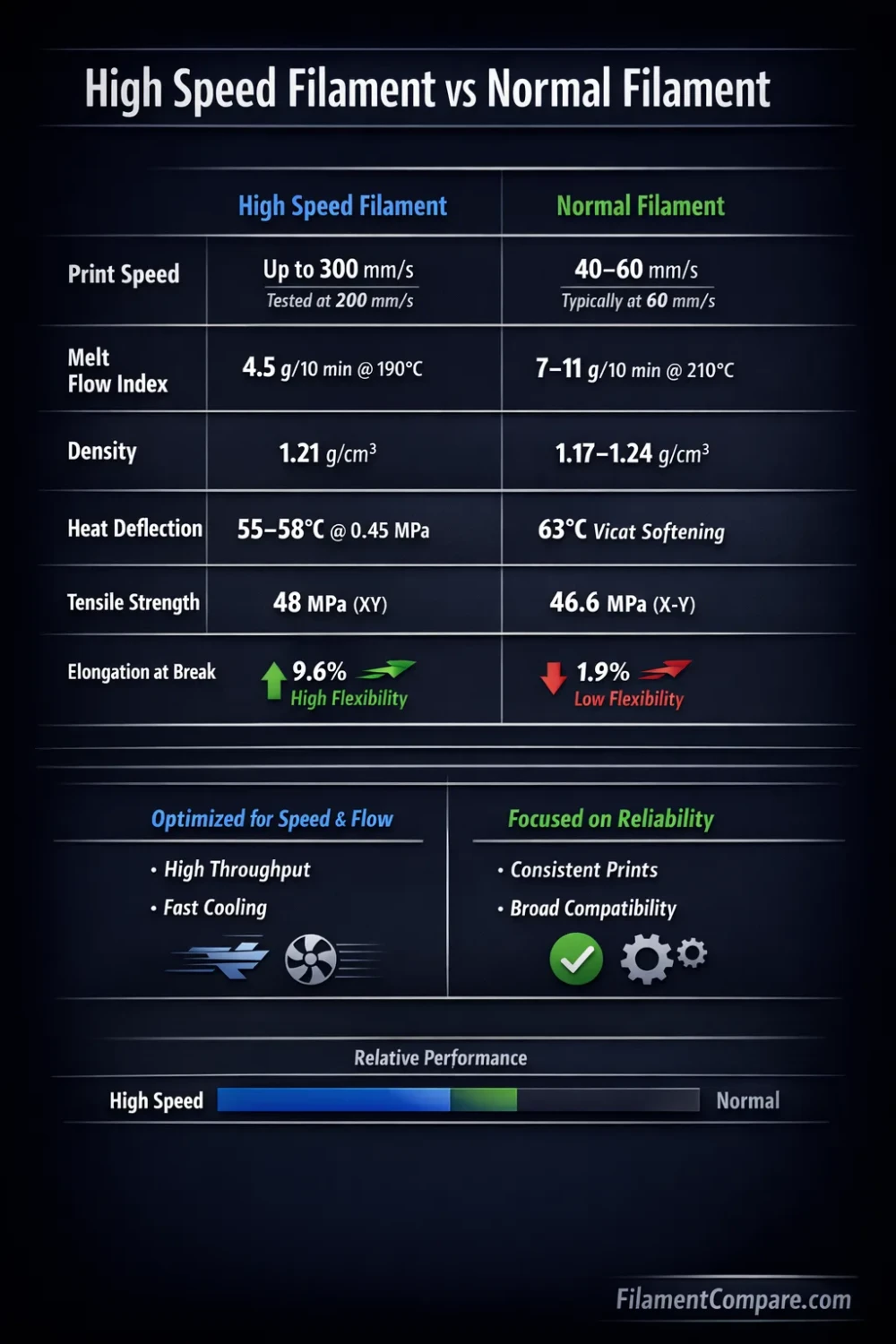
| Attribute | High Speed Filament | Normal Filament |
|---|---|---|
| Data Reference Used Here | Raise3D Hyper Speed PLA | Polymaker PolyLite PLA |
| Published / Listed Print Speed (mm/s) | Up to 300; specimens printed at 200 | Recommended 40–60; specimens printed at 60 |
| Melt Flow Index (g/10 min) | 4.5 @ 190°C / 2.16 kg | 7–11 @ 210°C / 2.16 kg |
| Density (g/cm³) | 1.21 | 1.17–1.24 |
| Heat Distortion / Deflection (°C) | 58 @ 0.45 MPa; 55 @ 1.8 MPa | 63 (Vicat softening temperature) |
| Tensile Modulus (MPa) | 2600 ±215 (XY) | 2636 ±330 (X-Y) |
| Tensile Strength (MPa) | 48 ±7 (XY) | 46.6 ±0.9 (X-Y) |
| Elongation at Break (%) | 9.6 ±0.8 (XY) | 1.9 ±0.2 (X-Y) |
| Flexural Modulus (MPa) | 2700 ±154 | 3283 ±132 |
| Notes on Comparing Numbers | Test temperatures, loads, and specimen orientation can differ across datasheets, so values are most useful as a context clue rather than a universal promise. | |
High Speed column numeric values come from the Raise3D Hyper Speed PLA technical data sheet (Dec 2024).✅Source
- What “High Speed Filament” Usually Means
- What “Normal Filament” Usually Means
- Where the Differences Show Up in Motion and Melt
- Volumetric Flow Rate vs Headline Speed
- Why Cooling Gets Mentioned So Much
- How Datasheets Describe Flow in a Comparable Way
- Mechanical and Thermal Terms That Actually Matter
- Tensile Properties
- Heat Deflection Under Load
- Density and Batch-to-Batch Signals
- What Changes in High Speed Grades Without the Hype
- Reading a Filament Label Like a Spec Sheet
- A Friendly Reality Check on “Normal” vs “High Speed”
Normal column numeric values come from the Polymaker PolyLite PLA technical data sheet (Version 4.0).✅Source
High Speed Filament and Normal Filament sound like a simple “fast vs standard” split, yet the real difference is usually about how the melt behaves at higher throughput. In practice, “high speed” is commonly tied to higher usable volumetric flow, steadier extrusion, and cleaner results when motion systems run at elevated speeds. Because melt stability can also be influenced by filament condition, proper humidity control and drying habits are discussed in this practical guide to filament storage and drying.
What “High Speed Filament” Usually Means
In the filament market, High Speed Filament is often a formulation label. It typically signals a material tuned to stay consistent when the printer pushes more plastic per second. That tuning can show up as predictable flow, fast stabilization after extrusion, and a wider “sweet spot” where the part still looks crisp.
- Flowability that remains stable at higher throughput (less “surging” feel in the extrusion).
- Cooling response that supports clean edges and tidy layer stacking at higher motion speeds.
- Material profiles that commonly reference higher speeds or higher flow targets without drama.
What “Normal Filament” Usually Means
Normal Filament is the broad “standard grade” category: lots of options, wide availability, and a familiar behavior that matches everyday slicer defaults. It’s often optimized for reliability, clean surfaces, and predictable results across many printers, rather than pushing the upper edge of speed.
- Balanced melt behavior for common hotends and everyday profiles.
- Wide compatibility across nozzles, cooling setups, and bed surfaces.
- Consistent finish at moderate speeds where details stay sharp.
Where the Differences Show Up in Motion and Melt
The practical gap between High Speed Filament and Normal Filament is most visible when the printer tries to keep extrusion steady while the toolhead accelerates, decelerates, and turns. That’s where melt consistency and flow stability matter.
Relative Behavior
(visual indicator, not a measured scale)
What this represents:
stable throughput, clean stacking, and smooth extrusion when printing faster.
Volumetric Flow Rate vs Headline Speed
“Speed” in mm/s is the motion speed, while the extruder cares about volumetric flow rate (how many mm³ of plastic must melt each second). This is why high speed claims often pair with hotend capacity and cooling behavior, not only motion tuning.
Volumetric Flow (mm³/s) = Line Width (mm) × Layer Height (mm) × Print Speed (mm/s)

Example: 0.45 × 0.20 × 200 = 18.0 mm³/s
Why Cooling Gets Mentioned So Much
At higher throughput, the material needs to solidify predictably so corners, bridges, and overhang edges keep their geometry. Many High Speed Filament labels highlight faster melting and quicker cooling because that combo helps surfaces stay clean while the printer stays quick.
How Datasheets Describe Flow in a Comparable Way
- MFR / MVR (Melt Flow)
- Standardized ways to express melt flow under a specified temperature and load. ISO 1133-1 defines procedures for melt mass-flow rate (MFR) and melt volume-flow rate (MVR).✅Source
- Why the Test Condition Matters
- A melt flow number is tied to the exact condition used. ASTM D1238 covers melt flow rate measurement with an extrusion plastometer and notes that multiple conditions can be used for additional characterization.✅Source
When comparing High Speed Filament and Normal Filament, the cleanest “numbers-first” habit is to look for matching test conditions (same temperature and load) before treating melt-flow values as directly comparable. That single detail keeps spec reading honest.
Mechanical and Thermal Terms That Actually Matter
Tensile Properties
Many datasheets report tensile modulus and strength using a recognized tensile standard. ISO 527-1 sets the general principles for determining tensile properties like tensile strength and tensile modulus under defined conditions.✅Source
- Modulus often tracks perceived stiffness.
- Strength indicates peak stress before break in that test setup.
- Orientation notes are common in 3D-printed specimen reporting.
Heat Deflection Under Load
Heat deflection (often called HDT) is reported in many polymer documents as a temperature-of-deflection under load test. ISO 75-1 describes the method and its role in assessing relative behavior of plastics at elevated temperature under load.✅Source
- Load level (like 0.45 MPa or 1.8 MPa) changes the reported temperature.
- Comparability improves when materials have similar room-temperature flexural modulus.
Density and Batch-to-Batch Signals
Density is a simple number that still tells a story: fillers, pigments, and formulation tweaks can move it. ISO 1183-1 explains methods for determining density of non-cellular plastics and notes density is often used to follow variations in physical structure or composition.✅Source
What Changes in High Speed Grades Without the Hype
A well-made High Speed Filament usually tries to keep extrusion and solidification predictable while the printer’s motion gets faster. A solid Normal Filament focuses on broad reliability and consistent surfaces across the mainstream range of conditions. Both approaches can deliver clean geometry and repeatable output.
- Flow stability tends to be emphasized more in High Speed Filament branding.
- Edge definition at higher travel and print speeds is often part of the message.
- Profile alignment matters: many “high speed” products are positioned alongside specific fast-print ecosystems.
- Standard-grade consistency remains the main selling point of Normal Filament.
Reading a Filament Label Like a Spec Sheet
- “Up to 300 mm/s”
- Usually a published capability under a compatible setup, not a universal constant. The meaningful companion details are often nozzle diameter, temperature, and how specimens were printed for mechanical testing.
- Melt Flow Index
- A standardized indicator that can help compare grades when the test condition matches. It’s helpful for understanding why a filament may feel more “smooth-flowing” in demanding throughput scenarios.
- Mechanical Tables
- Often listed with the testing method (like ISO tensile or ISO flexural) and sometimes orientation notes. Those details keep apples-to-apples comparisons realistic.
A Friendly Reality Check on “Normal” vs “High Speed”
Normal Filament can still print fast on capable hardware, and High Speed Filament still benefits from a stable melt zone and consistent cooling. The label mostly tells you what the formulation and product positioning prioritize: broad simplicity or high-throughput stability.
