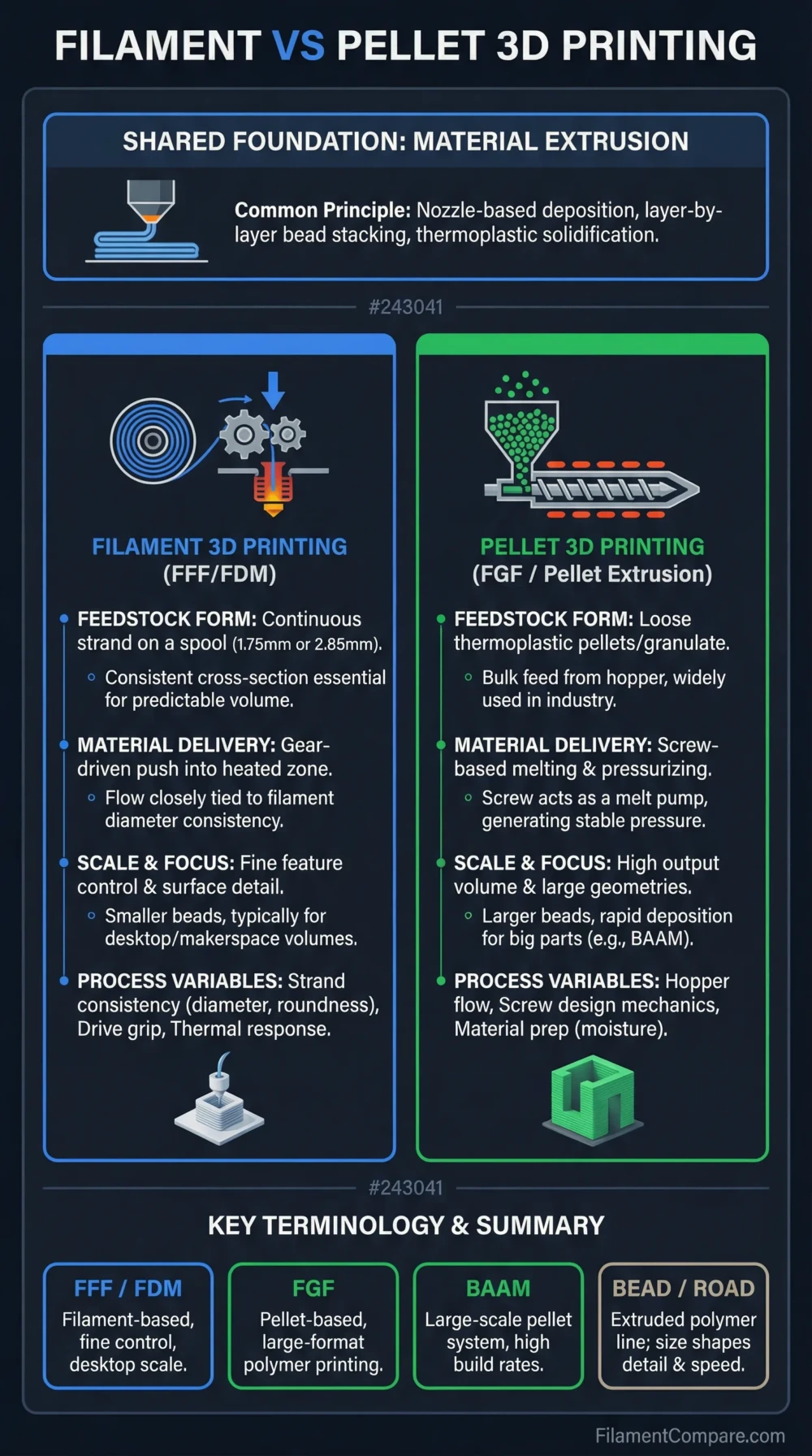
Filament printing offers simpler setup and finer small-part control, while pellet printing exchanges some of that convenience for higher material throughput, lower raw-feedstock cost at production scale, and access to more industrial resin grades. The choice is mainly about the printer, extrusion system, part size, output target, and operating workflow—not about one feedstock form producing universally stronger plastic.
The Practical Choice
Choose filament printing for desktop machines, detailed prototypes, short production runs, frequent material changes, predictable retraction, and a low-complexity workflow.
Choose pellet printing when large parts, high deposition rates, bulk material use, custom compounds, or continuous industrial production justify a screw extruder and its supporting equipment.
There is no universal winner. For most home, education, design, and small-workshop use, filament remains the more practical format. Pellet extrusion becomes more attractive as part size and material consumption rise.
Best for First-Time Users
Filament — easier loading, wider machine support, established slicer profiles, and simpler fault diagnosis.
Better for Small Details
Filament — smaller common nozzle sizes and more controlled start-stop extrusion suit fine features.
Better for Large Parts
Pellets — screw extruders can deliver much more polymer per hour when paired with a suitable motion platform.
Lower Feedstock Cost at Scale
Pellets — bulk resin commonly requires less processing than dimensionally controlled spooled filament.
Better for Frequent Color Changes
Filament — spool swaps and short purge paths are usually easier to manage than clearing a pellet barrel.
Better for Custom Compounds
Pellets — industrial granules provide more choices for filled, flexible, recycled, and specialty formulations.
Better for Low Startup Waste
Filament — less material normally remains inside the melt path when starting, stopping, or changing polymers.
Better for Continuous Output
Pellets — hoppers, dryers, and automatic feeding systems can support long production jobs without spool changes.
| Decision Area | Filament Printing | Pellet Printing | Better Fit |
|---|---|---|---|
| Feedstock form | Continuous polymer strand wound onto a spool | Loose thermoplastic granules loaded into a hopper or feeding system | Application-dependent |
| Material category | Feedstock format, not one polymer type | Feedstock format, not one polymer type | Same principle |
| Common machine scale | Desktop to industrial, with broad small-format availability | Specialized desktop systems through large gantry and robotic systems | Depends on part size |
| Extrusion mechanism | Drive gears push solid filament into a heated melt zone | A rotating screw conveys, compresses, melts, and meters granules | Different workflows |
| Common filament diameter | 1.75 mm is widely used; 2.85 mm also exists[a] | Not applicable | Filament standardization |
| Pellet dimensions | Not applicable | Extruder-dependent; pellet length, shape, dust level, and bulk flow must match the feeder | Check machine limits |
| Typical nozzle size | Usually selected for detail and moderate flow; small nozzles are widely supported | Often larger to support high flow; one industrial extruder example offers 1–5 mm nozzles | Filament for detail |
| Nozzle temperature | Determined by polymer grade and print speed | Determined by polymer grade, screw design, residence time, and flow rate | Polymer-dependent |
| Bed temperature | Determined by polymer, build surface, and part geometry | Determined by polymer, bead size, part mass, and thermal strategy | Polymer-dependent |
| Enclosure need | Usually material-dependent | Material- and machine-dependent; large parts may require active thermal planning | Material-dependent |
| Print setup difficulty | Lower for common desktop materials and established profiles | Higher because screw speed, feed behavior, heating zones, and flow calibration interact | Filament |
| Retraction control | Well supported on most desktop extruders | More system-sensitive; some screw extruders restrict or discourage conventional reverse retraction | Filament |
| Material throughput | Usually lower, though high-flow filament hotends can narrow the difference | Usually higher on purpose-built pellet heads | Pellets |
| Fine surface detail | Usually better before post-processing | Usually coarser when large nozzles and thick beads are used | Filament |
| Dimensional control | More familiar for small components and tight desktop tolerances | Can be accurate, but bead width, screw pressure, heat accumulation, and machine stiffness need close control | Filament for small parts |
| Layer adhesion | Can be high with correct temperature, flow, orientation, and layer timing | Can also be high; large beads make interlayer temperature management more demanding | Process-dependent |
| Moisture handling | Drying may be required, especially for hygroscopic polymers | Drying may be required, often with a dryer connected directly to the feed system | Polymer-dependent |
| Material changeover | Usually faster and uses less purge material | May require hopper emptying, barrel purging, and screw cleaning | Filament |
| Raw material cost | Higher processing, winding, tolerance control, packaging, and spool costs may be reflected in price | Bulk pellets are often cheaper per kilogram, especially for industrial grades | Pellets at volume |
| Machine investment | Low entry cost and broad equipment selection | Higher for dependable screw extrusion, feeding, drying, cooling, and machine integration | Filament |
| Recycled feedstock | Usually needs to be converted into consistent filament first | Some systems can process recycled pellets or prepared granulate, subject to size and contamination limits | Pellets |
| Typical uses | Prototypes, fixtures, models, small production parts, education, and hobby printing | Large tooling, molds, furniture-scale forms, industrial prototypes, composite structures, and high-volume deposition | Part-scale dependent |
| Main limitation | Lower bulk output and higher feedstock price per kilogram | More machine complexity, coarser default output, and longer material transitions | Different tradeoffs |
This comparison combines filament and pellet equipment documentation, manufacturer process guidance, and technical research; the results describe common trends rather than fixed outcomes because polymer grade, fillers, color, moisture, machine design, bead geometry, and slicer settings can change actual performance.
How the Two Printing Workflows Differ
Filament Workflow Profile
- Feedstock: Dimensionally controlled polymer strand
- Drive system: Geared wheel or hobbed gear feeding
- Print difficulty: Low to moderate, depending on polymer
- Temperature range: Defined by the selected filament grade
- Enclosure: Optional or required according to material
- Drying need: Polymer-dependent
- Typical behavior: Responsive flow control and practical retraction
- Best use cases: Detailed parts, prototypes, fixtures, short runs, and mixed daily work
Pellet Workflow Profile
- Feedstock: Loose thermoplastic pellets or approved granulate
- Drive system: Rotating screw and heated barrel
- Print difficulty: Moderate to advanced
- Temperature range: Defined by polymer, flow demand, and barrel design
- Enclosure: Machine-, polymer-, and part-scale dependent
- Drying need: Often integrated into the production feed path
- Typical behavior: High continuous flow with greater pressure and residence-time effects
- Best use cases: Large forms, tooling, heavy deposition, custom compounds, and bulk production
Relative Printing-Use Indicators
Filament Printing
Pellet Printing
These meter values are comparative workflow indicators rather than laboratory ratings. Machine scale, polymer formulation, nozzle size, moisture, extrusion calibration, print orientation, layer timing, and operator experience can shift the balance.
Feedstock Form Does Not Define Part Strength
Pellets and filament can begin with the same base polymer. A PLA pellet and a PLA filament may therefore share a polymer family while differing in molecular history, additives, pigments, moisture condition, melt-flow behavior, and processing exposure.
This distinction matters because pellet printing is not automatically stronger. Part strength depends on what is being measured: tensile strength, stiffness, impact resistance, bending behavior, creep, interlayer bonding, or fatigue life. Print orientation, void formation, bead temperature, cooling time, and layer pressure may have more influence than whether the machine received the plastic from a spool or hopper.
A controlled PLA study using fused granular fabrication found that print speed altered energy use and stiffness behavior without producing a simple rule that pellet-fed parts are always mechanically better[f]. Comparisons are most useful when the polymer grade, specimen geometry, moisture condition, print orientation, and test method are matched.
Comparison warning: Do not compare an unfilled desktop PLA filament with a carbon-fiber-reinforced pellet and attribute the entire difference to feedstock form. The polymer formulation and reinforcement would already make them different materials.
Extrusion Mechanics and Flow Control
Filament extruders use the incoming strand as both feedstock and a controlled pushing element. Drive gears move a known filament diameter toward the hotend, allowing the slicer to calculate extrusion from filament movement. This arrangement supports short melt paths, familiar pressure advance settings, and controlled retraction on common desktop systems.
Pellet extruders use a screw to transport granules through a heated barrel. The screw must feed, compact, melt, mix, and meter the polymer. Screw geometry, compression ratio, barrel temperature, motor torque, pellet shape, and material viscosity all influence the delivered bead. CEAD describes pellet systems as screw-based extruders with several heating zones and external material drying, contrasting them with filament-fed desktop hotends[b].
The longer melt path also changes start-stop behavior. Molten plastic remains inside the barrel, and the screw cannot always remove pressure in the same way a filament extruder retracts a solid strand. Dyze Design’s pellet documentation, for example, places limits on pellet dimensions and warns that retraction behavior must match the individual screw system[c].
Filament Flow Control
- Shorter and more familiar melt path
- Practical retraction for travel moves
- Established pressure advance workflows
- Easier calibration by measured filament length
- Better fit for many disconnected features
Pellet Flow Control
- Screw RPM must be mapped to actual polymer output
- Barrel pressure may respond slowly to sudden speed changes
- Long idle periods can overheat material inside the barrel
- Starts and stops may leave visible bead changes
- Continuous toolpaths are often preferred
Output, Bead Size, and Surface Finish
Pellet printing is most convincing when the part consumes many kilograms of polymer. Purpose-built screw extruders can maintain a high mass flow that would require frequent spool changes or unusually thick filament on a conventional system. One Dyze large-format pellet extruder is rated for up to 500 mm³/s or 2.5 kg/h under its stated test condition and supports nozzle sizes from 1 to 5 mm[d]. That figure describes a specific machine, not every pellet extruder.
More output usually means a wider and taller bead. The part grows faster, but small radii, thin walls, embossed text, holes, and sharp transitions may lose definition. Layer lines also become more visible. Large pellet-printed tooling is therefore often designed with machining allowance so critical surfaces can be milled after printing.
Filament systems deposit less material per pass in ordinary desktop configurations, yet that lower flow is useful for controlled detail. Small nozzles, narrow lines, shorter pressure response, and mature slicer profiles make filament a better match for enclosures, clips, test fixtures, visual prototypes, and parts that must leave the printer close to their final dimensions.
Small Functional Part
Filament usually fits better because dimensional tuning, hole size, travel moves, and surface detail matter more than kilograms per hour.
Furniture-Scale Form
Pellets usually fit better because a large bead and continuous high flow reduce the time required to build the main volume.
Machined Tooling Blank
Pellets often fit better when the print is intentionally oversized and CNC machining creates the final surface and tolerance.
Material Cost and the Real Break-Even Point
Pellets are commonly less expensive per kilogram because they can bypass filament extrusion, diameter control, spooling, and spool packaging. This advantage becomes meaningful when a shop consumes large quantities of the same resin.
Lower material price does not automatically produce a cheaper part. A pellet system may also require a dryer, hopper, vacuum loader, compressed air, additional heating power, cooling equipment, reinforced motion hardware, safety controls, operator training, purge material, and more maintenance. For short jobs, those costs may outweigh the feedstock saving.
A More Useful Cost Calculation
- Feedstock cost per usable kilogram
- Machine purchase or conversion cost
- Drying and material transport equipment
- Electricity during heating, printing, and idle periods
- Setup, calibration, purging, and cleanup labor
- Failed-print material and startup waste
- Post-processing or CNC machining
- Machine utilization across the year
Pellet printing tends to gain economic value when material consumption and machine utilization remain high. Filament often retains the advantage for prototypes, mixed materials, irregular demand, and small production batches.
Drying, Feeding, and Material Changeovers
Moisture requirements come from the polymer, not the feedstock shape alone. Nylon, polycarbonate, PET-based materials, TPU, and several engineering resins can absorb moisture whether they are supplied as filament or pellets. Wet material may produce bubbles, rough extrusion, unstable flow, reduced surface quality, or weaker bonding.
Pellet production systems often connect the dryer directly to the hopper so dry granules remain protected during long jobs. This improves continuity, but the feed path introduces new variables: pellet dimensions, dust, bulk density, bridging, static, hose restrictions, and hopper geometry. Pellet shape can affect whether granules flow freely or form a blockage above the screw inlet[g].
Material changeovers are another dividing line. Filament users can unload a strand, insert another spool, and purge a relatively small hotend. Pellet users may need to empty the hopper, clear transport lines, purge the barrel, verify that the earlier polymer has been removed, and recalibrate flow. Changing from a high-temperature polymer to a lower-temperature material needs extra care because residue may remain in the screw and barrel.
Filament Storage Pattern
- Individual sealed spools are easy to label
- Small quantities can be dried independently
- Color and grade changes are straightforward
- Partial spools are convenient for varied work
Pellet Storage Pattern
- Bulk containers suit repeated production
- Dryer-to-hopper feeding can protect material during use
- Lot tracking matters for industrial resin
- Clean handling is needed to control dust and contamination
Heat Management Across Large Beads
High-output printing does not remove the need for thermal control. It makes layer timing more important. The previous bead must be warm enough to bond, but cool and stiff enough to support the next layer.
NIST research on large-area pellet-fed extrusion describes two failure directions: an underlying layer that is too cool can contribute to warping or cracking, while a layer that remains too hot can deform or fail to support new deposition[e]. The useful temperature window is specific to the polymer, formulation, bead geometry, and loading condition.
Large-format operators manage this balance through print speed, layer time, toolpath order, chamber conditions, local cooling, bed temperature, bead dimensions, and sometimes fiber-filled materials with lower thermal expansion. A high nominal flow rating is therefore only useful when the machine can move accurately and the deposited bead can solidify at a controlled rate.
Thermal planning note: Increasing screw speed alone may create an unstable process. The heater capacity, melt residence time, motion speed, previous-layer temperature, and part cooling strategy must support the requested output.
Use-Case Recommendation Table
| Use Case | More Suitable Option | Reason |
|---|---|---|
| First desktop printer | Filament | Lower setup burden, broad support, and ready-made material profiles |
| Miniatures and display models | Filament | Better control of small features, seams, and narrow walls |
| Prototype enclosure | Filament | Easier dimensional tuning and cleaner openings for fasteners and ports |
| Small mechanical fixture | Filament | Practical for short runs and frequent design revisions |
| Large mold or tooling blank | Pellets | High deposition rate and lower bulk material cost support large volumes |
| Furniture-scale shell | Pellets | Wide beads build the main form faster |
| One-off color prototypes | Filament | Fast spool changes reduce purging and cleanup |
| Repeated production in one resin | Pellets | Bulk feeding and continuous operation can improve material economics |
| Custom filled compound research | Pellets | Granules provide direct access to more compounding and injection-molding grades |
| Fine multi-part assemblies | Filament | Smaller beads and mature calibration methods help control mating dimensions |
| Oversized part followed by CNC milling | Pellets | Fast near-net deposition works well when machining creates the final surface |
| Frequent polymer changes | Filament | Shorter melt path and easier unloading reduce transition time |
| Recycled granule development | Pellets | Approved granular feedstock may bypass filament-making, subject to sorting and preparation |
| Shared classroom printer | Filament | Simpler operation, lower machine cost, and easier material tracking |
Where Each Process Fits Better
Choose Filament Printing When
- The parts fit comfortably on a desktop or medium-format printer
- Fine detail and narrow features matter
- The workshop changes colors or materials frequently
- Print quantities are small or irregular
- Simple setup and broad community support are priorities
- Retraction-heavy geometry is common
- The machine must be easy for several operators to share
Filament Is Less Suitable When
- A single part consumes many kilograms of material
- Spool changes interrupt long production runs
- Required industrial resin grades are unavailable as filament
- Material cost per kilogram dominates the job
- The target bead is much larger than an ordinary hotend can sustain
Choose Pellet Printing When
- Large deposition volume matters more than fine as-printed detail
- The same polymer runs for long production periods
- Bulk resin pricing can offset equipment and operating costs
- The application needs filled or custom industrial compounds
- A dryer, feeder, and trained operator are available
- Post-print milling is already part of the process
- The motion system is designed for a heavy, high-flow printhead
Pellet Printing Is Less Suitable When
- The job contains many tiny isolated features
- Color and polymer changes happen several times per day
- The printer must remain compact and easy to move
- Material consumption is too low to recover the equipment cost
- The workspace cannot support drying, bulk handling, cooling, or safety controls
- Operators expect filament-style retraction without system-specific tuning
Material Selection Matrix
Best Choice by Priority
Choose filament if: the part is small or medium-sized, detail matters, materials change often, production volume is moderate, and operational simplicity has more value than the lowest possible resin price.
Choose pellets if: the part is large, material consumption is high, the same formulation runs repeatedly, a screw extrusion system is already available, and the workflow can support drying, feeding, purging, thermal control, and maintenance.
For mechanical performance: compare the actual polymer grade, reinforcement, test direction, porosity, layer temperature, and print settings. Feedstock form alone does not establish the stronger part.
For production economics: compare total cost per accepted part rather than resin price alone. Include machine time, operator time, drying, energy, purge waste, failures, and post-processing.
Filament and pellet systems do not replace each other in every application. Filament is optimized around accessibility and controlled small-scale deposition; pellet printing is optimized around material flow, scale, and industrial feedstock access.
Common Filament and Pellet Printing Questions
Are pellet-printed parts stronger than filament-printed parts?
Not automatically. Strength depends on polymer grade, fillers, moisture, print orientation, bead temperature, layer bonding, voids, and test method. A controlled comparison must keep these variables as similar as possible.
Can an ordinary desktop printer use pellets?
Not without a pellet extruder conversion or a printer designed for granules. The machine must support the printhead’s weight, motor, heaters, sensors, power requirements, firmware control, hopper, and safe material feeding.
Can every injection-molding pellet be printed?
No. A pellet may be commercially moldable yet unsuitable for a particular 3D printer. Melt viscosity, pellet shape, pellet size, fillers, required drying, processing temperature, shrinkage, screw design, and nozzle wear must be checked.
Are pellets always cheaper than filament?
Pellets are often cheaper per kilogram, but the accepted part may not be cheaper. Equipment, drying, setup labor, purging, failed prints, maintenance, energy, and machining can change the calculation.
Can pellet printers use recycled plastic directly?
Some systems can process prepared recycled pellets or controlled granulate. Unsorted household fragments should not be treated as ready-to-print feedstock. Contamination, mixed polymers, moisture, particle dimensions, metal pieces, degradation, and inconsistent melt flow can damage equipment or produce unstable parts.
Which process is better for prototypes?
Filament is usually better for handheld prototypes, fit checks, detailed housings, and frequent design changes. Pellets make more sense for full-scale forms, large tooling trials, and prototypes whose material volume would make filament printing too slow or expensive.
Technical References Used
- [a] 1.75 mm – Glossary — Prusa’s explanation of the common filament diameters used by FFF printers. It supports the feedstock-standardization entry in the main comparison table.
- [b] Guidelines for large format 3d printing: from desktop prototyping to large format additive manufacturing — CEAD’s technical explanation of screw extrusion, pellet drying, material availability, nozzle scale, and continuous large-format toolpaths. It informs the workflow, cost, and extrusion sections.
- [c] Pulsar™ Atom Precision Pellet Extruder — Manufacturer documentation covering pellet dimensions, screw options, flow calibration, feeding, maintenance, and retraction cautions. It supports the handling and machine-integration discussion.
- [d] Pulsar™ Large-Scale Pellet Extruder — Product specifications for one industrial pellet head, including its stated output test condition and available nozzle sizes. The values are presented as a machine example rather than a universal pellet-printing range.
- [e] Compressive deformation analysis of large area pellet-fed material extrusion 3D printed parts in relation to in situ thermal imaging — NIST research examining how previous-layer temperature relates to deformation, cracking, adhesion, and load support in large-area pellet extrusion. It supports the thermal-window section.
- [f] Characterization of 3D Printed Polylactic Acid by Fused Granular Fabrication through Printing Accuracy, Porosity, Thermal and Mechanical Analyses — A peer-reviewed PLA study covering granular extrusion, print speed, stiffness, strength, porosity, and energy use. It supports the warning against treating pellet feedstock as automatically stronger.
- [g] Thermoplastic pellets for large-scale 3d printing explained — CEAD’s material-handling discussion of pellet dimensions, particle shape, bridging, dust, recycled granulate, and feeder restrictions. It supports the storage and hopper-flow section.
