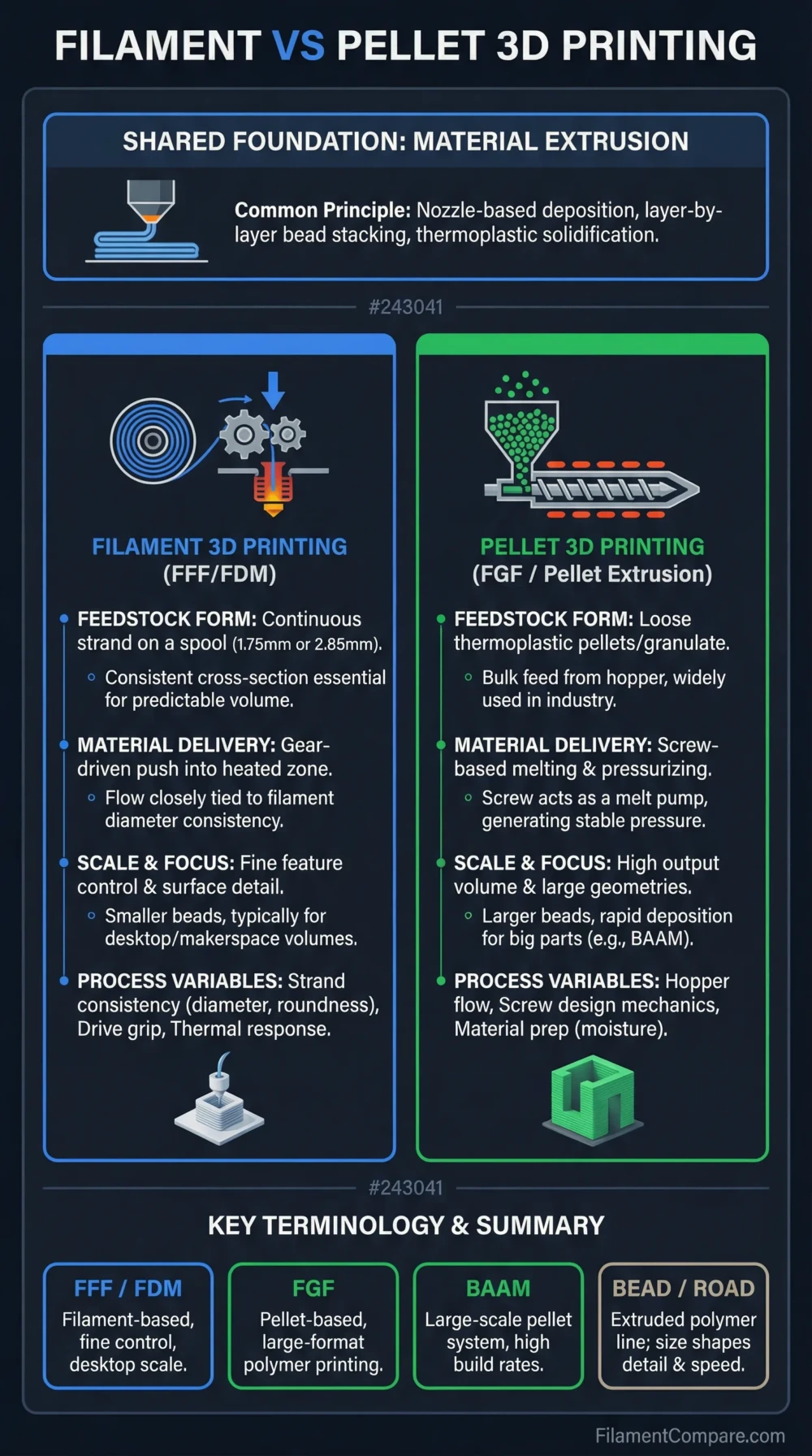
| Comparison Point | Filament 3D Printing (FFF/FDM) | Pellet 3D Printing (FGF / Pellet Extrusion) |
|---|---|---|
| Feedstock Form | Continuous filament strand on a spool | Loose thermoplastic pellets / granulate (often from compounding) |
| Common Feedstock Size | 1.75 mm or 2.85 mm diameter filament ✅Source | Granulate/pellets (shape and size vary by supplier and formulation) |
| Material Delivery | Drive gears push filament into a heated zone; flow is closely tied to filament diameter consistency | Screw-based feeding and melting; flow depends on screw design, pellet behavior, and temperature zoning |
| Example Desktop Specs | Build volumes commonly seen in makerspaces: 250×210×220 mm (Prusa) or 215×215×200 mm (Ultimaker), with listed filament diameters 1.75 mm and 2.85 mm ✅Source | Often larger-format frames are used, especially when higher throughput is the goal |
| Example High-Throughput System | Typically focused on fine feature control and repeatable small parts | BAAM example reported at 6.1 m × 2.44 m × 1.83 m build volume and up to 45.4 kg/h (100 lbs/h) build rates ✅Source |
| What “Good” Usually Means | Surface detail, small features, and consistent extrusion on smaller beads | Output volume, large beads, and rapid deposition for bigger geometries |
| Where You’ll See It | Personal printers, prototyping labs, education, small-batch parts | Large-format polymer printing, tooling, fixtures, big prototypes, material development platforms |
Note: Filament 3D printing and pellet 3D printing sit under the same material extrusion umbrella, yet the feedstock format changes the hardware, the flow behavior, and the “typical” scale of parts.
- Shared Foundation: Material Extrusion
- Feedstock Form: Strand vs Granulate
- Filament Feedstock
- Pellet Feedstock
- Extrusion Hardware: Drive vs Screw
- Scale, Speed, and Bead Size
- Surface Character and Feature Resolution
- Process Stability and Repeatability Factors
- Filament-Side Variables
- Pellet-Side Variables
- Materials Context: What Changes When the Feedstock Changes
- Safety and Handling Notes for Thermoplastic Printing
- Terminology You Will See in Specs and Research
- What Often Shows Up on Datasheets
Both filament 3D printing and pellet 3D printing build parts layer by layer through material extrusion, where polymer is pushed through a nozzle to form beads that stack into a 3D shape. The shared idea is simple; the melt delivery system is what makes them feel like two different worlds. ✅Source
Shared Foundation: Material Extrusion
Material extrusion is the common base: a printer deposits a softened polymer bead through a nozzle, then repeats the path to build up layers. With filament 3D printing, the “metering” happens as a precise strand is fed. With pellet 3D printing, the metering usually happens inside a screw where pellets are melted and pressurized.
- Same family: nozzle-based deposition, bead stacking, thermoplastic solidification.
- Different feel: feed consistency, pressure generation, and typical bead size shift with the feedstock.
- Same vocabulary core: bead, layer, raster, nozzle, melt zone, build platform.
Feedstock Form: Strand vs Granulate
Filament Feedstock
Filament is a continuous strand produced to a controlled diameter, then wound onto spools. The printer counts on that consistent cross-section so the drive system can deliver predictable volume. Common diameters referenced in FDM/FFF literature include 1.75 mm and 2.85 mm for thermoplastic filaments. Day-to-day print reliability also depends on how filament is stored and kept dry, which is explored further in this filament storage and equipment overview. ✅Source
- Physical format: easy to handle, tidy storage, predictable feeding path.
- Flow character: driven by filament push plus melt-zone response.
- Changeover feel: spool swap is a common operational pattern.
Pellet Feedstock
Pellets (granulate) are a standard industrial feedstock form for thermoplastics, widely used in compounding and molding supply chains. In pellet 3D printing, the printer meters material from a hopper into a melting section, commonly with a screw that can generate stable pressure for high output.
- Physical format: bulk feed via hopper, often suited to large material volumes.
- Formulation flexibility: pellets can be pre-compounded with fillers, fibers, or additives.
- Operational focus: consistent melt delivery across longer runs is a typical design target.
Extrusion Hardware: Drive vs Screw
- Filament Extruder (Typical)
- Drive gears grip the filament, pushing it into a heated zone. Flow behavior is closely tied to filament stiffness, diameter stability, and the melt-zone’s response.
- Pellet Extruder (Typical)
- A screw conveys pellets forward, melting and pressurizing the polymer before it exits the nozzle. This style is often described as single-screw extrusion in large-format polymer systems.
In published large-format BAAM work, pellets are delivered as a pre-compounded feedstock and processed through a single-screw extrusion system, with reported examples including a feed rate around 10 lbs/h under specific test conditions. The important bit is the mechanism: the screw is a melt pump, not just a feeder. ✅Source
- Pressure Generation: filament feed pushes a solid strand into heat; screw extrusion builds pressure while melting bulk material.
- Material Behavior Window: both depend on temperature control, yet pellets typically introduce extra variables like pellet geometry and hopper flow.
- Machine Design: filament systems are common on compact gantry setups; pellet systems often use heavier print heads to maintain stable melt flow.
Scale, Speed, and Bead Size
Filament 3D printing is often associated with smaller beads and fine geometry, while pellet 3D printing is often associated with larger beads and high output. Neither is “better” in the abstract; they simply target different production envelopes.
Relative Comparison Meters (typical positioning, not a spec sheet)
- Top Bar: Filament
- Bottom Bar: Pellet
- Visual guide, not a guarantee
Surface Character and Feature Resolution
Bead size is a clean way to talk about finish and features without hype. In one BAAM-focused study, typical nozzle diameters were described as 0.010 in for FDM and 0.3 in for BAAM, linking larger beads to higher deposition and smaller beads to finer detail. ✅Source
- Filament systems often emphasize small features, thinner beads, and tighter surface texture.
- Pellet systems often emphasize rapid build-up, thicker beads, and faster wall growth.
- Hybrid thinking is common in practice: some platforms explore selective higher-resolution areas while keeping high output elsewhere.
Process Stability and Repeatability Factors
Repeatability in filament 3D printing often centers on consistent filament feeding and steady melt response. In pellet 3D printing, repeatability often centers on hopper behavior, screw conveyance, and temperature zoning across the melting path.
Filament-Side Variables
- Strand consistency: diameter tolerance, roundness, stiffness.
- Drive interaction: grip, compression, and steady pushing.
- Thermal response: melt-zone length, nozzle geometry, flow lag.
Pellet-Side Variables
- Bulk feeding: hopper flow, bridging tendencies, pellet shape mix.
- Extrusion mechanics: screw design, compression, melt uniformity.
- Material preparation: moisture sensitivity and consistent melt viscosity.
Materials Context: What Changes When the Feedstock Changes
Filament ecosystems are typically organized around spool-ready materials, where the polymer has already passed through a filament-making step. Pellet ecosystems are typically organized around compounding and pellet supply, which can support a broad catalog of formulations in industrial plastics markets. The core difference is where the “formatting” happens: before printing as filament, or at the printer as melted pellets.
- Color and additives: both formats can carry pigments and modifiers; the supply chain packaging differs.
- Composites: both can include fibers or fillers, with pellet compounding being a common industrial route.
- Material volume planning: pellets often align with bulk consumption, while filament aligns with spool-based planning.
Safety and Handling Notes for Thermoplastic Printing
Thermoplastic printing can involve heated polymers, post-processing, and potential exposures during activities like cleaning or removing parts. A NIOSH guidance handout highlights that exposure potential can vary across printing stages and work activities, emphasizing thoughtful workplace practices around printing, post-printing, and maintenance. ✅Source
Terminology You Will See in Specs and Research
- FFF / FDM
- Filament-based material extrusion where a continuous strand is fed and extruded; often associated with desktop-scale printers and fine feature control.
- FGF
- Pellet-based material extrusion where granulate is melted and extruded; commonly discussed in large-format polymer printing contexts.
- BAAM
- A well-known large-format approach associated with pellet feedstock and high build rates, often referenced in industrial research literature.
- Bead (Road)
- The extruded line of polymer; bead width and bead height shape surface texture, detail scale, and build time behavior.
- Build Volume
- The maximum printable envelope; widely varies, and it often correlates with whether a platform emphasizes precision or throughput.
What Often Shows Up on Datasheets
- Nozzle Diameter: a direct hint about bead scale; smaller nozzles tend to align with finer features, larger nozzles with higher output.
- Hot End / Barrel Temperature Range: how the system supports different polymers and melt viscosities.
- Feedstock Requirements: filament diameter compatibility or pellet handling expectations.
- Deposition Rate or Build Rate: often listed for pellet systems; for filament systems, it may appear indirectly via speed and extrusion limits.
- Motion System Limits: acceleration, jerk, and gantry stiffness, which shape how confidently a system can place beads.
