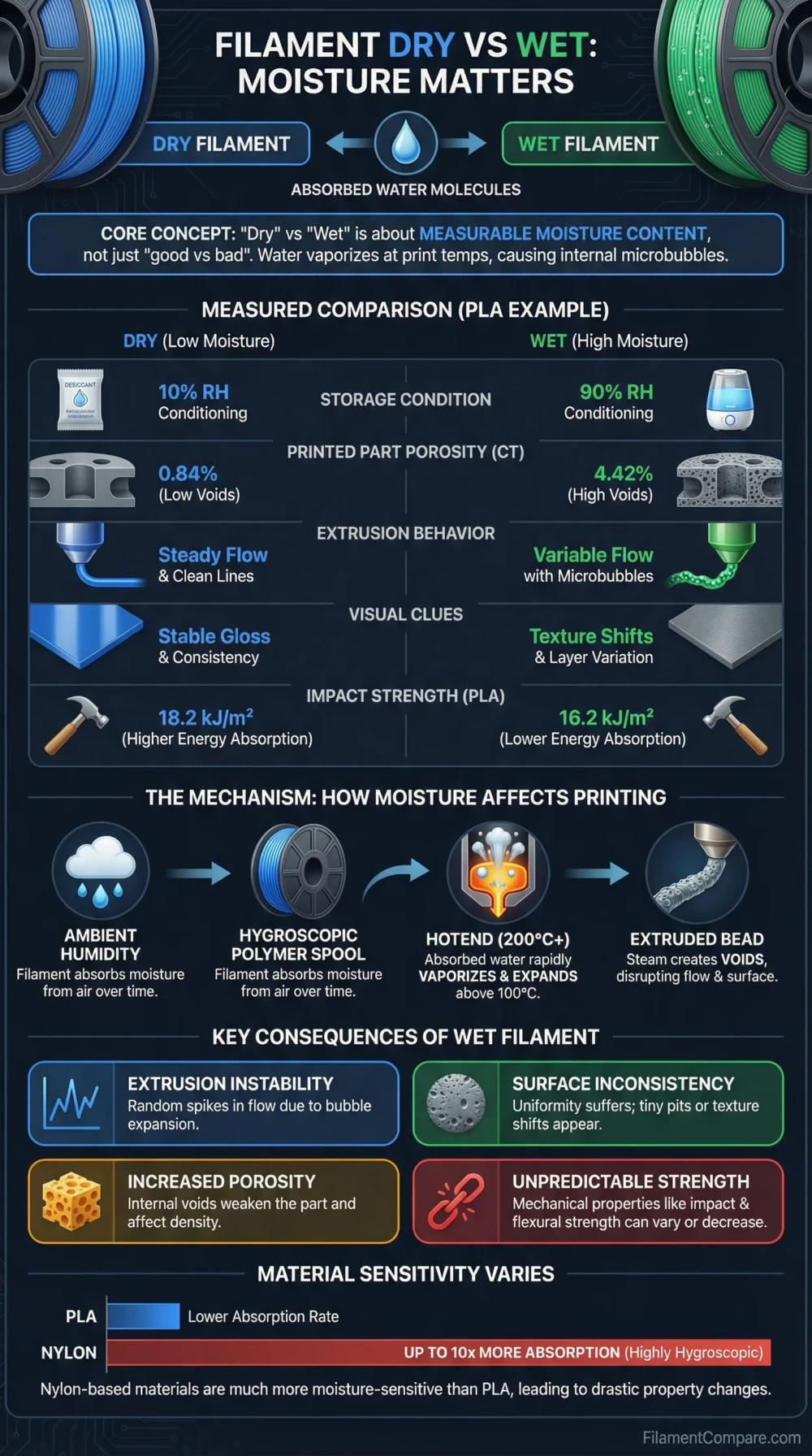
| Category | Dry Filament Side | Wet Filament Side | What That Usually Means For Prints |
|---|---|---|---|
| Storage Relative Humidity (RH) | 10% RH conditioning | 90% RH conditioning | Moisture uptake changes how the melt behaves during material extrusion. |
| Printed-Part Porosity (CT) | 0.84% | 4.42% | Higher porosity often shows up as tiny voids and less consistent surface finish. |
| Flexural Strength (PLA) | 103.0 MPa | 99.6 MPa | A small shift, but it can matter when you want steady load-bearing behavior. |
| Impact Strength (PLA) | 18.2 kJ/m² | 16.2 kJ/m² | Moisture-related voids can reduce how energy is absorbed in a sudden hit. |
| Extrusion Behavior | Steady Flow and clean lines | Variable Flow with microbubbles | Steam inside the melt can create tiny interruptions that show up as texture or small pits. |
| Visual Clues | Gloss/Consistency tends to stay stable | Texture Shifts can appear across layers | More variation in strand bonding can change how the top surface looks, even on the same model. |
Dry vs wet is mainly about moisture level, not “good vs bad.” The table uses a controlled PLA humidity study as a numeric reference point, while the sections below cover the broader filament behavior across materials.
- Dry Filament and Wet Filament: What The Words Really Mean
- Dry Filament Profile
- Wet Filament Profile
- Moisture Pathways: How Water Gets Into Filament
- Why Moisture Becomes “Visible” During Printing
- What “Wet” Changes First: Flow, Texture, and Internal Voids
- A Measured Nylon Example: Moisture Content Moves Fast
- What That Nylon Data Implies For “Dry” vs “Wet”
- A Useful PLA Reminder: Moisture Effects Can Be Directional, Not Just “Less or More”
- Broader Research Signals: Hygroscopic Polymers React Strongly
- How “Dry” and “Wet” Are Verified In Practice
- Glossary Terms Used In This Comparison
A dry filament spool and a wet filament spool can be the exact same polymer, just holding a different amount of absorbed water. That water doesn’t stay quiet at printing temperatures; it changes how the melt flows, how the surface forms, and how predictable the final part feels in real use. If you want to understand how storage conditions, drying methods, and equipment influence filament moisture levels, see the Filament Storage, Drying & Equipment Guide.
- Moisture Content (wt.%)
- Relative Humidity (RH)
- Porosity (internal voids)
- Extrusion Stability
- Surface Consistency
- Mechanical Response
Dry Filament and Wet Filament: What The Words Really Mean
Dry Filament Profile
Dry filament means the polymer is closer to a low moisture equilibrium for its storage environment. In practice, it behaves with more consistent melt flow and fewer micro-voids forming during extrusion.
- Stable extrusion with fewer random spikes in flow
- Surface finish tends to look more uniform across the same wall
- Dimensional repeatability is easier to maintain across long prints
Wet Filament Profile
Wet filament means the material has absorbed more water molecules from storage air or handling time. When heated, that moisture can expand into microbubbles, which can change both appearance and internal structure.
- Flow variability can increase from bubble expansion
- Porosity risk may rise in the printed bead
- Mechanical scatter can widen because voids are not always uniform
Moisture Pathways: How Water Gets Into Filament
Most spools gain moisture through slow diffusion from air, and some polymers take it up faster than others. A hygroscopic polymer doesn’t need “liquid water” to change; normal storage humidity can be enough over time to shift print behavior.
- Ambient RH exposure (even indoors) gradually changes water content
- Open spools “breathe” more than sealed spools, so equilibrium is reached faster
- Some materials hold water inside the polymer network, so the effect shows up as melt changes rather than visible droplets
Why Moisture Becomes “Visible” During Printing
Inside a hotend, the temperature is far above the normal boiling point of water (about 373.15 K), so absorbed moisture can vaporize rapidly and expand within the molten polymer, creating bubble-driven voids that affect extrusion smoothness.✅Source
What “Wet” Changes First: Flow, Texture, and Internal Voids
Moisture often shows up as a change in flow consistency before it shows up as a dramatic visual shift. When volatile expansion creates tiny gaps, the bead can deposit with more variability, which nudges porosity upward and makes the surface less uniform from layer to layer.
Relative Comparison Bars (visual cue, not a lab measurement)
- Extrusion Smoothness can change when microbubbles disrupt the strand
- Top Surface may show tiny pits or a faint texture shift as voids rise and pop
- Layer Bond Predictability can vary because the bead isn’t always the same density
A Measured Nylon Example: Moisture Content Moves Fast
For a clear lab-style view, one nylon study conditioned filament at 40 °C and 80% RH, then measured moisture directly in weight percent. Even the “virgin” nylon sample contained about 1 wt.% water, and after 72 hours the measured moisture was around 5.5 wt.%.✅Source
What That Nylon Data Implies For “Dry” vs “Wet”
That gap between about 0.9 wt.% and about 5.5 wt.% is not a tiny rounding error; it’s enough to shift strand morphology and make the printed bead less uniform under heat. In other words, wet filament can be “wet” in a measurable, repeatable way.
A Useful PLA Reminder: Moisture Effects Can Be Directional, Not Just “Less or More”
Moisture does not always push properties in one single direction for every polymer and every test. In a PLA tensile study, specimens were compared at 1%, 5%, and 10% moisture content, and reported that ultimate tensile strength decreased by 24.4% as moisture content decreased from 10% to 1% (within that study’s specific setup).✅Source
Takeaway for comparisons: “Dry” is still about low water content, and “wet” is still about higher water content. The direction of the performance shift depends on the polymer, the print conditions, and what property is being measured.
Broader Research Signals: Hygroscopic Polymers React Strongly
Across common 3D-printing polymers, nylon-based materials are widely described as more moisture sensitive than PLA. In one open-access study that immersed printed specimens in water at 21 °C and 70 °C, nylon-based materials absorbed up to 10× more water than PLA under the same conditions, and nylon’s flexural modulus decreased by as much as 60% after 7 days of immersion.✅Source
This kind of result helps explain why moisture management is discussed so often for highly hygroscopic filaments. It is less about “fear of humidity,” more about keeping material behavior stable when the melt is under heat and pressure.
How “Dry” and “Wet” Are Verified In Practice
Because dry filament and wet filament are about measurable moisture, verification usually relies on what can be observed or measured, not guesses. Different shops use different methods, but the underlying idea is the same: quantify moisture-related change.
- Moisture Analyzer readings in wt.% (common in lab studies)
- Controlled RH Conditioning to compare behavior at different humidity levels
- Printed-Part CT or Microscopy to detect porosity and strand texture changes
- Repeatability Checks across identical prints to see whether the melt flow stays consistent
If you want an evidence-first definition, “dry” means lower moisture content for that polymer at that moment, and “wet” means higher moisture content. The rest—texture, sound, porosity, and strength—are the visible or measurable effects of that water presence.
Glossary Terms Used In This Comparison
- Relative Humidity (RH)
- The amount of water vapor in air compared with the maximum it can hold at the same temperature. Higher RH often speeds up moisture uptake for hygroscopic polymers.
- Moisture Content (wt.%)
- Water in the material expressed as a percentage by mass. This is the cleanest way to separate dry filament from wet filament.
- Porosity
- Tiny internal voids inside the printed bead or part. Higher porosity often links to less consistent load transfer through the structure.
- Flexural Strength
- How much bending stress a sample can take before it fails. In moisture studies, shifts in flexural behavior are often used to quantify changes.
- Flexural Modulus
- A stiffness measure during bending. When moisture changes the polymer network or introduces voids, modulus can shift.
Dry filament is about consistency, and wet filament is about change. When you describe both with numbers—RH, wt.%, porosity, and strength—you get a comparison that stays clear even across different materials and printers.
Extra research context: A conference paper on PLA also reports that humidity influences tensile strength and notes that PLA stored with desiccants can show tensile strength comparable to a reference specimen in their setup.✅Source
