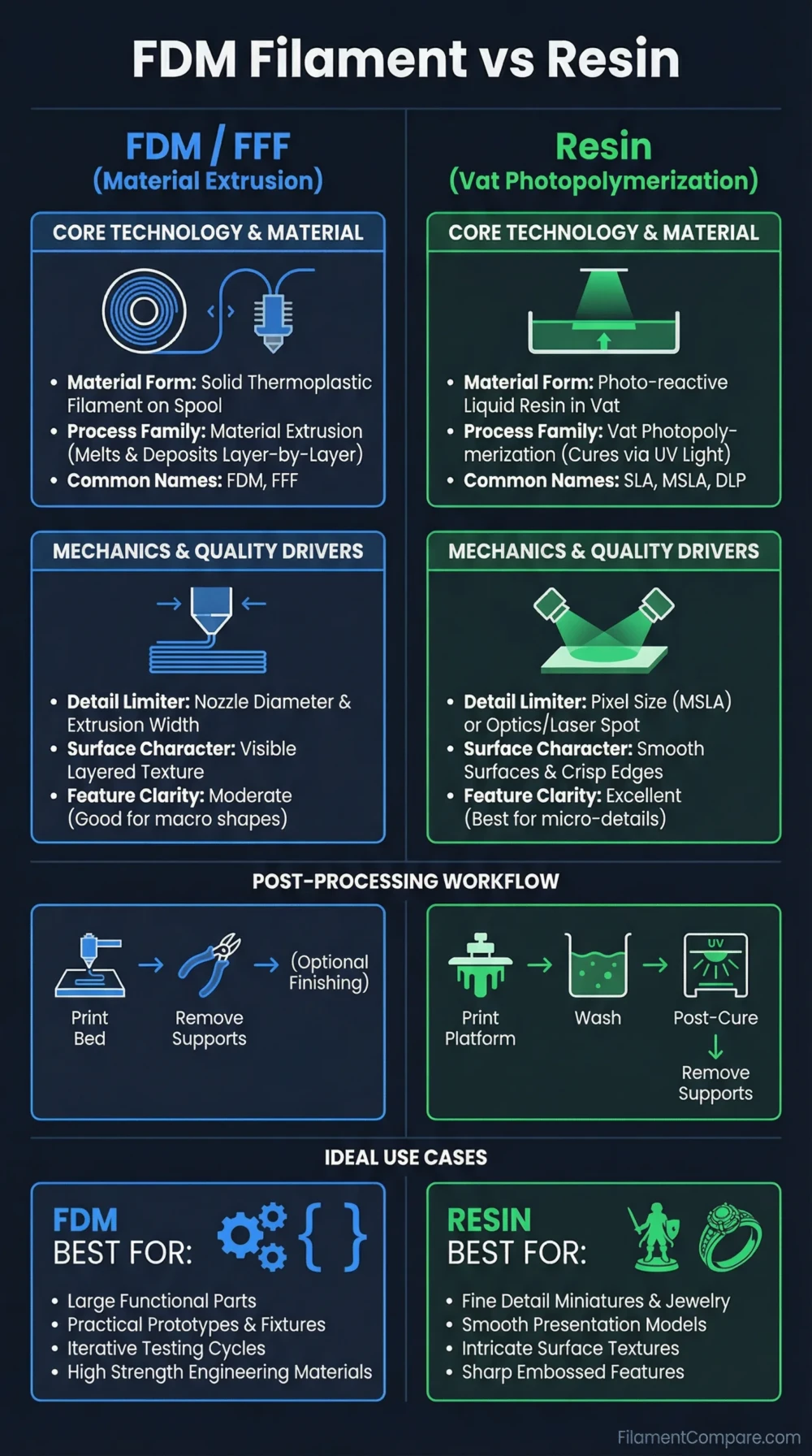
| Attribute | FDM Filament (Material Extrusion) | Resin (Vat Photopolymerization) |
|---|---|---|
| Material Form | Solid filament on a spool (thermoplastic feedstock) | Liquid resin in a vat (photopolymer feedstock) |
| Process Family | Material extrusion builds by depositing material layer-by-layer | Vat photopolymerization forms parts by curing resin with light |
| Standard Process Names Seen Online | Commonly labeled FDM or FFF | Commonly labeled SLA, MSLA, or DLP |
| Detail “Limiters” | Mostly driven by nozzle diameter and extrusion width | Mostly driven by pixel size (MSLA) or laser/optics (SLA/DLP) |
| Common FDM Hardware Numbers (Example) | 0.4 mm is a widely used nozzle size; a typical practical max layer height is about 80% of nozzle diameter (≈ 0.32 mm) ✅Source | Varies by printer model and nozzle choice |
| Example Resin Printer Numbers (Example) | Varies by printer model | Example specs (one manufacturer): 50 µm pixel size, 405 nm wavelength, typical print speed range 16–50 mm/hour ✅Source |
| Surface Character | Often shows a visible layered texture depending on settings and geometry | Often produces smoother surfaces and crisp small features |
| Support Structures | Supports are printed from the same filament, then removed | Supports are cured from the same resin, then removed |
| Post-Processing Pattern | Usually: remove supports, optional finishing | Usually: remove supports, wash, then post-cure (process varies by resin/printer) |
Note on Numbers: The table mixes general traits with example specs from specific products or common defaults. That keeps the comparison honest while still giving real-world scale.
- What “Filament” and “Resin” Really Mean
- FDM Filament as a Material
- Resin as a Material
- Terms, Labels, and Why Names Get Confusing
- How the Machines Build a Part
- FDM Material Extrusion Mechanics
- Resin Vat Photopolymerization Mechanics
- Detail, Surface, and Visual Finish
- What Drives Detail in FDM
- What Drives Detail in Resin
- Dimensional Fit, Edges, and Part Behavior
- Where Tolerances Usually Come From
- Workflow Differences as Simple Sequences
- Typical FDM Print Flow
- Typical Resin Print Flow
- Materials and Use Context
- Common Selection Signals People Look At
- Where Each Option Feels Like a Natural Fit
- Common Reasons People Choose FDM
- Common Reasons People Choose Resin
- A Practical Way to Compare Without Mixing Apples and Oranges
FDM filament and resin printing both sit under additive manufacturing, but their material behavior feels very different in practice. Additive manufacturing is defined around building 3D geometry by successive material addition, which is why these two approaches can be compared in a clean, structured way.✅Source
What “Filament” and “Resin” Really Mean
FDM Filament as a Material
Filament is typically a thermoplastic strand that softens when heated and returns to a solid state when cooled. The material is fed continuously, which makes spool handling and consistent diameter meaningful details for print consistency. Because many thermoplastics also react to ambient humidity, storage conditions and proper drying can influence print reliability; the Filament Storage, Drying & Equipment Guide explains how moisture management and equipment choices affect filament workflows.
- Physical form: solid wire-like strand on a spool
- Transformation: melts/softens in the hotend, then solidifies on the build plate
- Common tuning language: nozzle size, layer height, extrusion width, cooling
Resin as a Material
Resin for 3D printing is a photo-reactive liquid designed to solidify when exposed to the right light energy. In vat photopolymerization, the part is formed by curing resin with ultraviolet light through stages as the build progresses.✅Source
- Physical form: liquid in a vat/tank
- Transformation: cures from liquid to solid via controlled light exposure
- Common tuning language: exposure, layer thickness, lift/wipe behavior (varies by system)
Terms, Labels, and Why Names Get Confusing
- FDM vs FFF
- FDM is widely used as a generic label, but it is also a trademarked term associated with systems using this material extrusion approach; many communities use FFF as a neutral alternative.✅Source
- SLA, MSLA, DLP
- These sit under vat photopolymerization and differ mainly in how light is delivered to cure the resin (laser scanning, masked LCD, or projected image).
- “Filament Printer” vs “Resin Printer”
- The labels describe feedstock form more than quality level. Both families can be used for prototypes, fixtures, display models, and functional parts depending on material choice.
How the Machines Build a Part
Shared idea: both methods build layers from a digital model. The difference is the material state and the energy source that makes the layer “real.”✅Source
FDM Material Extrusion Mechanics
- Motion system: moves nozzle and/or bed along X/Y/Z axes
- Hotend: heats and pushes filament through a nozzle
- Bonding: layers fuse by thermal contact as new lines are deposited
- Part support: overhangs are handled by printed supports when needed
Resin Vat Photopolymerization Mechanics
- Light engine: cures resin in a pattern (laser/LCD/projector depending on type)
- Resin tank: holds liquid resin for layer formation
- Layer separation: the part lifts/peels between layers based on the system’s design
- Part support: supports are printed as cured resin structures, then removed
Detail, Surface, and Visual Finish
When people talk about print detail, they usually mean three things: small feature clarity, surface smoothness, and how cleanly edges show up in the final part. FDM and resin can both do impressive work, but they reach that look in different ways.
Relative Tendencies (visual guide, not a lab measurement)
How to read the bars: the first pair reflects fine feature clarity, the second pair reflects surface smoothness, and the third pair reflects text/edge crispness.
What Drives Detail in FDM
Nozzle diameter and layer height shape what an FDM printer can physically draw in plastic. A smaller nozzle can trace thinner lines, while a smaller layer height can make slopes look smoother. The trade-off is more layers and more motion, which changes the time profile of the print.
What Drives Detail in Resin
Light control is the core lever in resin printing, and it shows up as pixel size (for MSLA) or beam/optics behavior (for SLA/DLP). Because each layer is formed by curing, resin prints often show sharp micro-features and clean edges when the material and exposure profile are well-matched.
Dimensional Fit, Edges, and Part Behavior
Dimensional accuracy is not a single number; it’s a mix of machine calibration, material behavior, geometry, and how supports interact with surfaces. In FDM, the width of deposited lines and cooling behavior matter a lot. In resin, exposure, peel mechanics, and resin formulation can be the biggest levers.
Where Tolerances Usually Come From
- Machine calibration: steps/mm, light uniformity, and axis alignment
- Material response: thermal shrink, cure shrink, and time-dependent changes
- Support contact: where supports touch can affect edges and surface fidelity
- Model decisions: wall thickness, hole sizing strategy, and feature orientation
Workflow Differences as Simple Sequences
Both workflows start with a sliced file and end with a finished part. The middle steps look different because filament is deposited hot and solidifies immediately, while resin is cured and often benefits from structured cleanup and a final cure stage.
Typical FDM Print Flow
- Slice model into layers and toolpaths
- Load filament and heat the hotend
- Extrude, deposit, and cool layer-by-layer
- Remove supports and optionally finish surfaces
Typical Resin Print Flow
- Slice model into layers and exposure patterns
- Print by curing layers in the resin vat
- Remove supports after printing (timing depends on resin/system)
- Wash and post-cure as required by the resin workflow
Materials and Use Context
FDM filament spans everyday plastics and engineering materials, so you’ll see broad options for stiffness, flexibility, and temperature behavior depending on polymer family. Resin spans general-purpose and specialty formulations, often emphasizing surface finish and feature fidelity. In both cases, the material choice can matter more than the machine label.
Common Selection Signals People Look At
- Geometry scale: tiny features vs broad, large surfaces
- Surface goal: visible layers vs smooth skin
- Mechanical expectation: rigid, tough, flexible, or functional fit
- Finishing tolerance: how much post-processing the workflow normally involves
Where Each Option Feels Like a Natural Fit
Common Reasons People Choose FDM
- Large parts: bigger volumes are often more straightforward with filament
- Practical prototypes: enclosures, brackets, jigs, and test fixtures
- Material variety: wide range of thermoplastics and composites by brand
- Iterative cycles: easy to rerun and adjust geometry frequently
Common Reasons People Choose Resin
- Fine detail: miniatures, jewelry-scale forms, intricate surface texture
- Smooth finish: parts that need a clean skin right out of the printer
- Sharp edges: crisp lettering, embossed logos, and small mechanical features
- Presentation models: display parts where surface quality carries the look
A Practical Way to Compare Without Mixing Apples and Oranges
If the goal is accurate, repeatable comparison, it helps to line up the same kinds of factors: feedstock form, feature scale, surface expectations, and the typical post-processing pattern. That keeps FDM filament and resin in the same frame without forcing one “winner.”
