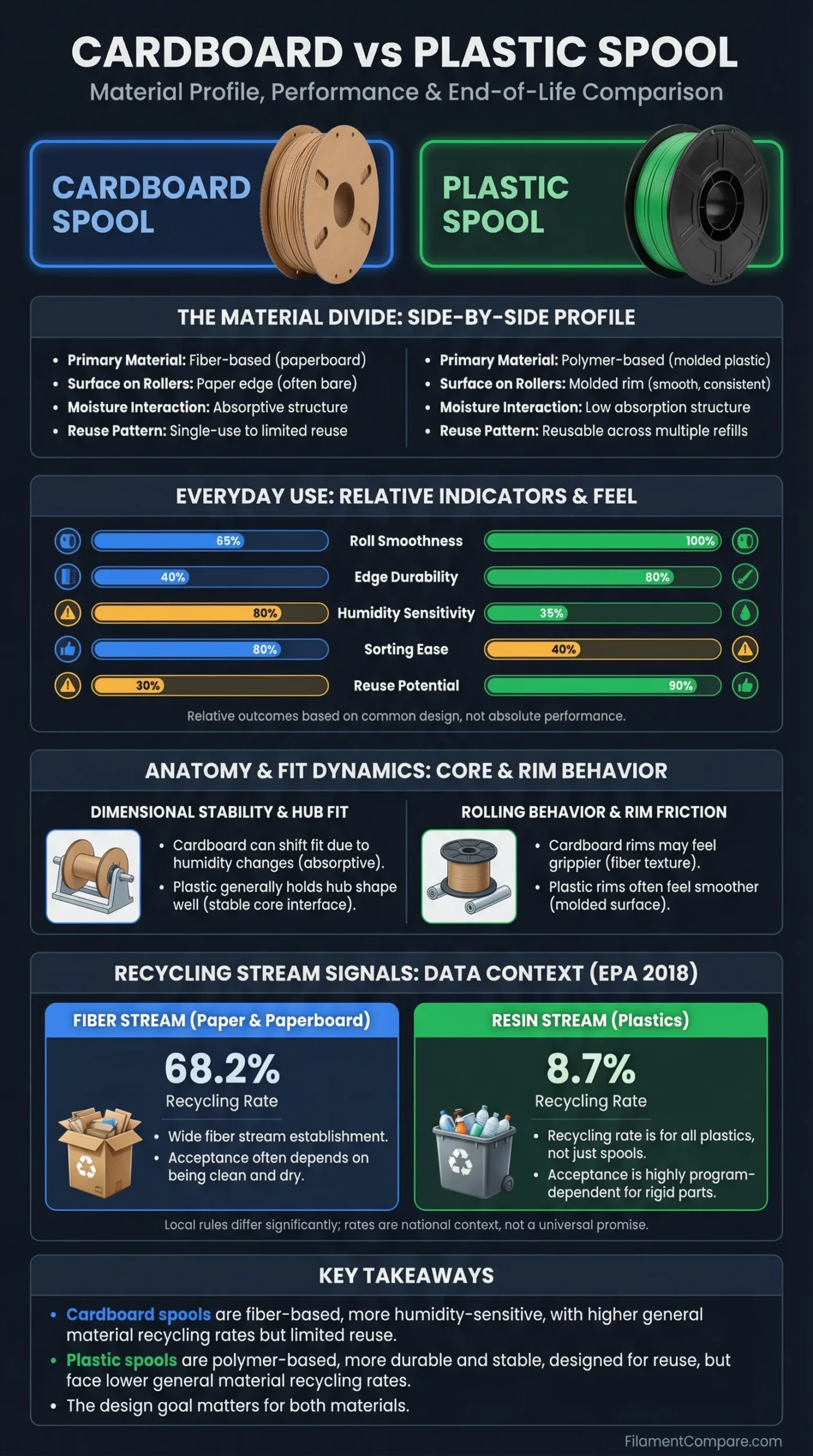
Cardboard spools reduce single-use plastic packaging and work well on many standard spool holders, while plastic spools usually provide a rounder, more moisture-resistant running surface for roller-driven feeders. The spool does not change a filament’s nozzle temperature, layer adhesion, strength, or surface finish; it changes how the roll is stored, dried, supported, and fed. The better choice therefore depends on the printer path and what happens to the empty spool afterward.
The Practical Choice
Choose a cardboard spool for a conventional center-axle holder, lower packaging weight, and a paper-based end-of-life route when the spool is clean, dry, and accepted locally.
Choose a plastic spool for roller-driven material systems, repeated refill use, humid workshops, or workflows where rim shape and spool rigidity must remain consistent.
No spool material is automatically better in every setup. A well-made cardboard spool can feed smoothly, while a warped plastic spool can still cause drag.
Best for Standard Axle Holders
Cardboard spool — usually rolls well when the holder supports the center bore rather than the outer rim.
Better for Powered Rollers
Plastic spool — a hard, uniform rim is generally easier for assisted rewind and feed systems to grip.
Better for Refill Programs
Reusable plastic spool — suitable when the spool is designed to open, lock, and accept manufacturer refills.
Lower Single-Use Plastic
Cardboard spool — especially when the manufacturer uses recycled fiber and avoids mixed-material coatings.
Better in Damp Storage Areas
Plastic spool — less likely to soften, swell, or lose rim shape after incidental moisture exposure.
Better for Easy Disposal Sorting
Cardboard spool — often simpler when it is a clean fiber-only design, though local acceptance still decides the correct bin.
Better for Repeated Handling
Plastic spool — resists edge crushing and can tolerate frequent loading, unloading, and shelf movement.
Better for Lightweight Shipping
Cardboard spool — many designs use less dense packaging material, but exact tare weight varies by brand and size.
| Decision Area | Cardboard Spool | Plastic Spool | Practical Edge |
|---|---|---|---|
| Primary construction | Pressed paperboard faces with a fiber core; glue and edge treatment vary | Injection-molded or printed polymer; resin and wall thickness vary | Design-dependent |
| Effect on filament properties | No direct effect when the filament is stored and fed correctly | No direct effect when the filament is stored and fed correctly | Equal |
| Center-axle holder behavior | Usually smooth if the bore is round and the flanges remain flat | Usually smooth if the bore fits the holder and the spool is not warped | Similar |
| Outer-rim roller behavior | May slip, shed fibers, or wobble if the rim is rough or dented | Usually offers a harder and more uniform roller contact surface | Plastic |
| Assisted rewind systems | Compatibility varies; some systems call for an adapter ring | Often the expected format when dimensions match the feeder | Plastic |
| Water and high humidity exposure | Edges and faces can soften, swell, or delaminate | Generally resists incidental moisture better | Plastic |
| Drying compatibility | Depends on board, glue, core, and assembly method | Depends on polymer, locking method, and dryer temperature | Check the manufacturer |
| Drop behavior | More likely to dent or bend than shatter | May remain rigid, but some designs can crack | Different failure modes |
| Empty-spool tare | Often lighter, but not standardized | Often heavier, but reusable designs spread that mass across refills | Workflow-dependent |
| Reuse | Possible for organization or light reuse, but repeated loading can wear the core and edges | Better suited to repeated refill cycles when designed to open and relock | Reusable plastic |
| Paper recycling route | Often possible for clean, dry, fiber-based spools after removing non-paper parts | Not applicable | Cardboard |
| Plastic recycling route | Not applicable unless mixed parts are separated | Depends on resin identification and local acceptance; durable spools may not be collected curbside | Check locally |
| Dust and loose debris | Raw or damaged rims may release fibers during repeated roller contact | Normally produces less fiber debris, though worn surfaces can still shed particles | Plastic |
| Repair options | Edge rings, tape, flange supports, or respooling may help | Cracks may require replacement or respooling | Damage-dependent |
| Best fit | Standard holders, lower single-use plastic, straightforward fiber sorting | AMS-style rollers, refill ecosystems, repeated workshop use | Use-case based |
Spool Construction Profiles
Cardboard Spool Profile
- Material: Paperboard faces and a fiber core; adhesive and edge treatment vary by maker
- Print difficulty: Not applicable; feeding reliability is the relevant measure
- Holder fit: Usually good on center-supported axles
- Roller fit: Brand-dependent; treated edges or adapter rings may improve contact
- Drying need: Determined by the filament, but the spool assembly must tolerate the selected temperature
- Storage behavior: Keep clean and dry; protect the flanges from crushing
- Typical behavior: Light, quiet on many holders, and easier to sort into a paper stream when locally accepted
- Best use cases: Open spool holders, external feed paths, short storage cycles, and users prioritizing lower single-use plastic
Plastic Spool Profile
- Material: Molded or printed thermoplastic; the resin and heat limit vary by maker
- Print difficulty: Not applicable; geometry and feeder fit matter instead
- Holder fit: Usually predictable when bore width and outer diameter match the printer
- Roller fit: Often better for systems that drive or rewind from the outer rim
- Drying need: Determined by the filament; spool temperature limits still require verification
- Storage behavior: Better resistance to damp handling and edge compression
- Typical behavior: Rigid and dimensionally stable, with more potential for refill reuse when designed as a master spool
- Best use cases: Multi-material feeders, repeated refill cycles, print farms, and long workshop service
Relative Workflow Performance
The Spool Does Not Change the Filament
Spool material has no direct control over nozzle temperature, bed temperature, enclosure need, stiffness, toughness, layer adhesion, warping, stringing, or surface finish. Those properties come from the filament formulation, moisture condition, print orientation, geometry, and slicer settings.
The spool can still affect a print indirectly. A flange that rubs against a holder may add drag. A rough rim can cause an assisted feeder to slip. A crushed edge can let loops move sideways, and a loose winding can create a snag. These are feeding and handling problems, not changes in polymer performance.
Comparison rule: When two rolls contain the same filament grade, compare spool geometry separately from the filament datasheet. A plastic reel does not make PLA tougher, and a cardboard reel does not lower PETG heat resistance.
Roller Systems, AMS Units, and Rim Wear
Center-axle holders carry the spool through its hub, so the outer flange material matters less. Roller-based systems are different: they contact the outer rim and may reverse the spool during unloading. In that arrangement, roundness, rim hardness, flange width, and surface friction directly affect feeding.
Bambu Lab’s AMS guidance recommends correctly fitting plastic spools and advises an adapter ring when cardboard spools are used, mainly to lower the chance of slippage and debris inside the mechanism[b]. Its separate caution page also notes that some cardboard spools may be out of round, which can interfere with roller contact[c].
This does not mean every cardboard spool fails in an AMS. Hardened rims, accurate diameters, adapter rings, and a well-supported roll can work reliably. Polymaker publishes an adapter intended to reduce friction, give the rim a structured rolling surface, and limit fiber buildup in multi-material systems[h].
Drying, Humidity, and Shape Retention
The filament’s moisture sensitivity decides whether drying is needed. The spool decides whether the complete roll can survive the selected drying cycle. A cardboard face may tolerate a moderate dryer setting, but glue joints, press-fit hubs, laminated labels, and mixed-material centers can react differently.
Prusa’s drying documentation shows why construction details matter. Its older black hybrid spool used plastic sides pressed into a cardboard center and could loosen after heating above 45 °C unless mechanically secured; newer Prusament spool designs use different locking and heat-resistant constructions[d]. The lesson applies beyond one brand: do not infer dryer limits from “cardboard” or “plastic” alone.
For ambient storage, plastic flanges resist damp handling better. Cardboard should remain dry and should not sit directly on wet shelves or floors. Neither spool is a dry box. The filament still needs a sealed container, desiccant, or active drying when its material family requires it.
Before Drying a Cardboard Spool
- Read the filament maker’s drying page.
- Confirm the glue and hub construction can handle the target temperature.
- Inspect the rim for prior swelling or delamination.
- Support detachable faces when the maker calls for a screw or lock.
Before Drying a Plastic Spool
- Identify the manufacturer’s temperature limit.
- Do not assume every molded resin tolerates nylon or PC drying temperatures.
- Check for warping after the cycle before placing the spool in a roller feeder.
- Keep the roll below the filament’s softening range.
Reuse and End-of-Life Sorting
Cardboard has a clear advantage when the spool is made mainly from clean paper fiber and the local paper stream accepts it. Polymaker states that its current cardboard spool approach uses recycled cardboard and is designed for recycling[a]. That statement applies to the cited manufacturer’s construction, not every cardboard reel on the market.
Plastic spools offer another route: reuse. A spool that opens securely can serve many refill coils, reducing the number of complete reels purchased. Bambu Lab sells a reusable spool made for its refill system[f], while Prusament describes detachable plastic sides that can be moved onto a new refill and a cardboard center that can be separated for local recycling or reuse[e].
“Recyclable” does not mean every curbside program will collect the item. The U.S. EPA advises checking local acceptance for both paper products and specific plastic types, because programs and sorting capabilities differ[g]. Remove filament scraps, labels, metal hardware, RFID parts, and mixed-material inserts when the maker or recycler instructs you to do so.
Waste decision: A single-use cardboard spool often has the simpler fiber route. A durable plastic master spool may be the lower-waste choice when it is kept in service through many verified refill cycles. Disposal without reuse weakens that advantage.
EU Packaging Rules Add New Context in 2026
The EU Packaging and Packaging Waste Regulation, Regulation (EU) 2025/40, entered into force on February 11, 2025 and generally applies from August 12, 2026. The European Commission describes the PPWR as covering packaging and packaging waste across materials, with rules addressing packaging design, waste prevention, reuse or refill, collection, and recycling[i].
What the PPWR does not mean: it does not create a blanket ban on plastic filament spools. Cardboard and plastic remain material choices. The EU rules make recyclability, unnecessary material use, reuse, refill systems, and end-of-life design more relevant when packaging is placed on the EU market.
The Regulation states that packaging placed on the market must be recyclable and defines packaging broadly around functions such as containment, support, handling, delivery, and presentation. The stricter design-for-recycling market grades are phased in from 2030, so the August 2026 application date should not be read as an overnight ban on a particular spool material[j].
For filament packaging, this adds context to the choice already described above. A clean cardboard reel may offer a straightforward fiber route where local collection accepts it, while a durable plastic master spool can spread its material across repeated refill filament cycles. The useful comparison is still the complete packaging system and what actually happens to it after use.
Storage, Handling, and Remaining-Filament Estimates
Cardboard flanges need support during storage. Heavy rolls stacked sideways can bend the faces, and a dented rim may wobble on a roller. Store rolls upright or on a shelf that supports the hub, keep them away from water, and secure the filament end so it cannot cross under another loop.
Plastic reels are less sensitive to edge compression, but they are not immune to heat warping, cracked hubs, or loose refill locks. A reusable spool should be checked after assembly: both halves must seat fully, the refill ties should remain in place until the spool is locked, and the winding must not be pinched between the faces.
Spool tare weight is not standardized. When estimating remaining filament with a scale, use the empty weight printed by the manufacturer or weigh an identical empty spool. Switching from cardboard to plastic without updating tare can make the remaining-filament estimate inaccurate (sometimes by enough to affect a long print).
| Use Case | More Suitable Spool | Reason |
|---|---|---|
| Basic rear-mounted axle holder | Cardboard or plastic | Both can work well when the hub fits and the roll turns without side rubbing. |
| Bambu Lab AMS or similar powered rollers | Plastic, or approved cardboard with adapter | Hard round rims usually provide more predictable drive and rewind contact. |
| External spool holder feeding an enclosed printer | Cardboard | The outer rim may not contact drive rollers, so cardboard’s main compatibility concern is reduced. |
| Reusable refill ecosystem | Reusable plastic | A locking master spool can serve repeated refill coils. |
| One-time spool with local paper recycling | Cardboard | Clean fiber construction is often easier to sort than an unidentified rigid plastic reel. |
| Humid garage or basement | Plastic | Plastic flanges resist damp handling and edge swelling better, though the filament still needs dry storage. |
| High-temperature filament drying | Manufacturer-approved spool only | Cardboard glue systems and plastic resins have different limits; the label alone is not enough. |
| Print farm with frequent spool changes | Plastic | Rigid flanges and reusable formats tolerate repeated handling more consistently. |
| Lightweight mail-order packaging | Cardboard | Many fiber spools have a lower tare mass, although exact values vary. |
| Damaged or out-of-round cardboard rim | Respool or fit a verified adapter | A structured ring can restore roller contact, but clearance and alignment must be checked. |
| Long print planned by scale weight | Either, with known tare | Accurate empty-spool mass matters more than the spool material. |
| Display, storage, or filament catalog wall | Plastic | Rigid reusable reels usually keep their shape through repeated shelving and relabeling. |
Where Each Spool Fits Better
Choose Cardboard When
- The printer uses a simple center-axle holder.
- The spool has a round hub and undamaged, treated edges.
- Reducing single-use plastic packaging is a priority.
- A local paper program accepts the clean spool construction.
- The roll will remain in a dry cabinet or sealed bag.
- The spool will not undergo an unverified high-temperature drying cycle.
Cardboard Is Less Suitable When
- The outer rim must drive and rewind repeatedly without an approved ring.
- The workshop has direct water exposure or persistently damp shelving.
- The flanges are already bent, fuzzy, delaminated, or out of round.
- The spool must survive many refill and handling cycles.
Choose Plastic When
- The feeder uses powered rollers or assisted rewind.
- A refill system is available and the spool is built to relock safely.
- The roll will be loaded and unloaded many times.
- Rim roundness and flange rigidity matter to the machine.
- The storage area may expose the reel to damp handling.
- The manufacturer publishes a dryer temperature suitable for the filament.
Plastic Is Less Suitable When
- The spool is single-use and no local recycler accepts its resin or shape.
- The reel is cracked, heat-warped, or wider than the feeder allows.
- The reusable halves do not lock fully around the refill.
- A lower-packaging-mass purchase is the main priority.
Material Selection Matrix
Best Choice by Priority
Choose cardboard if the roll will run from a normal axle holder, remain dry, and enter a confirmed paper recycling stream after use.
Choose plastic if the roll will operate in a powered roller system, serve as a reusable refill spool, or face frequent handling and damp workshop conditions.
Choose neither by label alone if the spool must enter a heated dryer. Verify the complete spool’s temperature limit, not only the filament’s drying temperature.
Neither format replaces the other. The most reliable setup matches the spool’s diameter, width, hub, rim surface, and heat limit to the printer workflow.
Common Cardboard and Plastic Spool Questions
Does a Cardboard Spool Make Filament Absorb More Moisture?
Not by itself. Filament moisture depends on the polymer, exposure time, humidity, packaging, and storage. A cardboard spool can absorb ambient moisture and lose shape if stored badly, but it does not act as the main moisture path into every filament roll.
Can Cardboard Spools Be Used in an AMS?
Some can, especially when the diameter is correct and the rim is hardened or fitted with a compatible adapter. Official Bambu guidance still favors correctly fitting plastic spools or adapter rings because raw cardboard edges can slip or leave debris.
Are Cardboard Spools Always Recyclable?
No. Clean fiber spools are often accepted, but coatings, plastic hubs, labels, RFID parts, glue systems, and local rules can change the answer. Check the manufacturer’s disposal instructions and the local paper program.
Are Plastic Spools Better for Filament Dryers?
Not automatically. Some plastics warp at temperatures used for engineering filaments, while some spool assemblies are rated for higher heat. Cardboard constructions also vary. Use the spool maker’s stated limit and the dryer’s verified temperature control.
Should a Damaged Cardboard Spool Be Respun Onto Plastic?
Respooling is sensible when the flange is badly bent, the roll cannot turn freely, or an adapter would exceed the feeder’s size limit. Keep light tension during transfer and prevent loops from crossing, because a poorly respun roll can create more feeding trouble than the original spool.
Which Spool Is Better for the Environment?
A clean recycled-cardboard spool can reduce single-use plastic and may have an accessible fiber recycling route. A durable plastic spool can also perform well when reused through many refill cycles. The outcome depends on material source, transport, actual reuse count, local collection, and whether the item is truly recycled.
Does the EU PPWR Ban Plastic Filament Spools?
No blanket ban on plastic filament spools follows from the PPWR. The Regulation generally applies from August 12, 2026 and sets broader packaging requirements around areas such as waste prevention, recyclability, reuse, refill, and material use. Several technical requirements and market thresholds have later application dates, including design-for-recycling grades that phase in from 2030.
Resources Used
- [a] Cardboard vs. Plastic Spools | Polymaker Wiki (Used for the manufacturer’s description of recycled cardboard spool construction, recyclability, handling, and heat-related claims. These statements describe Polymaker’s design rather than all cardboard spools.)
- [b] Notes for AMS | Bambu Lab Wiki (Used for official guidance on correctly fitting spools and the recommendation to use an adapter ring with cardboard reels to reduce slippage and debris.)
- [c] Bambu Lab Mods to Be Cautious About | Bambu Lab Wiki (Used for the manufacturer’s caution about out-of-round cardboard spools and roller-system behavior.)
- [d] Drying Filament | Prusa Knowledge Base (Used for spool-construction limits during drying, including the older press-fit hybrid spool behavior and the newer heat-rated designs.)
- [e] How to Refill Your Prusament Spool | Prusament (Used for the detachable plastic-side and cardboard-center refill workflow, separation, reuse, and local recycling instructions.)
- [f] Bambu Reusable Spool | Bambu Lab (Used to confirm the official reusable-spool option and refill-oriented workflow.)
- [g] How Do I Recycle Common Recyclables? | U.S. Environmental Protection Agency (Used for the rule that paper and plastic acceptance varies by local collection program and resin type.)
- [h] Introducing Polymaker Cardboard Spool Adapter | Polymaker (Used for the adapter’s intended role in reducing friction, supporting a damaged rim, and limiting fiber debris in multi-material stations.)
- [i] Packaging Waste | European Commission (Used for the PPWR timeline, including the February 11, 2025 entry into force and the general application date of August 12, 2026.)
- [j] Regulation (EU) 2025/40 on Packaging and Packaging Waste | EUR-Lex (Used for the Regulation’s scope, packaging definition, recyclability requirement, reuse and refill context, and the phased design-for-recycling dates.)
