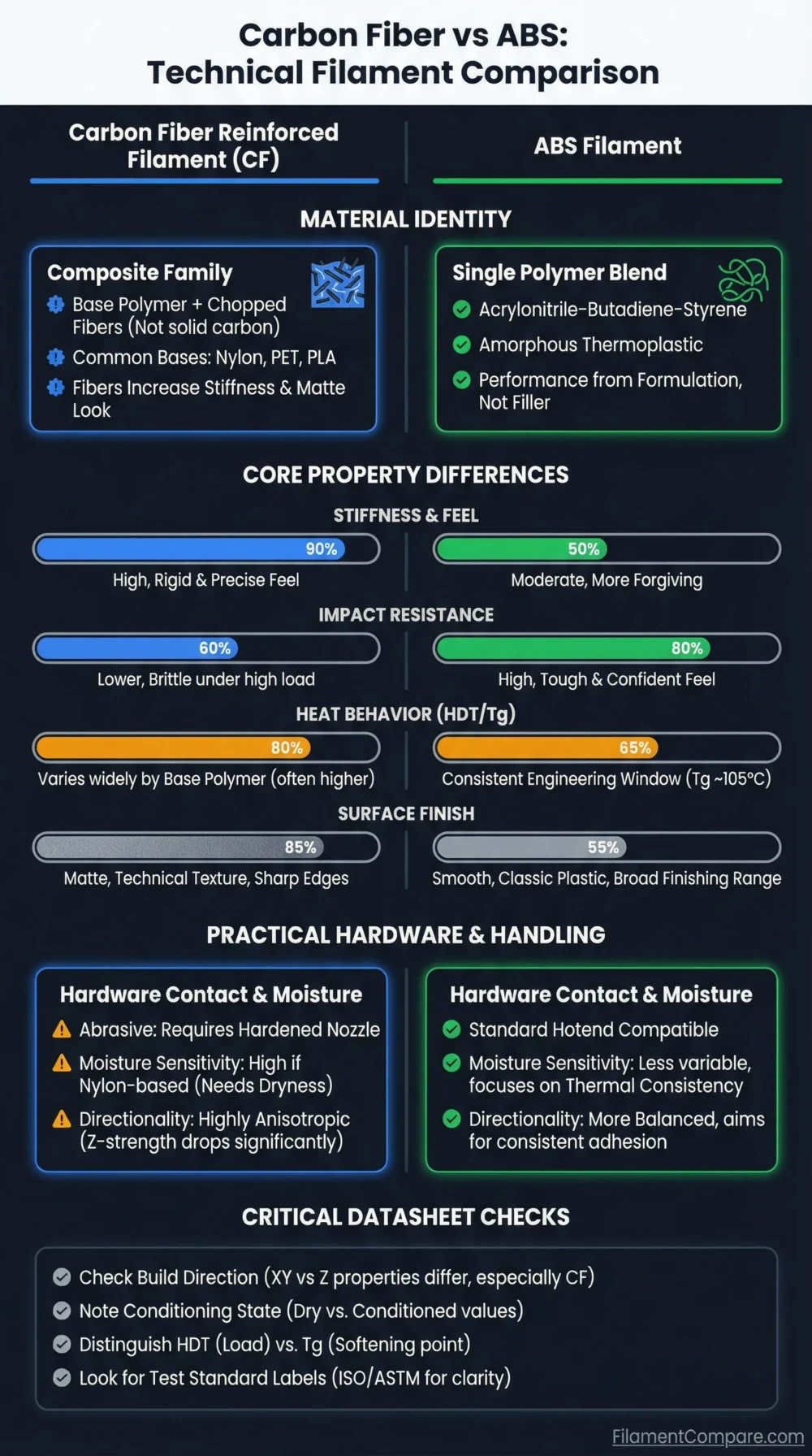
Carbon fiber reinforced filament is usually stiffer and more dimensionally stable, while ABS is a tougher, more forgiving engineering plastic for heat-resistant functional parts. The tricky part is that “carbon fiber filament” is not one material: it can be PLA-CF, PETG-CF, PA-CF, PC-CF, ABS-CF, or another polymer filled with chopped carbon fiber. For most FDM users, the choice is between rigid, low-warp composite parts and tougher ABS parts that can handle sanding, bonding, and acetone smoothing.
Choose carbon fiber reinforced filament when stiffness, matte surface finish, lower shrinkage, and dimensional stability matter more than impact absorption. Choose ABS when you need a durable general-purpose engineering plastic with better ductility, easier post-processing, and lower nozzle wear. There is no single overall winner because carbon fiber performance depends heavily on the base polymer.
Better for Stiff Parts
Carbon Fiber
Chopped fibers raise stiffness and help parts resist bending under moderate load.
Better for Impact Absorption
ABS
Standard ABS usually keeps more ductility than fiber-filled composites.
Better Dimensional Stability
Carbon Fiber
Fiber-filled grades often shrink and warp less than their unfilled base polymer.
Better Post-Processing
ABS
ABS can be sanded, bonded, and acetone-smoothed more predictably than most CF blends.
Better Nozzle Wear Control
ABS
Standard ABS is non-abrasive; carbon fiber blends normally need a hardened nozzle.
Better Matte Finish
Carbon Fiber
CF-filled filaments often hide layer lines and produce a dry, technical-looking surface.
Better Budget Engineering Material
ABS
ABS is widely available, usually cheaper, and does not require abrasive-material hardware.
Better for Light Fixtures and Jigs
Carbon Fiber
When the base polymer is suitable, CF blends can make stiff tooling with less flex.
| Property | Carbon Fiber Reinforced Filament | ABS | Better Choice |
|---|---|---|---|
| Material Family | Composite filament: chopped carbon fiber inside PLA, PETG, PA, PC, ABS, or another polymer | Acrylonitrile butadiene styrene thermoplastic | Depends on base polymer |
| Print Difficulty | Medium to advanced; drying, hardened nozzle, and larger nozzle diameter may be needed | Intermediate; enclosure and temperature control are strongly recommended | Use-case based |
| Typical Nozzle Temperature | Often about 240–285°C, depending on the base polymer[a] | Prusa lists 255°C as a recommended ABS nozzle temperature[b] | Similar range |
| Typical Bed Temperature | Often about 70–110°C, depending on the base polymer[c] | Usually around 80–110°C; 100°C is a common ABS target | Similar range |
| Enclosure Requirement | Depends on matrix: PLA-CF may not need one, while PA-CF, PC-CF, and ABS-CF often benefit from one | Usually needed for larger or functional parts to control warping | Depends on CF grade |
| Heat Resistance | Varies widely; PA-CF, PC-CF, PPS-CF, and high-temp CF grades can exceed ABS, while PLA-CF may not | Good for many functional parts, but not a high-temperature polymer | CF only if base polymer supports it |
| Toughness | Often lower impact toughness than the same unfilled polymer | Good ductility and impact behavior for printed functional parts | ABS |
| Stiffness | Usually higher than the unfilled base polymer | Moderate stiffness with more flex before failure | Carbon Fiber |
| Layer Adhesion | Can be reduced by fiber content and print orientation | Can be strong when printed hot and enclosed, but warping must be controlled | Print-settings dependent |
| Moisture Sensitivity | Grade-dependent; PA-CF is highly drying-sensitive, PETG-CF and PLA-CF vary by brand | Moderate; drying can improve consistency but ABS is usually less sensitive than nylon blends | ABS for easier storage |
| Nozzle Wear | Abrasive; hardened steel, hardened nickel-plated, ruby, or similar nozzle is recommended[d] | Low abrasion with standard brass nozzles | ABS |
| Surface Finish | Matte, technical, often hides layer lines | Satin to glossy depending on grade; can be acetone-smoothed | Different finish goals |
| Outdoor Suitability | Depends on base polymer; PA-CF and PETG-CF may do better than PLA-CF, but UV-stabilized grades are safer | Less suitable for long UV exposure than ASA; can yellow or become more brittle outdoors | Use ASA or UV-rated grades for outdoor use |
| Typical Uses | Rigid brackets, fixtures, drones, mounts, tooling, dry matte parts, dimension-sensitive pieces | Housings, brackets, automotive-like prototypes, enclosures, parts needing sanding or acetone smoothing | Use-case based |
| Main Limitation | Abrasive, more brittle, base polymer matters, can clog small nozzles | Warping, odor, ventilation need, weaker UV fit than ASA | Different limits |
This Carbon Fiber vs ABS comparison uses manufacturer material guidance, technical data sheet context, and common FDM printing behavior; real results change with brand, fiber loading, matrix polymer, color, moisture, nozzle type, part orientation, and slicer settings.
Carbon Fiber Reinforced Filament Profile
- Polymer type: Chopped carbon fiber blended into PLA, PETG, PA, PC, ABS, PPS, PPA, or other polymers
- Print difficulty: Medium to expert, depending on base polymer
- Nozzle range: Usually higher than the unfilled version of the same polymer
- Bed range: Matrix-dependent; PLA-CF is easier, PA-CF and PC-CF need more heat control
- Enclosure: Optional for some easy CF blends, useful or required for higher-temperature grades
- Drying need: Important for nylon-based CF; still useful for many CF blends
- Typical behavior: Stiff, matte, dimensionally stable, abrasive, less ductile
- Best use cases: Fixtures, mounts, drone parts, rigid tooling, brackets, visual engineering prototypes
ABS Material Profile
- Polymer type: Acrylonitrile butadiene styrene
- Print difficulty: Intermediate
- Nozzle range: Commonly around 240–260°C, with brand tuning
- Bed range: Commonly around 90–110°C for reliable adhesion
- Enclosure: Strongly recommended, especially for large or flat parts
- Drying need: Useful when spool quality drops, but usually less demanding than PA-CF
- Typical behavior: Tough, heat-tolerant, shrink-prone, odor-producing, post-processable
- Best use cases: Housings, brackets, covers, functional prototypes, acetone-smoothed parts
These bars are relative FDM-use indicators, not fixed laboratory ratings. A PLA-CF spool, a PA-CF spool, and a PC-CF spool can behave very differently, and ABS results also shift with brand, additives, print orientation, chamber temperature, moisture, and slicer setup.
Carbon Fiber Is a Composite Category, Not One Filament
The biggest decision trap is treating carbon fiber filament as one fixed material. In FDM, the carbon fiber is usually a short chopped reinforcement mixed into a thermoplastic matrix. That matrix decides most of the heat resistance, bed temperature, chamber need, chemical behavior, and moisture sensitivity.
PLA-CF can print much more easily than ABS but may soften earlier in warm service. PETG-CF can be a practical middle ground with good stiffness and easier printing than nylon. PA-CF is stronger in many engineering use cases, but it needs drying and tuning. PC-CF and PPS-CF can move into higher-temperature territory, but they are not beginner materials.
Important distinction: Carbon fiber does not automatically make a filament stronger in every way. It often improves stiffness, dimensional stability, and surface finish, but it may reduce impact toughness and layer-to-layer bonding compared with the same unfilled polymer.
Mechanical Behavior: Stiffness vs Toughness
Carbon fiber reinforced filaments are usually chosen for stiffness. A bracket printed from PA-CF or PETG-CF often flexes less than the same shape printed from standard ABS. This helps with jigs, fixtures, mounts, and parts where bending changes alignment.
ABS has a different strength profile. It is not as rigid as many CF blends, but it can absorb more movement before failure. That makes ABS useful for covers, housings, clips with mild flex, protective shells, and parts that may see bumps rather than steady bending load.
Where Carbon Fiber Feels Stronger
- Parts that must stay flat or straight
- Thin brackets where flex is the main issue
- Tooling that benefits from low deflection
- Lightweight parts where a rigid feel matters
Where ABS Feels More Forgiving
- Impact-prone covers and housings
- Parts that need sanding or solvent smoothing
- Moderate snap-fit features with tuned geometry
- Functional parts where ductility matters more than stiffness
Printability and Hardware Requirements
ABS needs heat management. Without a warm, stable print environment, corners can lift, tall parts can crack, and flat pieces can shrink after cooling. An enclosure is one of the most useful ABS upgrades because it reduces drafts and temperature swings.
Carbon fiber filament needs hardware awareness. The fiber is abrasive, so a brass nozzle can wear faster and produce oversized extrusion paths. A hardened nozzle is the normal choice. Many users also move to a 0.6 mm nozzle for CF blends because small nozzles are more clog-sensitive.
Nozzle
ABS prints well with a standard brass nozzle. Carbon fiber blends usually need hardened steel, hardened plated, ruby, tungsten carbide, or another abrasion-resistant nozzle.
Chamber
ABS benefits from an enclosure. CF blends vary: PLA-CF may be open-frame friendly, while PA-CF, PC-CF, and ABS-CF need more thermal control.
Drying
ABS can improve after drying, but nylon-based CF blends are far more sensitive. Wet PA-CF may string, pop, weaken, or produce rough surfaces.
Heat Resistance and Shape Retention
ABS has useful heat resistance for many functional prints, but it is not a high-temperature engineering polymer. It is more suitable than PLA for moderately warm environments, yet hot enclosed spaces can still exceed the comfort range of some ABS prints (especially thin, loaded, or dark-colored parts).
Carbon fiber does not create heat resistance by itself. A PLA-CF part still follows much of PLA’s temperature behavior. A PA-CF, PC-CF, PPA-CF, or PPS-CF part can be far more suitable for heat, but those materials also demand stronger printers, better drying, and more careful print profiles.
Practical rule: Compare the base polymer first, then consider the carbon fiber reinforcement. “CF” tells you about stiffness and abrasion; the matrix tells you much of the heat behavior.
Surface Finish, Detail, and Post-Processing
CF-filled filaments often produce a clean matte finish. The surface can hide small layer lines, minor ringing, and tiny texture differences. This is one reason carbon fiber blends are popular for visible mechanical prototypes, drone parts, camera mounts, and product mockups.
ABS gives more post-processing options. It can be sanded, glued, drilled, and acetone-smoothed. Acetone smoothing can reduce visible layer lines and create a glossier surface, but it can also soften edges and affect tolerances, so it is not always right for mechanical fits.
Nozzle Wear and Abrasive Additives
This is one of the clearest differences. Standard ABS is gentle on nozzles. Carbon fiber filament is abrasive. Over time, a worn nozzle can change line width, reduce detail, make dimensions drift, and cause inconsistent extrusion.
A hardened nozzle solves most of the wear issue, but it changes the printing workflow. Some hardened steel nozzles conduct heat differently than brass, so a small temperature adjustment may be needed. For CF blends, a clean filament path and suitable nozzle diameter matter more than with ABS.
| Use Case | More Suitable Material | Reason |
|---|---|---|
| Beginner functional prints | ABS only if enclosed; otherwise an easier CF blend such as PLA-CF may print more simply | ABS warps without chamber control, while easy CF grades still need abrasive-nozzle awareness |
| Rigid brackets | Carbon Fiber | Higher stiffness helps reduce bending and shape change |
| Impact-prone covers | ABS | ABS usually keeps more ductility than many chopped-fiber composites |
| Matte visible prototypes | Carbon Fiber | CF blends often hide layer lines and produce a technical-looking surface |
| Acetone-smoothed parts | ABS | ABS is one of the common FDM materials used for acetone vapor smoothing |
| Dimension-sensitive fixtures | Carbon Fiber | Lower shrinkage and better stiffness can help with repeatable fit |
| Large flat prints | Carbon Fiber, if the base polymer is suitable | Many CF blends warp less than unfilled polymers, while ABS needs chamber control |
| Low hardware cost | ABS | ABS does not require a hardened nozzle |
| Warm functional parts | Depends on CF matrix | PA-CF, PC-CF, PPA-CF, or PPS-CF can outperform ABS, while PLA-CF may not |
| Parts needing mild flexibility | ABS | Fiber-filled parts are often more rigid and less forgiving |
| Drone frames and lightweight mounts | Carbon Fiber | Stiffness-to-weight feel and matte finish are useful |
| Outdoor exposure | Neither as a default outdoor answer | Use ASA or UV-stabilized grades when long UV exposure is expected |
Where Each Material Fits Better
Choose Carbon Fiber Reinforced Filament When
- You need a stiffer part with less flex.
- You want a matte, low-layer-line surface.
- Dimensional stability matters more than impact absorption.
- You already have a hardened nozzle.
- The base polymer matches the heat and moisture needs of the part.
- You are printing fixtures, mounts, jigs, drone parts, or rigid prototypes.
Carbon Fiber Is Less Suitable When
- You only have a brass nozzle and do not want extra hardware wear.
- The part needs ductility or repeated flexing.
- You need strong layer bonding across thin vertical features.
- You are using a small nozzle that may clog with fiber-filled material.
- You are comparing CF without checking the base polymer first.
Choose ABS When
- You need a tough engineering plastic with useful heat resistance.
- You want sanding, bonding, drilling, or acetone smoothing options.
- Nozzle wear and material cost matter.
- You have an enclosed printer or can control drafts well.
- The part is a housing, cover, bracket, or functional prototype.
- You prefer ductility over maximum stiffness.
ABS Is Less Suitable When
- You print on an open-frame machine in a cool or drafty room.
- The part is large, flat, and tolerance-sensitive without chamber control.
- You need a naturally matte carbon-fiber-style surface.
- Ventilation is limited.
- Long outdoor UV exposure is expected.
Carbon Fiber Variant Notes
If you are comparing carbon fiber filament against ABS for a real part, narrow the material name before buying. “Carbon Fiber” on a spool label is not enough. A PLA-CF spool and a PA-CF spool can have different nozzle temperatures, bed temperatures, drying needs, enclosure behavior, and heat resistance.
For many users, PETG-CF vs ABS is the fair everyday comparison. PETG-CF is often easier to print with less warping and a stiffer finish, while ABS is better for post-processing and ductile functional parts. For higher performance work, PA-CF vs ABS becomes more interesting, but PA-CF demands a drybox mindset and a well-tuned printer.
Material Selection Matrix
Choose carbon fiber reinforced filament if your priority is stiffness, dimensional stability, low visual layer texture, and a technical matte finish. It is the better fit for rigid mounts, jigs, drone frames, fixtures, and parts where flex is the main problem.
Choose ABS if your priority is toughness, ductility, lower nozzle wear, easier post-processing, and a proven general-purpose engineering plastic. It is the better fit for housings, covers, brackets, prototypes, and parts that may be sanded or acetone-smoothed.
Use the base polymer as the deciding filter. A high-grade PA-CF or PC-CF can outperform ABS in stiffness and heat behavior, but PLA-CF should not be treated as a direct ABS replacement for warm functional parts.
Common Carbon Fiber and ABS Questions
Is carbon fiber filament stronger than ABS?
It depends on what “stronger” means. Carbon fiber blends are usually stiffer, so they bend less. ABS is often tougher and more ductile, so it may handle impact or slight deformation better.
Can carbon fiber filament replace ABS?
Sometimes, but not as a blanket replacement. PETG-CF, PA-CF, PC-CF, or ABS-CF may replace ABS for certain rigid parts. PLA-CF may not be suitable where ABS is chosen for heat resistance.
Does carbon fiber filament need an enclosure?
The base polymer decides that. PLA-CF and some PETG-CF grades may print on open printers. PA-CF, PC-CF, and ABS-CF usually benefit from a controlled chamber, especially for large or functional prints.
Does ABS need a hardened nozzle?
Standard ABS does not. A brass nozzle is normally fine. Hardened nozzles are mainly needed for abrasive blends such as carbon fiber, glass fiber, glow-filled, or metal-filled filaments.
Which material is better for car interior parts?
Neither should be selected by name alone. ABS is more heat-tolerant than PLA, but hot car interiors can be demanding. A suitable PA-CF, PC-CF, ASA, or other heat-rated grade may be safer depending on the load, color, thickness, and exposure.
Why do carbon fiber prints look cleaner?
The chopped fibers often create a matte texture that hides layer lines and small surface artifacts. This does not always mean the part is mechanically better; it is mainly a surface and stiffness advantage.
Resources Used
- [a] Composite materials (filled with carbon, kevlar or glass) | Prusa Knowledge Base — Used for composite filament behavior, typical carbon-filled printing temperature ranges, dimensional stability, nozzle abrasion, and layer adhesion cautions.
- [b] ABS | Prusa Knowledge Base — Used for ABS nozzle and bed guidance, enclosure need, warping behavior, acetone smoothing, UV limitation, and ventilation notes.
- [c] PET-CF / PPA-CF / PPS-CF / PA6 CF Carbon Fibers Filament Guide | Bambu Lab Wiki — Used as a manufacturer reference for carbon fiber filament families, higher-temperature CF materials, and the need to treat each CF matrix separately.
- [d] 3D Printing Technical Data Sheets & Safety Data Sheets | 3DXTech — Used for the technical-data context that printed-specimen results vary by grade, test method, printer, and print settings.
