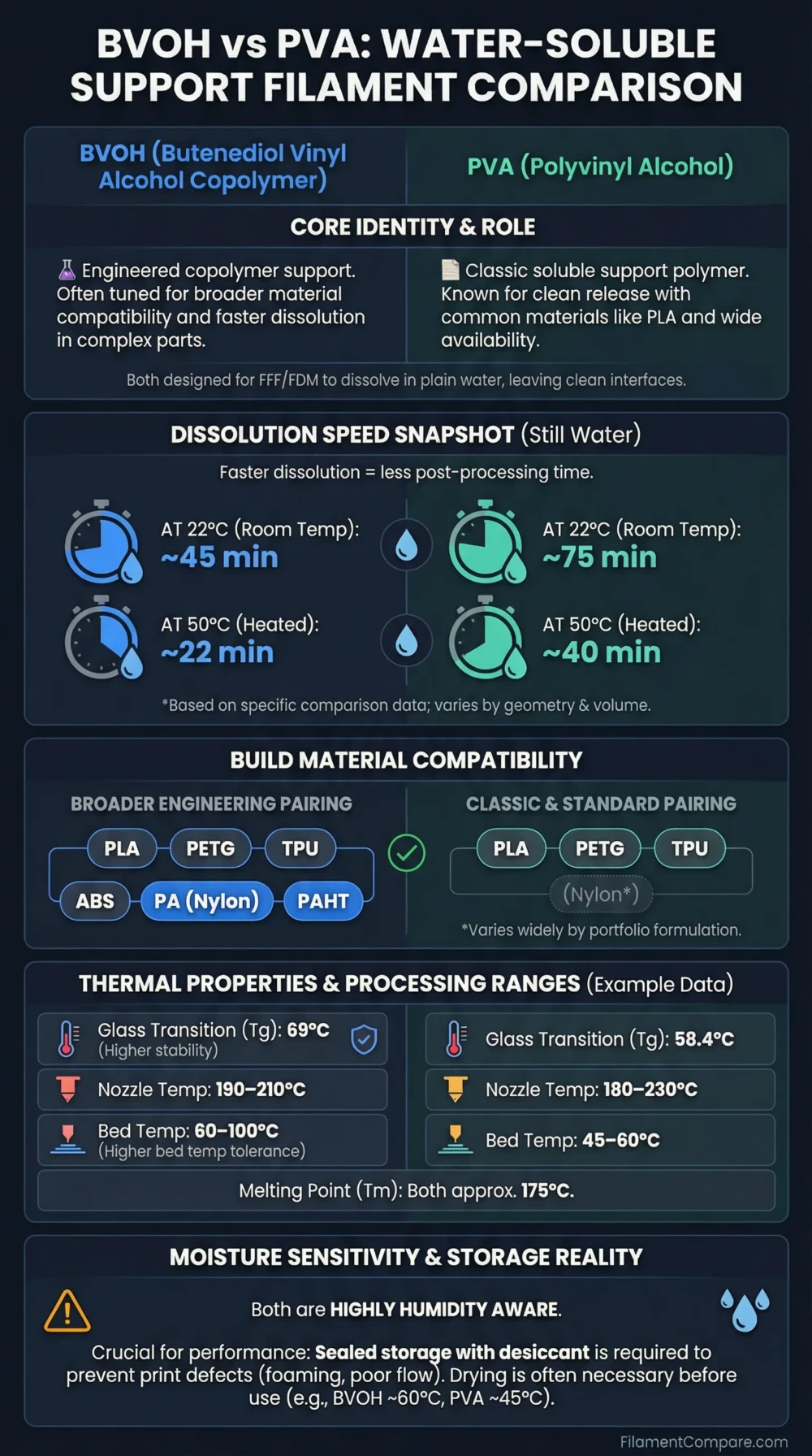
| Category | BVOH | PVA |
|---|---|---|
| Primary Role | Water-Soluble Support for FFF/FDM | Water-Soluble Support for FFF/FDM |
| Polymer Family | Butenediol Vinyl Alcohol Copolymer | Polyvinyl Alcohol |
| Dissolution Time Snapshot In Still Water | 45 min at 22°C 22 min at 50°C | 75 min at 22°C 40 min at 50°C |
| Glass Transition (Tg) | 69°C | 58.4°C |
| Melting Temperature (Tm) | 175°C | 175.4°C |
| Density / Specific Gravity | 1138 kg/m³ (≈ 1.138 g/cm³) | 1.23 g/cm³ |
| Flow Value (Standards-Based) | MVR 11.4 cm³/10 min (210°C, 2.16 kg) | MFR 17–21 g/10 min (190°C, 2.16 kg) |
| Example Nozzle Temperature Range | 190–210°C | 180–230°C |
| Example Bed Temperature Range | 60–100°C | 45–60°C |
| Example Print Speed Range | 30–60 mm/s | 20–50 mm/s |
| Example Drying Note (Published By Manufacturers) | 60°C for 4–16 h | 45°C for >10 h |
| Portfolio Compatibility Snapshot (Example Product Line) | PLA, Tough PLA, PET-G, TPU, ABS, PA, PAHT | PLA, Tough PLA, PET-G, TPU (often not listed for ABS/PA/PAHT in that snapshot) |
Where The Numbers Above Come From
BVOH processing ranges and material properties (like 190–210°C and Tg 69°C) are taken from a manufacturer technical data sheet for Ultrafuse BVOH.✅Source
- Where The Numbers Above Come From
- BVOH Profile Signals
- PVA Profile Signals
- Material Identity and Core Behavior
- Water Solubility and Dissolution Speed
- Compatibility with Common Build Materials
- Thermal Window and Flow Behavior
- BVOH Processing Range (Example)
- PVA Processing Range (Example)
- Moisture Response and Storage Reality
- What You Notice in Finished Parts
- Comparison Points People Use Most
- Term Meanings Used In Specs
Note: support filaments are sold in multiple grades, so values can shift across brands and diameters even when the polymer name is the same.
PVA thermal and density values shown (Tg 58.4°C, Tm 175.4°C, 1.23 g/cm³) reflect a dedicated technical data sheet for Ultimaker PVA.✅Source
Those print-temperature rows are presented as example manufacturer ranges, not a universal rule for every spool.
PVA example printing ranges in the table (180–230°C, 45–60°C, 20–50 mm/s) are published in a manufacturer PVA technical data sheet (a practical reference for how one commercial PVA is specified).✅Source
Dissolution timing changes with geometry, water movement, and support volume. The table keeps the same water temperatures for both materials so the comparison stays apples-to-apples.
Dissolution time snapshots (22°C and 50°C) and the portfolio-style compatibility snapshot are based on a BCN3D comparison graphic for BVOH and PVA.✅Source
Polymer names can be confusing in daily 3D printing talk. The chemistry name matters because it explains why two “water-soluble” supports can still behave differently.
Polyvinyl Alcohol is also listed as ethenol, homopolymer with CAS 9002-89-5 in the NIST Chemistry WebBook, which helps keep the naming consistent across suppliers and documents.✅Source
BVOH and PVA are both built for the same job: water-soluble support structures that disappear after printing, leaving the main part clean. The difference shows up in how fast they dissolve, which build materials they pair with, and the temperature window they like.
BVOH Profile Signals
- Copolymer Support
- Fast Dissolution
- Complex Cavities
- Broad Pairing
- Dry Storage
PVA Profile Signals
- Classic Soluble Support
- Clean Release
- Dual Extrusion
- Widely Available
- Humidity Aware
Material Identity and Core Behavior
BVOH is typically described as a vinyl-alcohol-based copolymer tuned for FFF support printing. That “copolymer” detail matters: it’s one reason BVOH is often positioned for a wider pairing range across different build materials.
PVA is polyvinyl alcohol, a polymer family used well beyond 3D printing. In the 3D printing context, PVA is valued because it forms support interfaces that can be removed in plain water without aggressive chemicals.
Water Solubility and Dissolution Speed
Both materials dissolve in water, yet the time curve can feel different. With the same water temperatures, one comparison snapshot shows BVOH reaching dissolution in 45 minutes at 22°C, while PVA shows 75 minutes; at 50°C, the same snapshot shows 22 minutes for BVOH and 40 minutes for PVA.
What this kind of timing table captures: the impact of water temperature on soluble supports. What it does not capture: how much support volume or trapped water a specific model creates.
Relative Indicators (visual guide, not a lab scale)
Compatibility with Common Build Materials
Compatibility is not just “does it stick.” It also includes thermal overlap, interface strength, and whether the support stays stable over long prints. In one portfolio-style snapshot, BVOH is shown alongside PLA, PET-G, and TPU, plus additional pairing options like ABS and PA that are not always listed for PVA in the same snapshot.
- BVOH is frequently positioned for broader pairings, especially when the build material list includes engineering polymers.
- PVA is commonly positioned for strong adhesion with PLA, PETG, and nylon-based build materials (portfolio dependent).
- Real-world pairing still depends on the exact spool formulation, nozzle geometry, and the slicer profile used for the support interface.
Thermal Window and Flow Behavior
Temperature numbers tell you how “forgiving” a support can feel when it sits hot in a nozzle for a while. In published data, BVOH shows Tg 69°C and Tm 175°C, while PVA shows Tg 58.4°C and Tm 175.4°C. Those values don’t replace print profiles, yet they do explain why both materials can share a similar melt region while still behaving differently as supports.
BVOH Processing Range (Example)
- Nozzle: 190–210°C
- Bed: 60–100°C
- Speed: 30–60 mm/s
- Drying Note: 60°C for 4–16 h
PVA Processing Range (Example)
- Nozzle: 180–230°C
- Bed: 45–60°C
- Speed: 20–50 mm/s
- Drying Note: 45°C for >10 h
Moisture Response and Storage Reality
Water-soluble polymers tend to be humidity aware, simply because the same chemistry that welcomes water during dissolution can interact with moisture in the air. For BVOH, datasheets often spell out sealed storage to limit moisture uptake. For PVA, some product sheets highlight improved handling by describing it as less moisture sensitive than other PVA formulations. If you want a deeper look at how humidity, storage conditions, and filament drying methods influence print reliability, see the Filament Storage, Drying & Equipment Guide.
Practical implication: moisture changes can show up as flow variability or support consistency. That is why many manufacturers publish drying notes for both BVOH and PVA.
What You Notice in Finished Parts
Support removal is the headline benefit: soluble supports can leave complex cavities, internal channels, and tight overhang zones free from manual breaking. In the BVOH vs PVA conversation, the user-facing differences usually land in removal time, how clean the interface looks, and how predictable the support remains during long prints.
Comparison Points People Use Most
- Dissolution speed in water at comparable temperatures.
- Material pairing breadth across the build-material portfolio.
- Thermal stability during extended support printing and standby time.
- Moisture response during storage and during printing sessions.
- Support-interface quality on fine surfaces, small gaps, and internal features.
Term Meanings Used In Specs
- Tg (Glass Transition)
- Where the polymer shifts from a glassy feel toward a more rubbery response. This influences how supports behave as the part sits warm.
- Tm (Melting Temperature)
- The melt-region reference point used in data sheets. It helps describe the thermal neighborhood a support filament is designed for.
- MFR and MVR (Flow Rates)
- Standardized flow measurements. MFR is mass-based (g/10 min), MVR is volume-based (cm³/10 min). Both are used to characterize how a polymer flows under defined conditions.
- Specific Gravity (Density Reference)
- A density expression used in many plastics data sheets. For filaments, it supports comparisons of spool length vs weight and material feel.

“I’m planning to start 3D‑printing anatomical vessels for synthetic organ fabrication, and I’m unsure whether to use PVA or BVOH. The main organ structure will be made from a PVA solution.”
best regards
Hi Marco,
That sounds like a really interesting project — especially printing vascular structures, which definitely requires a lot of precision.
If your main structure is going to be PVA-based, you’ll want to be a bit careful with the support material. Using the same material for both structure and support can sometimes lead to deformation during the dissolution step.
In this case, BVOH is usually the safer option.
It dissolves cleaner, leaves less residue, and generally performs better with fine details.
PVA can still work, but:
It’s quite sensitive to moisture
Dissolution can be a bit inconsistent
Surface quality isn’t always great on small features
So in your setup, I’d personally go with BVOH.
One small tip:
Water temperature and timing during dissolution can make a big difference.
Good luck — sounds like a very cool project 👍