Beverly Damon N.
Founder & Lead Editorial Researcher at FilamentCompare
Beverly Damon N. is the founder and principal researcher of FilamentCompare, an independent informational platform dedicated to evaluating 3D-printing filaments and decoding complex material specifications. She established the site with a clear mission: to make manufacturer data, material terminology, printing requirements, and practical polymer differences transparent and accessible to all makers and engineers.
Her published work specializes in synthesizing dense technical data into highly structured, application-oriented comparisons for FDM and FFF users. Under her direction, FilamentCompare maintains strict editorial integrity, never presenting source-based comparisons as independent laboratory tests without explicit methodology and transparent documentation.
Editorial Role
Beverly directs the editorial strategy of FilamentCompare and engineers the technical frameworks used to evaluate filament types. Her primary responsibilities include analyzing primary source materials, standardizing comparison criteria, fact-checking technical findings, overseeing editorial disclosures, and ensuring scientific consistency across the database.
Her methodology is deeply research-oriented, focusing on translating peer-reviewed and manufacturer-published technical data into actionable engineering insights, while strictly defining the boundaries between data analysis and first-hand laboratory evaluation.
Areas of Expertise
- FDM and FFF material science and comparative analysis
- Thermoplastic profiling (PLA, PETG, ABS, ASA, Nylon, Polycarbonate)
- Carbon-fiber and glass-fiber composite filament properties
- Engineering-grade, flexible, soluble, and high-temperature polymers
- Mechanical and thermal specification interpretation
- Advanced moisture mitigation, hygroscopic storage, and desiccant systems
- Application-specific material selection and print optimization
Research Methodology
Analyses attributed to Beverly are systematically derived from manufacturer technical data sheets (TDS), safety data sheets (SDS), published ISO/ASTM standards, academic literature, and official hardware guidance.
The research workflow initiates by strictly defining the polymer blends and grades under review. Material specifications are then contextualized against their specific test methodologies and environmental conditions. Values obtained from injection-molded samples versus 3D-printed samples, or conditioned versus dry states, are meticulously separated to prevent false equivalencies.
When technical data is proprietary, incomplete, or lacks standardized testing parameters, Beverly prioritizes analytical transparency, explaining the limitations rather than extrapolating unsupported numerical conclusions.
Source Hierarchy & Standards
FilamentCompare applies a rigorous hierarchy to technical sourcing:
- Verified manufacturer Technical Data Sheets (TDS) and engineering documentation
- Published ISO and ASTM testing methodology standards
- Peer-reviewed materials science research and established academic texts
- OEM printer specifications and documented handling protocols
- Vetted third-party technical evaluations (utilized exclusively for context when primary data is restricted)
Marketing copy, basic product listings, and unsourced performance claims are strictly excluded from numerical comparison datasets.
Specification Evaluation
Material metrics are never evaluated in a vacuum. Tensile strength, Young’s modulus, impact resistance, elongation at break, heat-deflection temperature (HDT), and glass-transition temperature (Tg) fluctuate significantly based on exact material formulation and laboratory conditions.
Beverly ensures that one manufacturer’s specific value is never presented as a universal standard for an entire polymer family. All conclusions are scientifically framed around documented grade variances, specific hardware requirements, and practical end-use applications.
Original Testing and Evidence Limits
FilamentCompare maintains a clear distinction between source-based editorial research, practical product evaluation, and controlled laboratory testing. An article is only classified as an independent laboratory test when original, standardized testing was explicitly conducted, detailing the hardware, environmental controls, and exact evaluation methodology.
Published research should inform, not replace, formal engineering certification or application-specific safety testing. Readers are advised to verify critical specifications directly with manufacturers and conduct localized validation printing based on their specific hardware and geometric requirements.
Professional Development & Certifications
To ensure rigorous technical analysis and maintain industry standards, Beverly continuously updates her expertise through specialized professional development in additive manufacturing, materials science, technical communication, and digital publishing.
Advanced 3D Printing Mechanics: FDM and Resin
Institution: Udemy
Advanced training covering FDM and SLA resin-printing parameters, material optimization, advanced slicing algorithms, and industrial hardware workflows.
Practical Engineering for FDM 3D Printing
Institution: Udemy
Comprehensive coursework focusing on desktop FDM calibration, advanced G-code preparation, precision tolerance tuning, and finished part evaluation.
Fused Deposition Modeling: Applied Principles
Institution: Udemy
Specialized study on the thermomechanical operating principles of extrusion-based printing, layer adhesion dynamics, and material behavioral responses.
Technical Writing & Communication
Institution: Coursera
Advanced study in document architecture, precise data interpretation, and methodologies for presenting highly specialized engineering information with absolute clarity.
Writing Effective Technical Documentation
Institution: Coursera
Professional training in planning, structuring, and auditing technical datasheets and manuals, ensuring compliance with industry comprehension standards.
Content Management & Digital Infrastructure
Provider: Learn WordPress — WordPress.org
Technical training in website architecture, content management systems (CMS), and ensuring the seamless delivery of multimedia editorial content.
Digital Information Evaluation & Research
Provider: The Open University
Coursework focused on advanced research methodologies, evaluating digital source credibility, and synthesizing complex technical data sets.
Digital Accessibility & WCAG Compliance
Institution: FutureLearn
Certification in web accessibility principles, ensuring that complex data tables, charts, and technical comparisons are universally readable and compliant.
Editorial Strategy & Content Marketing
Provider: HubSpot Academy
Certification in editorial calendar planning, audience technical needs assessment, and data-driven publishing strategies.
Advanced Copyediting & Technical Proofing
Institution: Alison
Professional development in technical editing, maintaining strict stylistic consistency, and maximizing the readability of dense material specifications.
Editorial Independence
Manufacturers, retailers, advertisers, and affiliate partners are strictly prohibited from purchasing preferred results, altering editorial conclusions, or pre-approving independent comparisons prior to publication.
Supplied test materials, sponsorships, affiliate relationships, and other commercial connections are transparently disclosed on all applicable pages.
Corrections & Updates
Database entries and published guides are continually reviewed as manufacturers revise product lines, update datasheets, or release new material handling standards. Confirmed factual inaccuracies are swiftly corrected, and structural methodology revisions are logged publicly.
Engineers, readers, and manufacturers are encouraged to submit verifiable technical documentation for review. Amendments are integrated strictly upon evidence verification.
Contact & Public Profiles
Technical inquiries, correction requests, and supporting datasheet submissions can be directed through the following official channels:
- Email: support@filamentcompare.com
- Website: FilamentCompare
- LinkedIn: Damon N. Beverly on LinkedIn
- Facebook: Damon N. Beverly on Facebook
- X: @damonmbeverly
Latest Published Analysis
Review the latest material comparisons, engineering guides, and technical explainers authored by Beverly Damon N.
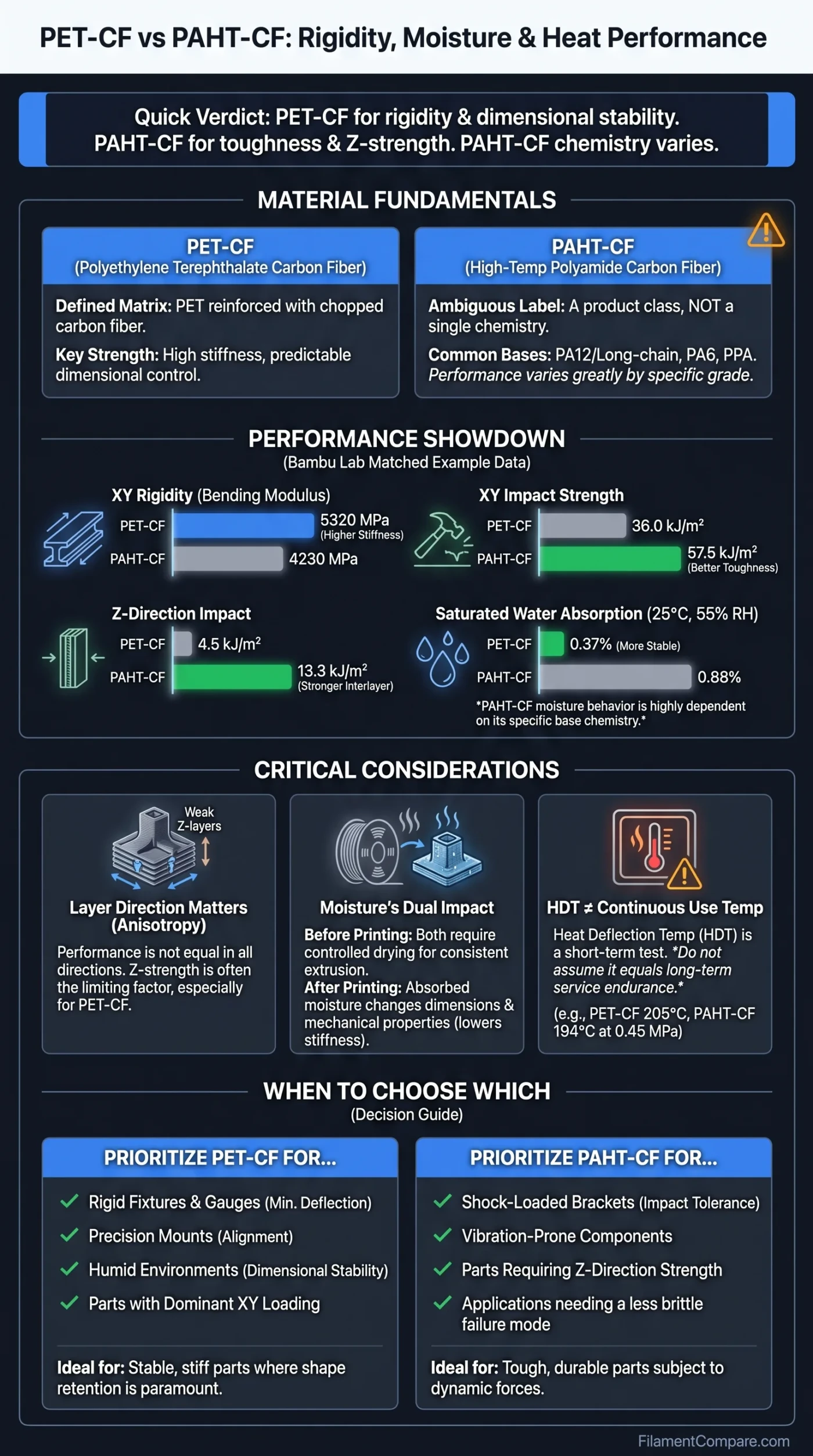
PET-CF vs PAHT-CF: Rigidity, Moisture and Heat Performance
PET-CF generally favors higher rigidity, lower moisture uptake and tighter dimensional control, while PAHT-CF can trade some stiffness for better impact behavior and stronger…
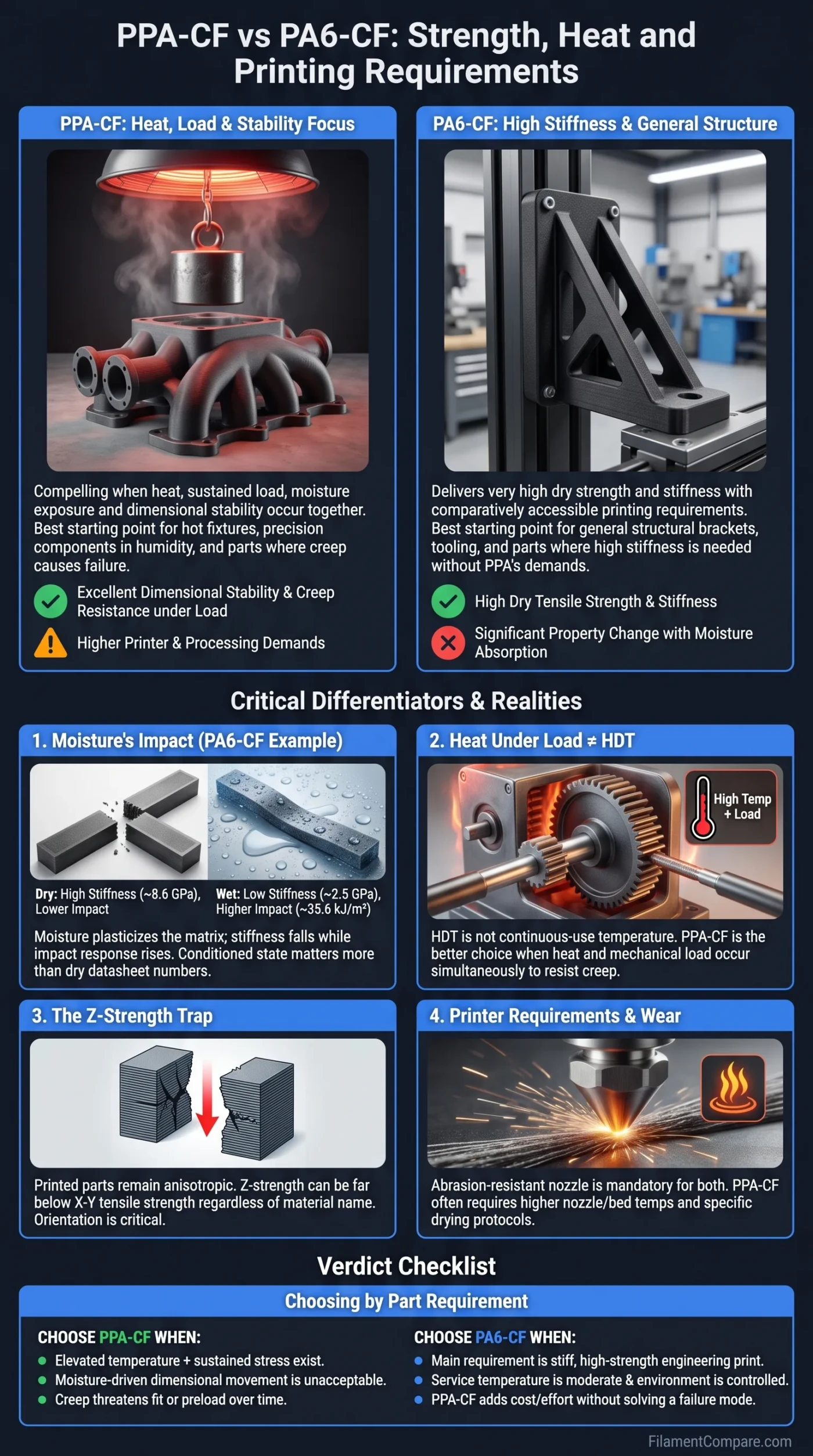
PPA-CF vs PA6-CF: Strength, Heat and Printing Requirements
PPA-CF and PA6-CF can both produce stiff, load-bearing printed parts, but they solve different engineering problems. PA6-CF can deliver very high dry strength and…
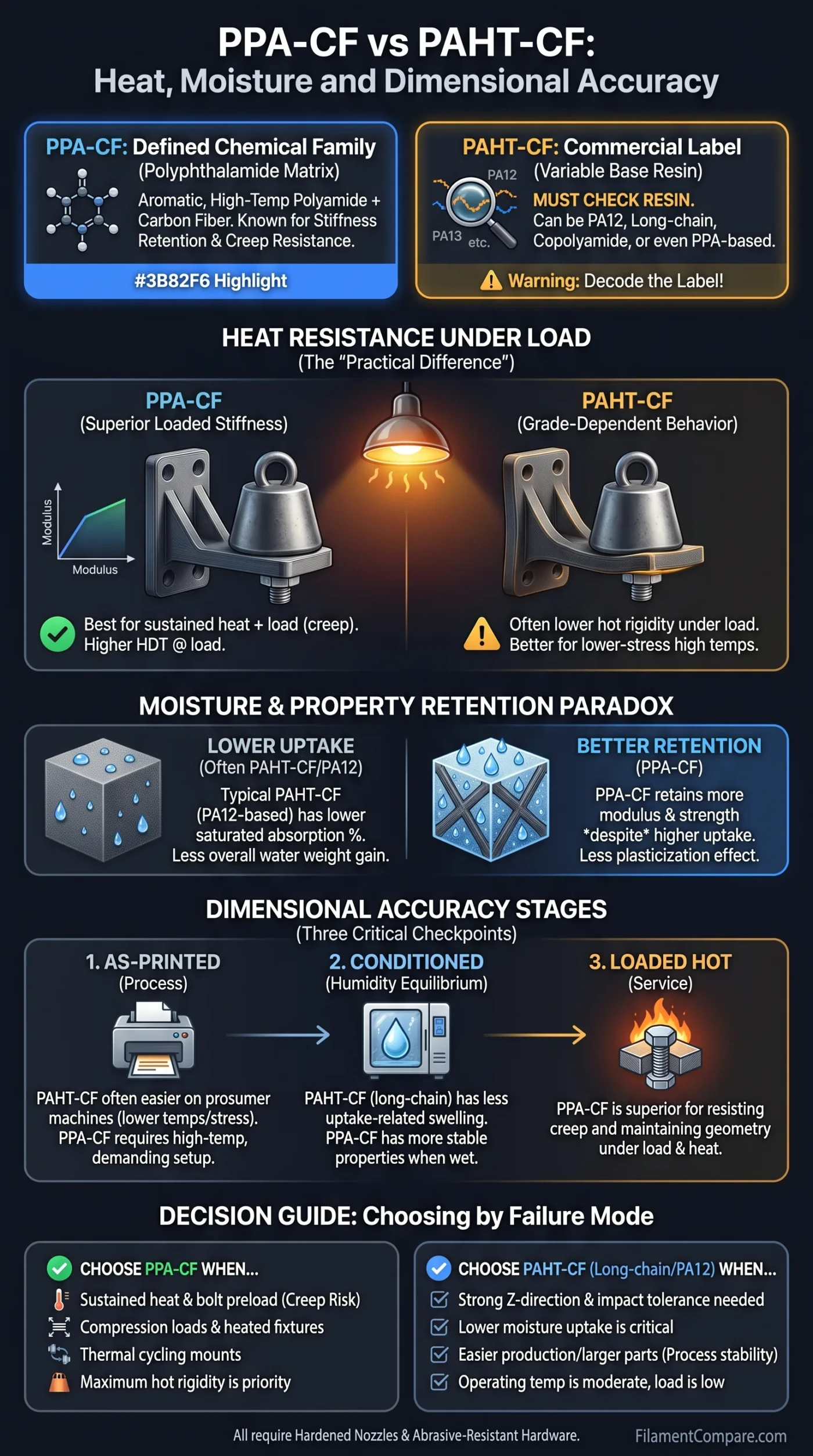
PPA-CF vs PAHT-CF: Heat, Moisture and Dimensional Accuracy
PPA-CF is usually chosen when a printed part must retain stiffness and geometry under sustained heat, while PAHT-CF often offers a more accessible balance…
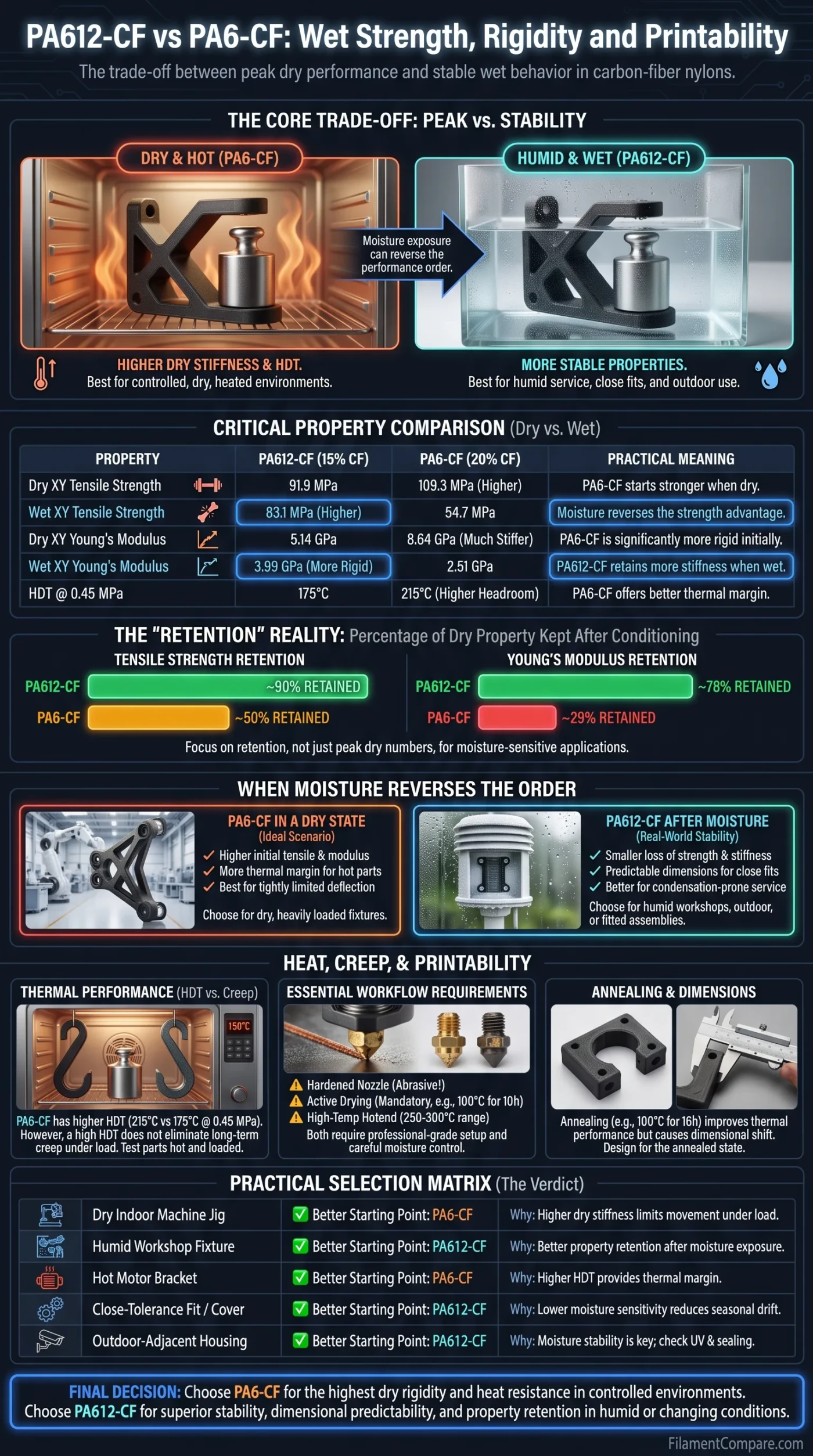
PA612-CF vs PA6-CF: Wet Strength, Rigidity and Printability
PA6-CF commonly delivers higher dry stiffness, tensile strength, and heat-deflection performance, while PA612-CF gives up some of that peak performance to keep its properties…
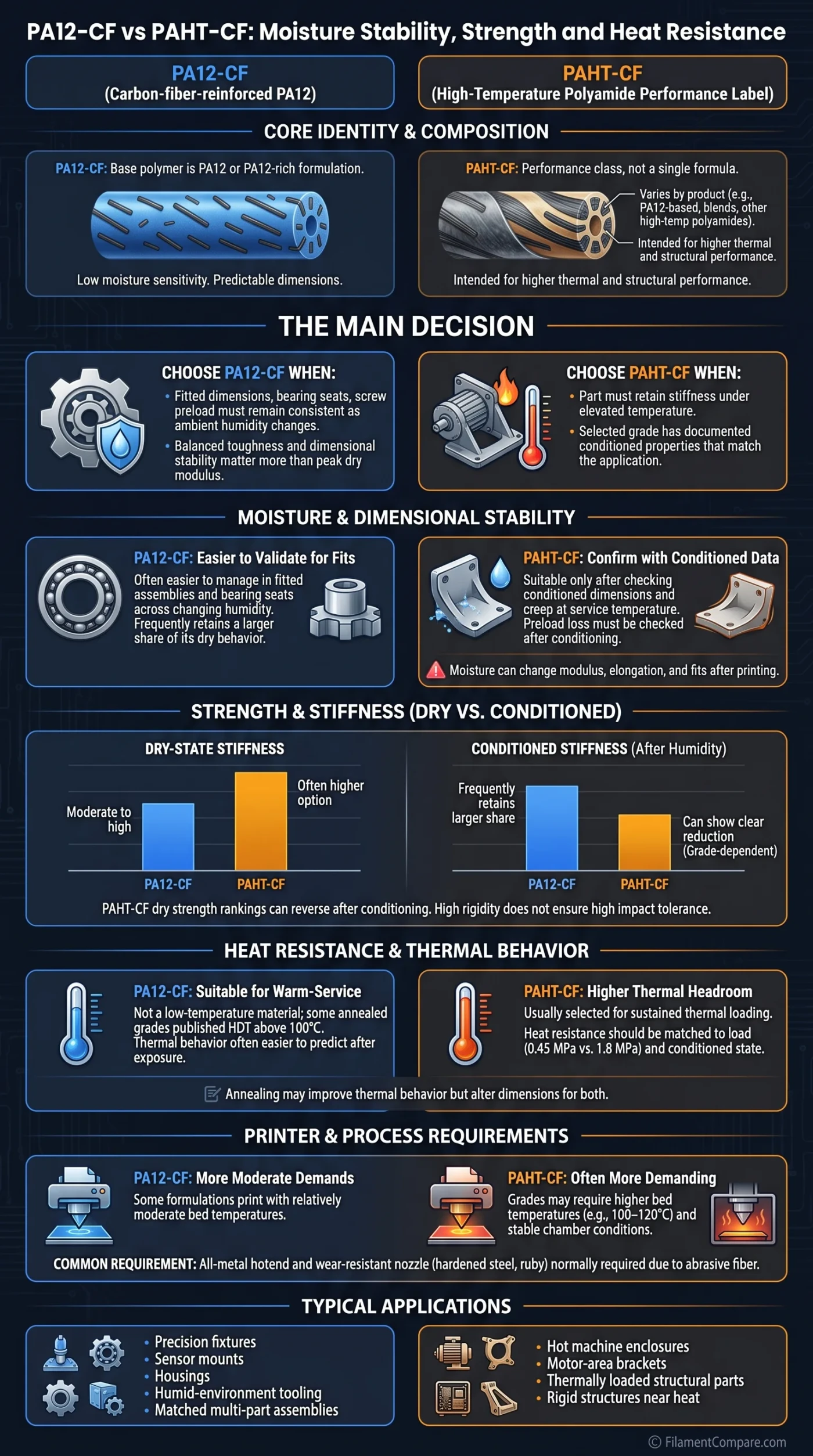
PA12-CF vs PAHT-CF: Moisture Stability, Strength and Heat Resistance
PA12-CF is usually chosen for low moisture sensitivity and predictable dimensions, while PAHT-CF is sold around higher thermal and structural performance. The difficult part…
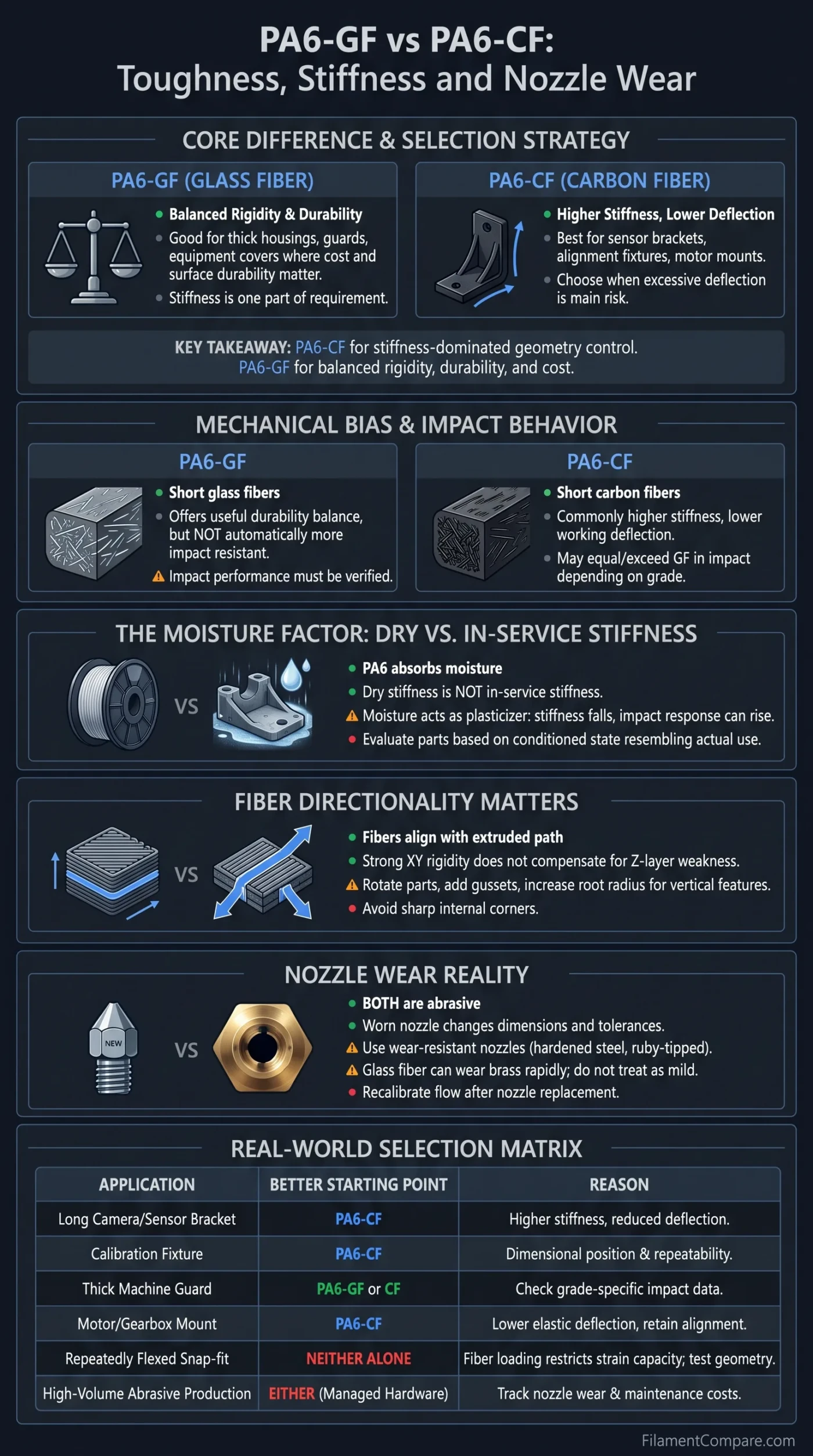
PA6-GF vs PA6-CF: Toughness, Stiffness and Nozzle Wear
PA6-CF is normally the better starting point when a printed part must resist bending, while PA6-GF can make more sense when the design needs…
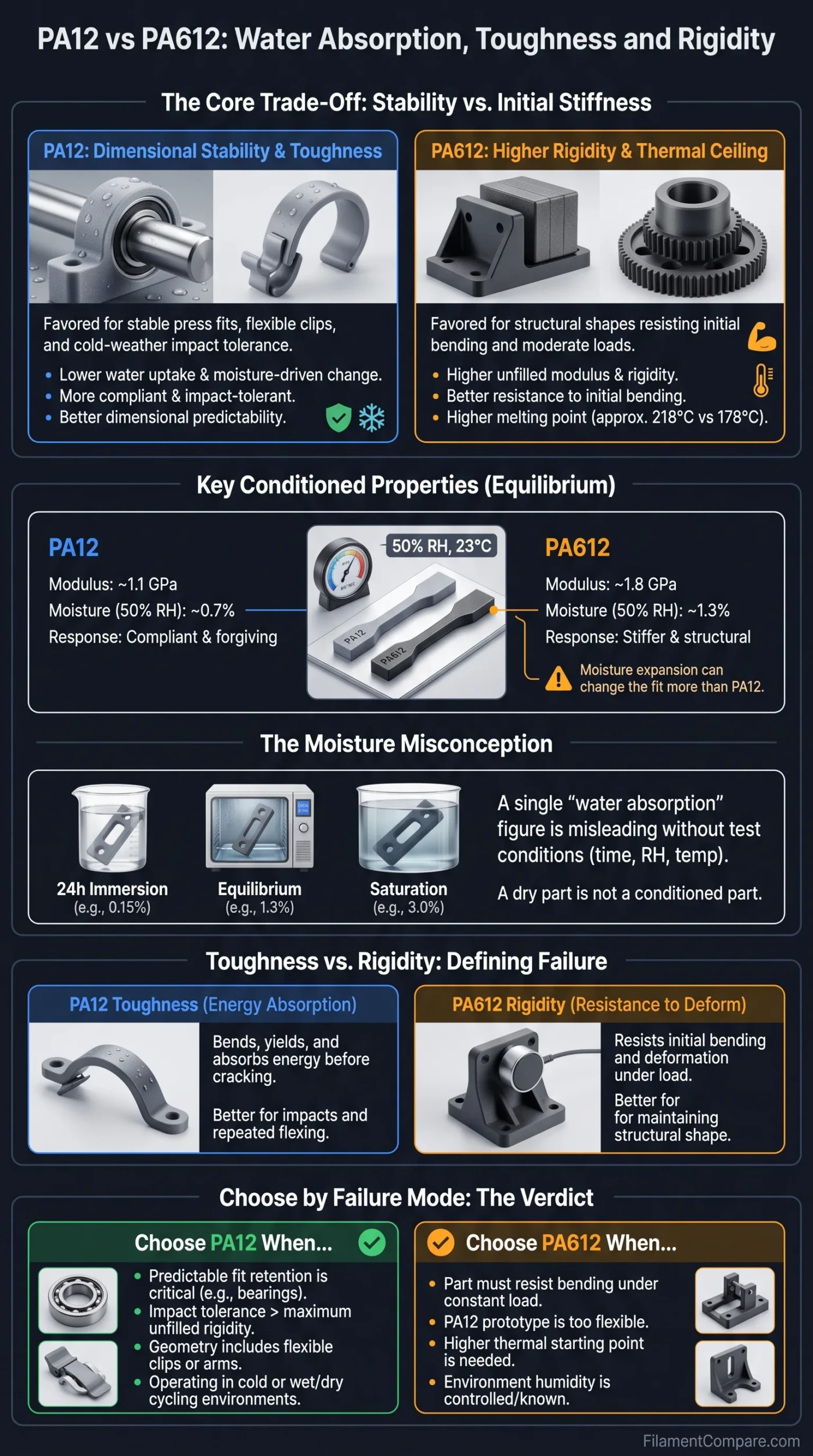
PA12 vs PA612: Water Absorption, Toughness and Rigidity
PA12 usually provides the more stable behavior when moisture, dimensional movement, and low-temperature impact are the main concerns, while PA612 can offer a stiffer…

PA6 vs PA66: Heat Resistance, Strength and Moisture Absorption
PA66 provides a higher thermal ceiling than PA6, but that advantage does not automatically produce a stronger or more reliable printed part. PA6 can…

PA11 vs PA12: Impact Strength, Moisture and Dimensional Stability
PA11 usually offers the more forgiving impact response, while PA12 is generally easier to specify when a part must retain holes, clearances, and mating…

PA6 vs PA11: Moisture, Toughness and Print Difficulty
PA6 usually offers greater dry-state stiffness and load resistance, while PA11 gives up some rigidity for lower moisture sensitivity, higher ductility and more stable…