| Category | 3mm-Class Filament (often labeled “3mm”) | 1.75mm Filament |
|---|---|---|
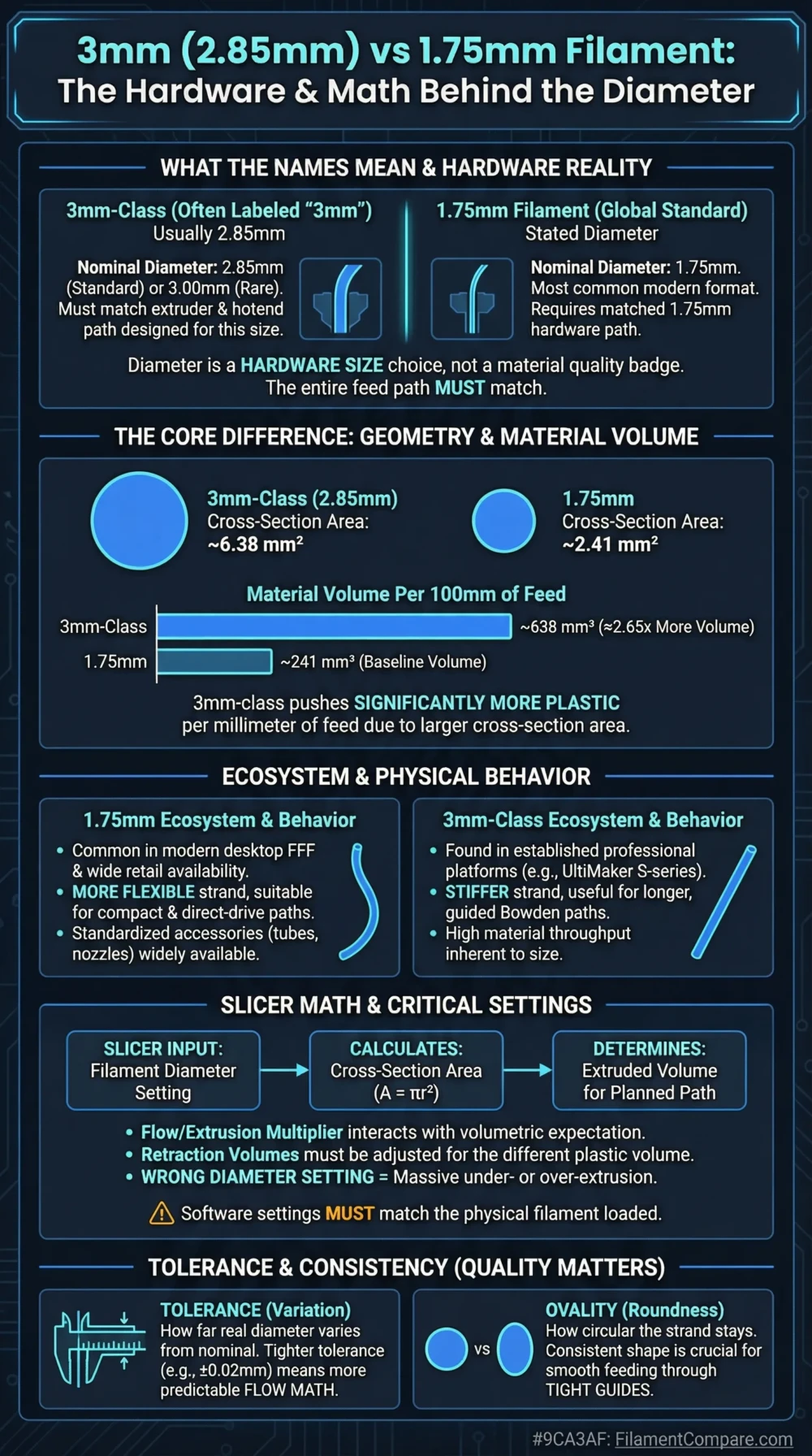
| What The Name Usually Means | 2.85mm is commonly sold as “3mm” in many ecosystems ✅Source | 1.75mm is the stated diameter and the most common global format |
| Cross-Section Area | 6.38 mm² (2.85mm) to 7.07 mm² (3.00mm) | 2.41 mm² |
| Material Volume Per 100mm Of Feed | ~638 mm³ (2.85mm) to ~707 mm³ (3.00mm) | ~241 mm³ |
| Relative Material Volume | ~2.65× (2.85mm) to ~2.94× (3.00mm) vs 1.75mm | 1.00× baseline |
| What Must Match | Extruder feed path, guides, PTFE tube path, heatbreak path, and nozzle inlet are sized for 3mm-class | Extruder feed path, guides, PTFE tube path, heatbreak path, and nozzle inlet are sized for 1.75mm |
| Where You See It Most | Common in established 2.85mm ecosystems and some professional platforms | Common in most modern desktop FFF printers and wide retail availability |
Friendly clarity: when people say “3mm filament”, they usually mean 2.85mm. A true 3.00mm strand exists, but printer hardware is typically built around either 1.75mm or 2.85mm paths.
Filament diameter is a hardware-sized choice, not a “better vs worse” badge. 3mm-class and 1.75mm filament can be the same polymer (PLA, PETG, TPU, and more), but the extruder path and hotend path are designed around one size. That’s why diameter shows up everywhere: in mechanics, in flow math, and in slicer assumptions.
- 1.75mm is widely adopted
- 3mm-class is often 2.85mm
- Flow math changes a lot
- Feed path must match
- Slicer diameter matters
Material Volume Changes With Diameter
The big difference is simple geometry. The slicer’s extrusion math is tied to cross-section area. A thicker strand carries more plastic per millimeter of feed, so 3mm-class moves noticeably more material than 1.75mm for the same “E length” concept.
Area reference (A = πr²): 1.75mm is about 2.41 mm². 2.85mm is about 6.38 mm². That’s roughly 2.65× the area, so it naturally supports a higher material throughput per mm of filament feed.
Relative Material Per 1mm Of Filament Feed (visual)
- Same nozzle size can be used in both ecosystems (0.4mm, 0.6mm, etc.), but the internal filament path must match the diameter.
- Volumetric flow capacity depends on hotend heating and melt zone, while diameter mainly changes how much material arrives per mm of feed.
- Flow tuning feels different because the extruder is pushing a strand with a different area and response.
Compatibility Is Mostly Hardware, Not Material
Most materials exist in both 1.75mm filament and 3mm-class filament, but a printer is typically built around one diameter. For example, UltiMaker documentation notes that S-series machines are set up for 2.85mm materials ✅Source. That same “built-for-one-size” idea applies across the market.
1.75mm Ecosystem Details
- Compact feed paths are common, including many direct-drive layouts.
- Wide retail availability across brands, colors, and material families.
- Accessory compatibility (tubes, extruders, sensors) is widely standardized for this diameter.
3mm-Class Ecosystem Details
- Stiffer filament can help in longer guided paths.
- Higher material flow per feed comes from the larger cross-section.
- Some printer platforms are designed for 2.85mm filament paths.
Feeding Path Behavior and Flexibility
Diameter changes how filament behaves inside the feed path. A thicker strand tends to be more resistant to bending, while a thinner strand is naturally more flexible. Many modern extruders focus on a fully guided path to keep feeding consistent across different filament types and stiffness levels.
Bondtech’s QR extruder description highlights two practical ideas: it supports 1.75 and 2.85/3.00 formats, and it emphasizes a fully guided filament path with tight internal tolerances to maintain reliable feeding ✅Source. That design approach matters regardless of diameter.
Diameter Consistency, Ovality, and Tolerance
- Nominal Diameter
- The labeled size (1.75mm, 2.85mm) used by slicers, profiles, and hardware design.
- Tolerance
- How far the real strand can vary around the nominal size. Lower variation usually means more predictable flow math.
- Roundness / Ovality
- How “circular” the filament stays. A more consistent shape supports smoother feeding through tight guides.
Manufacturers publish different spec styles. As one concrete example, an UltiMaker PLA technical data sheet lists filament diameter as 2.85 ± 0.10 mm and a maximum roundness deviation of 0.10 mm ✅Source. Specs like this tell you what the ecosystem is engineered to accept.
Some brands go further with process measurement. Prusament describes 2-axis laser diameter measuring at a high sampling rate and states a tighter tolerance target (commonly ±0.02 mm for many materials) compared with an often-cited ±0.05 mm “industry standard” reference ✅Source. This kind of measurement focus is relevant to both 3mm-class and 1.75mm formats.
Slicer, Firmware, and What the Numbers Affect
Even when two spools are the same material, diameter changes the math behind extrusion. The slicer typically converts a planned bead of plastic into an “amount of filament” based on the diameter field. That’s why the same model can look different if the slicer is told 2.85/3mm while the printer is physically loaded with 1.75mm, or vice versa.
- Filament Diameter Field: used to compute extruded volume from planned line width and layer height.
- Flow / Extrusion Multiplier: a fine control that interacts with volumetric expectation for the chosen diameter.
- Retraction Volumes: the same retraction distance corresponds to different plastic volume with different diameters.
- Pressure Behavior: melt zone + path friction + filament stiffness shape how responsive the system feels at a given flow rate.
Stock, Spools, and Day-to-Day Handling
Availability is mostly an ecosystem story. 1.75mm filament tends to show up in the broadest range of brands and storefronts, while 3mm-class filament is strongly represented in platforms designed around 2.85mm. Both formats exist across many polymers, and both can deliver clean results when the hardware path and slicer settings match. Day-to-day reliability also depends on how filament is stored and kept dry; practical humidity control and drying workflows are explained in this filament storage and drying overview.
A simple compatibility truth: the diameter choice is tied to mechanical dimensions (guides, tubes, heatbreak path) and software expectations (filament diameter field). When those two align, both 1.75mm and 3mm-class can feel straightforward and consistent.
