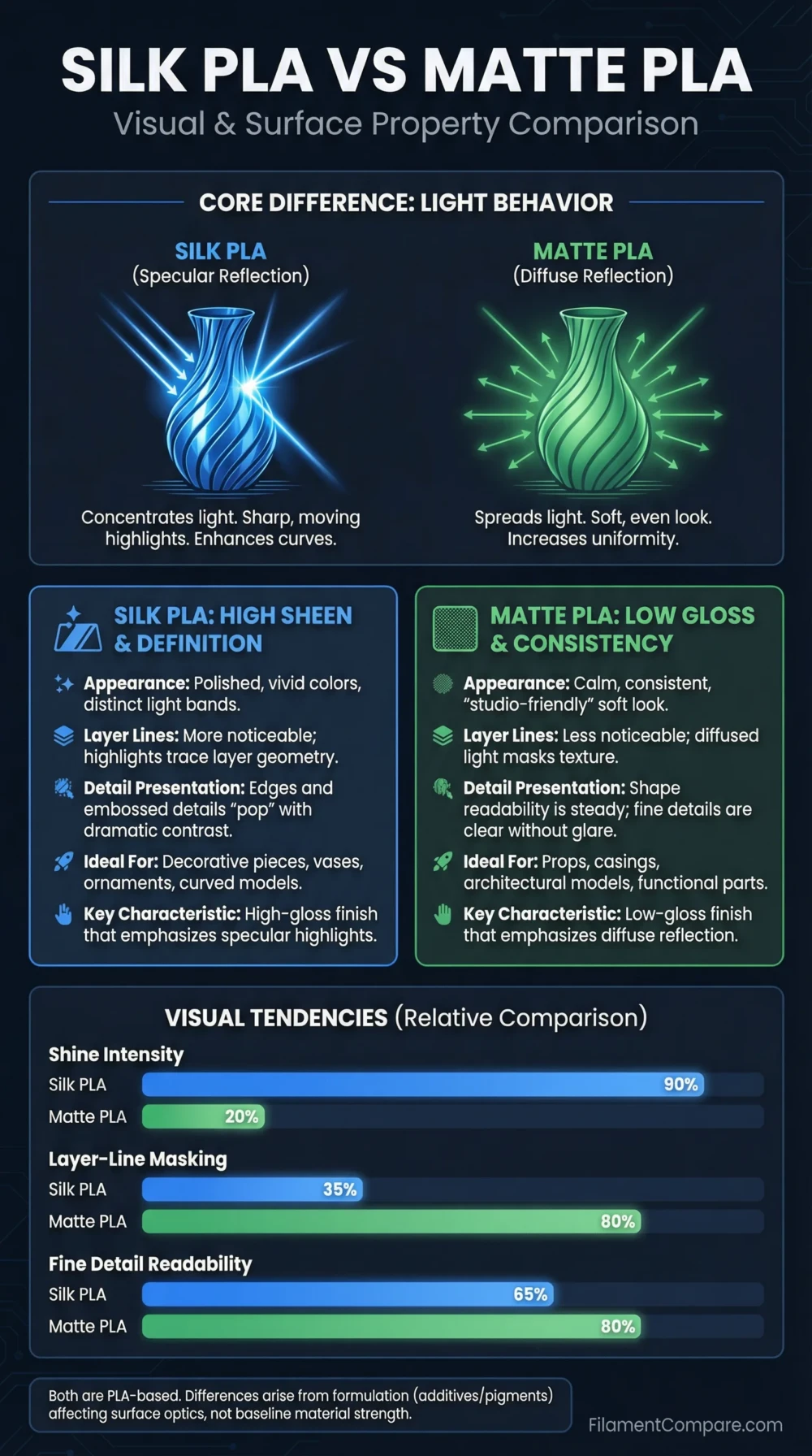
Silk PLA is chosen for glossy, reflective prints, while Matte PLA is chosen for a soft, low-shine finish that hides layer lines more easily. Both are PLA-based filaments, so they share easy printing, low warping, and limited heat resistance, but their additives change surface finish, flow behavior, strength feel, and tuning needs. For display parts, decorative models, gifts, miniatures, and visual prototypes, the better choice depends less on “PLA strength” and more on the finish you want on the final surface.
Choose Silk PLA when the part should look shiny, metallic, pearlescent, or color-shifting. It works best for display objects, vases, character models, trophies, signs, ornaments, and prints where visual reflection matters more than sharp tolerance control.
Choose Matte PLA when you want a clean, non-glossy surface with softer layer visibility. It is usually the better fit for architectural models, product mockups, props, desk items, educational parts, and visual prototypes that need a calm, professional finish.
Best for Glossy Display Prints
Silk PLA gives a reflective surface that can look metallic or pearlescent under direct light.
Better for Low-Shine Models
Matte PLA gives a softer finish and is less likely to show glare in photos or under room lighting.
Better for Hiding Layer Lines
Matte PLA usually masks fine layer transitions better, especially on broad surfaces and product mockups.
Better for Decorative Curves
Silk PLA can make curved geometry, spiral vases, and embossed shapes look more dynamic because reflections move across the surface.
Better for Functional-Looking Prototypes
Matte PLA often looks more neutral and less toy-like, which helps when presenting early product shapes.
Better for Fine Text and Logos
Matte PLA is usually easier to read on small labels because the surface produces less glare.
Better for Visual Impact
Silk PLA is more eye-catching for gifts, awards, fantasy models, and shelf pieces.
Better for Simple Tuning
Matte PLA is often less speed-sensitive than silk blends, although exact behavior depends on the brand.
| Category | Silk PLA | Matte PLA | Better Choice |
|---|---|---|---|
| Material Family | PLA-based blend with gloss-enhancing additives | PLA-based blend with matting additives or surface-modifying formulation | Depends on finish |
| Print Difficulty | Easy to moderate; more tuning-sensitive for gloss | Easy; usually close to standard PLA behavior | Matte PLA |
| Typical Nozzle Temperature | Usually around 210–240 °C depending on brand and shine target[a] | Often around 190–230 °C, with many PLA profiles near 210 °C[b] | Brand-dependent |
| Typical Bed Temperature | Usually 35–65 °C depending on plate type and material brand | Usually 40–60 °C for many PLA profiles[c] | Similar |
| Enclosure Requirement | Not normally required | Not normally required | Similar |
| Heat Resistance | Limited like most PLA blends; not a heat-use material | Limited like most PLA blends; some grades list HDT near the standard PLA range[d] | Similar |
| Toughness | Varies; some silk blends feel more brittle in thin features | Varies; often more predictable for everyday models | Matte PLA |
| Stiffness | Usually stiff, but additives can change feel | Usually stiff and suitable for visual prototypes | Similar |
| Layer Adhesion | Can be more sensitive to temperature, speed, and cooling | Usually easier to tune for consistent layers | Matte PLA |
| Moisture Sensitivity | Moderate for PLA; wet filament may string, pop, or lose surface quality | Moderate for PLA; matte texture can hide small surface flaws better | Similar |
| Surface Finish | Glossy, reflective, sometimes metallic-looking | Soft, low-glare, smooth-looking, layer-hiding | Use-case based |
| Outdoor Suitability | Limited for long-term sun and heat exposure | Limited for long-term sun and heat exposure | Neither is ideal |
| Typical Uses | Vases, ornaments, signs, trophies, character models, display pieces | Mockups, architectural models, props, desk organizers, educational prints | Use-case based |
| Main Limitation | Gloss may require slower outer walls; thin parts may be more fragile | Finish is less dramatic; some matte grades can feel chalkier or more abrasive | Depends on priority |
| Better Choice | For shine, color effects, and decorative curves | For muted finish, readable details, and easier visual prototyping | No single winner |
This Silk PLA and Matte PLA comparison uses manufacturer datasheets, official material notes, and common FDM printing behavior; the values describe normal trends, while brand, pigment, additives, moisture level, nozzle size, cooling, and slicer settings can change the printed result.
Silk PLA Material Profile
- Polymer type: PLA-based blend with gloss or luster additives.
- Print difficulty: Easy in basic shape, moderate when chasing the best shine.
- Nozzle range: Commonly 210–240 °C, with many silk profiles favoring the higher side for gloss.
- Bed range: Usually 35–65 °C depending on build plate and brand.
- Enclosure: Usually not needed; strong chamber heat can soften PLA.
- Drying need: Drying helps when the surface shows bubbles, popping, stringing, or dull patches.
- Typical behavior: High visual shine, smoother-looking walls, more sensitivity to outer-wall speed and cooling.
- Best use cases: Decorative models, curved vases, awards, signs, ornaments, fantasy props, and display objects.
Matte PLA Material Profile
- Polymer type: PLA-based blend with a low-gloss surface formulation.
- Print difficulty: Easy for most printers; close to normal PLA in many profiles.
- Nozzle range: Often 190–230 °C, but some high-speed matte grades print hotter.
- Bed range: Usually 40–60 °C, adjusted for bed surface and first-layer grip.
- Enclosure: Usually not required.
- Drying need: Helpful after humid storage, especially for clean walls and sharp top surfaces.
- Typical behavior: Low glare, reduced visible layer lines, clean presentation finish.
- Best use cases: Product mockups, architecture models, figurines, educational models, props, and neutral visual prototypes.
These meters are relative print-choice indicators, not fixed lab ratings. Actual results shift with filament brand, color, additive package, moisture level, part orientation, wall speed, cooling, layer height, and slicer profile.
Surface Finish and Visual Detail
Silk PLA is built for reflection. The surface catches light, so curved walls, bevels, embossed patterns, and spiral shapes can look richer than they would in standard PLA. This is why silk blends are common for dragons, busts, ornaments, vases, trophies, decorative signs, and objects meant to be seen from a distance.
That same gloss can make small defects more visible. A tiny seam, ringing mark, under-extruded corner, or inconsistent outer-wall speed may show as a bright line when light hits the part. Silk PLA also tends to look better when the outer wall is not printed too fast; Bambu Lab’s silk printing notes recommend a hotter nozzle range and controlled speed for better sheen[e].
Matte PLA takes the opposite route. It reduces glare and makes layer lines look softer, which helps flat faces, product housings, architectural pieces, desk accessories, and neutral models. The finish can make a print look more like a molded prototype, especially in white, gray, black, beige, and muted colors.
Finish-Based Rule
Use Silk PLA when the model benefits from light reflection. Use Matte PLA when the model should look clean, calm, and less reflective (especially under photography lights or office lighting).
Printability and Tuning Behavior
Both filaments are easier to print than ABS, Nylon, PC, and many flexible materials. They usually do not need an enclosure, they print on common PLA build surfaces, and they have low shrinkage. A standard 0.4 mm nozzle, normal PLA cooling, and a clean build plate are enough for most parts.
The difference appears when tuning for appearance. Silk PLA often needs a slightly hotter nozzle, slower outer walls, and stable cooling to keep the shine even. If the temperature is too low, the surface can look dull. If the speed is too high, the shine may vary between walls, corners, and small features.
Matte PLA is usually more forgiving visually. Small layer changes, faint ringing, and minor wall texture are less obvious because the surface does not reflect as strongly. Some matte filaments can feel slightly chalky or leave more residue on drive gears, so the extruder path should stay clean during long prints.
Silk PLA Tuning Notes
- Use a temperature tower if the shine looks uneven.
- Slow outer walls for more stable gloss.
- Keep cooling strong, but avoid overcooling tiny layers into a dull surface.
- Dry the spool if the surface shows bubbles or fine stringing.
- Use seam placement carefully because glossy surfaces show seams more clearly.
Matte PLA Tuning Notes
- Start with a normal PLA profile and adjust first-layer grip.
- Use moderate cooling for crisp corners and clean bridges.
- Check top-surface flow because matte finishes can hide or reveal different texture patterns.
- Use smaller layer heights for display-quality models.
- Clean the nozzle if the surface begins to look dusty or uneven.
Strength, Brittleness, and Part Geometry
Neither Silk PLA nor Matte PLA should be selected as a high-impact engineering filament. They are PLA-family materials, so they are stiff, dimensionally friendly, and easy to print, but they are not replacements for PETG, ASA, Nylon, or PC when heat, impact, fatigue, or long outdoor exposure matters.
For small decorative parts, both can work well. For thin hooks, clips, living hinges, snap tabs, or parts that are repeatedly flexed, neither is the ideal choice. Silk PLA can feel more brittle in thin sections depending on the additive package. Matte PLA may be more predictable for simple brackets and non-loaded organizers, but it still has the normal PLA limits around impact and heat.
Geometry matters. A thick decorative base printed in Silk PLA may feel solid, while a thin shiny spear, sword tip, or ornament peg can break easily. A Matte PLA housing may look professional, but screw bosses and snap fits need generous radii, enough wall thickness, and print orientation that supports the load path.
Heat Resistance and Shape Retention
Heat resistance is a shared weak point. General PLA materials commonly soften around the glass-transition region, and official PLA datasheets often list glass transition near 59–60 °C for standard grades[f]. Matte and silk versions may differ by formulation, but the practical advice stays the same: do not use either for parts that must keep shape in hot cars, near heaters, inside warm enclosures, or under constant mechanical load at elevated temperature.
Some brands publish heat deflection data for specific PLA variants, but those numbers are measured with defined test bars, load conditions, and print settings. They do not mean every real printed part will keep its shape at that exact temperature. A thin wall, dark color, high internal stress, or low infill can deform sooner.
Heat-use note: Silk PLA and Matte PLA are better treated as visual and light-duty materials. For parts exposed to warm outdoor conditions, car interiors, appliances, or load-bearing heat, consider PETG, ASA, ABS, Nylon, PC, or a heat-rated PLA grade after checking its datasheet.
Layer Lines, Seams, and Photography
Matte PLA is usually easier to photograph. The lower shine reduces harsh highlights, so layer lines, seams, and small wall changes do not jump out as much. This makes Matte PLA useful for store product photos, prototype presentations, architecture models, cosplay props before paint, and clean educational models.
Silk PLA can look excellent in photos when the model has smooth curves and controlled lighting. It is less forgiving on flat vertical walls because gloss can reveal ringing and extrusion inconsistency. If a Silk PLA print is meant for close-up photos, a slower outer wall, good belt tuning, calibrated extrusion, and clean seam placement matter more than they do with Matte PLA.
Best Settings Range
Use these as starting ranges, not fixed profiles. Brand instructions should come first, because “silk” and “matte” are finish categories rather than one universal formula.
| Setting | Silk PLA Starting Point | Matte PLA Starting Point | Adjustment Logic |
|---|---|---|---|
| Nozzle Temperature | 210–240 °C | 190–230 °C | Raise temperature if silk looks dull or layers look weak; lower if stringing and blobs increase. |
| Bed Temperature | 35–65 °C | 40–60 °C | Use the lower side on high-grip plates and the higher side on glass or cooler rooms. |
| Cooling | High cooling after first layers | High cooling after first layers | Reduce cooling only if layer adhesion is weak or small features curl. |
| Outer Wall Speed | Slow to moderate for best shine | Moderate; often more forgiving | Slow silk outer walls if reflections look uneven. |
| Layer Height | 0.12–0.24 mm typical | 0.12–0.24 mm typical | Use lower layers for miniatures, logos, and close-up display parts. |
| Retraction | Normal PLA range, tune for stringing | Normal PLA range, tune for stringing | Wet filament can mimic bad retraction. |
| Drying | Useful after humid storage | Useful after humid storage | Dry when you hear popping or see rough walls. |
| Nozzle Type | Brass is usually fine unless filled | Brass is usually fine unless filled | Use hardened nozzles only for abrasive specialty blends. |
Use Case Recommendations
| Use Case | More Suitable Material | Reason |
|---|---|---|
| Decorative vases | Silk PLA | Glossy reflections look strong on curved continuous surfaces. |
| Architectural models | Matte PLA | Low glare makes walls, roof shapes, and scale details easier to read. |
| Character busts | Depends on style | Silk gives a dramatic display look; matte gives softer sculptural detail. |
| Product mockups | Matte PLA | The finish looks more neutral and presentation-friendly. |
| Trophies and awards | Silk PLA | Metallic-looking shine can suit gold, silver, bronze, and pearl effects. |
| Small text labels | Matte PLA | Reduced glare improves readability on raised or recessed letters. |
| Miniatures before painting | Matte PLA | The muted surface is easier to inspect and often easier to prime. |
| Gift models | Silk PLA | Shine gives a more decorative first impression without post-processing. |
| Desk organizers | Matte PLA | The finish is calmer and less reflective for everyday objects. |
| Large flat panels | Matte PLA | Glossy silk can show waves, seams, and ringing more clearly. |
| Cosplay decorative accents | Depends on finish | Silk suits jewel and metal-like pieces; matte suits parts intended for sanding or painting. |
| Functional brackets | Standard PLA, PETG, or stronger material may be better | Silk and matte are finish choices first; loads, heat, and impact should drive material selection. |
Where Each Material Fits Better
Choose Silk PLA When
- The model is decorative and the surface should catch light.
- You want gold, silver, copper, pearl, or color-shift visual effects.
- The print has curves, bevels, organic shapes, or spiral geometry.
- The part will be displayed indoors at normal room temperature.
- Post-processing should be minimal, and the filament color is part of the design.
Silk PLA Is Less Suitable When
- The part has thin clips, snap tabs, or small load-bearing pegs.
- Flat walls must hide ringing, seams, and extrusion changes.
- You need a non-reflective surface for photography or readability.
- The model will be sanded, primed, and painted anyway.
- The part will be exposed to heat, sun, or repeated impact.
Choose Matte PLA When
- You want a soft, low-glare, professional-looking surface.
- The print has flat faces, labels, architectural geometry, or product-like shapes.
- You want layer lines to appear less obvious without sanding.
- You are making prototypes, mockups, educational models, or desk objects.
- You prefer easier tuning over maximum shine.
Matte PLA Is Less Suitable When
- The model should look metallic, pearl-like, or highly reflective.
- The print relies on dramatic light effects for its appearance.
- The filament formulation is very chalky and causes feed dust in long prints.
- You need a glossy final surface straight from the printer.
- The application needs heat, UV, impact, or fatigue resistance beyond PLA’s normal range.
Moisture, Storage, and Spool Handling
PLA absorbs less moisture than Nylon or some flexible filaments, but storage still matters. A humid spool can string more, pop during extrusion, leave tiny pits, or produce less even walls. With Silk PLA, moisture can reduce the clean reflective surface. With Matte PLA, it can create roughness on top layers or soft blobs near travel moves.
Store both in a sealed bag or dry box with desiccant. Dry the spool when surface quality changes suddenly, when a previously good profile starts stringing, or when you hear small popping sounds at the nozzle. Do not overheat the spool during drying; use the filament maker’s drying instructions and consider the spool material as well.
Printer Requirements
A basic open-frame FDM printer can print both materials well. A direct drive extruder is not required, and a hardened nozzle is not normally needed unless the filament includes abrasive fillers such as glitter, metal powder, glow pigment, carbon fiber, or glass fiber. Check the exact spool label before using a brass nozzle for specialty colors.
Build plate choice affects first-layer reliability more than the silk-versus-matte decision. Smooth PEI, textured PEI, glass with the right adhesive, and PLA-friendly plates can all work. If adhesion is too strong, let the bed cool fully before removing parts, especially on thin decorative bases.
Material Selection Matrix
Choose Silk PLA if your main goal is a shiny display finish, metallic-looking color, or strong visual effect on curved geometry.
Choose Matte PLA if your main goal is a low-glare, cleaner-looking surface that hides layer lines and supports prototype-style presentation.
Use a different filament if the part must survive heat, repeated impact, flexing, long outdoor exposure, or mechanical load. In those cases, the finish should come after the part requirement.
Silk PLA vs Matte PLA Questions
Is Silk PLA stronger than Matte PLA?
Not in a universal way. Strength depends on the exact formulation, print temperature, layer orientation, wall count, moisture, and part geometry. Silk PLA is often selected for appearance rather than mechanical reliability.
Does Matte PLA hide layer lines better?
Usually yes. The low-gloss surface reflects less light, so layer transitions and small wall texture are less visible than on shiny filament.
Why does Silk PLA sometimes look dull?
Common causes include low nozzle temperature, high outer-wall speed, wet filament, uneven cooling, or a brand formulation that produces a softer shine. A temperature tower and slower outer wall are useful first tests.
Can I use the same PLA profile for both?
You can start there, but Silk PLA may need hotter and slower outer walls for a better shine. Matte PLA often works closer to a normal PLA profile.
Are Silk PLA and Matte PLA good for outdoor parts?
They are not ideal for long outdoor exposure. Sunlight, heat, and weather can affect PLA-family materials. For outdoor parts, ASA or UV-stabilized materials are usually more suitable.
Can Silk PLA or Matte PLA be used for food-contact prints?
Do not assume that from the material name alone. Food-contact use depends on the certified grade, printer cleanliness, nozzle material, pigments, additives, layer-line cleaning, coating, and local rules.
Resources Used
- [a] PLA Silk+ | Bambu Lab EU Store (Used for Bambu Lab’s published Silk PLA-family printing range and product positioning. It supports the nozzle, bed, and finish discussion for glossy PLA blends.)
- [b] PLA – Prusa Knowledge Base (Used for general PLA printability, nozzle temperature, and bed temperature context. It supports the baseline comparison because both silk and matte variants remain PLA-based.)
- [c] Technical datasheet Prusament PLA by Prusa Polymers (Used for typical PLA print settings such as nozzle and heatbed ranges. It helps anchor the normal PLA behavior used as a baseline.)
- [d] Bambu Filament Technical Data Sheet V3.0 PLA Matte (Used for Matte PLA thermal and mechanical reference values, including heat deflection data and tested material properties.)
- [e] Printing with silk filaments (Used for Silk PLA tuning behavior, including the role of nozzle temperature and controlled print speed in surface shine.)
- [f] Ultimaker PLA TDS (Used for general PLA thermal context, especially glass-transition behavior and the limits of PLA-family materials in warm environments.)
