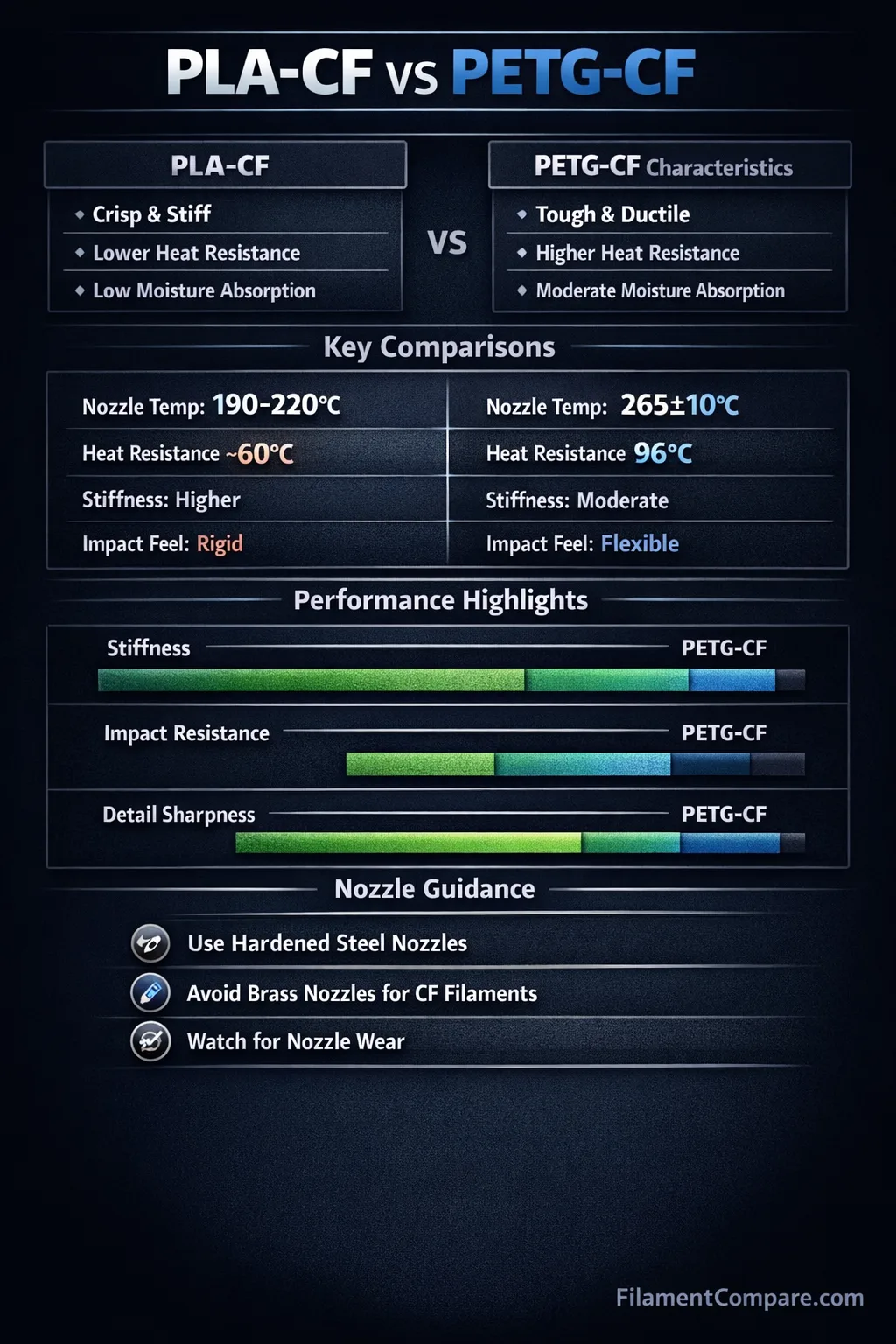
| Attribute | PLA-CF | PETG-CF | What This Usually Means |
|---|---|---|---|
| Base Polymer | PLA matrix | PETG (copolyester) matrix | Matrix choice drives the “feel” of prints: crisp vs ductile behavior. |
| Carbon Fiber Form | Chopped carbon fiber mixed into polymer | Chopped carbon fiber mixed into polymer | Most CF filaments use short fibers for stiffness and a matte look. |
| Carbon Fiber Share (If Stated) | 10% carbon fiber (example TDS) | Not always stated (varies by brand) | Some brands publish a fiber %; others describe it qualitatively. |
| Nozzle Temperature (Example Range) | 190–220°C | 265±10°C | Example ranges reflect typical vendor tuning: PLA-CF runs cooler; PETG-CF often runs hotter. |
| Bed Temperature (Example Range) | 0–45°C | 90±10°C | Bed targets are often about adhesion and flatness, not “better vs worse.” |
| Density (Example Value) | 1.30 g/cm³ | 1.27 g/cm³ | Density helps estimate part weight for the same volume. |
| Heat Resistance Metric (Example) | Vicat ~60°C | HDT 96°C (0.45 MPa) | Different tests appear on datasheets. Vicat and HDT describe how plastics behave under heat (and sometimes load). |
| Tensile Strength (Example) | 65 MPa (break, 3D printing) | 52±1 MPa (yield, filament) | Numbers can refer to filament or printed specimens. Always read the test note. |
| Stiffness (Example Modulus) | 12,500 MPa | 1.7–1.8 GPa (printed specimens) | CF tends to raise stiffness, but reported values depend heavily on specimen type and print direction. |
| Moisture Absorption (Example) | Often reported as “keep dry” (brand-dependent) | 0.07% (24h) and 0.1% (7 days) | Some datasheets quantify moisture uptake; it’s useful for repeatable surface quality. |
| Surface Look | Matte and “technical” texture is common | Matte to satin (varies) | CF often reduces gloss and can make layer lines look more uniform. |
| Hardware Note | Abrasive composite: hardened/ruby-class nozzles are commonly recommended | Carbon-filled materials can wear standard brass nozzles faster, so vendors often mention wear-resistant options. | |
PLA-CF and PETG-CF are both carbon-fiber reinforced filaments, so they share a similar “technical” vibe, a matte finish, and a more abrasive nature than standard plastics. The real difference is the base polymer: PLA-CF often leans toward sharp detail and a stiff feel, while PETG-CF typically leans toward a more forgiving kind of strength and a higher heat comfort zone.
- Material Composition and What “CF” Really Means
- Thermal Behavior and Heat-Related Limits
- PLA Family Temperature Landmarks
- PETG Family Temperature Landmarks
- Mechanical Profile: Stiffness, Strength, and Impact Feel
- Why Datasheets Can Look “Inconsistent” Across Brands
- Layer Bonding, Warp Behavior, and Dimensional “Calmness”
- Heat Deflection and What Those Load Numbers Mean
- Nozzle Wear and Hardware Compatibility
- Surface Texture, Visual Style, and Post-Processing Feel
- Where Each Material Tends To Fit
- PLA-CF: Typical Matchups
- PETG-CF: Typical Matchups
- Datasheet Details Worth Checking Before Comparing Brands
About The Numbers Above (so they stay meaningful): datasheet values depend on test method, print direction, specimen type, and brand formulation. The table uses one representative PLA-CF datasheet where the vendor states 10% carbon fiber and lists printing + mechanical values ✅Source.
The PETG-CF example values come from a technical datasheet that includes recommended temperatures, HDT under two loads, and moisture absorption figures ✅Source.
Material Composition and What “CF” Really Means
- Carbon-Fiber Reinforced
- Short, chopped carbon fibers are blended into a thermoplastic base. This often boosts a stiff feel and can create a matte surface, a reinforcement concept commonly explained in broader carbon fiber filament guides that explore how fiber content and polymer matrices shape real printed parts.
- Matrix Polymer (PLA vs PETG)
- The base polymer controls many “everyday” behaviors: PLA tends to feel crisper, while PETG tends to feel more elastic and more comfortable around moderate heat.
- Abrasiveness
- Carbon fibers are hard, so these filaments can be nozzle-wearing. That doesn’t make them “difficult,” it just means hardware choice matters.
Thermal Behavior and Heat-Related Limits
PLA Family Temperature Landmarks
PLA is known for a lower glass transition temperature, which is a key reason PLA-CF parts are often described as happiest in indoor or low-heat environments. A widely cited PLA resin datasheet lists 55–60°C as a typical glass transition window ✅Source.
- What CF changes: often improves shape stability during printing and gives a matte look.
- What CF does not “erase”: the base PLA heat signature still matters for real-world use.
PETG Family Temperature Landmarks
PETG (as a copolyester family) typically sits at a higher glass transition than PLA. An official copolyester technical document lists a Tg around 80°C for a PETG-type copolyester grade, measured by DSC ✅Source.
- What this often feels like: less softening in warm conditions for many printed parts.
- What CF adds: a stiffer feel and often a more uniform surface texture.
Mechanical Profile: Stiffness, Strength, and Impact Feel
Relative Comparison Bars (typical tendencies, not lab-grade promises)
PLA-CF is often chosen when the goal is a rigid, stiff part with a “machined” visual vibe. PETG-CF is often picked when people want a more elastic strength—still technical, still clean, just with a more forgiving bend-before-break character in many real prints.
Why Datasheets Can Look “Inconsistent” Across Brands
Test method matters, and so does specimen prep. Many CF filament sheets reference common plastics standards like ISO 527-1 for tensile properties, which is designed to make results more comparable across labs and materials ✅Source.
Layer Bonding, Warp Behavior, and Dimensional “Calmness”
- PLA-CF often shows low shrink behavior and a stable footprint on many beds, which helps with clean corners and sharp geometry.
- PETG-CF often has a more elastic feel and can show strong bonding when tuned, which supports durable functional shapes.
- Carbon fiber often reduces “rubbery” stringy vibes compared with unfilled PETG, giving a more controlled surface in many setups.
Heat Deflection and What Those Load Numbers Mean
When you see HDT (Heat Deflection Temperature) or “deflection under load,” the load is part of the story. Standards like ISO 75-1 describe how plastics are tested for deflection temperature under a defined flexural stress, making it clearer why the same material can show different HDT values at different loads ✅Source.
Nozzle Wear and Hardware Compatibility
CF filaments are commonly described as abrasive, and many printer knowledge bases recommend a hardened steel nozzle (or similarly wear-resistant options) when printing composites, since standard brass can wear faster with these blends ✅Source.
- Why it matters: nozzle wear can change line width and detail over time.
- What people look for: hardened steel, ruby-tipped, or other wear-resistant nozzle types.
- Filament path: smooth feeding and consistent tension help CF blends feel predictable.
Surface Texture, Visual Style, and Post-Processing Feel
- Matte finish is a frequent reason people like PLA-CF and PETG-CF; it often looks clean even before sanding.
- Edge definition often feels sharper on PLA-CF, especially on small text and crisp chamfers.
- Toughness vibe often feels more noticeable on PETG-CF parts when handled and flexed.
- Support scarring can exist on both; the CF look can make light marks seem less shiny and more uniform.
Where Each Material Tends To Fit
PLA-CF: Typical Matchups
- Crisp geometry where sharp edges and matte aesthetics are the goal.
- Rigid fixtures and parts that benefit from a stiff feel.
- Display-grade prototypes that still look technical without extra finishing.
PETG-CF: Typical Matchups
- Functional housings where a more forgiving strength is welcome.
- Warm-environment parts where PETG’s thermal comfort zone can be useful.
- Impact-prone designs that benefit from a less brittle feel in many setups.
Datasheet Details Worth Checking Before Comparing Brands
- Fiber description: is it “carbon filled,” “carbon fiber,” or explicitly percentage-based like 10%?
- What the numbers measure: filament tests vs printed specimen tests can look very different.
- Thermal metric type: Vicat, HDT, or glass transition values help compare heat behavior in a more grounded way.
- Moisture notes: some PETG-type materials publish absorption figures, which can help interpret surface consistency.
- Nozzle guidance: if the vendor calls out abrasiveness, it’s a hint their CF blend is fiber-rich enough to matter for wear.
