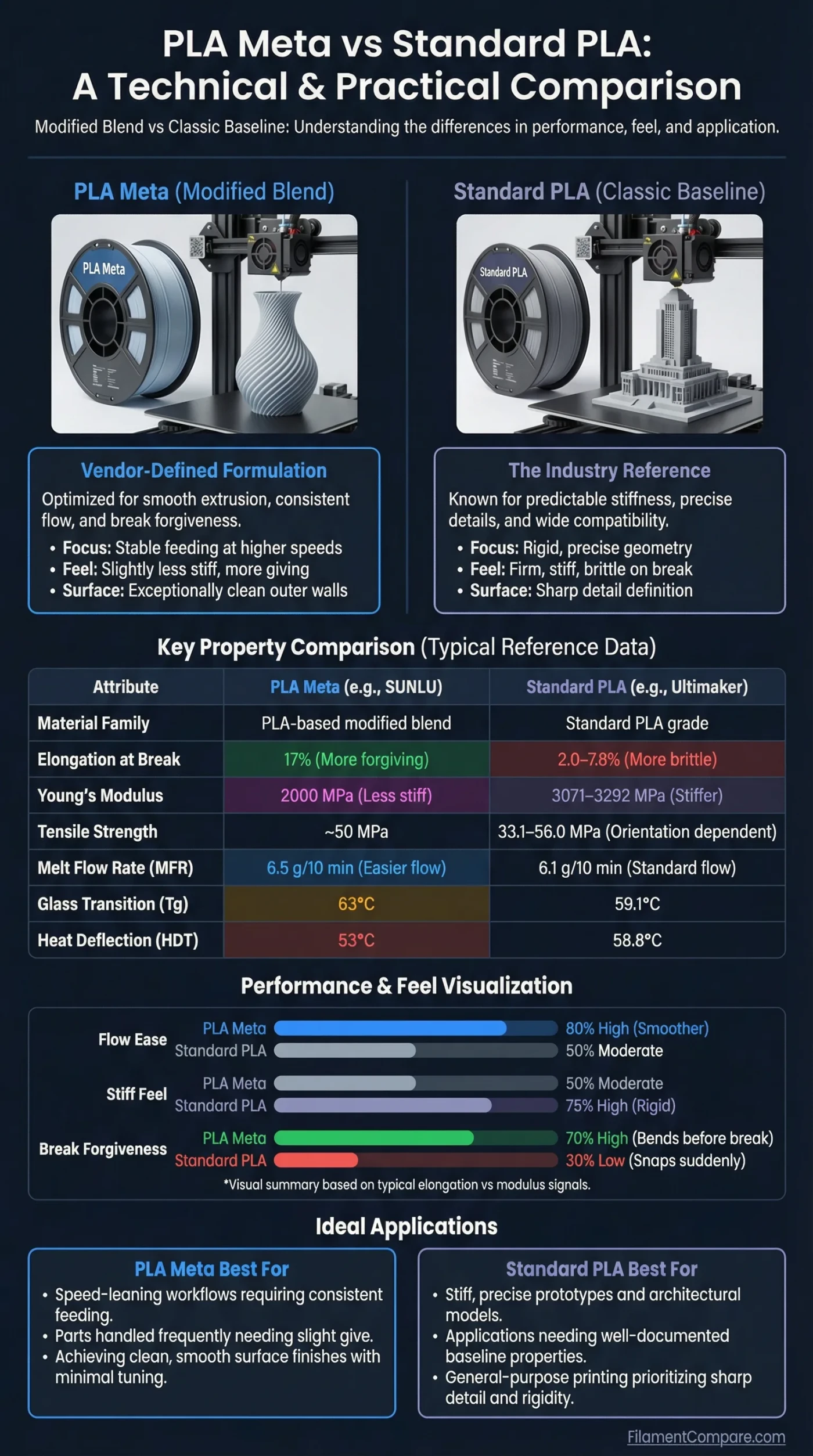
| Attribute | PLA Meta (SUNLU Reference Sheet) | PLA (Ultimaker Reference Sheet) |
|---|---|---|
| Material Family | PLA-based modified blend (vendor “Meta” formulation) | Standard PLA (PLA filament grade) |
| Density / Specific Gravity | 1.23 g/cm³ | 1.24 g/cm³ |
| Glass Transition (Tg) | 63°C | 59.1°C |
| Melting Temperature | 164°C | 151.8°C |
| Heat Deflection (≈0.45 MPa) | 53°C | 58.8°C |
| Vicat Softening | 54°C | 64.5°C |
| Tensile Strength | 50 MPa | 33.1–56.0 MPa (orientation-dependent) |
| Young’s Modulus | 2000 MPa | 3071–3292 MPa (orientation-dependent) |
| Elongation at Break | 17% | 2.0–7.8% (orientation-dependent) |
| Impact (Notched) | Izod: 48 J/m | Charpy: 3.9 kJ/m² |
| Melt Flow Rate (MFR) | 6.5 g/10 min (190°C / 2.16 kg) | 6.1 g/10 min (210°C / 2.16 kg) |
PLA Meta table values come from a product information sheet (typical lab data + recommended parameters) for one PLA Meta formulation; different brands can be slightly different, even if the spool also says PLA Meta. ✅Source
- What The “Meta” Name Usually Signals
- Mechanical And Thermal Personality
- PLA Meta Reference Signals
- PLA Reference Signals
- Flow, Speed, And Temperature Sensitivity
- Relative Feel Meters
- Surface, Detail, And Part Behavior
- Where Each One Fits Best
- PLA Meta Often Chosen For
- PLA Often Chosen For
- A Simple Selection Matrix
PLA Meta and PLA share the same core polymer family, but they behave a bit differently in real printing. Think of PLA Meta as a vendor-defined modified PLA that’s commonly tuned for smoother extrusion and steadier feeding, while PLA is the classic baseline people use as a reference point. For a broader overview of PLA formulations and how variants like PLA+, HT-PLA, and Meta PLA fit into the wider PLA ecosystem, see the Ultimate PLA Filament Guide.
What The “Meta” Name Usually Signals
PLA Meta is not a single universal standard; it’s a label used by manufacturers for a PLA-based blend that aims to keep PLA’s familiar feel while changing how the filament flows and bonds. In many product lines, PLA Meta sits between “plain PLA” and tougher PLA variants, with a strong focus on consistent extrusion and clean surface output.
- Meta formulation is typically about extrusion behavior and stable feeding, not changing the material into a totally new plastic.
- PLA baseline remains the reference for “easy-to-print” feel, predictable stiffness, and sharp detail.
- Expect variation: two spools from different brands can both be called PLA Meta and still measure differently.
- Tg (Glass Transition)
- Softening starts to show as you approach this zone. For many PLA grades, Tg is around the upper 50s to low 60s °C.
- HDT (Heat Deflection)
- A practical indicator of how a part behaves under load + heat. A few degrees can matter in real-world placement.
- MFR (Melt Flow Rate)
- A standardized way to describe melt flow under set conditions. It helps explain why two filaments can feel different even if they are both PLA-based.
Mechanical And Thermal Personality
On paper, PLA Meta can show a noticeably higher elongation at break (example: 17% in one reference sheet) while still keeping a PLA-like stiffness profile. Standard PLA often presents higher modulus numbers in printed test bars, but also a stronger “direction matters” effect because FFF parts are layered and anisotropic.
PLA Meta Reference Signals
- Tensile strength around 50 MPa in the shown reference sheet.
- Modulus around 2000 MPa, giving a firm, clean-printing feel.
- Elongation listed as 17%, which often maps to a more forgiving break behavior in simple handling.
- Tg listed as 63°C, right in the classic PLA neighborhood.
PLA Reference Signals
In one well-documented reference set of printed samples, the reported Young’s modulus is roughly 3.1–3.3 GPa, with tensile strength shifting by orientation and layer direction. This is a very “real FFF” detail: the same spool can measure differently depending on how the specimen is printed. ✅Source
Flow, Speed, And Temperature Sensitivity
Extrusion temperature influences how well a PLA bead fuses and how much internal porosity shows up in printed parts. In one peer-reviewed study on PLA specimens made by FDM, a stable mechanical window was identified around 220–240°C for that setup, showing how temperature can shift strength outcomes even with the same polymer family. ✅Source
PLA Meta products often publish more specific speed-linked ranges. One reference sheet lists 185–195°C for moderate speeds and up to 195–225°C as speeds increase, plus a 50–60°C platform temperature range. This is useful for comparing the “intended extrusion behavior” between Meta PLA and baseline PLA—even when you keep your own workflow consistent.
Relative Feel Meters
PLA Meta vs PLA — Typical Relative Tendencies
These meters are a visual summary based on the comparison table signals: elongation vs modulus, plus typical product positioning.
Surface, Detail, And Part Behavior
If you care about crisp edges, both PLA and PLA Meta can deliver. The difference usually shows up as extrusion steadiness and how consistent the outer walls look across long prints. Many Meta PLA lines are designed to keep surface output clean when the print speed is pushed, while classic PLA is the baseline for sharp geometry and predictable finish.
- Layer definition: both are capable of fine detail; the deciding factor is often flow stability rather than the polymer name.
- Dimensional behavior: PLA-family filaments are widely valued for low-warp prints and tidy corners in everyday geometries.
- Meta branding: commonly targets smoother feeding and consistent lines across longer runs.
Where Each One Fits Best
PLA Meta Often Chosen For
- Speed-leaning workflows where consistent feeding matters across long toolpaths.
- Parts handled a lot where a touch more give feels reassuring.
- Clean surface goals when you want smooth outer walls with minimal fuss.
PLA Often Chosen For
- Stiff, precise shapes where the classic PLA feel is the reference.
- Well-documented baselines when you want specs that are easy to compare across brands.
- General-purpose printing where consistent detail and predictable results are the priority.
A Simple Selection Matrix
- PLA Meta is the cleaner match when your priority is stable flow and a formulation marketed around smoother feeding at higher throughput.
- PLA is the cleaner match when you want a widely comparable baseline filament with strong reference data and predictable stiffness signals.
- If the decision is “feel in hand,” compare elongation and modulus: they often hint at how a part behaves during everyday handling.
- If the decision is “heat placement,” focus on HDT, Tg, and Vicat together instead of a single number.
