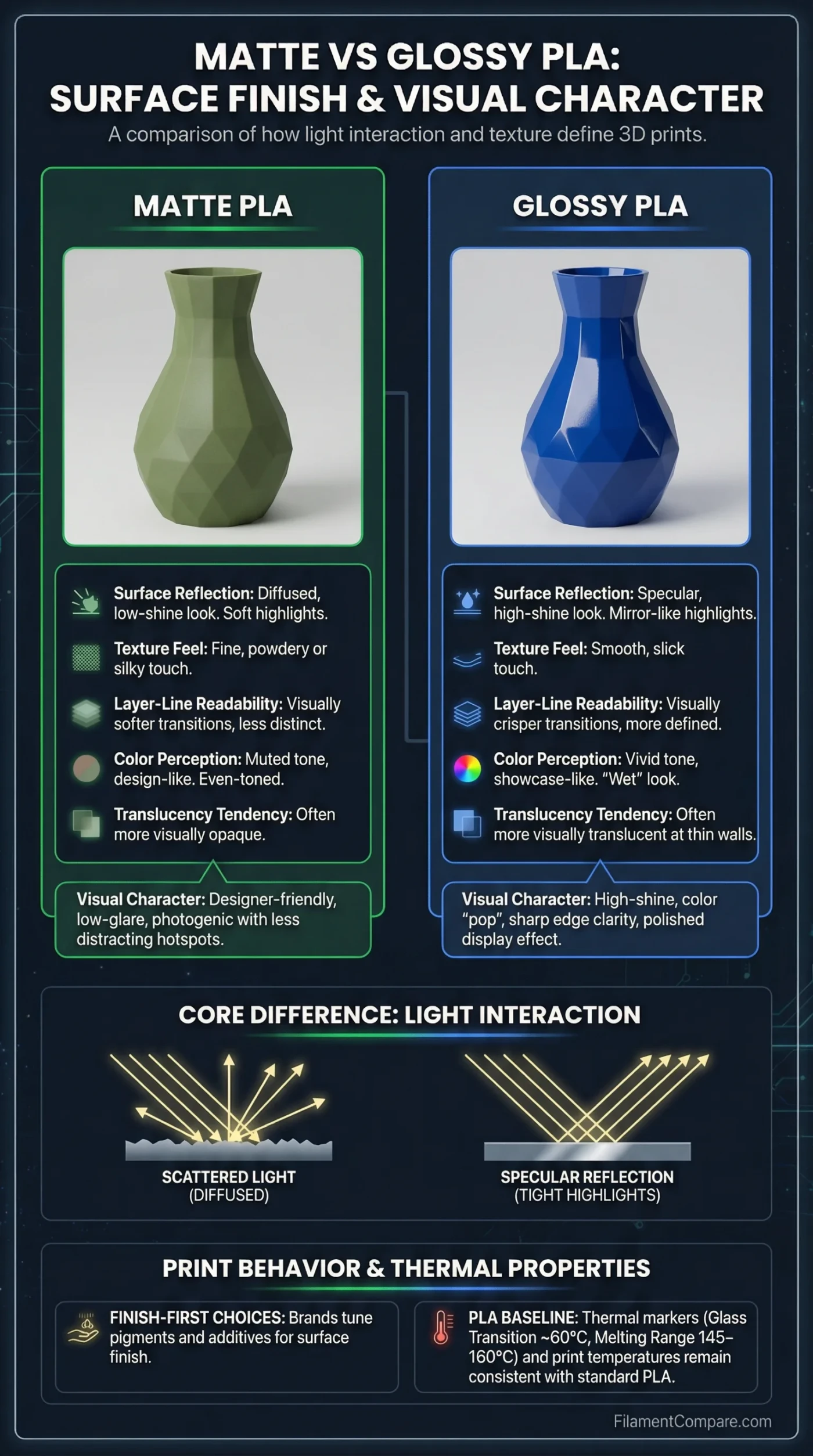
| Attribute | Matte PLA | Glossy PLA | What It Changes In Real Prints |
|---|---|---|---|
| Surface Reflection | Diffused low-shine look | Specular high-shine look | Lighting behaves differently: soft highlights vs mirror-like highlights. |
| Texture Feel | Fine “powdery” or “silky” touch is common | Smooth slick touch is common | Handling and finger marks read differently under indoor light. |
| Layer-Line Readability | Visually softer transitions are common | Visually crisper transitions are common | Same geometry, different “surface story” in photos and on shelves. |
| Color Perception | Muted tone feel is common (design-like) | Vivid tone feel is common (showcase-like) | Color depth can look “inked” in matte or “candy-coated” in glossy, even with the same pigment family. |
| Translucency Tendency | Often more visually opaque | Often more visually translucent at thin walls | Wall thickness and internal infill can show up sooner in glossy grades. |
| Baseline PLA Thermal Markers (Example TDS) |
Glass Transition: ~60 °C Melting Range: 145–160 °C MFR: 6.09 g/10 min Specific Gravity: 1.24 |
Glass Transition: ~60 °C Melting Range: 145–160 °C MFR: 6.09 g/10 min Specific Gravity: 1.24 |
These numbers describe PLA’s baseline window; finish can shift “feel” more than core polymer identity. ✅Source |
| Typical Profile Temperatures (Brand-Dependent) | Often close to standard PLA | Often close to standard PLA | Finish-first choices still sit inside normal PLA temperature ranges on most machines. |
Note: Matte PLA and Glossy PLA are both PLA-based. Brands tune the surface finish using pigments and additives, so the “matte feel” or “gloss pop” can vary by color and manufacturer.
- What Matte and Glossy Mean In PLA
- Light, Gloss, and How Shine Gets Described
- Visual Character and Surface Feel
- Matte PLA Visual Character
- Glossy PLA Visual Character
- Print Behavior You Might Notice Between Finishes
- Where Matte Often Stands Out Visually
- Where Glossy Often Stands Out Visually
- Temperature Numbers and How They Get Reported
- Gloss Measurement Language You’ll See
- Common Temperature Guidance You’ll Hear For PLA
- A Clean Way To Describe The Choice
- Matte PLA reads like
- Glossy PLA reads like
Matte PLA and Glossy PLA are the same familiar PLA filament at heart, yet they look like two different materials once light hits the surface. The real difference sits in surface finish, the way it handles reflections, and how it presents layer structure to your eyes. For a deeper overview of how PLA itself is formulated and how variants like PLA+, HT-PLA, and Meta PLA differ, see the Ultimate PLA Filament Guide.
- Finish: Diffused vs Specular
- Look: Designer vs Showcase
- Detail Read: Soft vs Crisp
- Camera: Low Glare vs High Glare
What Matte and Glossy Mean In PLA
- Matte PLA surface finish
- Low gloss appearance created by a surface that scatters light. The print can read “soft” even when the geometry is sharp.
- Glossy PLA surface finish
- High gloss appearance created by a smoother surface that reflects light more like a highlight line. Colors often look more “wet” or “polished.”
- Same Base Polymer different presentation
- The finish choice changes how light interacts with the surface. It can also change how you perceive layer lines and micro-texture.
Light, Gloss, and How Shine Gets Described
Gloss is commonly discussed as a measurable surface effect, not just a vibe. Standards like ISO 2813 describe gloss measurement using defined geometries (20°, 60°, 85°) on non-textured coatings, which is useful language when people talk about “matte” and “glossy” surfaces in general. ✅Source
Reflection Intensity relative look
Matte PLA keeps highlights broad and quiet; Glossy PLA creates tight highlights that move as you move the part.
Layer-Line Visibility visual read
Matte PLA often makes the surface feel more uniform, while Glossy PLA can make tiny steps look more defined under angled light.
Color “Pop” perceived saturation
Glossy PLA can read more vivid because highlights add contrast; Matte PLA can read more “printed” and even-toned.
Visual Character and Surface Feel
Matte PLA Visual Character
- Low-glare surfaces keep reflections subtle, so curves look smooth.
- Design-friendly look: colors can appear soft and balanced under room lighting.
- Texture-first impression: the surface can feel fine even when geometry is sharp.
- Photo behavior: lighting hotspots are often less distracting, which helps the model read as one piece.
Glossy PLA Visual Character
- High-shine surfaces create defined highlights that track across the part.
- Color “pop”: pigments can look richer with a polished feel.
- Edge clarity: crisp edges can look extra sharp because reflections add contrast.
- Display effect: glossy finishes can read premium when lighting is controlled.
Small but real detail: The same PLA color name can look different in matte vs glossy because shine changes the perceived brightness and contrast. This is a surface optics effect, not just pigment.
Print Behavior You Might Notice Between Finishes
Matte PLA and Glossy PLA often run in the same PLA family, yet brands tweak the recipe to steer the surface finish. That can subtly influence how the filament behaves during extrusion, even though the goal is still PLA-like reliability.
- Surface micro-texture: matte grades often aim for light scattering, which can create a more uniform look on flat faces.
- Highlight sensitivity: glossy grades make tiny surface changes more visible because reflections are sharper.
- Color uniformity: matte finishes can look even across big surfaces; glossy finishes can look dynamic under moving light.
- Brand variability: within both categories, color and additive choice can shift the “feel” more than the label does.
Where Matte Often Stands Out Visually
- Large flats: softer sheen keeps the plane looking consistent.
- Organic shapes: curves can read smooth without sharp hot spots.
- “Product mockup” vibe: industrial design surfaces look intentional.
Where Glossy Often Stands Out Visually
- Color showcase: highlights can make color depth look richer.
- Sharp geometry: edges look defined because reflections add contrast.
- Decorative shine: glossy parts can read polished under display lighting.
Temperature Numbers and How They Get Reported
PLA data sheets often mention glass transition and related thermal points because they describe the polymer’s softening region. Test methods like ASTM E1356 define how glass transition temperature is assigned using DSC or DTA, which is why different data sheets can look consistent even when numbers are not identical. ✅Source
- Glass Transition (Tg) what it signals
- Tg marks a range where PLA shifts from “glassy” to more rubbery behavior. Finish choice affects appearance, while Tg is a material property you’ll see in TDS language.
- Melting Range what it signals
- PLA’s melting behavior often appears as a range, especially when crystallinity and formulation differ. This supports why matte and glossy can share the same “PLA family” yet feel slightly different in processing.
- Melt Flow Rate (MFR) why it shows up
- MFR is a flow indicator used to compare material batches. It helps explain why one brand’s matte PLA and another brand’s glossy PLA can still behave differently.
Gloss Measurement Language You’ll See
When people say glossy, they’re often describing specular reflection. ASTM D523 explains gloss in terms of how a surface reflects light near the specular direction, and it also covers common glossmeter geometries like 60°, 20°, and 85°. That same language fits the way matte and glossy prints are visually compared. ✅Source
Friendly translation: Matte PLA spreads reflections, so shine feels quiet. Glossy PLA concentrates reflections, so shine feels loud and directional.
Common Temperature Guidance You’ll Hear For PLA
Many printer profiles and guides treat PLA as a low-temperature material, and you’ll often see nozzle numbers around 210–215 °C with a bed around 60 °C in common recommendations. Those figures describe typical PLA usage and show up frequently when comparing matte and glossy variants. ✅Source
- Key point: most matte PLA and glossy PLA stay inside familiar PLA ranges, with brand-specific tuning.
- Why it matters: the finish choice changes what you see before it changes the PLA identity.
- What to watch for: the same model can look “finished” in matte or “polished” in glossy with identical geometry.
A Clean Way To Describe The Choice
Matte PLA reads like
- Soft-surface design language with low glare.
- Even tone across big faces, with subtle highlights.
- Texture-first look that can feel intentional.
Glossy PLA reads like
- Polished presentation with defined highlights.
- Color-forward look with lively reflections.
- Edge-contrast that can feel crisp in display lighting.
