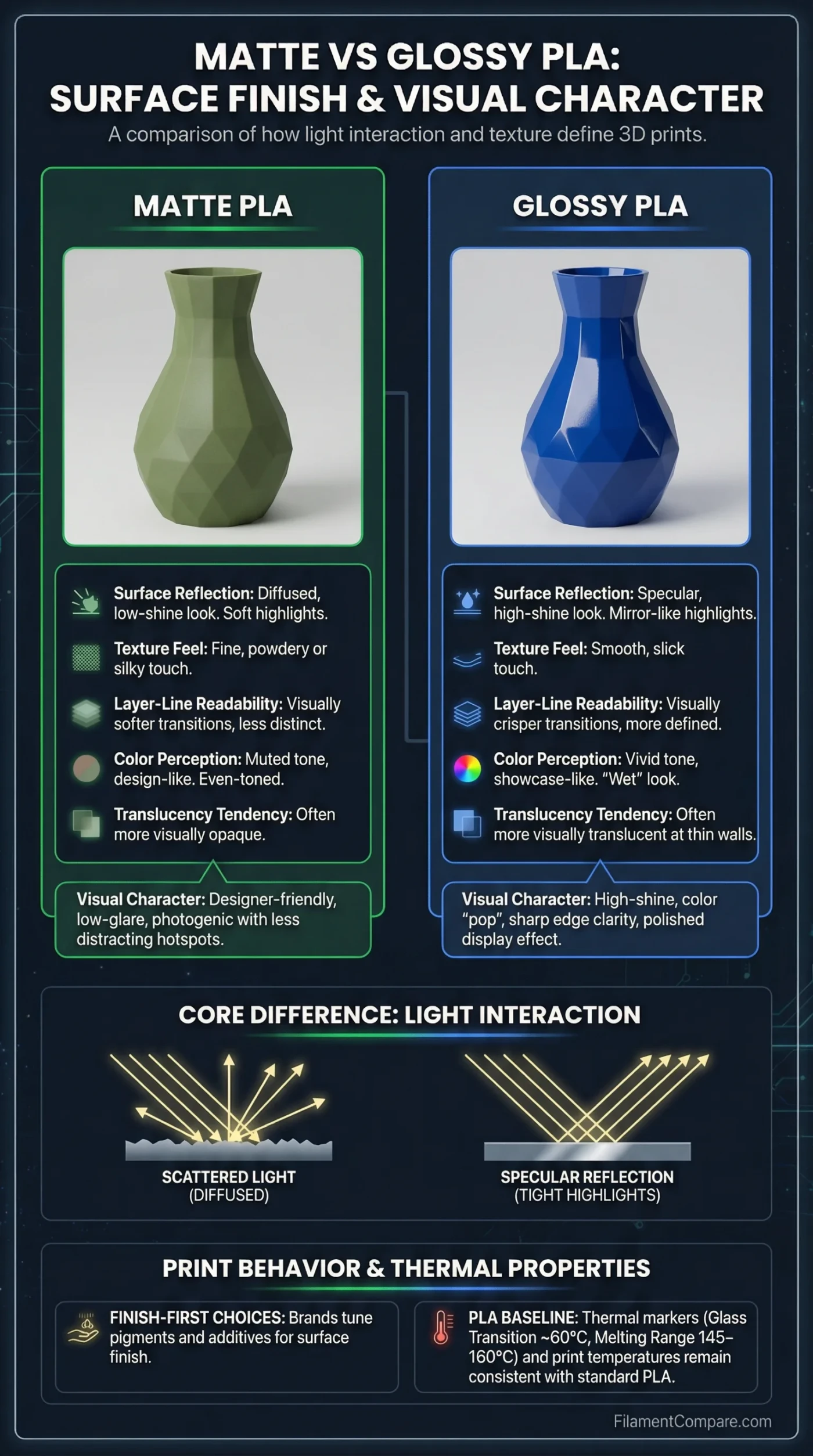
Matte PLA diffuses reflections and hides layer transitions, while glossy PLA produces a brighter, more reflective surface that shows color depth and small surface changes more clearly. Both are usually PLA-based and print within a similar temperature window; the larger difference is formulation, optical finish, and how forgiving the surface looks under direct light. Matte PLA suits display pieces, architectural models, and photographed prototypes, while glossy PLA is often the clearer choice for saturated colors, smooth curves, and predictable general-purpose printing.
Direct Finish Verdict
Choose matte PLA when low glare, softer color, and reduced layer-line visibility matter more than maximum color saturation.
Choose glossy PLA when you want richer-looking color, reflective highlights, easier access to standard PLA profiles, and lower concern about formulation-related nozzle wear.
Neither finish is automatically stronger. Mechanical behavior depends on the exact compound, print orientation, temperature, wall count, moisture level, and part geometry.
Layer-Line Concealment
Matte PLA scatters light and makes small layer transitions less obvious.
Color Saturation
Glossy PLA usually gives colors a deeper, brighter appearance under controlled light.
Architectural Models
Matte PLA reduces distracting reflections across flat walls and scale surfaces.
Smooth Curved Objects
Glossy PLA emphasizes continuous curves with visible highlights.
Product Photography
Matte PLA is easier to light when glare and hot spots are unwanted.
Standard Printer Profiles
Glossy PLA often matches generic PLA presets with fewer finish-specific adjustments.
Painted Prototypes
Matte PLA provides a visually even starting surface, though cleaning and primer still matter.
Long Brass-Nozzle Runs
Glossy PLA is the safer default when the matte formulation contains wear-producing additives.
| Decision Point | Matte PLA | Glossy PLA | Practical Edge |
|---|---|---|---|
| Material family | Usually a PLA-based compound with matting pigments, fillers, surface-modifying additives, or a tuned base resin | Usually standard or appearance-focused PLA with a smooth semi-gloss to glossy surface | Same broad polymer family |
| Visual response | Low reflection with softer highlights | Stronger specular highlights and brighter reflections | Depends on the design |
| Layer-line visibility | Usually lower under direct light | Usually higher when light catches each layer ridge | Matte PLA |
| Color appearance | Soft, muted, or velvety | Deeper-looking and more saturated | Glossy PLA |
| Typical nozzle temperature | Often 190–230°C, brand-dependent[a] | Often 190–230°C, brand-dependent[b] | Similar range |
| Typical bed temperature | Usually about 25–65°C, depending on plate and brand | Usually about 25–65°C, depending on plate and brand | Similar range |
| Enclosure | Normally not required | Normally not required | No clear difference |
| Drying | Dry when moisture causes popping, rough extrusion, or stringing | Dry when moisture symptoms appear | Formulation and storage matter |
| Print-speed effect | Finish is usually stable across ordinary PLA speeds, but extrusion consistency still changes texture | High speed can reduce visible shine on some appearance-focused grades | Tune for the desired surface |
| Nozzle wear | Some matte grades are mildly more abrasive than regular PLA | Standard unfilled grades are usually gentler on brass nozzles | Glossy PLA |
| Mechanical predictability | More formulation-dependent; matte appearance alone does not reveal strength | Generic PLA data is often easier to match, but brand and color still matter | Glossy PLA |
| Heat resistance | Standard PLA-level unless sold as a heat-resistant grade | Standard PLA-level unless sold as a heat-resistant grade | Finish does not solve heat limits |
| Surface defect concealment | Better at hiding mild ringing, layer transitions, and uneven sheen | Reflections can reveal small extrusion changes | Matte PLA |
| Typical uses | Scale models, busts, decor, enclosures, prototypes, photographed objects | Toys, organizers, display objects, colorful decor, smooth geometric parts | Use-case based |
| Main limitation | Color can look less vivid; additives may alter strength or nozzle wear | Glare can make layer lines and surface inconsistency easier to see | Choose by visual priority |
Material and Workflow Profiles
Matte PLA Profile
- Polymer type: PLA-based aesthetic compound; exact additive package varies.
- Print difficulty: Easy to moderate.
- Nozzle range: Commonly within standard PLA temperatures.
- Bed range: Low to moderate heat, plate-dependent.
- Enclosure: Usually unnecessary.
- Drying need: Conditional; dry when moisture symptoms appear.
- Typical behavior: Low glare, soft highlights, reduced visibility of small surface inconsistencies.
- Best uses: Models, props, housings, busts, presentation prototypes, and objects viewed under strong light.
Glossy PLA Profile
- Polymer type: Standard or appearance-tuned PLA with a smooth semi-gloss or glossy surface.
- Print difficulty: Usually easy.
- Nozzle range: Commonly within standard PLA temperatures.
- Bed range: Low to moderate heat, plate-dependent.
- Enclosure: Usually unnecessary.
- Drying need: Conditional; storage quality still affects extrusion.
- Typical behavior: Stronger highlights, vivid color, and greater visibility of layer-to-layer sheen changes.
- Best uses: Colorful decor, smooth curved objects, toys, organizers, signs, and everyday prints.
Relative Printing-Use Scores
Layer-Line Concealment
Color Saturation
Ease of Printing
Glare Control
Generic Profile Predictability
Nozzle Wear Control
These meters are relative printing-use indicators rather than fixed laboratory grades. Brand chemistry, colorants, surface additives, moisture, layer orientation, nozzle size, wall speed, cooling, and slicer choices can move the practical result in either direction.
Finish Is an Optical Property, Not a Separate Polymer
Matte and glossy describe how the printed surface handles light. A matte surface spreads reflections across more angles, while a glossy surface returns a tighter highlight. ASTM’s plastic-gloss method notes that gloss is a complex surface attribute and that measured gloss varies with smoothness and flatness[c].
This distinction matters because two PLA spools can share a similar printing temperature yet create very different visual results. The finish can come from the base resin, pigments, fine fillers, flow behavior, or a combination of those elements (the formula is rarely identical across brands).
Glossy PLA is not automatically silk PLA. Standard glossy PLA normally has a smooth or semi-gloss appearance without the metallic-looking sheen associated with many silk compounds. Silk PLA often uses a more specialized blend and can behave differently in layer bonding, flow, and impact response.
Layer Lines, Detail, and Lighting
Matte PLA does not remove layer lines. It makes them less visually dominant by reducing bright reflections along the ridges. Bambu Lab describes its PLA Matte as reducing visible layer lines and producing a smooth non-glossy appearance[d].
The benefit is strongest on broad walls, organic sculpts, busts, terrain, and architectural models. Small ringing marks or slight wall-speed transitions can blend into the low-reflection surface. Under a side light, the geometry remains visible, but the eye is less likely to lock onto every extrusion path.
Glossy PLA works differently. Highlights can make a smooth curve look cleaner and more polished, especially on vases, toys, signs, and rounded decorative parts. The same highlights can also expose inconsistent extrusion, layer-time changes, variable cooling, or a seam that would be less noticeable on matte material.
Detail Visibility Is Not the Same as Layer-Line Visibility
Matte PLA can hide layer ridges while still showing sculpted detail through soft shadows. Glossy PLA may make tiny ridges more visible but can strengthen the visual shape of smooth curves through reflected highlights. The better finish depends on whether the model relies on texture, color, or continuous curved surfaces.
Temperature, Speed, and Cooling Change the Sheen
Surface finish is not controlled by the spool label alone. Nozzle temperature, outer-wall speed, cooling, layer height, and extrusion consistency affect how smooth the deposited road becomes before it solidifies. Polymaker lists standard PLA settings for its matte range and notes that very glossy options may lose shine when printed too quickly[e].
A hotter or slower outer wall often gives the polymer more time to level, which can increase visible shine. A cooler or faster wall can leave a more textured surface, but pushing either direction too far may reduce dimensional accuracy, overhang quality, or layer bonding. Tune the finish only after confirming that extrusion and part strength remain acceptable.
For a More Even Matte Surface
- Keep outer-wall speed consistent across the model.
- Use enough cooling for clean overhangs without creating weak layer bonding.
- Reduce abrupt changes between minimum-layer-time zones.
- Calibrate flow so broad walls do not alternate between dull and shiny bands.
- Dry the spool if the extrusion looks rough or produces small bubbles.
For a Cleaner Glossy Surface
- Use a stable outer-wall speed rather than chasing the highest throughput.
- Test nozzle temperature in small steps.
- Place the seam where highlights will not emphasize it.
- Keep cooling and layer time consistent around the object.
- Use a fine layer height only when the longer print time adds visible value.
Strength, Stiffness, and Nozzle Wear
There is no universal rule that matte PLA is weaker than glossy PLA. A matte compound may contain pigments, mineral-like particles, or other surface-modifying ingredients, but the amount and type are brand-specific. One product may be more brittle, another may be tougher, and a third may track ordinary PLA closely.
For brackets, clips, thin hinges, or parts loaded across layer lines, use the manufacturer’s technical data for the exact SKU rather than choosing by finish. Printed strength also changes with orientation, wall count, infill connection, nozzle temperature, cooling, moisture, and the direction of the applied load.
Some matte PLA grades are mildly more abrasive than unfilled glossy PLA. This does not mean a hardened nozzle is mandatory for every spool. A brass nozzle is generally reasonable for occasional use unless the manufacturer says otherwise; frequent production printing with an abrasive matte grade can justify a wear-resistant nozzle.
The Build Plate Controls the Bottom Surface
The first-layer face does not necessarily match the side walls. A smooth plate can produce a shiny, glass-like bottom even when the filament is matte. A textured PEI plate can make glossy PLA look grainy and low-reflection on the contact face. Bambu Lab’s build-plate guidance notes that a textured surface transfers a distinct texture to the bottom of the printed part[f].
This can be used deliberately. Put a visible panel face on a smooth plate when you want a reflective finish, or place it against a textured plate when you want a uniform grain. The side walls will still show the filament’s normal appearance, so the transition between faces should be considered during model orientation.
Heat and Outdoor Limits Remain PLA Limits
Matte additives do not automatically turn PLA into a heat-resistant or outdoor-grade material. Standard PLA is easy to print and low-warp, but Prusa’s material guidance places it mainly in detailed models and prototypes rather than parts needing high temperature, chemical, or outdoor resistance[g].
For a warm enclosure, sun-exposed fixture, vehicle interior, or long-loaded bracket, select by a verified heat-deflection value, creep behavior, UV stabilization, and mechanical data. Surface finish should be a secondary decision. ASA, PETG, PC blends, or a purpose-made high-temperature PLA may fit better, depending on the part and printer.
Food-contact suitability also cannot be inferred from matte or glossy appearance. The exact material grade, colorants, nozzle material, printer contamination, layer grooves, coatings, cleaning method, and local rules all affect the decision.
Best Finish by Print Scenario
| Print Scenario | Better Fit | Reason |
|---|---|---|
| Architectural massing model | Matte PLA | Low glare keeps attention on shape and proportion. |
| Character bust | Matte PLA | Soft reflections reduce the visibility of layer ridges across organic surfaces. |
| Colorful desk organizer | Glossy PLA | Saturated color and smooth highlights suit everyday decorative objects. |
| Product prototype for photography | Matte PLA | Lighting is easier to control and reflections are less distracting. |
| Vase with continuous curves | Glossy PLA | Highlights emphasize clean curvature when extrusion is consistent. |
| Cosplay armor before paint | Matte PLA | The surface is visually even, though sanding and primer are still needed. |
| Functional test bracket | Datasheet-dependent | Choose by measured mechanical data, not surface finish. |
| Long production run on a brass nozzle | Glossy PLA | Unfilled standard PLA usually presents less wear risk than an abrasive matte compound. |
| Embossed sign with strong colors | Glossy PLA | Reflections and color depth can make raised lettering more visible. |
| Terrain and tabletop scenery | Matte PLA | Reduced shine gives broad textured areas a more natural appearance. |
| Part with a display-facing first layer | Plate-dependent | The build surface may dominate the final finish on that face. |
| High-temperature enclosure component | Neither by finish alone | Select a verified heat-resistant material or grade. |
Where Each Finish Fits Better
Choose Matte PLA When
- The model will be viewed under direct room light.
- You want layer transitions to attract less attention.
- The design has broad flat walls or sculpted surfaces.
- You are photographing prototypes and want fewer glare spots.
- A soft, stone-like, ceramic-like, or neutral presentation suits the object.
- You plan to paint the part after normal surface preparation.
Matte PLA Is Less Suitable When
- The design depends on bright, reflective color.
- You need mechanical data that the manufacturer does not publish.
- You run large production volumes through a brass nozzle and the grade is mildly abrasive.
- The part must tolerate sustained heat, weather, or high mechanical load without a verified datasheet.
- You expect the finish to hide major under-extrusion, ringing, or seam defects.
Choose Glossy PLA When
- You want saturated colors and visible highlights.
- The object uses smooth curves, polished-looking walls, or bright branding.
- You prefer generic PLA profiles and straightforward tuning.
- You print long runs with a standard brass nozzle.
- The part is decorative or lightly functional in a controlled indoor setting.
- You want a surface that clearly reveals whether extrusion is consistent.
Glossy PLA Is Less Suitable When
- Glare will interfere with photography, scanning, or viewing.
- The model has layer lines that you do not want emphasized.
- Outer-wall speed changes create visible bands of different sheen.
- You need a subdued or natural-looking finish without paint.
- The surface must look uniform under uncontrolled lighting.
Material Selection Matrix
Best Choice by Priority
Choose matte PLA if the print is primarily visual and you value low glare, softer highlights, less obvious layer transitions, and easier photography.
Choose glossy PLA if the print needs brighter color, smooth reflected highlights, common PLA profile compatibility, and lower formulation-related nozzle-wear concern.
Choose by datasheet rather than finish if the part carries load, flexes repeatedly, sits in warmth, remains outdoors, contacts chemicals, or must hold tight tolerances over time.
Matte and glossy PLA do not replace one another. The practical choice follows the viewing conditions, surface geometry, and verified requirements of the part.
Matte vs Glossy PLA Questions
Is Matte PLA Weaker Than Glossy PLA?
Not as a universal rule. Matte compounds can use different additives and base resins, so tensile strength, toughness, stiffness, and layer adhesion must be checked for the exact product. Print orientation and temperature may matter more than the finish label.
Does Matte PLA Require a Hardened Nozzle?
Usually not for occasional printing unless the manufacturer calls for one. Some matte grades are slightly more abrasive than basic PLA, so a hardened nozzle can be useful for frequent, high-volume use. Matte carbon-fiber, wood-filled, or mineral-filled PLA should be treated as separate material categories.
Can Print Settings Make Glossy PLA Look Matte?
They can reduce sheen. Faster outer walls, lower temperature, stronger cooling, or a rougher layer texture may create a duller surface, but they can also affect bonding and accuracy. A dedicated matte filament gives a more repeatable low-glare result.
Is Glossy PLA the Same as Silk PLA?
No. Glossy PLA may simply be standard PLA with a smooth reflective surface. Silk PLA is normally an appearance-focused compound made to produce a stronger metallic or satin-like sheen and may need different speed and temperature tuning.
Which Finish Is Better for Miniatures?
Matte PLA usually photographs well and keeps layer reflections under control. Glossy PLA can make bright colors stand out, but direct light may reveal more layer texture. For very small miniatures, nozzle size, layer height, cooling, and model orientation remain more influential than finish alone.
Can Matte and Glossy PLA Be Used in One Print?
Yes, when their temperature windows and layer bonding are compatible. The finish transition will be visible, which can be useful for labels, panels, icons, or multi-color accents. Test purge volume and inter-material adhesion before a long print.
Technical References and Manufacturer Guidance
- [a] Panchroma™ Matte PLA | Polymaker Wiki (Used for the matte PLA print-temperature range, bed range, enclosure guidance, drying note, and formulation-specific abrasion warning.)
- [b] Panchroma™ PLA | Polymaker Wiki (Used for standard PLA print settings and the manufacturer’s description of its semi-gloss surface.)
- [c] Standard Test Method for Specular Gloss of Plastic Films and Solid Plastics (Used to explain that gloss is tied to surface reflection, smoothness, and flatness rather than polymer name alone.)
- [d] PLA Matte | Bambu Lab USA Store (Used for the manufacturer’s stated low-glare appearance and reduced visibility of layer lines.)
- [e] Polymaker Material Print Tips | Polymaker Wiki (Used for guidance that print speed can change the retained shine of very glossy PLA options.)
- [f] Introduction to Bambu Lab Build Plates (Used to explain how a textured build surface transfers its texture to the first-layer face.)
- [g] PLA | Prusa Knowledge Base (Used for general PLA printability, common applications, and limits involving heat, UV exposure, and demanding technical use.)
