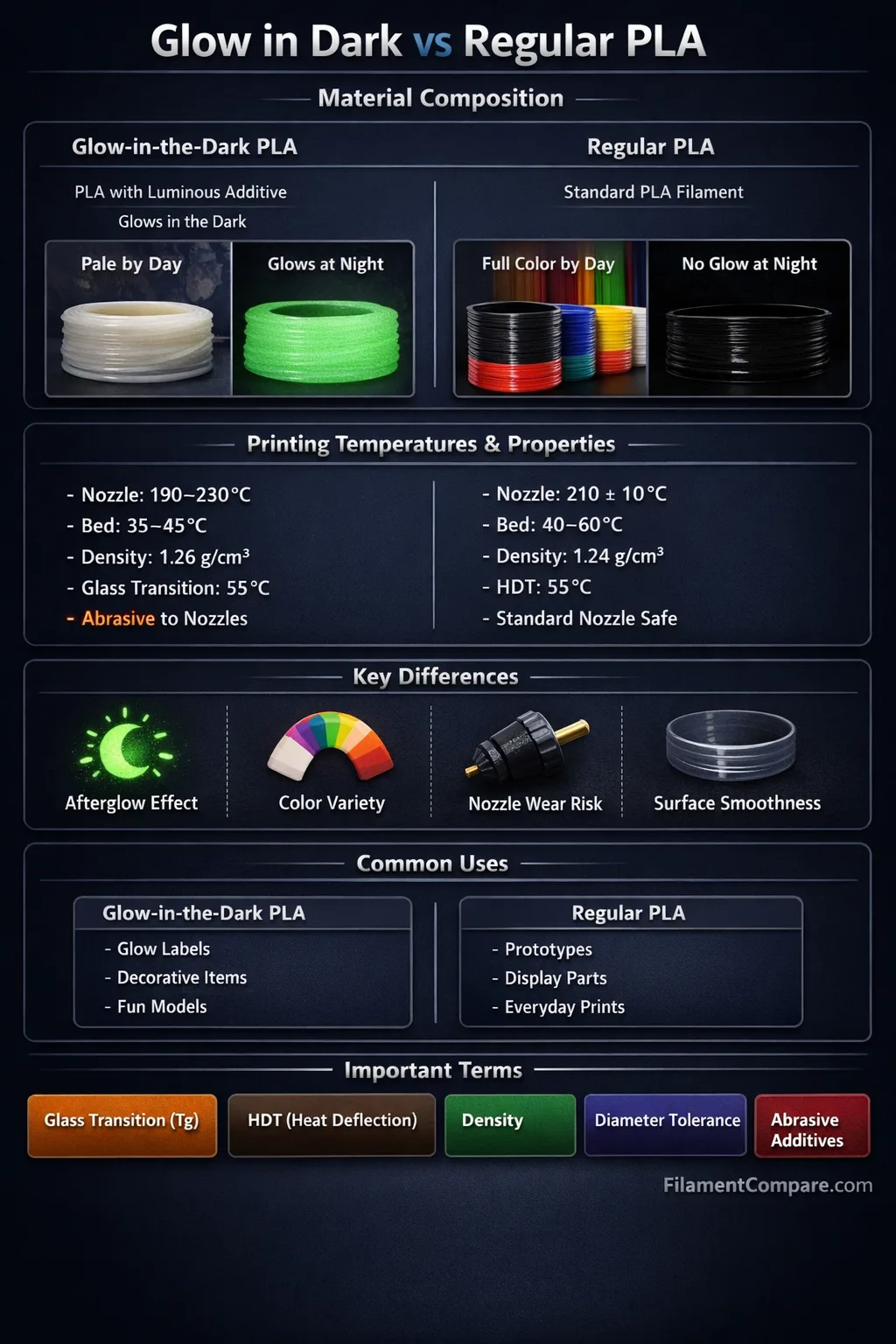
| Attribute | Glow-in-the-Dark PLA | Regular PLA |
|---|---|---|
| What It Is | PLA-based filament with a luminous additive mixed into the plastic. | PLA filament with standard pigments (or none for natural/clear variants). |
| Signature Look | Daylight: usually a soft, pale tone (often “milky”). Dark: visible afterglow after exposure to light. | Daylight: full color range (matte, glossy, transparent, etc.). Dark: no glow without special additives. |
| Where It Shines | Decorative parts, labels, night-visibility accents, playful display pieces. | General printing: prototypes, models, fixtures, educational prints, everyday parts. |
| Numbers From A Real TDS |
|
|
| Practical Watch-Out | Glow pigments can behave like fine particles, so nozzle choice matters for long-term consistency. | Regular PLA is typically gentle on standard nozzles, so hardware stays predictable over time. |
Those numbers are real datasheet examples, not universal constants. Different brands and colors can shift temperature windows and surface feel, even within PLA.
- Material Composition and Visual Behavior
- Glow-in-the-Dark PLA As A Material
- Regular PLA As A Material
- Printing Behavior and Output Consistency
- Extrusion Feel and Layer Look
- Relative Meters For Side-by-Side Feel
- Nozzles, Abrasion, and Long-Run Consistency
- Glow PLA and Abrasive Additives
- Glow Behavior and What Influences It
- Brightness, Duration, and Visual Expectations
- Use Context: Where Each Filament Usually Appears
- Glow-in-the-Dark PLA Common Roles
- Regular PLA Common Roles
- Terms You’ll See on Product Pages
Glow-in-the-Dark PLA and Regular PLA share the same familiar PLA “personality,” yet they don’t behave identically. The big change is the luminous additive inside Glow PLA, which affects appearance, light behavior, and sometimes the “feel” of extrusion. If you’re comparing filaments for a filament knowledge or filament comparison site, these are the points that actually separate them in real use.
- PLA Base + Glow Additive
- Same Printer Class, different output behavior
- Daylight Look vs Afterglow
- Nozzle Wear Awareness for Glow PLA
- Detail Printing friendly (both)
- Material Datasheets are your best reality check
Material Composition and Visual Behavior
Glow-in-the-Dark PLA As A Material
Glow-in-the-Dark PLA is still PLA, but it contains a luminous powder that absorbs light and emits a glow in the dark. This additive can make the daylight color appear more pastel or slightly cloudy, as the particles scatter light rather than act like a standard dye. Filaments like glow, silk, or wood-filled variants are often grouped as specialty 3D-printing filaments because they modify the visual or physical behavior of standard PLA.
✅Source
Regular PLA As A Material
Regular PLA usually relies on standard colorants, so the focus is consistent color accuracy, predictable surface sheen, and a wide spectrum of finishes. With fewer specialty particles in the mix, regular PLA often gives a more “clean” look under bright lighting, especially on smooth curves and large flat faces.
- Why Daylight Color Often Looks Different
- In Glow PLA, the glow additive can act like a fine filler. That changes how light travels through the filament, so Glow-in-the-Dark PLA may appear less saturated than a similar shade in Regular PLA.
- What “Glow” Really Means
- Glow is a light-storage effect. Brighter charging light and longer exposure usually produce a stronger afterglow, while very dim charging creates a softer glow.
Printing Behavior and Output Consistency
Both are PLA, so you’ll see familiar traits: clean overhangs with cooling, stable dimensional behavior, and sharp detail. The difference is that Glow PLA may feel slightly different in flow because of the luminous filler.
Extrusion Feel and Layer Look
- Glow-in-the-Dark PLA: can show a slightly grainy texture on close inspection, especially in strong side-light. Many parts still look very clean from normal viewing distance.
- Regular PLA: tends to deliver a more uniform sheen and more predictable “color read” across layers.
- Both: do well with small features and tight corners compared to higher-temp materials.
Relative Meters For Side-by-Side Feel
These meters are relative and typical, meant for quick comparison. They are not lab ratings. Brand formulation and color can move the needle.
Afterglow Presence
(visual effect)
Daylight Color Range
(variety)
Nozzle Wear Awareness
(long-term)
Surface Uniformity
(smooth look)
Nozzles, Abrasion, and Long-Run Consistency
Glow PLA and Abrasive Additives
Some Glow-in-the-Dark filaments are treated as abrasive because of the additives inside them. That’s why you’ll often see hardened nozzle discussions around Glow PLA, especially for long prints or frequent use. Some guidance also notes that hardened steel nozzles can behave a little differently than brass in heat transfer, and that can shift the temperature you end up running.
✅Source
Regular PLA is typically comfortable with standard brass nozzles. In contrast, with abrasive filaments, brass nozzles can wear faster, which is why abrasion-resistant options exist in the first place.
✅Source
- What Wear Changes In Real Prints
- Nozzle wear can subtly shift line width, which affects dimensional accuracy, surface texture, and top-layer finish. It’s not a “good vs bad” story—just a consistency variable that matters more with Glow PLA.
- How To Think About “Abrasive”
- “Abrasive” here is about hardware longevity. It does not mean unsafe or unprintable. Many people print Glow-in-the-Dark PLA daily with great results.
Glow Behavior and What Influences It
Brightness, Duration, and Visual Expectations
- Charging: stronger light generally yields a stronger afterglow.
- Geometry: thicker walls and solid infill zones can hold more of the glowing material, so the effect often looks stronger on chunky parts.
- Surface: matte textures can diffuse light and make the glow look softer, while smoother faces can look more “clean.”
- Color family: different glow colors can appear different in brightness and tone, even when printed with similar settings.
Use Context: Where Each Filament Usually Appears
Glow-in-the-Dark PLA Common Roles
- Labels and markers where a low-light cue is part of the design.
- Decor pieces that need a day-to-night visual change.
- Fun educational models that highlight material behavior and light effects.
- Art prints where the glow is a built-in “second layer” of visual interest.
Regular PLA Common Roles
- Prototypes where you want predictable dimensions and clean detail.
- Color-accurate models that rely on shade matching rather than glow.
- Display prints where surface finish and color consistency matter most.
- Everyday parts that benefit from PLA’s typical stability and sharp edges.
Terms You’ll See on Product Pages
- Glass Transition (Tg)
- The temperature range where PLA starts to soften noticeably. It’s a key reason why both Glow PLA and Regular PLA are usually treated as low-to-medium heat materials.
- HDT (Heat Deflection Temperature)
- A standardized measure that helps compare heat response under load. It’s useful for comparing PLA variants, including Glow PLA.
- Density
- Useful for weight estimates and spool comparisons. Glow additives can nudge density slightly, so glow products sometimes read a bit higher than regular PLA examples.
- Diameter Tolerance
- A stability indicator for extrusion consistency. Tighter tolerance can support more consistent flow in long prints, regardless of whether you’re using Glow PLA or Regular PLA.
- Abrasive Additives
- A label used when a filament contains particles that can accelerate nozzle wear. This is often discussed with Glow-in-the-Dark PLA and some other filled materials.
