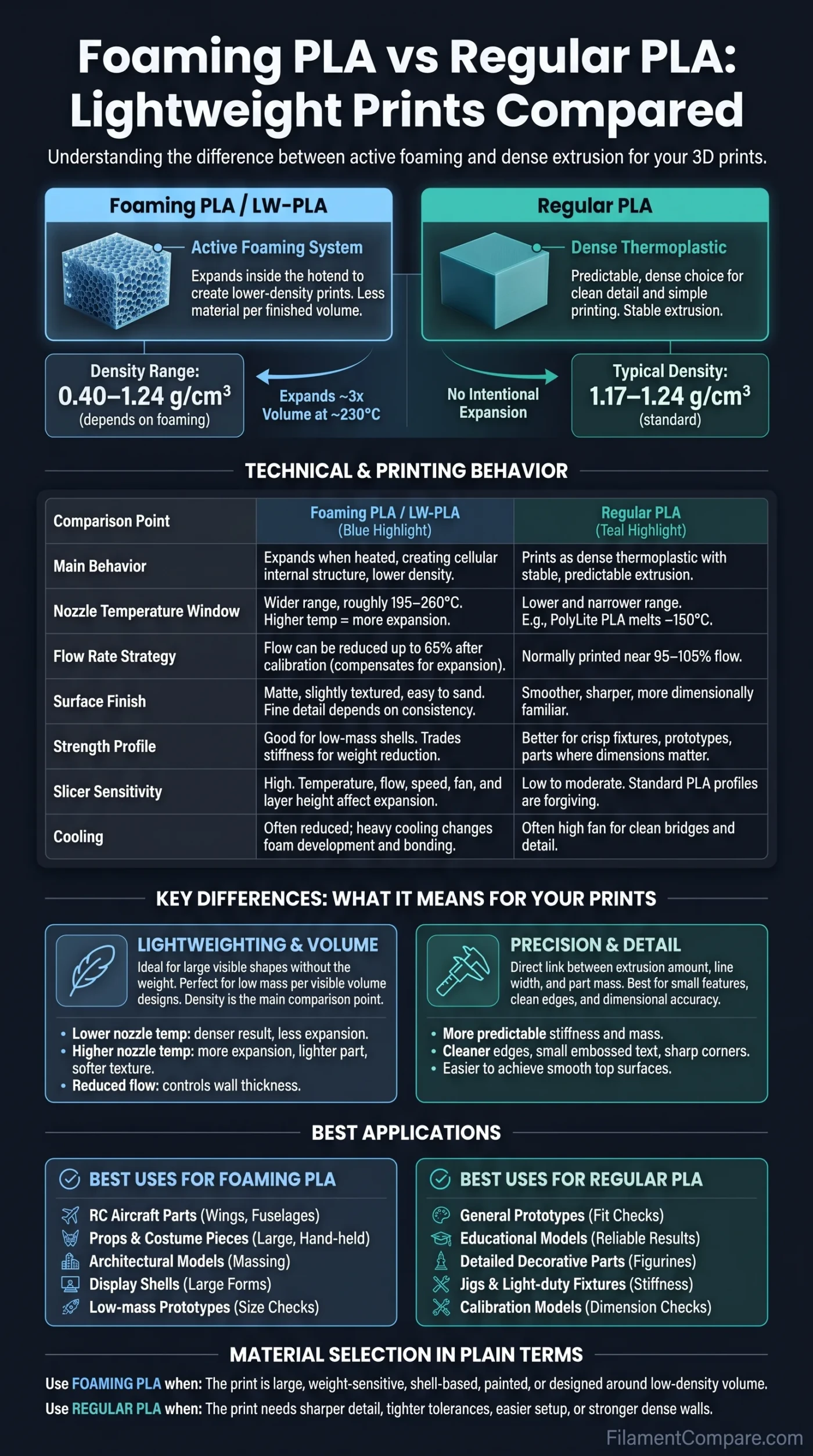
Foaming PLA and regular PLA share the same familiar base polymer family, but they behave very differently once the nozzle gets hot. Regular PLA is the predictable, dense choice for clean detail and simple printing. Foaming PLA, often sold as LW-PLA or lightweight PLA, expands inside the hotend to create lower-density prints with less material per finished volume.
| Comparison Point | Foaming PLA / LW-PLA | Regular PLA |
|---|---|---|
| Main Material Behavior | Expands when heated, creating a cellular internal structure with lower part density. | Prints as a dense thermoplastic with stable, predictable extrusion. |
| Typical Density Direction | Can print much lighter than normal PLA when foaming is activated; ColorFabb lists an injection-molded density range of 0.40–1.24 g/cm³ for LW-PLA depending on foaming state.[a] | Common PLA filament grades sit around 1.17–1.24 g/cm³, depending on brand and test method.[b] |
| Foaming Activation | ColorFabb states that LW-PLA starts foaming at around 230°C and can increase volume by nearly three times.[c] | No intentional foaming reaction. Flow stays closer to the slicer’s normal extrusion model. |
| Nozzle Temperature Window | Often printed across a wider range, roughly 195–260°C for ColorFabb LW-PLA, with higher temperatures producing more expansion.[d] | Usually lower and narrower. PolyLite PLA thermal data lists 150°C melting temperature and 61°C glass transition, while actual nozzle settings depend on machine and grade.[e] |
| Flow Rate Strategy | Flow can be reduced after calibration because expansion adds volume. ColorFabb notes users can reduce material flow by up to 65% for lightweight parts.[f] | Normally printed near 95–105% flow after extrusion calibration. |
| Surface Finish | Matte, slightly textured, and easy to sand. Fine detail depends heavily on foaming consistency. | Smoother, sharper, and more dimensionally familiar for everyday models. |
| Strength Profile | Good for low-mass shells and large visual parts. Foamed sections trade some dense-material stiffness for weight reduction. | Better for crisp fixtures, prototypes, brackets with moderate loads, and parts where dimensions matter more than weight. |
| Slicer Sensitivity | High. Temperature, flow, speed, fan, and layer height all affect expansion. | Low to moderate. Standard PLA profiles are widely available and forgiving. |
| Best-Fit Print Types | RC aircraft parts, props, costume pieces, architectural models, display shells, low-mass prototypes. | Decorative prints, prototypes, household parts, jigs, educational models, detailed objects. |
The Foaming PLA vs Regular PLA comparison below uses manufacturer datasheets, official material pages, and recognized plastics test references; values show typical trends, while real print results can shift with brand, color, nozzle size, slicer flow, cooling, and part geometry.
What Foaming PLA Changes Inside the Print
Foaming PLA is not just “PLA with a lighter label.” It contains an active foaming system that expands during extrusion. As the filament passes through the hotend, the softened polymer develops tiny internal cells. The same outer wall can occupy more volume while using less mass. That is the entire appeal.
Regular PLA behaves more like a normal dense extrusion material. The slicer asks for a line width and layer height, the printer pushes a matching amount of filament, and the part weight stays close to what the slicer estimates. With LW-PLA, the slicer’s material estimate can be misleading unless flow is tuned around the chosen foaming temperature.
In practical terms, foaming PLA lets a printed wall become thicker per gram. Regular PLA gives a more direct link between extrusion amount, final line width, and part mass.
Active Foaming vs Dense Extrusion
The main difference is expansion control. In regular PLA, dimensional accuracy depends mostly on extrusion calibration, temperature stability, cooling, and motion accuracy. In foaming PLA, those same variables still matter, but temperature also changes the physical volume of the material after it leaves the nozzle.
- Lower foaming temperature: denser result, less expansion, surface closer to regular PLA.
- Higher foaming temperature: more expansion, lower part weight, softer visual texture.
- Reduced flow: used to control wall thickness after the filament expands.
- Slower speed: gives the material more consistent heating time inside the nozzle.
Material Properties That Matter for Lightweight Prints
Regular PLA is already light compared with many engineering plastics, but foaming PLA is built for a different target: volume with less mass. That matters when a model needs a large visible shape without the weight of a fully dense part.
| Property | Foaming PLA / LW-PLA | Regular PLA | Why It Matters |
|---|---|---|---|
| Base Polymer Family | PLA-based, modified for active foaming | PLA-based, non-foaming | Both can print on common FDM printers, but tuning differs. |
| Density Behavior | Variable because expansion changes the mass-to-volume ratio | Stable; Polymaker lists PolyLite PLA density at 1.17 g/cm³ at 23°C[g] | Density is the main reason LW-PLA can reduce finished part weight. |
| Thermal Softening Range | Similar PLA thermal base, with foaming behavior added | PolyLite PLA lists a 61°C glass transition and 63°C Vicat softening temperature[h] | Neither should be treated like a high-temperature engineering filament. |
| Tensile Testing Context | Results depend strongly on foaming level and print parameters | Dense PLA values are easier to compare across profiles | Standards such as ISO 527 and ASTM D638 define controlled tensile test methods, but printed parts still depend on preparation.[i] |
| Part Feel | Light, matte, sometimes slightly cork-like | Firm, denser, more familiar plastic feel | Touch and finish can affect props, displays, and painted models. |
Density Is the Real Comparison Point
The biggest reason to compare foaming PLA vs regular PLA is not nozzle temperature. It is density. Regular PLA puts a fairly consistent amount of plastic into a given printed volume. Foaming PLA can fill that same space with less polymer because the expanded structure contains tiny gas-filled cells.
This is why a single-wall airplane part, a helmet shell, or a large display model can feel different when printed in lightweight PLA. The object may keep its shape and size while dropping grams. For weight-sensitive builds, grams are not small details. They are the design.
Strength Is Not One Simple Number
Foamed material is lower in density, so a direct dense-material strength comparison can be misleading. A foamed wall may have lower tensile strength per solid cross-section, yet still be useful when the part design benefits from thicker walls, lower mass, and better stiffness-to-weight balance. Geometry changes the result.
Regular PLA remains the more predictable choice for small mechanical prints where dimensions, screw holes, clips, and layer detail need to stay close to the CAD model. Foaming PLA is more interesting when the design target is low mass per visible volume.
Print Settings: Foaming PLA Needs a Different Mindset
Regular PLA is friendly because most slicers already understand it. A standard PLA profile usually gets close: moderate nozzle heat, heated bed, cooling fan, and normal flow. Foaming PLA can use PLA-like bed temperatures, but the hotend settings are the main control knob.
Typical Starting Ranges
- Foaming PLA nozzle: around 195–260°C for ColorFabb LW-PLA, with stronger foaming toward the upper part of the range.[j]
- Foaming PLA bed: commonly around 50–60°C for LW-PLA.
- Regular PLA bed: usually around 50–60°C, depending on surface and brand.
- Regular PLA cooling: often high fan after early layers for clean bridges and detail.
- Foaming PLA cooling: often reduced, because heavy cooling can change foam development and layer bonding.
Temperature Controls Expansion
With regular PLA, a hotter nozzle mainly changes flow, gloss, stringing, and layer bonding. With foaming PLA, heat also changes expansion ratio. Raise the temperature, and the line can swell more. Lower it, and the print behaves closer to dense PLA. Simple idea. Sensitive execution.
A tuned LW-PLA profile often uses a lower flow percentage than regular PLA. This is not under-extrusion in the usual sense; it is compensation for expansion. The goal is a full-looking wall without pushing dense-material volume through the nozzle.
Flow Calibration Is More Important Than the Label on the Spool
Two foaming PLA spools may not behave identically, especially across colors. Pigments can affect heat absorption and visible foam texture. Regular PLA colors can also vary, but the effect is usually easier to manage because there is no active expansion layer in the equation.
- Print temperature changes how much the filament expands.
- Flow percentage changes how much raw filament enters the hotend.
- Print speed changes heating time inside the melt zone.
- Fan speed changes surface cooling and bonding behavior.
Weight, Wall Thickness, and Infill Behavior
Foaming PLA is most useful when the part can be designed around shells, skins, and thicker-looking walls. A dense regular PLA print with high infill can become heavier fast. A foamed PLA print can look large without carrying the same mass.
| Slicer Choice | Foaming PLA Effect | Regular PLA Effect |
|---|---|---|
| Wall Count | Can create surprisingly light shells when flow is tuned. | Adds predictable strength and weight with each perimeter. |
| Layer Height | Large layer heights can pair well with expansion for fast, light visual parts. | Large layer heights reduce detail but keep dense material behavior. |
| Infill Percentage | Low infill often works well for display shells and aircraft-style parts. | Higher infill gives more predictable stiffness and mass. |
| Line Width | Expanded material can make thicker lines than expected if flow is not reduced. | Line width follows slicer commands more directly. |
| Top Layers | Foamed surfaces may need tuning to avoid uneven top skin texture. | Top surfaces are easier to make smooth with normal PLA settings. |
Why Foaming PLA Can Save More Than Filament Weight
The material saving is not only about grams on the scale. If a part can use fewer perimeters, lower flow, or larger layers, print time can also change. ColorFabb notes that the expanding properties can be used with larger layer heights or thick single perimeters to reduce print time in suitable models.[k]
That does not make foaming PLA a universal faster-printing material. For tiny parts, detailed lettering, threaded features, or tight fits, regular PLA can be more direct. Less setup. Fewer surprises.
Surface Finish and Detail Quality
Regular PLA usually wins on sharp corners, small embossed text, clean edges, and fine decorative detail. It cools into a dense bead, so the printer’s motion system and slicer settings have a clearer link to the final surface.
Foaming PLA has its own look: matte, soft, low-gloss, and slightly textured. That texture can be useful for aircraft, props, cosplay pieces, terrain, and architectural models. It hides layer shine well. It also sands nicely compared with many glossy PLA grades.
Where Regular PLA Looks Cleaner
- Small text, logos, and embossed labels
- Dimensional calibration pieces
- Decorative models with crisp edges
- Parts with tight holes, pins, sockets, or snap-fit zones
- Visual prints where glossy or silk-like surfaces are desired
Where Foaming PLA Looks More Natural
- Aircraft wings, fuselage sections, and lightweight shells
- Large props that need low hand-held weight
- Architectural massing models
- Painted display parts where a matte base is helpful
- Models where low weight matters more than tiny details
Dimensional Accuracy and Tolerances
Regular PLA is easier to predict because extrusion volume is more stable. A calibrated printer can produce clean holes, repeatable wall thickness, and reliable part fit. This is why regular PLA remains a common choice for prototypes and functional test parts.
Foaming PLA can still print accurate parts, but the route is less direct. If temperature rises, expansion may increase. If flow is too high, walls may swell. If speed changes across the model, some regions may receive different heat exposure. The model prints, but tolerances need attention.
For tight assemblies, regular PLA is usually the safer material. For large low-mass shapes, foaming PLA offers the more interesting weight advantage.
Mechanical Behavior in Real Printed Parts
Dense PLA parts often feel stiff. That stiffness is useful for brackets, fixtures, gauges, drawer organizers, and clean prototypes. Foaming PLA behaves differently because the printed line contains internal cells. The part can feel light and somewhat softer, especially at higher expansion settings.
The comparison becomes more fair when part design is included. A foamed part may use thicker walls for the same mass, while a regular PLA part may use thinner but denser walls. The best answer depends on the load direction, wall layout, layer bonding, and whether the part is meant to resist bending, crushing, vibration, or simple handling.
| Part Requirement | Better Fit | Reason |
|---|---|---|
| Lowest possible shell weight | Foaming PLA | Expansion can reduce mass while keeping visible volume. |
| Small stiff bracket | Regular PLA | Dense extrusion gives more predictable stiffness and hole accuracy. |
| Large painted prop | Foaming PLA | Low weight and matte texture are useful for handling and finishing. |
| Tight mechanical fit | Regular PLA | Less expansion-related variation around edges and openings. |
| Single-wall aircraft-style print | Foaming PLA | Thin shells can gain useful wall volume without dense material mass. |
| Detailed desk model | Regular PLA | Sharper surface detail and easier slicer control. |
Heat Resistance and Environmental Limits
Both materials remain PLA-family filaments, so neither should be treated like polycarbonate, nylon, PPS, PEI, or other high-temperature materials. Regular PLA datasheets commonly place glass transition near the low 60°C range; PolyLite PLA lists 61°C glass transition and 58–60°C heat deflection values depending on load.[l]
Foaming PLA does not remove that PLA-family thermal character. The part is lighter, but the polymer base still softens in warm environments. A foamed shell left under heat can lose shape more easily than the same part stored indoors at normal room temperature.
Moisture, Storage, and Print Consistency
PLA is not the most moisture-sensitive FDM material, yet dry filament still prints more consistently. Foaming PLA benefits from stable storage because inconsistent moisture and heat behavior can affect surface texture, tiny bubbles, and stringing. Regular PLA also benefits from dryness, especially for clean walls and reduced popping.
Cost and Material Efficiency
Foaming PLA spools can cost more per kilogram than basic PLA. That price comparison alone is incomplete. If the material is tuned so one printed object uses much less filament mass, the cost per finished lightweight part can become attractive.
Regular PLA is usually cheaper, widely stocked, and available in many colors, finishes, blends, and spool sizes. It is the practical everyday option. Foaming PLA is more specialized. It earns its place when low finished weight is part of the design target, not just a nice bonus.
Best Uses for Foaming PLA
Foaming PLA fits projects where size matters more than dense strength. Large shells are its natural home. The material shines when a print needs volume, paintability, and easy handling without the mass of regular PLA.
- RC aircraft: wings, fuselages, stabilizers, and lightweight aerodynamic shells.
- Props and costume parts: large forms that are carried, worn, or painted.
- Architectural models: large massing models that remain easy to transport.
- Display shells: big objects with low internal load.
- Low-density prototypes: models used to check size and visual form without heavy material use.
Best Uses for Regular PLA
Regular PLA remains the baseline for FDM printing because it balances detail, stiffness, availability, and easy setup. It is often the better option when the part has small features, needs clean edges, or must match a drawing closely.
- General prototypes: fit checks, visual models, simple product mockups.
- Educational prints: reliable results across many printers and classrooms.
- Detailed decorative parts: figurines, desk objects, labels, and fine geometry.
- Jigs and light-duty fixtures: parts where dense stiffness is useful.
- Calibration models: dimension checks, flow tuning, and machine testing.
Print Profile Differences That Affect the Final Part
A regular PLA profile can often be shared across printers with small changes. A foaming PLA profile is more personal to the machine. The hotend design, nozzle material, heater block stability, part cooling duct, extrusion path, and filament color can all change the final foam level.
| Profile Area | Regular PLA Approach | Foaming PLA Approach |
|---|---|---|
| Extrusion Multiplier | Calibrate for accurate line width. | Calibrate after choosing foaming temperature; lower flow may be normal. |
| Temperature Tower | Used mainly for stringing, bonding, and surface finish. | Used to map expansion, density, texture, and wall swelling. |
| Retraction | Standard PLA values usually work after small tuning. | May need adjustment because expanded material can string differently. |
| Cooling | High fan often supports detail and bridging. | Reduced cooling can support smoother foam behavior and bonding. |
| Speed | Moderate to fast speeds are common on tuned machines. | Slower or steadier speeds help keep expansion more even. |
When Foaming PLA Is the Better Choice
Choose foaming PLA when the part is large, lightly loaded, and weight-sensitive. It is especially useful when the design can use single walls, thick-looking shells, or low infill. It also makes sense when the print will be sanded, filled, and painted.
It is a strong match for objects that need to feel light in the hand. Big shape, low mass. That is the point.
When Regular PLA Is the Better Choice
Choose regular PLA when the part needs clean dimensions, simple setup, fine detail, or predictable stiffness. It is also the better first material for testing a new printer, checking slicer behavior, or printing small functional pieces where foam expansion would add unnecessary variables.
Regular PLA is not less advanced; it is simply more direct. For many parts, direct is exactly what you want.
Foaming PLA vs Regular PLA by Application
| Application | Foaming PLA Fit | Regular PLA Fit | Material Logic |
|---|---|---|---|
| RC Plane Wing | Very strong fit | Usable, but heavier | Foamed shells help reduce wing loading. |
| Cosplay Helmet | Strong fit | Also usable | Foaming PLA reduces wearing weight; regular PLA gives sharper raw detail. |
| Gear or Moving Part | Limited fit | Better fit | Dense, predictable geometry matters more than low mass. |
| Architectural Massing Model | Strong fit | Good fit | Large scale and low transport weight favor foaming PLA. |
| Miniature With Fine Detail | Limited fit | Strong fit | Regular PLA holds small edges and surfaces more cleanly. |
| Painted Display Prop | Strong fit | Good fit | Matte texture and low mass help large painted objects. |
| Shop Jig | Situational | Strong fit | Regular PLA gives simpler dimensional control. |
Common Misunderstandings About Lightweight PLA
Foaming PLA Is Not Just Hollow PLA
A hollow regular PLA print removes internal material through slicer settings. Foaming PLA changes the material structure of the printed bead itself. Both can reduce weight, but they do it through different mechanisms.
Lower Flow Does Not Always Mean Under-Extrusion
With regular PLA, low flow usually causes thin walls and weak bonding. With foaming PLA, lower flow can be correct after expansion is activated. The raw filament amount is lower, but the expanded bead may still fill the intended space.
More Heat Is Not Automatically Better
Higher temperature can create stronger expansion, but the best print is not always the lightest possible one. Surface quality, wall consistency, layer adhesion, and part geometry still matter. Balance beats maximum foam.
Buying and Testing Considerations
For regular PLA, most users can compare color, price, tolerance, spool size, and brand reputation. For foaming PLA, the better comparison includes expansion behavior, recommended temperature window, spool weight, and whether the brand provides clear printing data.
- Check whether the filament is truly active foaming PLA, not just a matte PLA blend.
- Look for manufacturer temperature ranges and flow guidance.
- Expect a calibration print before using it on a large model.
- Compare part weight after printing, not only slicer-estimated grams.
- Use the same nozzle, layer height, and speed when comparing two profiles.
Material Selection in Plain Terms
- Use foaming PLA when
- The print is large, weight-sensitive, shell-based, painted, sanded, or designed around low-density volume.
- Use regular PLA when
- The print needs sharper detail, tighter tolerances, easier setup, stronger dense walls, or more predictable slicer behavior.
- The main trade
- Foaming PLA gives lower mass and a matte cellular structure; regular PLA gives cleaner control and denser, familiar part behavior.
Resources Used
- [a] ColorFabb LW-PLA Technical Datasheet: ColorFabb LW-PLA TDS
- [b] Polymaker PolyLite PLA Technical Data Sheet: PolyLite PLA TDS
- [c] ColorFabb LW-PLA Natural Product Page: LW-PLA Natural
- [d] ColorFabb LW-PLA Printing Information: How to Print with ColorFabb LW-PLA
- [e] Polymaker PolyLite PLA Thermal Properties: PolyLite PLA Thermal Data
- [f] ColorFabb LW-PLA Flow Guidance: LW-PLA Flow and Expansion Data
- [g] Polymaker PolyLite PLA Density Data: PolyLite PLA Density
- [h] Polymaker PolyLite PLA Vicat and Glass Transition Data: PolyLite PLA Thermal Table
- [i] ASTM D638 Tensile Properties of Plastics: ASTM D638
- [j] ColorFabb LW-PLA Nozzle and Bed Temperature Range: LW-PLA Print Settings
- [k] ColorFabb LW-PLA Expansion and Print-Time Note: LW-PLA Expansion Details
- [l] Polymaker PolyLite PLA Heat Deflection Data: PolyLite PLA HDT Data
