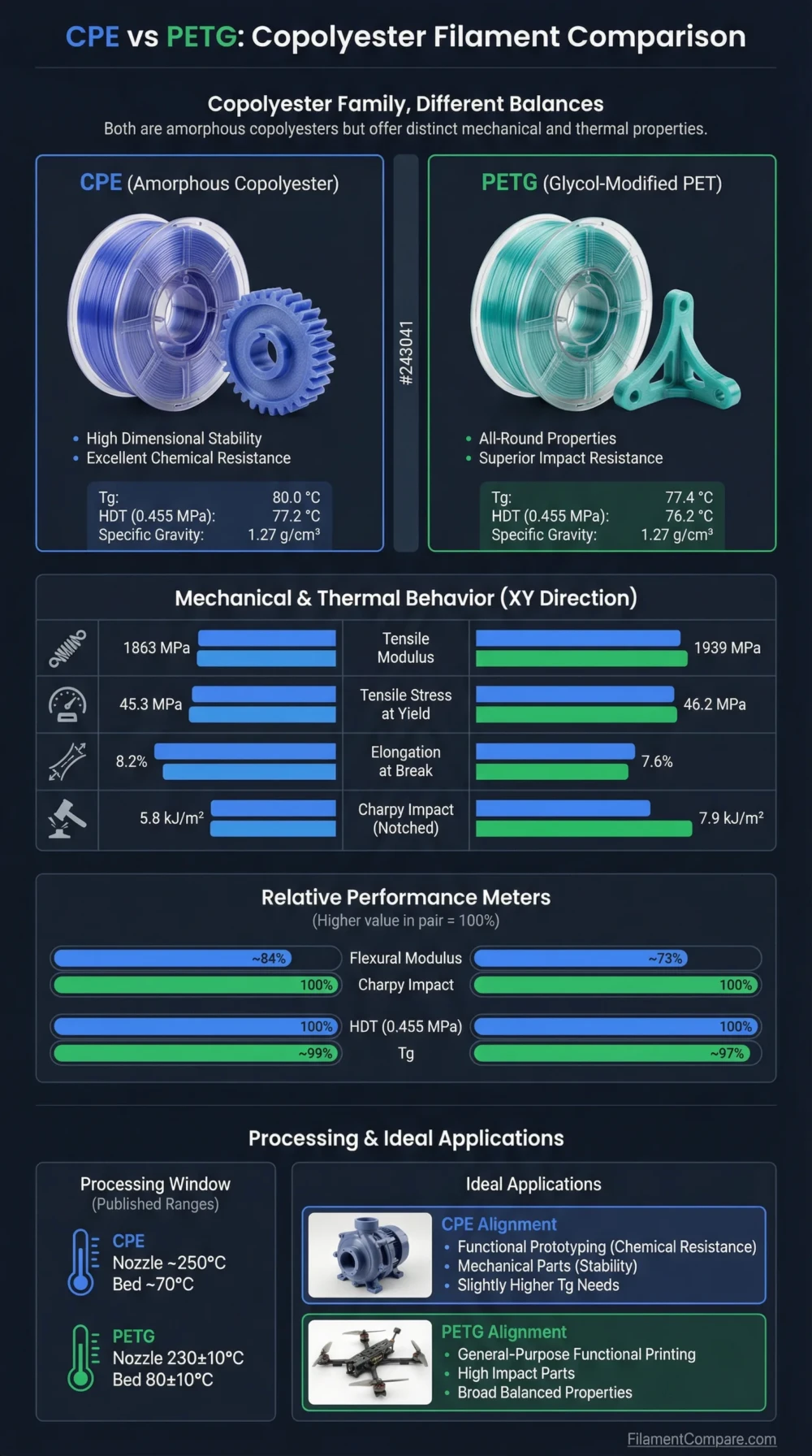
CPE is usually the tougher, more engineering-focused copolyester, while PETG is the easier and more widely available choice for everyday functional prints. Both materials belong to the PET-based copolyester family, but CPE grades are often tuned for higher impact resistance, chemical resistance, and cleaner technical parts. PETG still makes more sense when you want lower cost, simple printer setup, and reliable layer adhesion without moving into more demanding materials.
Choose CPE for technical housings, tougher prototypes, chemical-exposed parts, and prints where PETG feels a little too soft or stringy for the job.
Choose PETG for general functional parts, brackets, containers, printer upgrades, and low-warp prints where cost and availability matter.
There is no universal winner here. CPE is the more capable engineering option in many grades; PETG is the more practical daily-use filament for most desktop FDM users.
Best for Everyday Functional Prints
PETG is the easier default for brackets, mounts, covers, and workshop parts.
Better for Technical Prototypes
CPE fits better when the part needs toughness, stiffness balance, and a more engineering-oriented feel.
Better for Cost Control
PETG is usually cheaper, easier to source, and available in more colors and spool sizes.
Better Chemical Resistance Potential
CPE grades are often selected for improved resistance to cleaning agents, oils, alcohols, and mild chemical exposure.
Better Printer Compatibility
PETG works well on most open-frame printers with a heated bed and basic temperature tuning.
Better for Impact-Tolerant Parts
CPE is usually the stronger pick when the part may be dropped, flexed, or hit during use.
Better for Translucent Technical Parts
CPE can produce clean translucent prints in selected grades, especially when printed slowly and hot enough.
Better for Fast Iteration
PETG is easier to test, replace, and reprint when you are refining a design.
| Property | CPE | PETG | Better Choice |
|---|---|---|---|
| Material Family | Copolyester; often modified for technical printing | Polyethylene terephthalate glycol copolymer | Both are PET-based copolyesters |
| Print Difficulty | Moderate; grade-dependent and more tuning-sensitive | Easy to moderate; widely profiled | PETG |
| Typical Nozzle Temperature | Usually around 240–275 °C depending on grade; CPE HG100 lists 255–275 °C[a] | Usually around 220–250 °C; Prusament PETG V0 lists 230 ± 10 °C[b] | PETG for lower-temperature printers |
| Typical Bed Temperature | Usually 70–85 °C depending on brand | Usually 70–90 °C depending on surface and brand | Similar |
| Enclosure Requirement | Not always required, but a stable warm environment helps larger parts | Usually not required | PETG |
| Heat Resistance | Grade-dependent; some CPE and CPE+ grades are positioned above standard PETG | Moderate; Ultimaker PETG reports HDT at 76.2 ± 0.8 °C under its test setup[c] | CPE in higher-grade formulations |
| Toughness | Usually higher impact tolerance in technical grades | Good toughness for general functional prints | CPE |
| Stiffness | Moderate; depends heavily on grade and additives | Moderate; less brittle than PLA, less stiff than many PLA grades | Grade-dependent |
| Layer Adhesion | Good when printed hot enough and dry | Good; one of PETG’s main strengths | Both |
| Moisture Sensitivity | Can absorb moisture enough to affect clarity, stringing, and surface quality | Also moisture-sensitive, but often more forgiving in casual use | PETG |
| Stringing and Oozing | Can string if wet or printed too hot | Prone to stringing; tuning retraction and cooling is often needed | Both need tuning |
| Surface Finish | Can look cleaner and more technical, especially in translucent grades | Smooth, glossy, sometimes slightly gummy on fine details | CPE for refined technical finish |
| Outdoor Suitability | Useful for mild outdoor use in suitable grades, but not a substitute for ASA or UV-stabilized materials | Common for mild outdoor parts; long UV exposure can still degrade color and properties | Depends on formulation |
| Typical Uses | Technical prototypes, housings, fixtures, translucent parts, chemical-exposed covers | Printer parts, organizers, brackets, containers, practical household and workshop parts | Use-case based |
| Main Limitation | Higher print temperature, higher price, fewer ready-made profiles | Stringing, strong bed adhesion, less refined overhang/detail behavior | Different limits |
This CPE and PETG comparison uses manufacturer datasheets, material guides, and practical FDM behavior as a general trend; real results can shift with brand, color, additives, drying, nozzle temperature, part orientation, and slicer profile.
CPE Material Profile
- Polymer type: Copolyester, often modified for technical FDM printing.
- Print difficulty: Moderate; easier than nylon or PC, usually less casual than PETG.
- Nozzle range: Commonly around 240–275 °C, with some grades needing the upper end.
- Bed range: Usually around 70–85 °C.
- Enclosure: Helpful for larger parts, not always required for small prints.
- Drying need: Recommended when surface quality, clarity, and string control matter.
- Typical behavior: Tough, smooth, chemical-resistant, and more technical than standard PETG.
- Best use cases: Housings, fixtures, prototypes, fluid-adjacent covers, and translucent engineering parts.
PETG Material Profile
- Polymer type: Glycol-modified PET copolyester for FDM printing.
- Print difficulty: Easy to moderate; common printer profiles are widely available.
- Nozzle range: Usually around 220–250 °C depending on brand and speed.
- Bed range: Usually around 70–90 °C.
- Enclosure: Usually not needed.
- Drying need: Useful when the spool strings, pops, or leaves rough surfaces.
- Typical behavior: Tough, low-warp, glossy, with strong layer bonding and some stringing.
- Best use cases: Brackets, printer upgrades, storage parts, jigs, covers, and general functional objects.
The scores above are relative FDM-use indicators, not fixed lab ratings. Brand, additives, moisture level, color, print direction, nozzle size, cooling, and slicer settings can change the result.
Printability and Tuning Behavior
PETG is the easier material for most users because it has mature slicer profiles, runs on common all-metal and PTFE-lined hotends, and does not usually need an enclosure. Its main tuning issue is stringing. A dry spool, slightly lower nozzle temperature, calibrated retraction, and controlled part cooling usually improve the result.
CPE is not difficult in the same way as nylon or polycarbonate, but it gives less room for a weak setup. Many CPE grades need more nozzle heat, stable bed temperature, and slower printing for clean surfaces. If the printer has unstable extrusion, poor cooling control, or limited hotend temperature, PETG will feel more predictable.
Bed adhesion also behaves differently. PETG can bond very strongly to smooth PEI and glass, so a release layer may be needed on some surfaces. CPE also needs a compatible build surface, but it is usually selected by users who already expect to tune adhesion and drying rather than use one generic profile for every spool.
Mechanical Behavior and Part Strength
PETG is strong in the practical desktop-printing sense: it bends more before failure than PLA, bonds layers well, and keeps warping low. That makes it useful for brackets, covers, hooks, holders, and printer parts. But PETG can feel slightly flexible or gummy where a part needs a sharper, more technical response.
CPE is often chosen when PETG is close, but not enough. Higher-grade CPE materials can offer better impact behavior, improved dimensional feel, and a cleaner engineering finish. Ultimaker CPE+ reports high toughness behavior with elongation above 100% before break in its overview, while its printed mechanical values also show strong orientation effects[d]. That orientation note matters: a flat test bar and a real printed bracket do not always fail the same way.
For snap-fit geometry, neither material should be treated like nylon. PETG works for mild clips if the design avoids sharp stress points. CPE can be better for tougher functional housings, but repeated flexing still depends on wall thickness, radius design, layer direction, and material grade.
Heat Resistance and Shape Retention
Both materials tolerate heat better than basic PLA, but neither should be treated as a high-temperature engineering plastic. PETG is often comfortable for warm indoor parts, printer components near moderate heat, and utility objects that may see occasional warmth. It is not the right default for sustained high-temperature loads.
CPE can have the advantage when the grade is designed for higher thermal resistance. Some CPE variants are marketed around 80–100 °C resistance depending on the product line, but this does not mean every CPE spool will behave the same. Load, wall thickness, annealing, airflow, and the exact test method all affect real part deformation.
For hot car interiors, machine enclosures, or parts near motors, choose carefully. CPE may outperform standard PETG, but ASA, PC, nylon blends, or filled engineering materials may be more suitable when the part must hold shape under sustained heat.
Moisture, Stringing, and Surface Quality
Moisture affects both CPE and PETG. A wet spool may string more, pop during extrusion, lose clarity, and create a rougher surface. PETG is often more forgiving because users accept a little stringing on practical prints, but drying still improves results.
CPE benefits more from controlled storage when the goal is a clean technical surface. Translucent CPE especially shows moisture and extrusion inconsistency. If the surface needs to look clean, dry the spool before printing and store it sealed with desiccant after use.
Stringing is not only a material issue. Nozzle temperature, travel speed, retraction distance, pressure advance, hotend design, and cooling all matter. PETG can often be tuned quickly. CPE may need more testing because many brands use different copolyester blends under the CPE name.
Outdoor, Chemical, and Water Exposure
PETG is commonly used for mild outdoor and water-adjacent parts because it prints with low warp and has good layer bonding. Prusa lists PETG as tough, low-warp, and suitable for mechanical parts, while also noting stringing, strong bed adhesion, and weaker bridging behavior[e]. That makes PETG a sensible choice for covers, organizers, brackets, and protective housings that are not safety-critical.
CPE is more attractive when chemical resistance is part of the decision. Selected CPE grades are positioned for resistance to acids, alkalis, alcohols, hydrocarbons, and cleaning exposure. Even then, the final choice should be tested with the actual liquid, concentration, temperature, and exposure time. A printed part has layer lines and porosity that an injection-molded test sample may not have.
For long-term UV exposure, neither standard PETG nor standard CPE should be presented as weatherproof. ASA or UV-stabilized grades are safer choices when sunlight, color retention, and long outdoor service life are the main requirements.
| Use Case | Better Material | Reason |
|---|---|---|
| Beginner functional prints | PETG | More profiles, lower cost, and easier troubleshooting. |
| Printer upgrades and brackets | PETG | Good layer adhesion, low warp, and easy replacement. |
| Technical prototypes | CPE | Cleaner engineering feel and better toughness potential. |
| Chemical-exposed covers | CPE | Selected grades offer stronger chemical resistance potential. |
| Large flat parts | PETG | Usually easier to control on open-frame printers. |
| Translucent housings | CPE | Can produce cleaner translucent technical parts in suitable grades. |
| Low-budget production | PETG | Cheaper spools and wider supplier choice. |
| Impact-tolerant fixtures | CPE | Higher-grade CPE can absorb impact better than many standard PETG grades. |
| Decorative glossy prints | PETG | Glossy finish and broad color availability. |
| Warm indoor mechanical parts | CPE | Some grades offer better shape retention than standard PETG. |
| Containers and organizers | PETG | Reliable, practical, and easy to reprint. |
| Fine detail models | Neither as first choice | PLA usually gives cleaner small detail and sharper corners. |
Choose CPE When
- The part needs more toughness than standard PETG.
- You want a technical-looking surface, especially in translucent grades.
- Chemical resistance matters more than spool price.
- Your printer can run higher nozzle temperatures reliably.
- You are printing housings, fixtures, prototypes, or covers for demanding use.
CPE Is Less Suitable When
- Your printer cannot maintain the required nozzle temperature.
- You need the cheapest functional filament.
- You do not want to dry or tune the material.
- You need many color choices from local suppliers.
Choose PETG When
- You want a reliable daily functional filament.
- The print must have good layer adhesion with low warping.
- You are making brackets, organizers, covers, mounts, and printer parts.
- You want easier profiles and broad availability.
- Cost matters more than higher-grade chemical or impact performance.
PETG Is Less Suitable When
- The part needs cleaner fine detail or sharp small features.
- Stringing and glossy surfaces are a problem for the design.
- The part will face sustained heat close to PETG’s softening range.
- You need stronger chemical resistance than standard PETG can offer.
Best Settings Range
Use these ranges as starting points, not fixed values. Always follow the spool label first.
CPE Starting Range
- Nozzle: 240–275 °C
- Bed: 70–85 °C
- Cooling: low to moderate
- Speed: moderate; slow down for surface quality
- Drying: useful before demanding prints
PETG Starting Range
- Nozzle: 220–250 °C
- Bed: 70–90 °C
- Cooling: moderate after first layers
- Speed: moderate; slow down for stronger bonding
- Drying: useful when stringing rises
Tuning Priorities
- Dry the spool if surfaces look rough.
- Reduce temperature if stringing is heavy.
- Increase temperature if layer bonding is weak.
- Use a release layer if bed adhesion is too strong.
- Test part orientation before loading the print in use.
Choose CPE if the part is a technical prototype, housing, fixture, translucent engineering print, or chemical-adjacent component where higher material performance is worth extra tuning.
Choose PETG if the part is a practical everyday print and you want strong layer adhesion, low warp, wide availability, and lower material cost.
For most hobby and workshop prints, PETG is the safer default. For more demanding technical parts, CPE is the upgrade path before moving to nylon, PC, ASA, or filled engineering grades.
Common CPE and PETG Questions
Is CPE stronger than PETG?
CPE is often tougher and more impact-tolerant in technical grades, but “stronger” depends on the property. PETG can still have very good tensile behavior and layer adhesion. Compare tensile strength, impact resistance, stiffness, and print orientation rather than using one strength label.
Is CPE harder to print than PETG?
Usually yes. CPE often needs higher nozzle temperature, better drying, and more careful tuning. PETG is easier for most open-frame desktop printers.
Can PETG replace CPE?
PETG can replace CPE for many basic functional parts, especially when the part is not exposed to demanding heat, impact, or chemicals. It is not a direct replacement for higher-grade CPE in technical use.
Can CPE replace PETG?
CPE can replace PETG when the printer supports it and the extra cost is acceptable. For simple brackets, containers, and organizers, PETG is usually more practical.
Do CPE and PETG need drying?
Both benefit from drying. Wet filament can cause stringing, popping, cloudy surfaces, weak details, and inconsistent extrusion. CPE shows these issues more clearly when surface finish or transparency matters.
Which is better for outdoor prints?
Both can work for mild outdoor use, depending on grade and design. For long sunlight exposure, ASA or a UV-stabilized material is usually a better target than standard PETG or standard CPE.
Resources Used
- [a] CPE HG100 | Fillamentum (Used for CPE HG100 print temperature, heated bed range, heat resistance notes, chemical resistance positioning, and CPE-vs-PETG product comparison context.)
- [b] Technical datasheet — Prusament PETG V0 by Prusa Polymers (Used for PETG print setting range, especially nozzle and bed temperature values.)
- [c] Ultimaker PETG Technical data sheet (Used for PETG HDT, Vicat, glass transition, density, and printed mechanical property context.)
- [d] Ultimaker CPE+ Technical data sheet (Used for CPE+ toughness, temperature resistance, chemical resistance notes, and print-orientation-sensitive mechanical behavior.)
- [e] PETG | Prusa Knowledge Base (Used for practical PETG print behavior, including stringing, layer adhesion, bed adhesion, heated bed use, and typical applications.)
