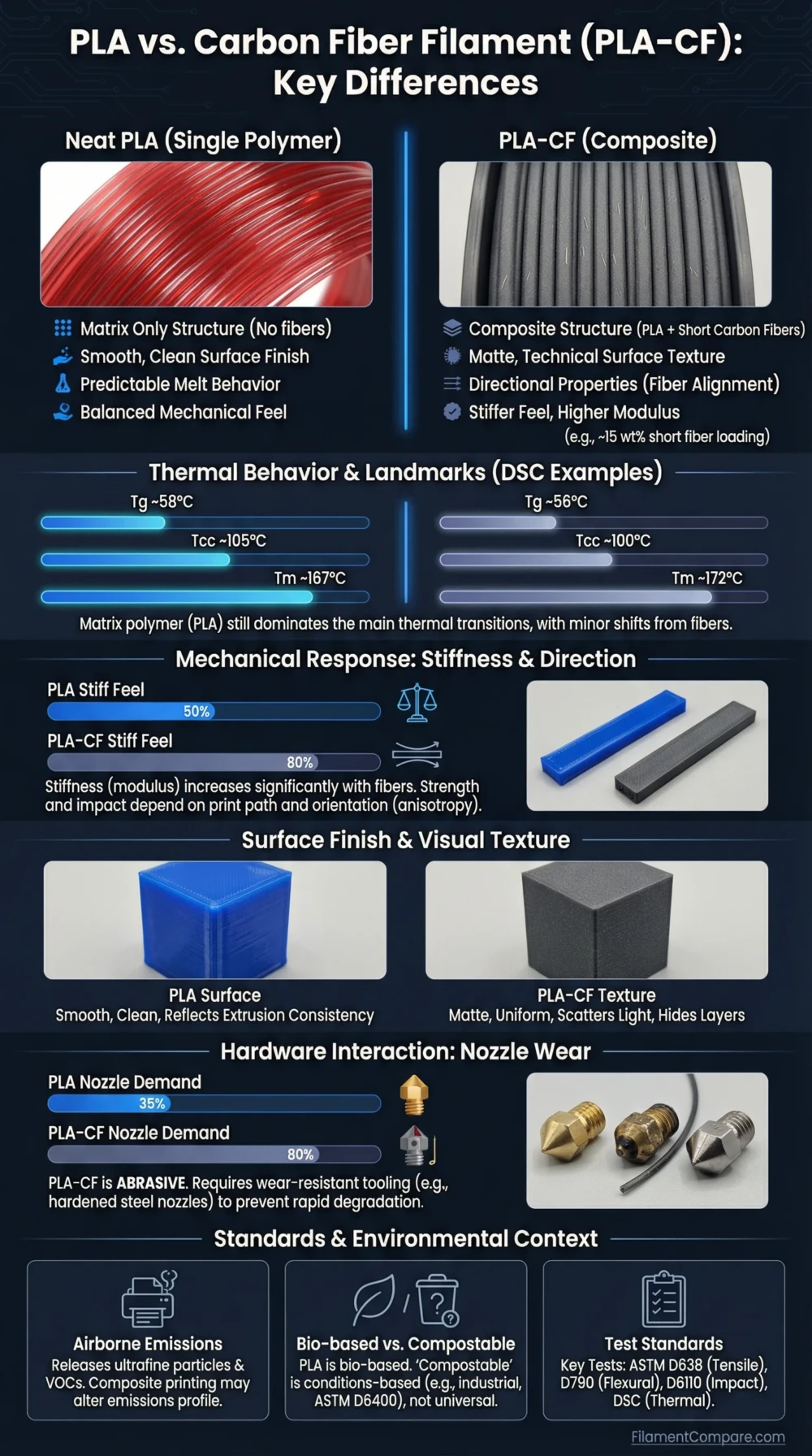
Carbon fiber-filled filament is stiffer, more dimensionally stable, and more wear-resistant than standard PLA, while PLA is easier, cheaper, and safer for everyday printing on a basic desktop machine. The choice is not only “carbon fiber vs PLA”; it also depends on the base polymer behind the carbon fiber blend, such as PLA-CF, PET-CF, PA-CF, or PC-CF. For simple models, prototypes, school projects, and decorative parts, PLA is usually the cleaner choice. For rigid brackets, jigs, fixtures, matte technical parts, and low-warp engineering prints, carbon fiber-filled filament can make more sense.
Choose PLA if you want easy printing, low nozzle wear, bright color options, smooth detail, and a low-cost material for visual models or light-duty parts.
Choose carbon fiber-filled filament if you need a stiffer part, a matte technical surface, better dimensional stability, lower shrinkage, and a material that keeps flat or thin parts more controlled during printing.
For heat resistance, do not judge carbon fiber alone. PLA-CF is still limited by PLA’s heat behavior, while PC-CF or PA-CF can handle warmer and more demanding use cases.
Best for Beginners
PLA is the safer starting point because it prints with lower temperatures, less tuning, and no hardened nozzle requirement.
Better for Rigid Fixtures
Carbon fiber-filled filament is better when stiffness and shape control matter more than impact flex.
Lower Nozzle Wear
PLA works well with common brass nozzles. Carbon fiber additives are abrasive and need hardened steel or similar wear-resistant nozzles.
Better Matte Technical Finish
Carbon fiber-filled filament usually produces a muted, fine-textured surface that hides layer lines better than glossy PLA.
Better for Low-Warp Printing
Both can print with low warp, but carbon fiber reinforcement often reduces shrinkage in the base polymer and helps large flat parts stay controlled.
Better for Bright Visual Prints
PLA offers more colors, silk effects, translucent grades, marble blends, matte grades, and decorative variants.
Better Heat Option
Carbon fiber-filled PC, PA, or PET blends can outperform PLA in heat, but PLA-CF should not be treated as a high-temperature material.
Better Cost Control
PLA is usually cheaper per kilogram and does not add nozzle replacement cost to regular printing.
| Category | Carbon Fiber-Filled Filament | PLA | Better Choice |
|---|---|---|---|
| Material Family | Composite filament: chopped carbon fiber mixed into a base polymer such as PLA, PET, PA, ASA, or PC | Polylactic acid thermoplastic polyester, usually sold as standard PLA, PLA+, matte PLA, silk PLA, or tough PLA | Depends on the part |
| Print Difficulty | Moderate; depends heavily on base polymer and abrasive nozzle needs | Easy; one of the most beginner-friendly FDM materials | PLA |
| Typical Nozzle Temperature | Usually about 210–300 °C depending on base polymer; PC-CF can need around 285 ± 10 °C[a] | Usually about 190–230 °C; Prusament PLA lists 210 ± 10 °C[b] | PLA for basic printers |
| Typical Bed Temperature | Usually 35–110 °C depending on formulation and build surface | Usually 40–60 °C, with many PLA prints working on PEI, glass, or textured plates | PLA |
| Enclosure Requirement | Not always needed for PLA-CF or some PC-CF grades, but useful or required for many PA-CF, ABS-CF, and ASA-CF materials | Usually not required | PLA |
| Nozzle Requirement | Hardened steel, tungsten carbide, ruby, or another abrasion-resistant nozzle is strongly recommended | Standard brass nozzle is normally fine | PLA |
| Heat Resistance | Grade-dependent. PLA-CF remains PLA-limited; PC-CF and PA-CF can be much better | Typically low; Prusament PLA lists HDT around 55 °C under ISO 75 conditions[c] | Carbon fiber blend, if the base polymer supports heat |
| Toughness | Can be rigid but sometimes more brittle than the unfilled base polymer; impact behavior is formulation-dependent | Standard PLA is stiff but less impact-tolerant than tougher materials; tough PLA grades vary | Depends on grade |
| Stiffness | Usually higher due to carbon fiber reinforcement | Good stiffness for easy prints, but less rigid than many CF-filled blends | Carbon fiber-filled filament |
| Layer Adhesion | Can be more tuning-sensitive; fibers may reduce ductility across layers in some grades | Generally reliable when printed in the correct temperature range | Depends on settings |
| Moisture Sensitivity | Base-polymer dependent. PA-CF and some PET-CF grades need drying discipline; PLA-CF is usually less demanding but still benefits from dry storage | Moderate; easier than nylon, but wet PLA can still string, pop, and lose surface quality | PLA for storage ease |
| Surface Finish | Usually matte, fine, technical, and layer-line hiding | Can be glossy, matte, silk, translucent, or highly colorful | Carbon fiber for technical look; PLA for variety |
| Outdoor Suitability | Depends on base polymer. ASA-CF and PC-CF are better candidates than PLA-CF for outdoor exposure | Less suitable for long sun and heat exposure unless the application is mild and temporary | Carbon fiber blend only with suitable base polymer |
| Typical Uses | Jigs, fixtures, brackets, drone parts, printer parts, matte housings, alignment tools, lightweight rigid components | Concept models, educational prints, toys, decorations, prototypes, miniatures, organizers, low-load brackets | Use-case based |
| Main Limitation | Abrasive, costlier, often darker color range, can be brittle, and may need a stronger hotend | Lower heat resistance, lower outdoor fit, and less suitable for loaded technical parts in warm environments | Neither replaces the other |
This Carbon Fiber vs PLA comparison uses manufacturer datasheets and material guides as reference points, but real results vary with the exact CF base polymer, fiber loading, color, nozzle type, moisture level, part orientation, and slicer settings.
Carbon Fiber-Filled Filament Profile
- Polymer type: Composite filament with chopped carbon fibers in a thermoplastic base.
- Print difficulty: Moderate to advanced, depending on whether the base is PLA, PET, PA, ASA, or PC.
- Nozzle range: Often about 210–300 °C, but always follow the specific spool datasheet.
- Bed range: Broad range from low-temperature PLA-CF beds to hot PC-CF or PA-CF beds.
- Enclosure: Optional for some grades, helpful or required for others.
- Drying need: Low to high depending on base polymer; nylon carbon fiber blends usually need careful drying.
- Typical behavior: Stiff, matte, dimensionally stable, abrasive, and less flexible than many unfilled polymers.
- Best use cases: Rigid tooling, brackets, printer parts, fixtures, matte housings, and low-warp technical prints.
PLA Material Profile
- Polymer type: PLA is a bio-based thermoplastic polyester used widely in FDM printing.
- Print difficulty: Easy; suitable for first-time users and routine print jobs.
- Nozzle range: Usually about 190–230 °C, with many profiles near 200–215 °C.
- Bed range: Usually about 40–60 °C; some printers can print PLA on a clean surface with less heat.
- Enclosure: Not normally required and sometimes counterproductive if the chamber gets too warm.
- Drying need: Useful when the spool has absorbed moisture, but less demanding than nylon.
- Typical behavior: Stiff, low-warp, easy to cool, good detail, but limited in heat and outdoor exposure.
- Best use cases: Visual prototypes, models, organizers, educational prints, decorative parts, and low-load indoor parts.
These bars are relative indicators for printed-part decision-making, not fixed lab ratings. Brand, fiber percentage, base polymer, color, moisture, layer direction, nozzle size, and slicer profile can move the result in either direction.
What “Carbon Fiber Filament” Actually Means
Carbon fiber filament is not a spool of pure carbon fiber. It is a fiber-filled thermoplastic composite. Short carbon fibers are mixed into a printable polymer so the filament behaves differently from the unfilled base material.
That base polymer matters more than many buyers expect. PLA-CF prints more like modified PLA. PET-CF is different again. PA-CF is closer to an engineering nylon workflow. PC-CF can offer high heat resistance, but it also needs higher temperatures and more printer capability. So a simple “Carbon Fiber vs PLA” comparison has one important rule: carbon fiber changes stiffness, shrinkage, surface finish, and nozzle wear, but it does not erase the limits of the base plastic.
Practical Reading of the Label
- PLA-CF: easier CF look and stiffness, but still close to PLA in heat limits.
- PET-CF: better temperature and toughness potential than PLA-CF, with more drying and tuning needs.
- PA-CF: strong technical option for stiff functional parts, but moisture control is central.
- PC-CF: high-temperature technical option when the printer can handle the nozzle and bed requirements.
Printability and Printer Requirements
PLA is the lower-friction choice for daily printing. It usually works on open-frame printers, does not require an enclosure, cools well with a part fan, and gives usable results with ordinary brass nozzles. It is also forgiving when the first layer is not perfect.
Carbon fiber-filled filament asks more from the printer. The first issue is abrasion. Carbon fibers can wear a brass nozzle, which changes extrusion diameter over time and reduces print consistency. A hardened steel, tungsten carbide, ruby, or similar nozzle is the normal upgrade. The second issue is the base polymer. PLA-CF may run on many standard machines, but PA-CF and PC-CF may need a hotend above 260 °C, a hotter bed, lower cooling, and better drying.
Important: A carbon fiber blend can print “easier” than the same unfilled engineering polymer because fibers can reduce shrinkage and warping. That does not mean every carbon fiber filament is beginner-friendly. The nozzle, hotend, bed, and drying requirements still follow the base polymer.
Mechanical Behavior: Stiffness, Toughness, and Layer Strength
Carbon fiber-filled filament is usually chosen for stiffness and shape control. A printed bracket, alignment jig, camera mount, or machine fixture often benefits from a material that flexes less under load. Carbon fibers can also give thin walls and long flat sections a more controlled feel.
That stiffness has a tradeoff. Some CF-filled filaments are less ductile than the unfilled base polymer. A part may feel rigid and premium, but it may not absorb impact as well as a tougher unfilled material. Layer adhesion also depends on print temperature, orientation, fiber loading, and wall design. For loaded parts, the right choice is not simply the highest stiffness; it is the material that matches the direction of load, heat exposure, screw compression, and impact risk.
PLA is also stiff, especially compared with flexible materials like TPU. It can make accurate indoor brackets and light-duty fixtures. Its limit appears when the part needs repeated stress, outdoor exposure, or warm operating conditions. In those cases, a carbon fiber blend with a stronger base polymer may be the better technical route.
Heat Resistance: Carbon Fiber Is Not the Whole Story
Heat resistance is where many users make the wrong assumption. Carbon fiber can improve stiffness and reduce deformation, but the base polymer still controls much of the heat behavior. A PLA-CF part may look more technical than regular PLA, yet it can still soften in the same temperature zone that limits PLA.
For warm environments, PC-CF, PA-CF, ASA-CF, or selected PET-CF grades are more relevant than PLA-CF. Prusament PC Blend Carbon Fiber, for example, is listed by Prusa with high temperature resistance up to 114 °C and a possible annealed resistance up to 130 °C[d]. That type of value should not be transferred to every CF filament. It belongs to that specific PC-based formulation and test context.
For car interior parts, appliance-adjacent brackets, printer chamber parts, or fixtures near motors, standard PLA is usually a risky choice. PLA-CF may be better dimensionally, but it is not automatically enough. Check HDT, Vicat softening point, annealing instructions, and the manufacturer’s printed-specimen notes before using the part in warm service.
Surface Finish, Detail, and Visual Style
PLA is better for color choice and decorative range. Standard PLA, matte PLA, silk PLA, marble PLA, translucent PLA, wood-filled PLA, and glitter PLA give designers far more visual options. It is also strong for small details because it cools quickly and holds sharp corners well.
Carbon fiber-filled filament has a different visual purpose. The surface is usually matte, dark, and technical. It hides layer lines well, especially on mechanical housings and brackets. This makes CF-filled filament useful when a part should look like a finished tool rather than a colorful prototype.
Fine text and tiny features can be more complicated with CF blends because many users print them with larger nozzles to reduce clog risk. A 0.6 mm hardened nozzle is common for abrasive materials, but it will not reproduce tiny embossed text as cleanly as a well-tuned 0.4 mm PLA profile.
Nozzle Wear, Clogs, and Hardware Cost
PLA is gentle on printer hardware. It does not normally require special nozzles, and a clean 0.4 mm brass nozzle can produce sharp, repeatable prints for a long time. That simplicity matters when printing many educational models, product mockups, organizers, or prototypes.
Carbon fiber-filled filament is different. Carbon fibers are abrasive, and Prusa specifically warns that PCCF requires a hardened steel nozzle because the fibers may damage brass nozzles[e]. This is not a small detail. A worn nozzle can cause wider extrusion, fuzzy walls, weaker dimensions, and inconsistent surface finish.
Hardware Fit for PLA
- Standard brass nozzle
- Open-frame printer
- Basic PEI or glass bed
- Normal part cooling
- Low tuning effort
Hardware Fit for Carbon Fiber
- Hardened or wear-resistant nozzle
- Hotend matched to base polymer
- Dry storage, especially for nylon blends
- Build surface matched to formulation
- Slower, more controlled profile for many grades
Dimensional Accuracy and Warping
Both materials can produce accurate prints, but they reach that result in different ways. PLA has naturally low shrinkage and is easy to cool, so it is very good for dimensional prototypes, boxes, gauges, and visual fit checks. For many desktop users, PLA is the easiest path to a clean dimension on the first try.
Carbon fiber-filled filament can improve dimensional stability by limiting shrinkage and flex in the base polymer. This is one reason CF-filled nylon and CF-filled polycarbonate are popular for fixtures and engineering parts. Flat plates, arms, brackets, and housings often print with less curl than the unfilled base polymer.
The catch is calibration. Carbon fiber filament can be more sensitive to flow rate, nozzle size, extrusion consistency, and fiber-filled melt behavior. For accurate parts, tune flow, pressure advance or linear advance, wall count, and hole compensation. Do not rely on the material label alone.
Moisture Sensitivity and Storage
PLA should still be stored dry, but it is usually manageable for casual users. When PLA absorbs moisture, it may string, pop, leave rough surfaces, or become more brittle during printing. Drying can restore print quality when the spool has been exposed to humid air.
Carbon fiber-filled filament varies widely. PLA-CF may behave close to PLA. PA-CF is much more moisture-sensitive because nylon absorbs water readily. PET-CF and PC-CF also benefit from dry storage and controlled drying. For professional use, a dry box and a filament dryer are not optional extras; they are part of the workflow.
| Use Case | Better Fit | Why |
|---|---|---|
| First printer calibration models | PLA | Lower temperature, easy cooling, and less hardware risk. |
| Decorative models and color prints | PLA | More colors, finishes, and visual variants are available. |
| Rigid jigs and alignment fixtures | Carbon fiber-filled filament | Higher stiffness and better shape control are useful for tool-like parts. |
| Large flat technical plates | Carbon fiber-filled filament | Fiber reinforcement can reduce shrinkage and curling in many base polymers. |
| Miniatures and tiny details | PLA | Small nozzles and strong cooling make fine detail easier. |
| Matte black housings | Carbon fiber-filled filament | The surface usually looks more technical and hides layer lines well. |
| Low-cost prototype batches | PLA | Lower spool cost and no special nozzle requirement. |
| Printer upgrade parts near heat | Carbon fiber blend with heat-capable base polymer | PC-CF, PA-CF, or selected PET-CF grades are more relevant than PLA or PLA-CF. |
| Outdoor brackets | Depends on base polymer | ASA-CF or suitable PC/PET blends are better candidates than PLA-CF. |
| Snap-fit clips | Depends on design | PLA can crack, while CF-filled materials may be too rigid; PETG, nylon, or tough PLA may sometimes fit better. |
| Wear-prone sliding parts | Grade-dependent CF blend | Some CF blends resist wear well, but surface pairing and lubrication matter. |
| Food-contact adjacent prints | Use certified material and process control | Neither generic PLA nor generic CF filament should be assumed food-safe because nozzle, additives, layer lines, and local rules matter. |
Choose PLA When
- You want the easiest path to a clean print.
- Your printer has a brass nozzle and a basic hotend.
- The part is visual, educational, decorative, or a light-duty indoor prototype.
- You need bright colors, silk effects, translucent prints, or smooth small details.
- You are printing many parts and want lower material and hardware cost.
PLA Is Less Suitable When
- The part will sit in warm sun, near a motor, or inside a hot vehicle.
- The part needs repeated impact resistance or flex under load.
- The part is a long-term outdoor component.
- You need a matte carbon-fiber technical look.
Choose Carbon Fiber-Filled Filament When
- You need a stiffer printed part with less flex.
- You want a matte, technical surface that hides layer lines.
- You are printing jigs, fixtures, brackets, housings, or machine-adjacent parts.
- Your printer has a wear-resistant nozzle and enough hotend capacity for the chosen base polymer.
- You understand whether the spool is PLA-CF, PET-CF, PA-CF, ASA-CF, or PC-CF.
Carbon Fiber Filament Is Less Suitable When
- You only have a brass nozzle and do not want hardware wear.
- You need high color variety or glossy decorative finishes.
- The part needs flexible snap behavior or strong impact absorption.
- You are buying PLA-CF expecting the heat resistance of PC-CF or PA-CF.
Best Settings Range
Use these ranges as starting points, not final profiles. Carbon fiber blends vary too much by base polymer and fiber content to use one universal setting.
| Setting | PLA | Carbon Fiber-Filled Filament |
|---|---|---|
| Nozzle | 0.4 mm brass is usually fine | 0.4–0.6 mm hardened nozzle is commonly preferred |
| Nozzle Temperature | Usually 190–230 °C | Usually 210–300 °C depending on base polymer |
| Bed Temperature | Usually 40–60 °C | About 35–110 °C depending on formulation |
| Cooling | High part cooling is common | Lower cooling for many engineering CF blends; PLA-CF may use more cooling |
| Drying | Useful when print quality drops | Often recommended; essential for PA-CF and many technical blends |
| Speed | Can print fast on tuned machines | Often benefits from controlled speeds and tuned flow |
| Build Surface | PEI, glass, painter’s tape, or glue depending on printer | Follow spool guidance; some CF blends can bond strongly to smooth PEI |
Common Print Problems
With PLA
- Stringing from moisture or high nozzle temperature
- Softening in warm environments
- Elephant foot from too much bed heat or first-layer squeeze
- Brittle parts when the filament is old or wet
With Carbon Fiber
- Nozzle wear from abrasive fibers
- Clogs when using small nozzles or fiber-heavy blends
- Weak layer bonding from underheating or too much cooling
- Moisture defects in nylon and other hygroscopic blends
Shared Issues
- Incorrect flow calibration
- Poor bed cleaning
- Overly aggressive speed profiles
- Weak parts from poor orientation or too few walls
Choose PLA if your priority is easy printing, low cost, color choice, sharp detail, and predictable results on a standard desktop printer.
Choose carbon fiber-filled filament if your priority is stiffness, matte surface finish, controlled shrinkage, and functional parts that need a more technical feel.
Choose the carbon fiber base polymer carefully. PLA-CF is not the same as PA-CF or PC-CF. For heat, outdoor exposure, and loaded engineering use, the polymer behind the carbon fiber is the real decision point.
Common Carbon Fiber and PLA Questions
Is carbon fiber filament stronger than PLA?
It is usually stiffer than PLA, but “stronger” depends on the strength type. Carbon fiber-filled filament can resist flex well, yet some blends are more brittle and less impact-tolerant than their unfilled base polymer.
Is PLA-CF better than regular PLA?
PLA-CF is better when you want a matte surface, higher stiffness, and better shape control. Regular PLA is better for low cost, color range, easy printing, small details, and lower nozzle wear.
Does carbon fiber filament need a hardened nozzle?
Yes, it is strongly recommended. Carbon fiber additives are abrasive and can wear brass nozzles, which affects extrusion width and print accuracy over time.
Can carbon fiber PLA handle heat better than PLA?
Only to a limited degree. PLA-CF may feel stiffer, but it is still constrained by the PLA base polymer. For real heat improvement, look at PC-CF, PA-CF, ASA-CF, or other heat-capable base polymers.
Is carbon fiber filament good for outdoor parts?
It depends on the base polymer. PLA-CF is not a strong long-term outdoor choice. ASA-CF, selected PC-CF, or suitable PET-based blends are better candidates, but UV exposure, load, and temperature still need to be considered.
Should beginners use carbon fiber filament?
Beginners should usually start with PLA first. Carbon fiber filament becomes more practical after the printer is tuned and equipped with a wear-resistant nozzle.
Resources Used
- [a] Prusament PC Blend Carbon Fiber (Used for PC-CF print temperature, bed temperature, abrasion, temperature resistance, and general carbon fiber-filled filament behavior.)
- [b] Prusament PLA (Used for PLA printer requirements, nozzle temperature, bed temperature, enclosure need, and typical beginner-friendly behavior.)
- [c] Technical datasheet – Prusament PLA by Prusa Polymers (Used for PLA HDT, density, moisture absorption, and datasheet-based print settings.)
- [d] Technical datasheet – Prusament PC Blend Carbon Fiber by Prusa Polymers (Used for PC Blend Carbon Fiber print settings, temperature behavior, and the note that datasheet results depend on print conditions.)
- [e] Prusament PC Blend Carbon Fiber filament (Used for hardened nozzle guidance, abrasive carbon fiber warning, and practical print preparation notes.)
