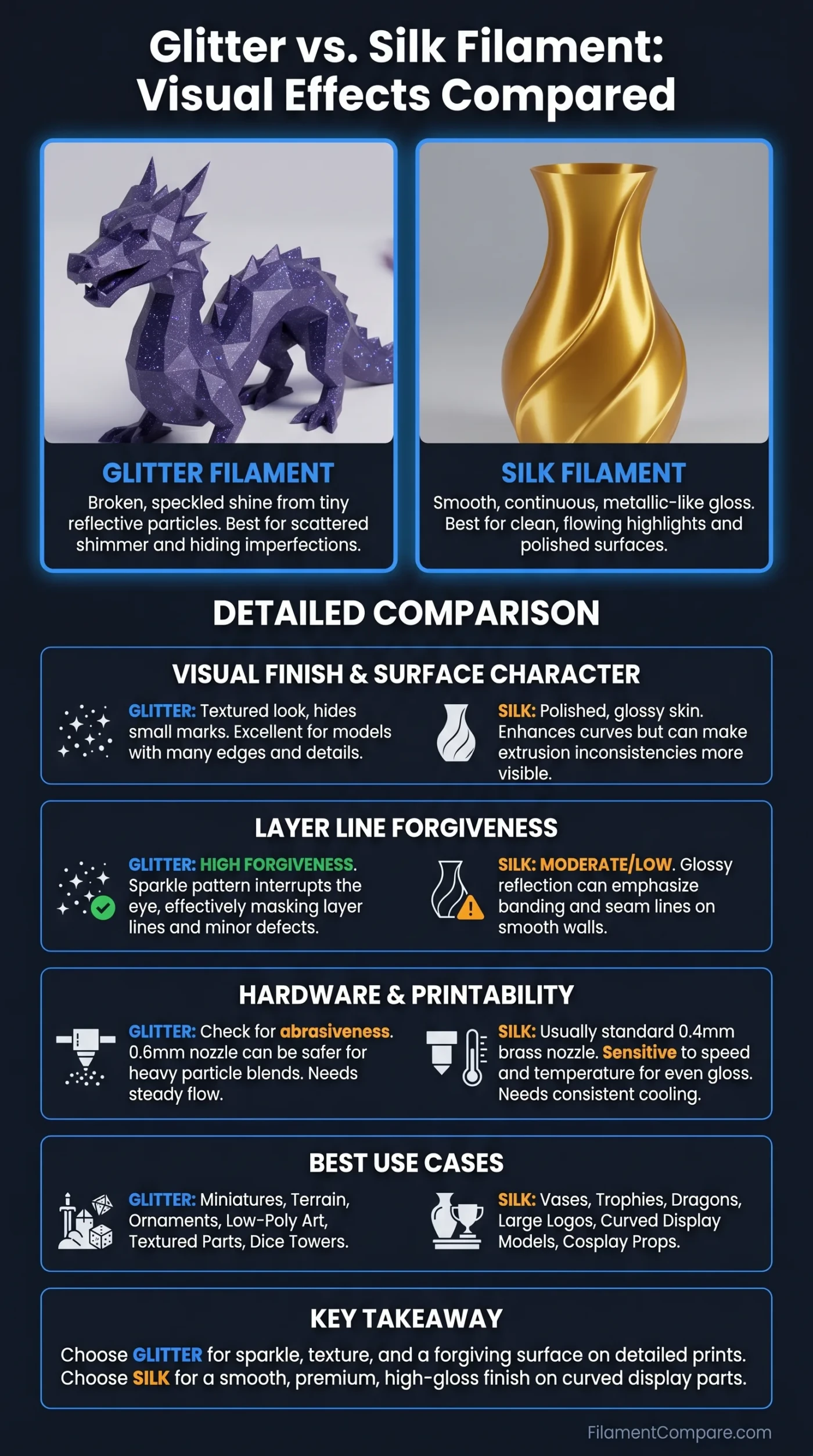
Glitter filament and silk filament both sit in the same visual-first corner of FDM printing, yet they create very different surfaces. Glitter filament breaks light into tiny spark points, while silk filament reflects light as a smooth, continuous shine. One looks speckled and textured. The other looks polished and glossy.
| Comparison Point | Glitter Filament | Silk Filament | What It Means for the Print |
|---|---|---|---|
| Main Visual Effect | Sparkle, flecks, star-like reflections, speckled depth | Glossy sheen, metallic-like flow, smooth reflective bands | Glitter is better for scattered shimmer; silk is better for clean shine. |
| Surface Character | Fine particles help break up layer lines | Gloss can make layer direction more visible on curved walls | Glitter often hides small surface marks; silk rewards smooth walls and clean extrusion. |
| Typical Base Material | Usually PLA, PETG, or other common FDM bases with glitter particles | Usually PLA-based blends with gloss-enhancing additives | The base polymer still controls heat resistance, stiffness, and bed adhesion. |
| Nozzle Wear | Depends on filler type and particle load; some glitter filaments are listed as non-abrasive, while particle-filled filaments can still deserve nozzle attention [a] | Usually printable with a standard brass nozzle unless the product also contains abrasive fillers | Glitter needs more vendor-specific checking. Silk is usually simpler for standard hardware. |
| Common Nozzle Size | 0.4 mm often works with fine glitter; 0.6 mm can be safer for heavier particle blends | 0.4 mm works well for most silk PLA products | Large flakes and narrow nozzles can reduce flow reliability. |
| Typical Printing Temperature | Usually close to the base filament’s normal range | Often PLA-like; Polymaker PolyLite PLA Silk lists 200–220°C [b] | Silk often likes stable heat and moderate speed to keep gloss even. |
| Bed Temperature | Usually base-material dependent | Polymaker PolyLite PLA Silk lists 30–70°C [c] | PLA-based silk and glitter filaments are usually friendly on open-frame printers. |
| Layer-Line Hiding | Strong, especially with fine multi-directional sparkle | Medium; shine can soften lines but may also show banding | Glitter is more forgiving on decorative prints. |
| Mechanical Focus | Depends heavily on base material and filler amount | Some silk PLAs show lower Z strength than their XY strength; PolyLite PLA Silk lists 51.5 MPa XY tensile strength and 21.5 MPa Z tensile strength [d] | For functional loads, read the datasheet rather than judging by appearance. |
| Best Visual Uses | Miniatures, display models, holiday ornaments, dice towers, vases, cosmic colors, stone-like looks | Dragons, trophies, logos, props, decorative containers, lettering, display parts | Glitter adds depth; silk adds a showroom finish. |
This comparison treats glitter filament and silk filament as effect materials and uses manufacturer datasheets plus trusted technical references; real print results can shift with brand formula, nozzle size, slicer profile, part geometry, and printer tuning.
- Best sparkle: Glitter
- Best gloss: Silk
- Most forgiving surface: Glitter
- Cleanest reflective curves: Silk
- Hardware check needed: Glitter
How the Two Effects Are Made
Glitter filament gets its look from small reflective particles suspended in the plastic. These particles catch light from different angles, so the surface does not reflect as one smooth sheet. It flashes in points. On darker colors, the effect can look like a night-sky finish. On bright colors, it can look more playful and decorative.
Silk filament works differently. The shine comes from the filament formula and pigment system, not from obvious glitter flakes. The result is a smooth reflective skin that can look close to polished plastic or soft metal, especially on curved models with long outer walls.
Simple Difference
Glitter creates many tiny highlights. Silk creates one flowing highlight. That single difference changes how each material looks on flat panels, curved parts, text, small details, and layer lines.
Visual Finish: Sparkle vs Gloss
Glitter filament has a broken, granular shine. The surface may still be smooth to the touch, but visually it reads as textured because the reflective particles are scattered inside the plastic. This makes it useful when the model has many edges, grooves, embossed details, or surfaces that would otherwise show small print artifacts.
Silk filament has a cleaner, more continuous reflection. Curves look fuller. Rounded letters look polished. A vase, trophy, dragon, mask, or decorative logo can look more finished straight off the build plate. The shine is direct, so it also reveals the path of the outer wall more clearly than matte PLA.
| Model Feature | Glitter Filament Appearance | Silk Filament Appearance |
|---|---|---|
| Flat Wall | Speckled shine; small print lines are less obvious | Glossy panel; extrusion consistency is more visible |
| Curved Wall | Scattered sparkle with soft depth | Strong flowing highlight across the curve |
| Sharp Edges | Edges flash with small points of light | Edges look clean but less sparkly |
| Small Text | Glitter can make lettering lively, but large particles may reduce crispness | Raised text looks glossy and polished when extrusion is clean |
| Layer Lines | Often masked by particle reflections | Can be softened by shine, yet banding may stand out under direct light |
Lighting Matters More Than Many People Expect
A glitter print can look modest in soft indoor light and much brighter under a focused lamp. Silk behaves almost the opposite: it shows a controlled ribbon of shine when light sweeps across the surface. Move the model a little. The difference appears fast.
For product photos, glitter filament benefits from angled light that catches the particles. Silk filament benefits from broad, soft light that shows the curve without creating harsh hot spots.
Printability and Slicer Behavior
Most glitter and silk filaments print close to the base material they are made from. PLA-based versions are the easiest to compare because they usually need no enclosure, have low warp, and work well with standard cooling. Prusament describes PLA as easy to print, low warping, hard, and suitable for small detailed objects as well as large prints [e].
Silk filament can be more sensitive to speed, temperature, and cooling because its visual finish depends on a clean outer wall. Too cold, and the surface may look dull. Too hot, and fine details can soften. The target is steady extrusion, not force.
Glitter filament is usually tolerant visually because the particles hide small surface variation. Yet the internal filler changes the melt path slightly. If the glitter load is high or the particles are larger, flow can become less forgiving through a narrow nozzle.
| Setting Area | Glitter Filament | Silk Filament | Reason |
|---|---|---|---|
| Outer Wall Speed | Moderate speed helps particle-filled extrusion stay even | Moderate speed helps preserve a smooth shine | Both effects look better when the visible wall is stable. |
| Layer Height | 0.16–0.24 mm often gives a good balance | 0.12–0.20 mm often makes gloss look smoother | Lower layers can refine curves, but very low layers are not always worth the longer print time. |
| Cooling | Usually PLA-like cooling for PLA-based versions | Usually fan on for silk PLA; Polymaker’s Panchroma Silk page lists cooling fan ON [f] | Cooling helps edges and overhangs stay clean. |
| Retraction | Base-material range; watch for particle-related flow variation | PLA-like range; Polymaker lists 1–3 mm for PolyLite PLA Silk [g] | String control matters because shiny surfaces make stray hairs easier to notice. |
| Seam Placement | Can be hidden more easily by sparkle | More visible on glossy walls | Silk reflects light along the seam area. |
Nozzle Wear, Clogging, and Hardware Fit
This is where glitter filament deserves closer attention. A filament with particles is not automatically harsh on the nozzle, but particle-filled materials can act differently from plain PLA. Prusa notes that some filaments with particles can be abrasive, and that hardened nozzles are recommended for abrasive filaments because brass nozzles can wear quickly [h].
There is an important detail here: not every glitter PLA is the same. Fillamentum describes its Original Vertigo glitter line as non-abrasive and easy to process, while also noting that the fine glitter can help hide layer lines [i]. That makes vendor data useful, not optional.
Practical reading: silk PLA is usually safe to treat like a visual PLA blend, while glitter filament should be checked spool by spool. Fine cosmetic glitter may print like normal PLA. Heavier mineral, metal, glow, carbon, or glass-filled effects belong in a different hardware category.
When a 0.6 mm Nozzle Makes Sense
A 0.4 mm nozzle is common for both materials. For fine glitter PLA, it often works well. A 0.6 mm nozzle becomes attractive when the filament has visible particles, when the brand recommends it, or when long prints need safer flow. The surface may show slightly wider extrusion lines, but glitter can hide that nicely.
Silk filament rarely needs a larger nozzle for the effect itself. A 0.4 mm nozzle gives good detail, clean lettering, and glossy curves. For large decorative parts, 0.6 mm can still work, especially when the model has bold shapes and does not depend on tiny edges.
Strength and Part Use
Visual filament should not be judged by shine alone. The base polymer, additives, layer bonding, moisture level, print temperature, wall count, infill pattern, and part orientation all change real strength. A good-looking part can still be a display part. That is normal.
Silk PLA has a known pattern in many datasheets: the visual formula can produce attractive shine, while Z-direction strength depends strongly on layer bonding. Polymaker’s PolyLite PLA Silk datasheet lists 51.5 ± 1.9 MPa tensile strength in X-Y and 21.5 ± 2.2 MPa in Z, measured under the stated test conditions [j].
Glitter filament has no single strength number because the category is broad. A glitter PLA may behave close to regular PLA. A sparkle PETG may behave closer to PETG. A dense particle-filled material may behave differently again. The fair comparison is brand datasheet to brand datasheet.
- For decorative display parts
- Both are strong enough for many models when printed with suitable walls and good layer adhesion.
- For thin snap-fit details
- Check the exact material datasheet. Silk PLA may need more generous geometry than standard PLA in small stressed areas.
- For warm environments
- Base material matters more than the effect. PLA-based glitter and silk parts share PLA-like heat limits unless the manufacturer states otherwise.
- For outdoor display
- PETG-based glitter or UV-aware material choices may be more suitable than PLA-based silk, depending on exposure and expected life.
Layer Lines and Surface Forgiveness
Glitter filament is one of the more forgiving visual materials because it interrupts the eye. Small Z-banding, tiny extrusion changes, and mild seam marks can blend into the sparkle pattern. The print still needs good calibration, but the finish does not expose every tiny variation.
Silk filament is less forgiving in a different way. It can make a model look polished, but it also reflects light along layer paths. A small temperature shift, inconsistent outer-wall speed, or uneven cooling can become easier to see. On the right model, though, silk looks very clean.
Layer-Line Hiding
Gloss Strength
Standard Hardware Simplicity
Color Behavior and Model Geometry
Glitter works well on models with texture, cutouts, relief patterns, and many angles. The sparkle points need light changes to show their full character. A flat cube may look nice, but a faceted crystal, sci-fi panel, dragon scale, ornament, or embossed sign gives glitter more chances to flash.
Silk works well on broad curves and smooth decorative shapes. Rounded vases, trophies, masks, display helmets, spiral models, lettering, and flowing organic shapes show the silk highlight better than boxy mechanical geometry. Long continuous outer walls help the shine feel intentional.
| Print Type | Better Match | Why |
|---|---|---|
| Cosmic Vase | Glitter | Dark glitter colors create depth and scattered star-like points. |
| Gold Trophy | Silk | Glossy curves imitate a polished metallic finish without post-processing. |
| Miniature Terrain | Glitter | Speckled reflections can hide layer lines and add stone-like texture. |
| Large Logo or Lettering | Silk | Smooth shine makes bold text look cleaner from a distance. |
| Low-Poly Sculpture | Glitter | Each angled face catches different sparkle points. |
| Curved Character Model | Silk | Round forms carry the highlight across the surface. |
Post-Processing and Surface Handling
Both materials are usually chosen to avoid heavy finishing. Sanding can change the visual effect. With glitter filament, sanding may expose particles unevenly or dull the clear plastic around them. With silk filament, sanding can remove the glossy skin and leave a flatter surface.
For assembly, hidden joints are better than visible filler work. If a model needs multiple parts, seam placement matters. Glitter hides joins more easily, especially on busy surfaces. Silk needs cleaner alignment because the reflection can reveal steps between parts.
Handling Marks
Silk surfaces can show fingerprints more than glitter surfaces, especially in dark glossy colors. Glitter’s speckled finish is easier to handle without making every touch mark visible. A dry microfiber cloth is usually enough for display parts.
Moisture, Storage, and Flow Quality
Moisture can reduce surface quality in both materials. Popping, stringing, tiny bubbles, or rough outer walls can weaken the effect. The issue is more visible on silk because gloss depends on a smooth skin. Glitter can hide some roughness, but wet filament still prints less cleanly.
Manufacturer drying guidance should be followed when available. Polymaker’s Panchroma Silk page lists a 55°C for 6 hours drying setting when moisture has been absorbed [k]. That kind of brand-specific number is safer than using one drying rule for every spool.
Best Uses for Glitter Filament
Glitter filament is a strong visual choice when the design benefits from depth, sparkle, and surface masking. It is less formal than silk, but it can look cleaner than plain PLA because the flecks distract from layer lines.
- Decorative vases with curved or faceted walls
- Miniatures, terrain pieces, and fantasy props
- Holiday ornaments and display objects
- Low-poly animals, crystals, stars, and cosmic themes
- Boxes, signs, and desk accessories where layer-line hiding is useful
- Parts where a speckled stone, galaxy, or confetti effect fits the design
Best Uses for Silk Filament
Silk filament is best when the model needs a smooth, polished, high-gloss look straight from the printer. It suits decorative prints that rely on light flowing across the shape.
- Trophies, awards, and display plaques
- Dragons, masks, busts, and character models
- Large logos, raised lettering, and brand-style decor
- Vases, bowls, and spiral forms
- Cosplay trim and ornamental parts
- Gold, silver, copper, bronze, and dual-color display prints
Where Each Filament Has Technical Limits
Glitter filament’s main limit is predictability across brands. One glitter PLA may print almost like standard PLA. Another may contain particles that call for a larger nozzle or more wear-resistant hardware. The spool label and datasheet matter.
Silk filament’s main limit is surface honesty. It looks smooth when the printer is consistent, but it can show ringing, seams, banding, and speed changes more clearly than glitter. The gloss is beautiful. It is also revealing.
| Area | Glitter Filament | Silk Filament |
|---|---|---|
| Tiny Nozzles | Fine glitter may work; heavier particles are less suited to very small nozzles | Often works well, though very small nozzles can reduce glossy flow on large parts |
| High-Speed Printing | Depends on particle load and base polymer | Some newer silk formulas are designed for higher speed, but finish quality still depends on the brand profile |
| Functional Clips | Possible with suitable base material and geometry | Needs datasheet review and careful part orientation |
| Direct Sun or Heat | Base material controls performance | PLA-based silk should be treated with PLA-like heat expectations unless stated otherwise |
| Surface Repair | Hard to sand without changing sparkle | Hard to sand without dulling gloss |
Buyer-Focused Material Selection
Choose glitter filament when the design needs sparkle, texture, and forgiving surfaces. Choose silk filament when the design needs smooth gloss and a polished display look. For purely decorative prints, the decision is mostly visual. For parts that need strength or heat tolerance, the base material and datasheet come first.
Choose Glitter Filament When
- The model has lots of facets, texture, grooves, or small details.
- You want layer lines to be less noticeable.
- A speckled, cosmic, stone-like, or playful effect fits the design.
- You can check whether the filament needs a hardened nozzle or larger nozzle.
Choose Silk Filament When
- The model has broad curves and smooth visible walls.
- You want a glossy, metallic-like decorative finish.
- The part is mainly for display, props, awards, lettering, or decor.
- Your printer can produce clean outer walls with stable speed and temperature.
Common Print Profiles That Usually Work
For PLA-based versions, both materials often begin near normal PLA settings. The safer approach is to start from the manufacturer profile, then adjust only what the surface shows. Glitter usually asks for flow reliability. Silk asks for clean outer walls.
| Profile Item | Glitter PLA Starting Range | Silk PLA Starting Range |
|---|---|---|
| Nozzle Temperature | Base PLA range, often around 200–220°C | Often around 200–220°C; some products list wider 190–230°C ranges |
| Bed Temperature | Usually 40–60°C for PLA-based versions | Often 30–70°C depending on product and surface |
| Nozzle | 0.4 mm for fine glitter; 0.6 mm for heavier particles if advised | 0.4 mm for most visual detail |
| Cooling | Fan on for PLA-based prints unless the brand profile says otherwise | Fan on for clean surface quality |
| Outer Wall Speed | Moderate | Moderate to preserve shine |
| Bed Surface | PLA-compatible sheet, glue if the brand recommends it | PLA-compatible sheet, glue when needed on strong-grip surfaces |
Small Details That Change the Result
A silk filament print can lose part of its premium look if the seam runs through the front face. Seam position matters. A glitter print can tolerate that seam better, especially if the color has dense particles and the model has natural texture.
Wall count also matters. Thin decorative parts may look better with more perimeters because the outer wall has a cleaner foundation. On translucent or semi-translucent glitter colors, infill can slightly affect how light passes through the surface. Dense walls create a more solid look.
Color choice changes the effect more than expected. Black glitter looks deep and starry. Blue glitter can feel colder and sharper. Gold silk looks bold. Silver silk shows layer rhythm more easily under direct light. Copper silk often looks warmer and softer.
Final Comparison Without the Usual Guesswork
Glitter filament is the better pick for sparkle, surface masking, and textured decorative prints. Silk filament is the better pick for gloss, smooth curves, and polished display parts. Neither effect is automatically stronger, easier, or more heat-resistant. The base material decides much of that.
For the most reliable choice, treat the visual effect as one layer of the decision. Then check the base polymer, nozzle recommendation, temperature range, tensile data, and intended use. That keeps the print beautiful and technically sensible.
Resources Used
- [a] Fillamentum, Original Vertigo line note on fine glitter and non-abrasive processing: Fillamentum Vertigo Glitter Finish
- [b] Polymaker PolyLite PLA Silk Technical Data Sheet, nozzle temperature: PolyLite PLA Silk TDS
- [c] Polymaker PolyLite PLA Silk Technical Data Sheet, build plate temperature: PolyLite PLA Silk TDS
- [d] Polymaker PolyLite PLA Silk Technical Data Sheet, XY and Z tensile strength: PolyLite PLA Silk TDS
- [e] Prusament PLA material page, PLA printability and low warping notes: Prusament PLA
- [f] Polymaker Panchroma Silk PLA print settings, cooling fan: Panchroma Silk PLA
- [g] Polymaker PolyLite PLA Silk Technical Data Sheet, retraction range: PolyLite PLA Silk TDS
- [h] Prusa Knowledge Base, nozzle guidance for abrasive particle-filled filaments: Prusa E3D V6 Nozzles
- [i] Fillamentum, Original Vertigo line note on layer-line hiding and non-abrasive behavior: Fillamentum Original Vertigo
- [j] Polymaker PolyLite PLA Silk Technical Data Sheet, mechanical properties: PolyLite PLA Silk TDS
- [k] Polymaker Panchroma Silk PLA drying setting: Panchroma Silk PLA Settings
