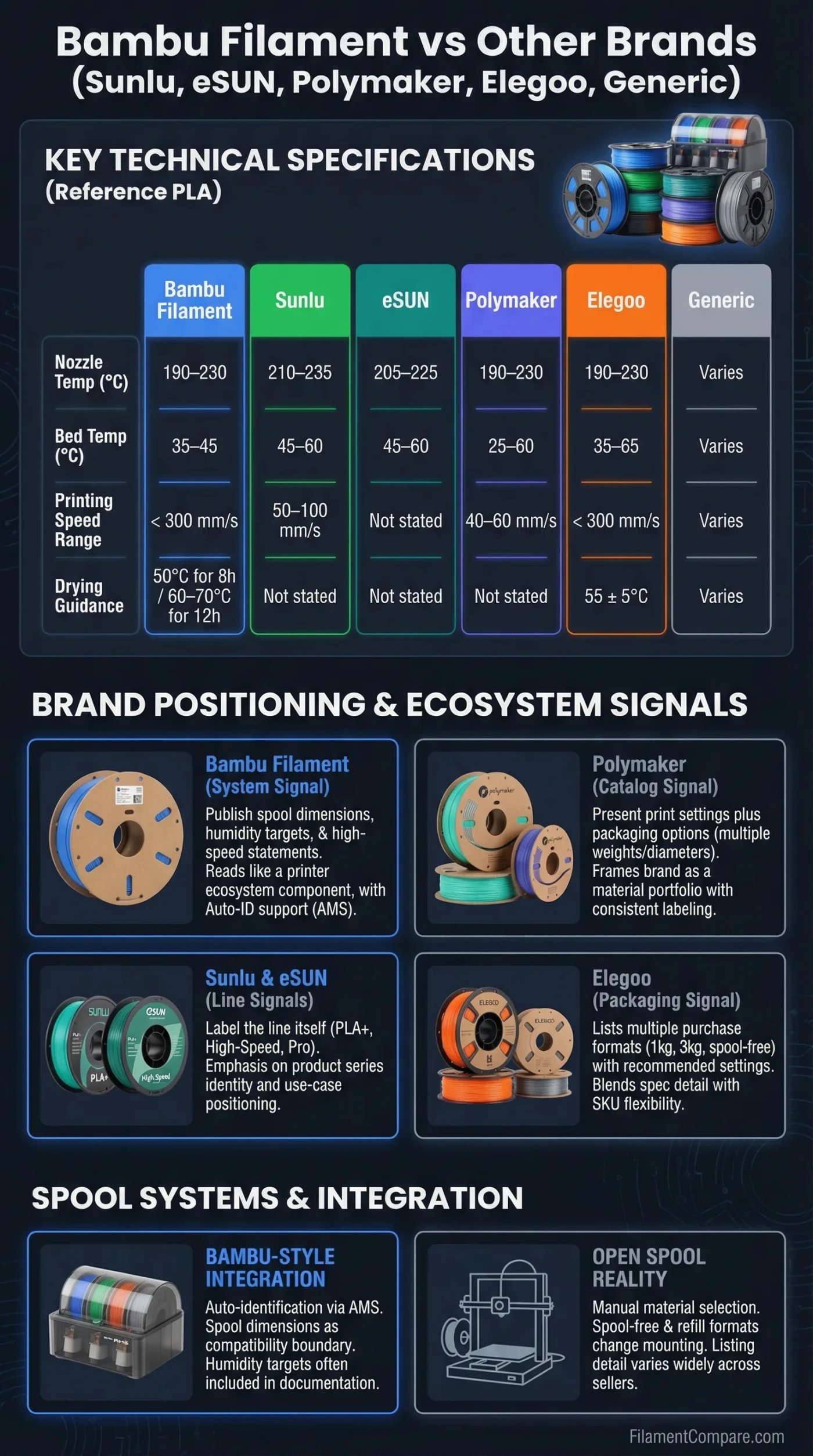
Bambu filament offers the smoothest Bambu printer and AMS workflow, while SUNLU, eSUN, Polymaker, ELEGOO, and generic filament usually exchange some automation for lower purchase cost, different formulations, or wider local availability. The printed result depends more on the exact material grade than the logo on the spool. For many users, the most practical setup is Bambu filament for automation-sensitive jobs and a tested third-party brand for routine production.
Choose Bambu filament when automatic identification, ready-made Bambu Studio profiles, repeatable AMS operation, matching refill spools, and reduced setup time matter more than the lowest cost per kilogram.
Choose an established third-party brand when cost control, local stock, specialty formulations, large multipacks, or material-specific documentation matters more than RFID convenience.
Do not choose by brand alone. Bambu PLA Basic, eSUN PLA+, Polymaker PolyLite PLA, SUNLU PLA+ 2.0, and ELEGOO Rapid PLA+ are not identical formulations. A fair comparison must match PLA with PLA, high-speed PLA with high-speed PLA, and reinforced materials with equivalent reinforced grades.
Best Choice by Printing Priority
Least Setup on Bambu Printers
Bambu is the clearest choice when the spool should be recognized automatically and the supplied profile should work with minimal adjustment.
Bulk Everyday Printing
SUNLU is often attractive for routine PLA, PLA+, and PETG work where multipacks, refills, and lower unit cost are priorities.
Tougher PLA-Style Parts
eSUN is a useful starting point for PLA+ and related modified formulations intended to balance stiffness, toughness, and easy printing.
Technical Documentation
Polymaker stands out when test methods, typical material values, application notes, and clearly separated product families help guide material selection.
High-Speed Budget Printing
ELEGOO is well suited to users seeking high-flow PLA variants, multipacks, and broad 1.75 mm printer compatibility without paying for Bambu RFID integration.
AMS Convenience
Bambu has the strongest native fit. Third-party filament works, but material type, color, remaining quantity, and profile selection may need more manual attention.
Specialty Material Selection
Polymaker or eSUN is often the better place to look for clearly differentiated support, flexible, lightweight, reinforced, engineering, and modified material families.
Lowest Initial Purchase Cost
A verified generic spool may cost less, but it should be treated as an unvalidated formulation until diameter, flow, moisture condition, winding, and batch consistency are checked.
Bambu Filament Compared with Major Alternatives
| Decision Area | Bambu Lab | SUNLU | eSUN | Polymaker | ELEGOO | Generic |
|---|---|---|---|---|---|---|
| Main Advantage | Native Bambu workflow and RFID-supported identification | Bulk value, broad everyday range, and refill options | Wide modified and functional material range | Detailed documentation and clearly separated product families | Value-focused high-speed and multipack options | Potentially low purchase cost and local availability |
| Native Bambu RFID | Available on supported official spools | Not normally included | Not normally included | Not normally included | Not normally included | Do not assume it is included |
| Bambu Studio Setup | Official material profile is normally available | Generic or user-tuned profile may be needed | Generic, downloadable, or user-tuned profile depending on product | Generic or manufacturer profile, followed by validation | Generic or user-tuned profile may be needed | Generic profile followed by calibration |
| Typical Price Position | Usually premium, although refills and bundles can narrow the gap | Usually value to lower-mid range | Usually value to mid range | Usually mid to premium depending on the product family | Usually value-oriented, especially in multipacks | Seller-dependent and often low-cost |
| Product Documentation | Good printer-specific settings and compatibility guidance | Product-page guidance varies by filament line | Broad product library with TDS, parameter, and download sections for many grades | Strong access to TDS, test methods, print settings, and material families | Useful product specifications, though depth varies by line | May range from a full datasheet to no traceable technical information |
| Material Breadth | Broad range built around the Bambu printer ecosystem | Broad general, high-speed, aesthetic, and engineering range | Very broad range of PLA, PETG, flexible, soluble, support, and engineering products | Very broad range with distinct aesthetic, support, flexible, and engineering families | Strong selection of common and high-speed consumer filaments | Varies by seller; product naming may not describe the formulation clearly |
| Spool and Refill Options | Reusable spool and official refill system on supported products | Plastic spools, larger spools, and compatible refill products are available in some lines | Spool format varies by product and package size | Product-dependent; cardboard and other lower-plastic formats are common in several lines | Cardboard spools are common; AMS contact surfaces may need inspection | Plastic, cardboard, reused, or unidentified spool construction |
| First-Print Predictability | High when the material, printer, build plate, and official profile match | Usually good after selecting the correct material profile | Usually good, but PLA+ and specialty grades should not be treated as standard PLA | Usually good when the matching product profile and drying guidance are followed | Usually good for common PLA lines; high-speed claims still depend on part geometry and hotend flow | Unknown until a test print and calibration are completed |
| Color and Batch Traceability | Clearly identified official SKU and color system | Established brand and named product lines | Established brand with many named formulations | Clearly divided product families and documented grades | Established product lines and bulk color packs | Seller, factory, resin blend, or pigment may change without a clear revision notice |
| High-Speed Printing | Dedicated high-flow or high-speed grades available | Dedicated high-speed PLA and PLA+ families available | High-speed and modified products available | Product-specific; flow capability should be checked in the selected grade | Rapid PLA and Rapid PLA+ are positioned for high-flow printing | Do not infer high-flow capability from a generic PLA label |
| Best Fit | Users who value automation, low setup effort, and Bambu-specific profiles | Print farms, prototypes, everyday models, and cost-sensitive volume printing | Users needing PLA+, flexible, support, or other modified formulations | Users selecting materials from technical data and application requirements | Fast everyday printing and economical color stocking | Low-risk prototypes after a spool has been tested |
| Main Limitation | Higher cost may not produce a proportional mechanical advantage over every equivalent third-party grade | Documentation and formulation detail are not equally deep across all lines | The product range is wide, so similar names must be matched carefully | Some products cost close to or above Bambu filament without adding RFID convenience | Cardboard spool behavior and exact high-speed performance need printer-specific validation | Uncertain formulation, batch control, support, winding, and traceability |
| Better Choice When | Workflow time costs more than the filament saving | Cost per finished part and bulk supply are priorities | A modified or specialty formulation matches the part requirement | Technical selection and documented properties matter most | Fast printing and bulk color purchasing are priorities | The spool is inexpensive, noncritical, and fully testable before production |
This comparison uses Bambu, SUNLU, eSUN, Polymaker, and ELEGOO product documentation and datasheet information; it describes general brand and workflow trends rather than fixed performance, because the actual result changes with polymer grade, additives, color, moisture, spool batch, printer hardware, orientation, and slicer settings.
Workflow Profiles
Bambu Filament Workflow Profile
- Product type: First-party filament developed and profiled for the Bambu printer ecosystem
- Setup difficulty: Low when an official profile exists
- Material identification: Supported Bambu spools use RFID for automatic recognition of filament information[a]
- Profile handling: Official presets reduce the need to create a material profile from zero
- Spool system: Reusable spool and refill combinations are available for supported materials
- Drying: Still required when the material has absorbed moisture; first-party packaging does not remove the need for correct storage
- Typical behavior: Predictable when the selected plate, nozzle, profile, and filament grade match
- Best uses: Multicolor jobs, unattended operation, shared printers, production queues, and users who prefer fewer manual steps
Third-Party Filament Workflow Profile
- Product type: Open-market filament from established brands or unverified sellers
- Setup difficulty: Low to moderate for common PLA; higher for modified, reinforced, flexible, or moisture-sensitive grades
- Material identification: Normally entered manually rather than read as official Bambu filament
- Profile handling: Third-party materials can be added and managed manually in Bambu Studio[b]
- Spool system: Plastic, cardboard, refill, large-spool, and spoolless formats are available
- Drying: Must follow the polymer and manufacturer guidance rather than a generic brand rule
- Typical behavior: Often reliable after flow, temperature, cooling, pressure advance, and maximum volumetric speed are checked
- Best uses: Bulk production, local sourcing, color expansion, specialty grades, and controlled cost-per-part work
Relative Brand Performance Indicators
These meters compare the buying and printing workflow rather than tensile strength or heat resistance. A brand cannot receive one valid mechanical score across PLA, PETG, ASA, TPU, nylon, and fiber-filled products.
The meter values are relative buying and printing-use indicators, not laboratory grades. Product line, polymer blend, pigment, additives, storage humidity, print orientation, nozzle condition, slicer profile, retailer, and regional packaging can move the practical result above or below the displayed level.
Why Brand Names Do Not Replace Material Matching
The first comparison should always be the material family and formulation. Standard PLA is usually stiff and easy to print, while PLA+ is a modified category whose additives and mechanical balance differ between manufacturers. A high-speed PLA may be formulated for higher melt flow, and matte PLA may sacrifice some layer bonding or impact behavior in exchange for a low-gloss surface.
That means Bambu PLA Basic should not automatically be judged against eSUN PLA+, Polymaker PLA Pro, SUNLU PLA+ 2.0, or ELEGOO Rapid PLA+ as though every spool contains the same polymer blend. The names describe different commercial formulations. Even when nozzle and bed temperatures overlap, toughness, stiffness, flow behavior, surface texture, maximum volumetric speed, and layer adhesion can differ.
Match these before comparing brands: polymer family, standard or modified grade, matte or glossy finish, high-speed designation, recycled content, fiber reinforcement, spool weight, nozzle requirements, drying instructions, and the test method used for any mechanical value.
PLA Basic Is Not the Same as PLA+
PLA+ is not a single standardized recipe. eSUN describes its PLA+ as a modified PLA intended to improve the balance of rigidity, toughness, impact behavior, layer adhesion, and printability[e]. SUNLU, ELEGOO, Polymaker, Bambu, and other manufacturers use their own formulations and product labels. A plus symbol does not guarantee a fixed tensile strength, heat-deflection temperature, or impact value across brands.
High-Speed Labels Need a Flow Test
A high-speed label indicates that the filament is intended to melt and flow efficiently, but printer movement speed alone does not prove that the hotend can supply the required material. A large model printed at 300 mm/s with wide lines and thick layers may demand far more volumetric flow than a small model reaching the same movement speed for brief travel segments.
ELEGOO positions Rapid PLA+ for fast printing and states a ±0.02 mm diameter tolerance on its product page. It also notes that the demonstrated result depends on the printer and application conditions[g]. The useful test is therefore maximum stable volumetric flow with the selected nozzle, temperature, cooling, and acceptable surface quality.
Bambu Integration and Third-Party Setup
Bambu filament’s clearest advantage is not that every spool is mechanically stronger. It is the connection between the spool, AMS, printer, slicer, and official material profile. Supported Bambu spools can provide material and color information through RFID, reducing manual entry during loading and multicolor preparation.
Third-party filament remains usable. The material can be selected manually in the AMS interface or configured through the filament management workflow. A suitable generic preset may work immediately for ordinary PLA, but a saved custom profile is better when the same SUNLU, eSUN, Polymaker, or ELEGOO product will be printed repeatedly.
A Useful Third-Party Calibration Order
- Confirm the exact material and product line rather than selecting a profile by color alone.
- Dry the filament when the polymer or storage history indicates moisture exposure.
- Start with the closest safe generic material preset.
- Run a nozzle-temperature test using the intended cooling and layer height.
- Calibrate flow ratio for dimensional and surface consistency.
- Calibrate pressure advance or flow dynamics when the printer supports it.
- Find a stable maximum volumetric speed rather than copying the largest advertised movement speed.
- Save the profile with the full brand, product, color, and nozzle information.
When RFID Saves Meaningful Time
RFID has the most value in an AMS with frequent spool changes, several similar colors, multiple operators, or automated production queues. It reduces profile-selection errors and makes loading more direct. The benefit is smaller for a printer that uses one external spool for several days and already has a validated third-party profile.
RFID Does Not Measure Filament Condition
Automatic recognition does not test moisture content, confirm that a refill was installed correctly, detect nozzle wear, or verify that the selected build surface is clean. Bambu filament can still string, bubble, under-extrude, or lose surface quality when storage and printer conditions are unsuitable.
Spool Design, AMS Feeding, and Refills
Spool construction affects AMS reliability separately from filament chemistry. Important details include outer diameter, hub width, rim stiffness, surface friction, remaining spool weight, winding quality, and whether the spool sheds cardboard fibers near rollers or feeder paths.
Bambu Reusable Spools
Bambu’s refill system can reduce the amount of complete plastic spools purchased, but the refill must be installed on a compatible reusable spool and locked correctly. Official PLA Basic product guidance also provides drying recommendations, showing that even easy-printing PLA may need controlled drying after moisture exposure[c].
SUNLU Refill and Large-Spool Options
SUNLU sells standard spools, larger packages, multipacks, and refill products in selected PLA, PLA+, and PETG lines. Its official PLA+ collection includes refill filament described as compatible with SUNLU reusable spools and the Bambu reusable spool[d]. Compatibility should still be checked for the exact refill generation and spool model.
Cardboard Spools
Cardboard spools from ELEGOO, Polymaker, eSUN, and other brands may work normally, but rim condition matters. A softened, dented, rough, or delaminating edge can increase rolling resistance. ELEGOO provides a printable filament ring for some cardboard spools and states that it is intended to reduce delamination and improve adaptation to AMS contact surfaces.
A ring or respooling process should not be applied automatically to every product. Added rings change spool diameter and friction, while a poorly fitted ring can create its own feeding problem. Inspect the spool in the intended AMS version and verify that it rotates freely when nearly full and nearly empty.
Consistency, Moisture, and Batch Control
An established brand provides a named product line, packaging record, manufacturer identity, and a better chance of buying the same formulation again. This does not mean every spool is identical. Pigment loading, production lot, storage time, regional inventory, and product revisions can change practical behavior.
Diameter Tolerance Is Only One Part of Consistency
SUNLU and ELEGOO advertise tight diameter tolerance on several PLA products. That is useful for stable feeding, but diameter alone does not describe ovality, melt flow, pigment dispersion, moisture, winding, toughness, or layer bonding. A spool can measure close to 1.75 mm and still require a different temperature or flow ratio from another brand.
Moisture Can Hide the Real Brand Difference
A dry value filament may print more cleanly than a premium spool that has been left open in a humid room. Moisture can cause popping, rough extrusion, stringing, weak-looking surfaces, unstable flow, and reduced interlayer quality. PETG, TPU, nylon, support materials, and several reinforced grades usually reveal moisture problems sooner than ordinary PLA.
Drying should follow the exact product guidance. Excessive temperature can deform a spool, soften PLA, or alter a material before printing. A food dehydrator, filament dryer, printer drying function, or controlled oven should be evaluated by its actual chamber temperature rather than its dial setting.
Why Generic Filament Needs a Receiving Test
“Generic” is not a manufacturer or formulation. Two generic PLA listings may come from different extrusion lines, resin suppliers, pigment systems, and packaging conditions. A low-cost spool can perform well, but the result from one purchase should not be projected onto the next batch without checking the label and running a small validation print.
Useful receiving checks: packaging seal, desiccant condition, spool damage, visible dust, winding pattern, filament brittleness, several diameter measurements, empty-spool weight record, temperature tower, flow calibration, and a short part with bridges, overhangs, flat walls, and small holes.
How the Major Alternatives Differ
SUNLU
SUNLU is strongest where large quantities of common filament are needed at a controlled cost. Its catalog includes standard, plus, high-speed, matte, aesthetic, flexible, reinforced, and engineering products.
The main selection risk is treating every SUNLU PLA label as interchangeable. PLA, PLA Meta, PLA+, PLA+ 2.0, high-speed PLA+, matte PLA, and silk PLA may require different profiles and may produce different surface and mechanical behavior.
eSUN
eSUN offers one of the widest ranges among the compared alternatives. Its product catalog includes basic PLA, PLA+, high-speed grades, PETG, ABS variants, TPU, lightweight materials, support products, and other application-specific formulations.
Product naming should be read carefully. ePLA, PLA+, ePLA-HF, matte, silk, and other modified grades do not share one universal profile merely because PLA appears in the name.
Polymaker
Polymaker is a strong option when the purchase is driven by material data rather than only color and cost. Its documentation separates physical, thermal, mechanical, moisture, chemical, and printing information for many products.
For example, the PolyLite PLA technical page identifies test methods and typical values instead of treating all PLA as one property set[f]. Those values apply to the named product and specimen conditions, not every Polymaker or PLA filament.
ELEGOO
ELEGOO is particularly competitive for users stocking common colors or running high-speed consumer printers. Rapid PLA+ is designed around improved flow and is sold in single-spool and larger package formats.
Maximum advertised speed should be interpreted as a product capability under suitable conditions, not a required slicer setting for every wall, bridge, overhang, or small feature.
Bambu
Bambu is strongest where the printer ecosystem is part of the purchasing decision. The value comes from automatic recognition, profile availability, refill integration, and reduced setup work.
The premium is less persuasive when a validated third-party profile is already available and the printer repeatedly runs one material, one color, and one external spool.
Generic Filament
Generic filament may be suitable for prototypes, draft models, fixtures with low consequences, or users prepared to calibrate each shipment. The purchase should be based on traceability and testing rather than the lowest listing price alone.
It is less suitable for color-matched production, published mechanical claims, long unattended prints, or parts where a material change could create a safety or warranty problem.
Cost, Availability, and the Real Price per Part
The cheapest spool does not always produce the cheapest finished part. A useful calculation includes filament price, shipping, failed prints, calibration material, drying energy, respooling time, AMS adapters, operator attention, and the value of delayed production.
Effective Filament Cost
Effective cost per usable kilogram = purchase and delivery cost + setup and drying cost + failed-print material + operator time, divided by the quantity that becomes acceptable parts.
A low-cost spool that needs one calibration model may remain economical. A spool that causes repeated feeder errors during a long multicolor job may cost more than an official refill even when its purchase price is much lower.
When Bambu’s Premium Is Easier to Justify
- Several AMS units are loaded and changed frequently.
- Multiple people use the same printers.
- Incorrect material assignment would waste a long print.
- Standardized profiles are more valuable than small material savings.
- Refill colors and official spool tracking simplify inventory.
- Support time is limited and production must restart quickly.
When Third-Party Savings Grow
- The same validated profile is reused across many kilograms.
- Filament is purchased in multipacks or large spools.
- The printer runs one external spool rather than frequent AMS swaps.
- Local stock avoids international shipping or long restock delays.
- A specialty grade is unavailable from Bambu.
- The operator already calibrates flow and volumetric speed as part of normal production.
Material and Workflow Use Cases
| Use Case | Better Starting Point | Reason |
|---|---|---|
| First spool on a new Bambu printer | Bambu | Removes several setup variables while the printer and slicer workflow are being learned. |
| High-volume PLA prototypes | SUNLU or ELEGOO | Bulk packaging and value-focused common materials can reduce cost after one profile is validated. |
| PLA+ functional housings | eSUN, SUNLU, ELEGOO, or Polymaker | Each offers modified PLA families, but the exact grade should be chosen by stiffness, impact behavior, and temperature needs. |
| Multicolor AMS production | Bambu | RFID-supported loading and official profiles reduce material-assignment work across several slots. |
| Material selected from published test data | Polymaker | Product-specific TDS pages make it easier to compare test methods and typical values. |
| Large decorative models | SUNLU or ELEGOO | Multipacks and large-spool options can reduce material cost where appearance matters more than a certified mechanical value. |
| Specialty support or flexible material | eSUN or Polymaker | Both brands offer broad, clearly differentiated specialty material families. |
| Fast PLA production | Bambu high-flow grade, SUNLU high-speed line, or ELEGOO Rapid PLA+ | A dedicated high-flow formulation is a better starting point than raising speed on unidentified standard PLA. |
| Color-critical repeat orders | Bambu or a documented established brand | A stable SKU and traceable product line are easier to reorder than an anonymous generic listing. |
| Low-risk draft prints | Tested generic filament | Low purchase cost may be worthwhile when mechanical traceability and color repeatability are not required. |
| Carbon-fiber or glass-fiber parts | Bambu, Polymaker, eSUN, or SUNLU engineering grade | Nozzle abrasion, recommended diameter, drying, fiber loading, and clogging risk should be checked in product-specific documentation. |
| Outdoor functional part | Choose by ASA, UV-stabilized PETG, or another suitable formulation rather than brand | Ordinary PLA from any compared brand is less suitable for prolonged warmth and UV exposure than a correctly selected outdoor-oriented polymer. |
Where Each Option Fits Better
Choose Bambu Filament When
- Native AMS identification is valuable.
- Official profiles should require minimal editing.
- Several users share the same printer.
- Material-loading mistakes need to be reduced.
- A Bambu refill and reusable spool system fits the inventory process.
- Operator time costs more than the expected spool saving.
Bambu Is Less Suitable When
- The required material, finish, or color is not available.
- A large amount of ordinary PLA is needed at the lowest practical cost.
- A third-party profile has already been validated for production.
- Local availability is limited or delivery time is too long.
- The purchase decision requires a property set better documented by another manufacturer.
Choose SUNLU When
- Everyday PLA, PLA+, or PETG is purchased in volume.
- Multipacks, larger spools, or compatible refills reduce cost.
- A high-speed or aesthetic line matches the print requirement.
- The operator is comfortable saving a custom profile.
SUNLU Is Less Suitable When
- The purchase requires detailed test data for the exact grade.
- Automatic Bambu identification is required.
- Similar SUNLU product names have not been separated during profile setup.
- A long production job is being started before the new batch is tested.
Choose eSUN When
- PLA+, flexible, lightweight, support, or another modified grade is needed.
- A broad product catalog is useful.
- Manufacturer downloads or Bambu-oriented parameter information are available for the selected grade.
- A functional PLA-style material is preferred over basic display PLA.
eSUN Is Less Suitable When
- The product name has not been matched to the correct profile.
- A PLA+ value is being compared directly with standard PLA data.
- RFID automation is required.
- The buyer wants one universal setting for the entire eSUN catalog.
Choose Polymaker When
- Material selection is based on TDS values and test methods.
- A specialty, support, flexible, aesthetic, or engineering grade is needed.
- Published drying and print guidance will be incorporated into the workflow.
- Part requirements matter more than the lowest purchase price.
Polymaker Is Less Suitable When
- The only objective is the cheapest ordinary PLA spool.
- Native Bambu RFID is required.
- A cardboard spool has not been checked for the intended AMS setup.
- The user assumes every premium grade will outperform basic PLA in every mechanical category.
Choose ELEGOO When
- Rapid PLA+, common colors, or multipacks fit the print queue.
- A value-focused high-flow material is needed.
- Broad 1.75 mm printer compatibility is useful.
- The cardboard spool is suitable for the selected feeder or fitted with a validated ring.
ELEGOO Is Less Suitable When
- An advertised movement speed is being treated as a guaranteed speed for every model.
- Cardboard rim condition has not been checked before AMS use.
- Native Bambu identification is required.
- The job needs deeper material testing documentation than the selected product provides.
Choose Generic Filament When
- The print is low-risk and easily repeated.
- The spool can be tested before a long job.
- Low initial cost is more important than batch traceability.
- The seller provides a real manufacturer, product grade, and usable technical sheet.
Generic Filament Is Less Suitable When
- Mechanical performance must be traceable.
- Color must match a previous production batch.
- The print will run unattended for many hours.
- The material will be used near heat, outdoors, under repeated load, or in a safety-related part without verified data.
- The listing uses vague terms such as high strength or engineering grade without test conditions.
Material Selection Matrix
Choose Bambu if automatic recognition, official profiles, AMS organization, and reduced setup time are the main priorities.
Choose SUNLU if routine PLA, PLA+, PETG, refills, large packages, and cost-per-part matter most.
Choose eSUN if a broad range of modified, functional, flexible, support, or specialty formulations is needed.
Choose Polymaker if the decision depends on product-specific technical data, separated material families, and engineering-oriented selection.
Choose ELEGOO if economical high-speed PLA options and multipack purchasing fit the print workload.
Choose generic filament only when the product can be traced or tested and the part does not depend on guaranteed color, formulation, mechanical performance, heat behavior, or long-term durability.
The strongest general strategy is usually mixed sourcing. Keep Bambu filament where ecosystem automation saves time, then qualify one or two third-party products for recurring high-volume work. Neither route replaces the need to match the polymer to the part.
Bambu and Third-Party Filament Questions
Do SUNLU, eSUN, Polymaker, and ELEGOO filament work in Bambu printers?
Yes, compatible 1.75 mm products can generally be used when the printer temperature, nozzle, build plate, feeder, and material requirements are suitable. A generic or custom filament profile may be needed.
Will the AMS identify third-party filament automatically?
Official Bambu RFID-supported spools can be recognized automatically. Ordinary third-party spools normally require manual material and color selection. A specific third-party product should not be assumed to contain compatible RFID unless the manufacturer clearly documents it.
Is Bambu filament stronger than SUNLU or eSUN?
Not as a general brand rule. Strength must be separated into tensile behavior, stiffness, impact resistance, layer adhesion, flexibility, creep, and print orientation. The exact Bambu and third-party grades must be compared under the same test method and specimen conditions.
Is SUNLU the manufacturer of Bambu filament?
Public speculation about contract manufacturing should not be treated as verified product information. Even products made in the same facility could use different resin blends, pigments, tolerances, quality controls, drying processes, profiles, or packaging requirements.
Can ELEGOO or Polymaker cardboard spools go directly into an AMS?
Many cardboard spools can feed successfully, but fit and rim condition vary. Check diameter, width, rolling resistance, dust, edge damage, and contact with the AMS rollers. A manufacturer-provided or tested spool ring may help on some products, but it should rotate freely before a long print begins.
Is generic filament worth buying?
It can be worthwhile for drafts and noncritical parts when each batch is tested. It is a weaker choice when repeatable color, documented properties, long unattended printing, outdoor exposure, heat resistance, or mechanical traceability matters.
Manufacturer Documentation Used
- [a] PLA Usage Guide — Bambu Lab’s PLA guidance explains its RFID-assisted recognition and the use of default filament parameters. It was used for the Bambu identification and workflow sections.
- [b] Filament Manager — Bambu Lab’s software documentation describes adding and managing third-party filament manually. It supports the profile setup and calibration discussion.
- [c] PLA Basic — The official product page provides refill, spool, compatibility, print-setting, and drying information for Bambu PLA Basic. It was used for refill and storage guidance.
- [d] SUNLU PLA+ Filament | High Strength & Fast 600mm/s Printing — SUNLU’s official collection lists its PLA+ families, high-speed variants, large spools, and refill products, including selected refills intended for reusable spool systems.
- [e] eSUN PLA+ Filament 3D Printer PLA Plus Filament PLA Pro — eSUN’s official PLA+ page describes its modified PLA positioning, printing behavior, product sizes, application areas, and available parameter downloads.
- [f] PolyLite™ PLA — Polymaker’s official technical page lists test methods and typical physical, thermal, chemical, moisture, and mechanical information for the named PolyLite PLA grade.
- [g] ELEGOO RAPID PLA Plus Filament 1.75mm Colored 1KG — ELEGOO’s official product page supplies diameter tolerance, spool construction, high-speed positioning, compatibility, winding, packaging, and AMS filament-ring information.
