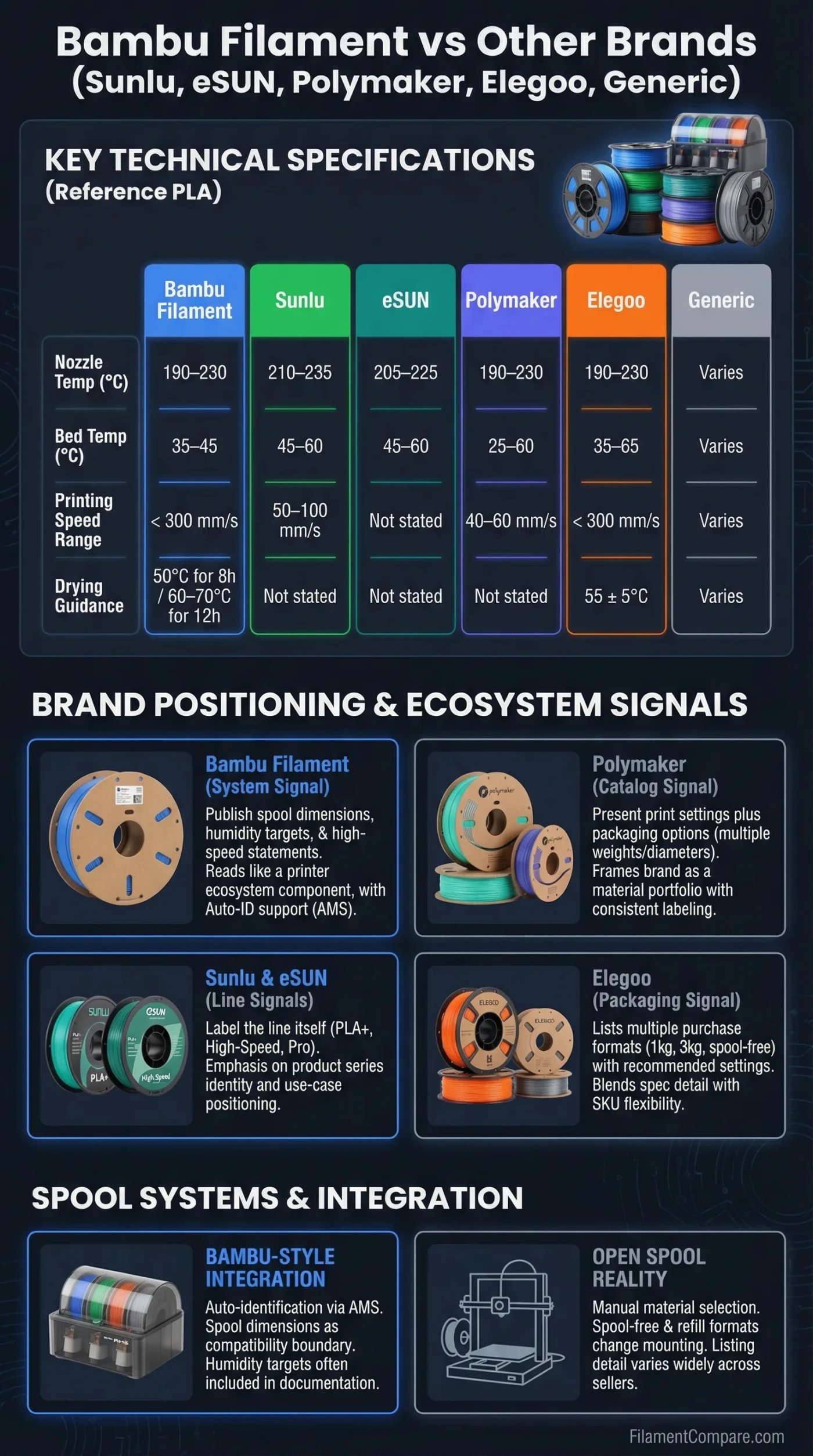
| Attribute | Bambu Filament✅Source | Sunlu✅Source | eSUN✅Source | Polymaker✅Source | Elegoo✅Source | Generic |
|---|---|---|---|---|---|---|
| Reference PLA Nozzle Temp (°C) | 190–230 | 210–235 | 205–225 | 190–230 | 190–230 | Varies by listing |
| Reference PLA Bed Temp (°C) | 35–45 | 45–60 | 45–60 | 25–60 | 35–65 | Varies by listing |
| Stated Printing Speed Range | < 300 mm/s | 50–100 mm/s | Not stated on this page | 40–60 mm/s | < 300 mm/s | Varies by listing |
| Drying Guidance Before Printing | 50°C for 8 h (blast oven) 60–70°C for 12 h (printer heatbed) | Not stated on this page | Not stated on this page | Not stated on this page | 55 ± 5°C (time not stated) | Varies by material |
| Storage Humidity Target | < 20% RH (sealed with desiccant) | Not stated on this page | Not stated on this page | Not stated on this page | ≤ 20% RH (sealed with desiccant) | Varies by packaging |
| Diameter Mentioned | 1.75 mm | 1.75 mm (tolerance stated on page) | Not stated on this page | 1.75 mm or 2.85 mm | Not stated in this section (sold as 1.75 mm on this page) | Varies by listing |
| Published Density (g/cm³) | 1.24 | Not stated on this page | Not stated on this page | 1.19 | 1.26 | Not consistently stated |
| Ecosystem Auto-ID With AMS | Supported✅Source | Manual selection | Manual selection | Manual selection | Manual selection | Manual selection |
This page compares Bambu Filament with Sunlu, eSUN, Polymaker, Elegoo, and generic listings using brand-published parameters where available. You will see temperature ranges, speed statements, drying notes, and ecosystem details in a clean, spec-first format.
- Comparison Scope and Data Boundaries
- Where Brand Differences Show Up in the Numbers
- Temperature Windows
- Speed Statements
- Moisture and Drying Notes
- Bambu Filament vs Other Brands
- Dimensional Tolerance and Listing Clarity
- Spool Systems and AMS Compatibility
- Bambu-Style Integration
- Open Spool Reality
- Material Line Names and What They Usually Imply
- Generic Filament Listings in a Comparison Table
Comparison Scope and Data Boundaries
Values shown are reference settings from specific PLA-family product pages or technical sheets, not a universal rule for every spool a brand sells. A single brand can have multiple lines (for example high-speed PLA, PLA+, or standard PLA) and each line may publish different ranges for temperature and speed.
- Spec-first means you will see numbers (°C, mm/s, g/cm³) whenever the brand publishes them, plus “not stated” when it is missing.
- Brand-first means the differences are framed as ecosystem, documentation style, and product-line focus, not as “good” or “bad”.
- Generic listings are treated as seller-dependent; you will mostly see variability flags instead of fixed numbers.
Where Brand Differences Show Up in the Numbers
Temperature Windows
Look at the nozzle range and bed range first. In brand specs, a wider range often signals broader printer coverage, while a narrower range can signal a more targeted line such as high-speed PLA or a tuned profile set.
Speed Statements
Some brands publish a speed range (for example 40–60 mm/s), others publish a cap (for example < 300 mm/s). If a page does not state speed, that is still a meaningful data point for documentation depth and line positioning.
Moisture and Drying Notes
Drying guidance is usually shown as temperature plus time, or just a temperature target. When the brand publishes humidity targets like ≤ 20% RH, it signals a focus on storage conditions as part of their printing system. Practical methods for managing humidity, sealed storage, and filament drying are discussed in this filament storage and drying guide.
Bambu Filament vs Other Brands
- Bambu Filament as a system signal
- Bambu publishes spool dimensions, humidity targets, and high-speed statements alongside standard PLA settings, so “filament” reads like a printer ecosystem component, not just a material reel.
- Polymaker as a catalog signal
- Polymaker pages often present print settings plus packaging options (multiple weights, multiple diameters), which frames the brand as a material portfolio with consistent labeling.
- Sunlu and eSUN as line signals
- These brands frequently label the line itself (PLA+, high-speed, or pro) and publish temperature ranges. The emphasis is on product series identity and use-case positioning.
- Elegoo as a packaging signal
- Elegoo lists multiple purchase formats (1 kg, 3 kg, spool-free) while also publishing recommended settings and humidity targets, blending spec detail with SKU flexibility.
Dimensional Tolerance and Listing Clarity
When a product page explicitly states diameter tolerance, it gives you a clean checkpoint for feed consistency and slicer flow expectations. Some listings publish ±0.02 mm or ±0.03 mm, while others only publish the nominal 1.75 mm and leave tolerance off the page. For example, one eSUN PLA+ listing explicitly states a ±0.03 mm tolerance for 1.75 mm filament.✅Source
If a listing does not state tolerance, the most accurate description is simply “tolerance not published on this page”. That keeps the comparison fact-tight, and it avoids guessing numbers that can vary across batch, color, and product line.
Spool Systems and AMS Compatibility
Brand differences are not only about polymer and temperatures. They also show up as spool format, spool width, and how the filament is identified inside a multi-spool system. In the Bambu ecosystem, RFID identification can be part of the experience via AMS support, while many other brands are typically handled through manual material selection.
Bambu-Style Integration
- Auto-identification can exist as a published feature in the AMS ecosystem.
- Spool dimensions can be listed as a compatibility boundary, not a guess.
- Humidity targets can be part of the official filament documentation.
Open Spool Reality
- Spool-free and refill formats change how the filament is mounted.
- Material naming (PLA, PLA+, Pro) often determines the baseline settings.
- Listing detail varies widely across marketplaces and sellers.
Material Line Names and What They Usually Imply
Across Bambu, Sunlu, eSUN, Polymaker, and Elegoo, the name printed on the spool is often the fastest signal of the intended profile family. The wording below stays descriptive, not predictive.
- PLA usually indicates a standard PLA family with typical cooling behavior and common temperature bands.
- PLA+ or Pro often signals a modified PLA line where the brand positions it for certain mechanical or printing characteristics.
- High-Speed labeling often signals the brand’s intent to pair the material with higher throughput profiles and tuned flow behavior.
- Spool-Free or Refill signals a packaging format difference more than a chemistry difference.
Generic Filament Listings in a Comparison Table
Generic is not a single manufacturer; it is a category label used by sellers. That is why the table shows “varies by listing” for many rows. A generic listing might omit density, skip drying guidance, or publish only a single number without the broader context that branded pages provide.
In a spec-driven comparison, the most accurate approach is simple: record what is published, mark what is not published, and keep the rest as unknown. That keeps your data clean across Bambu, eSUN, Polymaker, Sunlu, Elegoo, and generic listings.
