| Category | Silk PLA | Matte PLA |
|---|---|---|
| Base Material | PLA-based filament with a formulation tuned for high sheen and a smooth-looking surface. | PLA-based filament with a formulation tuned for low gloss and a soft-diffuse surface look. |
| Light Behavior | Specular-style reflections feel stronger, so highlights look more “mirror-like” under direct light. | Diffuse-style reflections feel stronger, so highlights look more “even” under the same light.✅Source |
| Gloss Measurement Reference | Surface “gloss” is commonly measured with glossmeter geometries like 60°, 20°, and 85° for nonmetallic surfaces.✅Source | |
| Layer-Line Visibility | Bright reflections can make layer lines and seams more noticeable as light moves across the part. | Light scattering can make layer lines and seams look more subtle in typical room lighting. |
| Example PLA Resin Properties | Published experimental data (example PLA grade) reports density of 1.24 g/cm³, melting point of 155–170 °C, and melt flow index of 2.46 g/10 min (190 °C/2.16 kg); the same report dried PLA for 48 h at 50 °C before processing (study-specific).✅Source | |
| Thermal Softening Reference | Literature example reports glass transition at about 55 °C for a PLA sample (value depends on molecular weight and stereochemistry).✅Source | |
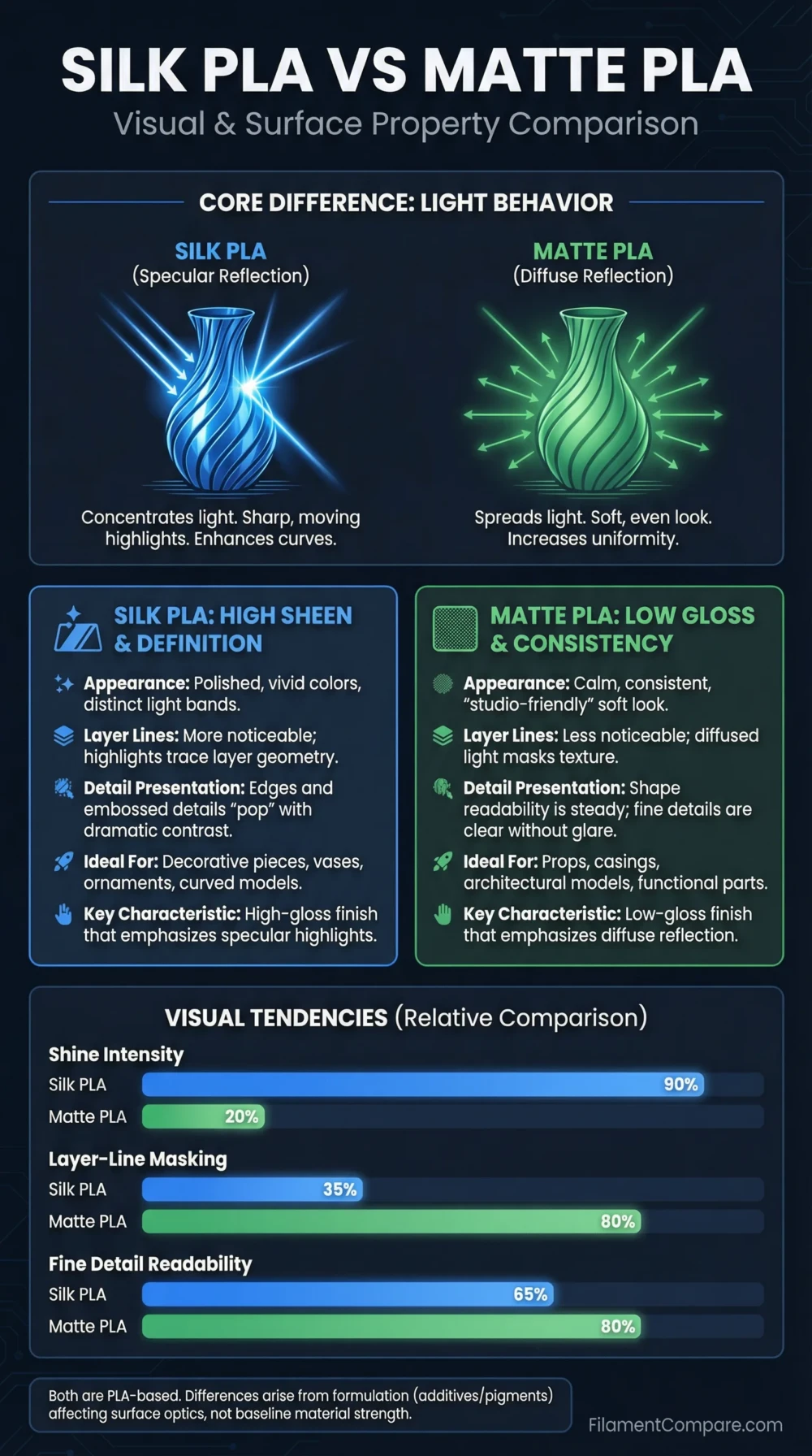
Silk PLA and Matte PLA are both built on PLA, but they behave very differently in the way they handle light, show surface detail, and “read” on camera. If your goal is a clean comparison, the fastest way to spot the difference is to watch how highlights slide across the surface: Silk PLA throws sharper highlights, while Matte PLA spreads them out.
- Surface Finish and Light Behavior
- What The Finish Does To Detail
- Visual Tendencies Across Common Prints
- Silk PLA Material Profile
- Appearance Characteristics
- How It Presents Surface Detail
- Matte PLA Material Profile
- Appearance Characteristics
- How It Presents Surface Detail
- Touch, Handling, and Everyday Appearance
- Mechanical Feel and Data Language
- Where The Difference Shows Up Most
- Why Two PLA Finishes Can Act So Different
- Silk PLA: high sheen
- Matte PLA: low gloss
- PLA-based thermoplastic
- Light response is the big split
- Finish affects visibility of details
Finish-first reality: With Silk PLA and Matte PLA, the “win” is rarely a single strength number. The main differences you’ll notice come from surface optics, texture, and how the print looks under real lighting.
Surface Finish and Light Behavior
Silk PLA is engineered to push a more reflective look. That means edges, curves, and embossed details can “pop” when the light hits them. The same optical behavior can also make layer texture easier to notice because bright highlights can trace the geometry of each layer line.
Matte PLA leans into diffusion. It spreads light across tiny surface textures, so the print often looks more consistent across angles. This makes surface uniformity feel higher, especially in rooms with overhead lighting that would otherwise create sharp, moving reflections.
What The Finish Does To Detail
- Silk PLA emphasizes specular highlights, so curved surfaces show stronger “shine bands” that move with the viewing angle.
- Matte PLA emphasizes diffuse reflection, so curves tend to look more even, with less dramatic highlight travel.
- Embossed text can look more dramatic in Silk PLA under a single light source, while Matte PLA often looks steadier under mixed lighting.
Visual Tendencies Across Common Prints
These indicators describe typical visual tendencies for Silk PLA and Matte PLA. They are not lab measurements. Formulations vary, and lighting makes a big difference. Still, the optics of gloss vs matte usually behave in consistent ways.
Shine Intensity (visual)
Layer-Line Masking (visual)
Photo/Video “Pop” Under Direct Light (visual)
Surface Mark Camouflage (visual)
Fine Detail Readability (visual)
Silk PLA Material Profile
Appearance Characteristics
- High-gloss sheen that creates distinct light bands on curves and edges.
- Color can look more vivid because specular highlights increase perceived contrast.
- Surface often looks more “polished” even when the geometry is the same.
How It Presents Surface Detail
- Layer texture may stand out when light rakes across the print.
- Edges and raised patterns can look more dramatic under a single lamp.
- Fine text can look crisp, but reflections can shift how readable it is across angles.
Many Silk PLA products achieve their look through formulation choices that change how the extruded surface “skins over” and how light reflects from micro-texture. That finish can make a model look premium in daylight, especially when the design has deliberate curves, bevels, and repeating patterns that catch highlights.
Matte PLA Material Profile
Appearance Characteristics
- Low-gloss finish that looks calm and consistent across angles.
- Colors often feel more soft and “studio-friendly” under mixed lighting.
- Large flat areas tend to look more uniform because highlights are less sharp.
How It Presents Surface Detail
- Layer lines can appear more subdued in typical room lighting.
- Small facets and sharp edges often read clearly because glare is reduced.
- Surface marks tend to blend in more because the finish spreads light.
Matte PLA is popular when the goal is a clean, even look that stays consistent across different environments. Because the finish is less reflective, the geometry itself often becomes the main visual feature—edges, chamfers, and curves stand on their own without strong “shine bands.” That makes shape readability feel very steady.
Touch, Handling, and Everyday Appearance
In hand, Silk PLA typically “reads” smoother because specular highlights suggest a polished surface, even when the underlying layer texture is similar. Matte PLA often feels more “textured-looking” because the surface finish reduces glare and makes micro-geometry more visible under ambient light.
Fingerprints and smudges are more about surface reflectivity than the base polymer. A shiny surface can show a change in reflectivity more clearly. A matte surface tends to look more consistent because it already spreads light. That’s why Silk PLA and Matte PLA can look quite different after handling, even if the print is the same part.
Mechanical Feel and Data Language
Because both are PLA-based, the baseline “feel” is often similar: parts can feel clean, rigid, and dimensionally stable in typical indoor conditions. Differences people notice between Silk PLA and Matte PLA usually come from formulation (additive package, pigments, and how the filament is made) rather than the PLA label alone. For a broader overview of how different PLA formulations behave in 3D printing—including PLA+, HT-PLA, and other modified versions—see the Ultimate PLA Filament Guide.
If you compare datasheets or lab reports, look for the test method behind the numbers. For plastics tensile behavior, one widely used standard is ASTM D638, which defines specimen and test conditions for tensile properties.✅Source This matters because “strength” can mean different things if the specimen shape, layer orientation, or test speed changes.
- Melt Flow Index (g/10 min)
- How much molten polymer flows through a standard die under a specified temperature and load. It’s a compact way to describe flow behavior across grades.
- Glass Transition (Tg)
- The temperature range where amorphous regions of the polymer shift into a more rubber-like state. For PLA, it’s a key reference point for heat softening.
- Surface Gloss
- A visual property tied to how strongly the surface produces specular reflections. Silk PLA aims higher gloss, while Matte PLA aims lower gloss.
Where The Difference Shows Up Most
- Silk PLA is often associated with prints where shine and highlight movement are part of the look—curves, ornaments, display pieces, and decorative geometry.
- Matte PLA is often associated with prints where surface consistency and layer-line masking matter—props, casings, and models meant to look even under many lights.
- When lighting changes a lot (window light, overheads, and camera flash), Silk PLA typically changes appearance more dramatically than Matte PLA.
Why Two PLA Finishes Can Act So Different
- Optics: Silk PLA concentrates reflections; Matte PLA spreads them out, changing how you perceive layer texture.
- Pigments and additives: Both finishes can use different pigment systems that shift how light is absorbed and scattered, influencing color depth.
- Surface micro-texture: Tiny surface differences (even when invisible up close) change highlight sharpness, which can change how smooth a print looks from a distance.
- Geometry: Large flats, gentle curves, and sharp edges all “read” differently depending on whether the surface is glossy or matte.
