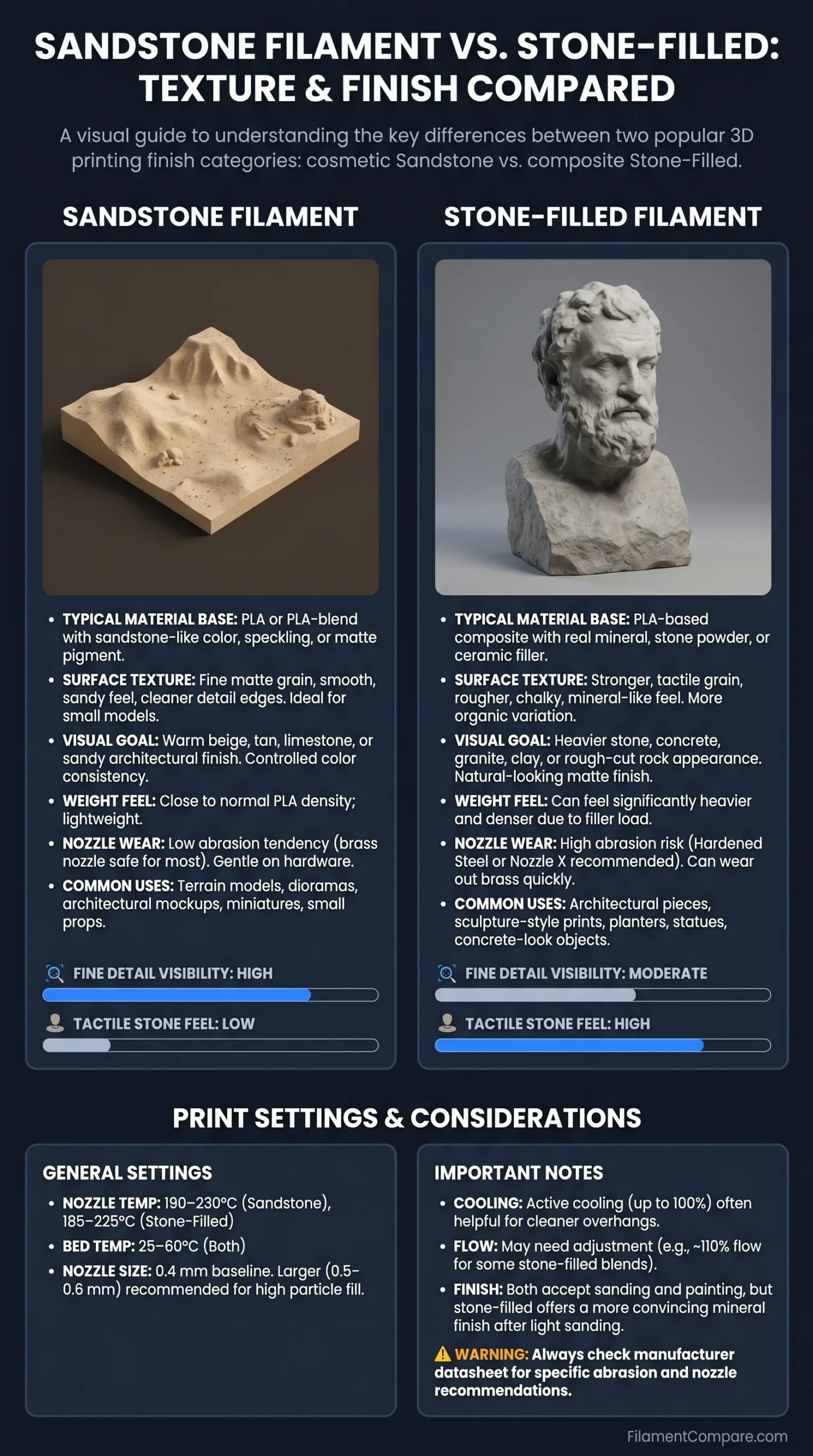
| Comparison Point | Sandstone Filament | Stone-Filled Filament |
|---|---|---|
| Typical Material Base | Usually PLA or PLA-blend with sandstone-like color, speckling, matte pigment, or light texture additives. | Usually PLA-based composite with mineral or stone-like filler; some products use real powdered stone. |
| Main Visual Goal | Warm beige, tan, desert-stone, limestone, or sandy architectural finish. | Heavier stone, concrete, granite, clay, marble, or carved-rock appearance. |
| Surface Texture | Fine matte grain, often smoother than true mineral-filled materials. | More tactile. Often rougher, chalkier, and more mineral-like, depending on filler load. |
| Layer Hiding | Good when the filament has speckles or a matte surface. | Often strong because mineral particles and matte finish reduce layer shine. |
| Typical Nozzle Temperature | Common PLA-style ranges, often around 190–230°C, depending on brand and color blend. | Examples range from 185–225°C for Spectrum PLA Stone Age and 195–220°C for colorFabb stoneFill; FormFutura StoneFil lists about 185–225°C. |
| Bed Temperature | Usually low PLA-style bed temperatures, often 25–60°C. | Often 0–60°C depending on product; Spectrum lists 0–45°C, colorFabb lists 50–60°C, and FormFutura lists about 50–60°C. |
| Density and Weight Feel | Close to normal PLA when the effect is mostly color or pigment. | Can feel heavier. FormFutura StoneFil is described as 50% powdered stone filled and denser than regular PLA. |
| Abrasion Tendency | Often mild, especially if it is mainly color/speckle-based. | Depends on filler. Spectrum PLA Stone Age is described as not abrasive, while high stone-powder blends may suit wear-resistant nozzles. |
| Typical Finish After Printing | Clean matte sandy look with controlled color consistency. | More organic stone effect, sometimes with natural-looking shade shifts and a rougher hand feel. |
| Common Uses | Terrain models, dioramas, architectural mockups, decorative objects, miniatures, vases, props. | Architectural pieces, sculpture-style prints, planters, statues, museum-style replicas, concrete-look objects, stone-look display parts. |
This comparison reads Sandstone Filament and Stone-Filled Filament through verified manufacturer datasheets and established materials references; the numbers show useful trends, while real print results still depend on printer, nozzle, slicer profile, model geometry, and filament batch.
Sandstone filament is usually chosen for a sandy, matte, natural-looking surface without making the print feel overly heavy or abrasive. Stone-filled filament aims for a stronger mineral impression: more weight, more tactile grain, and a finish closer to concrete, granite, clay, or rough-cut stone. The two categories overlap in search results and product names, but they are not always the same material. The real difference sits in the filler system.
A sandstone spool may simply be a PLA color blend with tan pigment and fine speckles. A stone-filled spool may contain mineral powder, stone powder, or a stone-effect formulation. Some brands avoid actual stone powder and still create a stone-like surface through formulation choices; colorFabb stoneFill, for example, states that its formulation does not incorporate stone powder while still mimicking a stone-like material.[a]
What Sandstone Filament Means in 3D Printing
Sandstone filament is best understood as a visual finish category, not one fixed polymer formula. Most sandstone-style spools are PLA or PLA-based filaments designed to print in beige, cream, light brown, ochre, tan, or desert-stone tones. Some have small dark flecks. Some are matte. Some are marketed as rock, marble, stone, sand, desert, or sandstone depending on the brand’s color naming.
The finish usually looks cleaner and more controlled than a heavily mineral-filled material. That matters for small prints. On a miniature wall, terrain tile, relief map, or architectural façade, fine grain can look more realistic than large visible particles. Tiny features stay crisp. Edges remain easier to read.
Typical Sandstone Filament Traits
- PLA-like printing behavior with low warping and moderate nozzle temperature.
- Matte or satin surface, depending on pigment and base resin.
- Sandy beige, limestone, desert rock, or weathered-stone color family.
- Usually lighter than high mineral-fill filaments.
- Good detail retention for small models, letters, engraved lines, and relief textures.
- Often easier to tune on a standard 0.4 mm nozzle.
The limitation is simple: sandstone filament can look like sand-colored plastic when the surface is too glossy or too uniform. Layer lines may also show more clearly on curved walls if the filament has little texture. A matte profile, smaller layer height, and surface-aware model design help the material look more stone-like.
What Stone-Filled Filament Means
Stone-filled filament is a broader composite category. The base is usually PLA or a modified PLA compound, while the effect comes from mineral filler, stone powder, chalky additives, or stone-effect formulation. FormFutura describes StoneFil as a PLA-based filament with 50% powdered stone filling, made for a rough, matte, stone-like finish.[b]
Other products create the effect differently. Spectrum PLA Stone Age is a PLA-based material with admixtures for a stony structure, rough surface, layer masking, and a recommended nozzle of at least 0.4 mm.[c] That means “stone-filled” should be read from the datasheet, not only from the product name. Names can be artistic. Datasheets are clearer.
Typical Stone-Filled Filament Traits
- More tactile surface than most color-only sandstone filaments.
- Matte finish that reduces plastic shine.
- Better layer hiding on statues, vases, masonry, cliffs, planters, and decorative stonework.
- Higher density when the filler load is high.
- Possible nozzle wear when hard mineral particles are present.
- More attention needed for flow, minimum layer height, and particle-friendly nozzle size.
Stone-filled filament is not automatically difficult. Some products are made to print close to standard PLA ranges. The difference is that the surface is less “flat plastic” and more mineral, chalky, and natural. That texture is the reason people choose it.
Texture Compared: Fine Sand Grain vs Mineral Roughness
Texture is where the comparison becomes visible. Sandstone filament often gives a fine-grain look. Stone-filled filament tends to create a rougher hand feel, especially when the formula contains a larger amount of mineral filler. The part can feel more like a cast object than a normal PLA print.
Texture Read by Eye and Touch
- Sandstone filament: fine speckles, sandy tone, soft matte finish, cleaner detail edges.
- Stone-filled filament: stronger tactile grain, heavier matte surface, more organic variation.
- Small parts: sandstone-style PLA can keep tiny edges neater.
- Large parts: stone-filled filament often gives walls, sculptures, and vases a more convincing mineral presence.
Think of a small architectural window frame. A sandstone PLA can preserve the thin bars and still look earthy. On a larger column, statue base, planter, or faux concrete block, the stronger texture of stone-filled filament may read better from a normal viewing distance. Scale changes the winner.
Why Speckles Matter
Speckles break up layer lines. They also reduce the flatness that often makes PLA look like plastic. A sandstone filament with well-distributed particles can hide shallow Z-banding better than a plain beige PLA. It still may not have the same stone-like touch as a mineral-filled composite, but visually it can be very convincing on smaller display models.
Why Mineral Fillers Matter
Mineral fillers change more than color. They can alter density, flow, surface sheen, and the way light scatters across the printed wall. A rougher material surface reflects less like glossy plastic. That gives matte stone depth even before sanding, priming, or painting.
Finish Compared: Matte, Rough, Layer-Hiding, and Natural Variation
Finish is not only texture. It includes sheen, color variation, edge clarity, layer visibility, and how the part reacts to light. Sandstone filament usually wins when the desired result is controlled and tidy. Stone-filled filament is often stronger when the desired result is aged, cast, carved, or mineral-like.
| Finish Feature | Sandstone Filament Behavior | Stone-Filled Filament Behavior |
|---|---|---|
| Matte Look | Moderate to high, depending on pigment and PLA blend. | Usually high when mineral or stone-effect additives are present. |
| Roughness | Fine and controlled. | More tactile, sometimes chalky or ceramic-like. |
| Color Variation | Usually speckled or lightly mottled. | Can include stronger natural-looking gradients in some stone-powder products. |
| Layer Masking | Good with matte pigments and flecks. | Often stronger on large surfaces because the surface itself is less glossy. |
| Edge Sharpness | Often cleaner on small details. | Good, but high filler blends may soften tiny raised details if flow is not tuned. |
| Post-Processing Feel | Sands and paints more like PLA. | Can sand into a more stone-like surface, though filler and binder behavior vary. |
A strong stone finish needs more than a stone-colored filament. Wall thickness, layer height, lighting, print orientation, and model texture all affect the final look. A smooth cube printed in sandstone color still looks like a cube. A sculpted surface printed in mineral-filled filament often looks more convincing because the material and geometry work together.
Print Settings and Flow Behavior
Both materials usually live in the PLA printing zone, but stone-filled filaments need more attention to particle flow. Spectrum PLA Stone Age lists 185–225°C nozzle temperature, 0–45°C bed temperature, 40–80 mm/s print speed, and a recommended nozzle of at least 0.4 mm.[d] colorFabb stoneFill lists 195–220°C nozzle temperature, 50–60°C bed temperature, 100% cooling fan, and 40–100 mm/s print speed.[e]
Sandstone-style PLA often prints with similar temperatures, but it may tolerate faster profiles when the effect is mostly color or fine pigment. The safer reading is this: particle size and filler load matter more than the word printed on the spool label.
Nozzle Size
A 0.4 mm nozzle is the common baseline for both materials. For stone-filled blends with visible particles, a larger nozzle can improve flow stability and reduce particle-related restriction. A 0.5 mm or 0.6 mm nozzle also makes sense when the model does not need very fine lines.
Small nozzle, gritty filament. That combination asks for patience. The material may still print, but the margin for clean extrusion becomes narrower.
Layer Height
Fine sandstone prints can use lower layer heights for detailed surface work. Stone-filled filament may look better with slightly taller layers if the texture is part of the design. Spectrum’s PLA Stone Age datasheet lists a layer height range of 0.05–0.30 mm, depending on geometry.[f]
Cooling
Most PLA-based stone-effect materials use active cooling. Spectrum lists active cooling up to 100%, while colorFabb lists 100% fan in its stoneFill guideline. Cooling helps keep overhangs cleaner, especially on statues, arches, relief edges, and carved-looking models.
Nozzle Wear and Abrasion
Nozzle wear depends on the filler, not the finish name. A sandstone-color PLA with pigment may be gentle on brass. A mineral-powder filament can be more demanding. Spectrum PLA Stone Age is specifically described as not abrasive in its datasheet.[g] FormFutura StoneFil, by contrast, is a high stone-powder material, so many users pair that kind of filled filament with hardened steel, ruby, tungsten carbide, or another wear-resistant nozzle for longer nozzle life.
Nozzle rule: do not judge abrasion by color alone. Real mineral content, filler hardness, filler percentage, and print volume decide how much nozzle wear to expect.
For a single small decorative print, a brass nozzle may complete the job without drama. For repeated stone-filled production runs, a wear-resistant nozzle is a more practical match. It keeps extrusion width more stable over time.
Strength, Stiffness, and Heat Behavior
Sandstone filament behaves mostly like its base polymer when the effect is cosmetic. If it is PLA-based, the part will usually share PLA-like stiffness, low warp behavior, and limited heat resistance. Stone-filled filament can become stiffer or heavier depending on filler type, but the printed part is still a layered thermoplastic composite, not a cut stone object.
For reference, colorFabb stoneFill reports 45 MPa tensile strength and 3325 MPa tensile modulus for 3D-printed specimens tested in the XY plane under its listed conditions.[h] Spectrum PLA Stone Age lists 53 MPa tensile strength at break, 60 MPa tensile strength at yield, and 3.5 GPa tensile modulus in its material properties table.[i]
Those values are useful for comparison, not a promise for every printed part. ASTM notes that tensile properties vary with specimen preparation, testing speed, and environment, so controlled sample preparation matters when comparing plastics.[j] ISO 527-1 also defines general principles for determining tensile properties of plastics and plastic composites under defined conditions.[k]
What the Numbers Mean in Real Prints
- Tensile strength helps compare how a printed specimen behaves under pulling force.
- Tensile modulus describes stiffness; higher values usually mean less flex under the same load.
- Heat distortion temperature gives a controlled test reference, but printed geometry still matters.
- Layer orientation can change strength because FFF/FDM parts are built line by line.
A stone-look filament is mainly selected for finish. It can still print durable display parts, but the material choice should match the part’s load, heat exposure, layer orientation, and wall design. Pretty surface first. Engineering claim second.
Dimensional Accuracy and Detail Retention
Sandstone filament often gives better detail retention when the formula is close to standard PLA. Small text, miniature brick patterns, terrain grid lines, and crisp architectural corners can print cleanly because the material flow is not heavily interrupted by coarse particles.
Stone-filled filament can also print detailed models, especially with a tuned profile, but the finish may slightly soften micro-detail if the particles, matte additives, or extra flow settings create a thicker surface. FormFutura lists about 110% flow for StoneFil in its general printing guidelines, which reflects how filled materials may need adjusted extrusion behavior.[l]
- For fine engraved detail
- Sandstone-style PLA is often easier to keep sharp, especially on small models.
- For natural wall texture
- Stone-filled filament often produces a stronger stone impression on larger visible surfaces.
- For repeatable color
- Sandstone filament usually feels more controlled from print to print.
- For organic variation
- Stone-filled filament can create a more natural, less uniform result.
Appearance by Model Type
The same filament can look different across model shapes. Flat panels show layer lines and sheen more clearly. Sculpted surfaces break light and hide print paths. Thin details reveal flow consistency. Large rounded walls reveal Z-banding. So the “better finish” depends on geometry.
| Print Type | Sandstone Filament Fit | Stone-Filled Filament Fit |
|---|---|---|
| Architectural Scale Models | Very strong for clean walls, terrain, beige stone, and fine relief. | Strong for masonry, ruins, columns, and rough cast surfaces. |
| Miniatures and Dioramas | Great for sand, cliffs, dry terrain, desert bases, and small stone props. | Good for larger bases and statues; particle texture may dominate very tiny details. |
| Vases and Planters | Clean sandy ceramic look. | More stone-like mass, roughness, and matte mineral feel. |
| Statues and Busts | Good for smooth limestone or sandstone sculpture style. | Very strong for carved stone, concrete, clay, or granite-inspired looks. |
| Functional Brackets | Possible when the base material and design fit the load. | Possible for light-duty uses, but finish-focused materials should be checked against datasheet values. |
| Display Props | Good when lightweight handling and crisp edges matter. | Good when a heavier, mineral-like object feel is desired. |
Relative Finish Indicators
Fine Detail Visibility
Tactile Stone Feel
Layer Line Masking
These indicators are not lab measurements. They reflect common finish trends seen across sandstone-style PLA and stone-effect composites. A matte sandstone filament with heavy speckling can beat a weak stone-effect material, while a well-formulated stone-filled spool can look much more natural than a simple beige PLA.
Post-Processing Differences
Sandstone filament and stone-filled filament both accept ordinary finishing work, but their surfaces respond differently. Sandstone PLA usually sands like a typical PLA-based material. It can be painted, dry-brushed, sealed, or lightly weathered. Stone-filled filament may produce a more convincing result with light sanding because the surface already has mineral-like texture.
- Light sanding: can reduce layer ridges while keeping a natural matte surface.
- Dry brushing: works well on stone-filled texture because raised grain catches pigment.
- Clear matte coat: helps protect display pieces without adding plastic shine.
- Filler primer: can erase texture, so it suits smooth sandstone-style parts more than rough stone surfaces.
- Edge highlighting: gives masonry, cliffs, ruins, and carved reliefs more depth.
For stone-like parts, over-finishing can remove the very thing the filament was chosen for. A light touch often looks better than a thick coating.
Which One Looks More Like Real Stone?
Stone-filled filament usually gives the stronger real-stone impression when the viewer can touch the part. The surface feels less like normal plastic, and the matte roughness works well on large forms. Sandstone filament can look more believable in photos or small-scale scenes because its controlled color and fine grain do not overwhelm the model.
The choice is not “realistic vs not realistic.” It is scale, surface, and viewing distance. A miniature desert wall may look better in sandstone PLA. A 200 mm statue base may look better in stone-filled filament. A clean architectural model may favor sandstone. A rough planter may favor stone-filled.
Choose Sandstone Filament When
- The model needs small detail, thin edges, or engraved geometry.
- The desired look is sandy, limestone-like, desert, beige, or lightly speckled.
- Low nozzle wear and simple PLA-style tuning matter.
- The part should stay lightweight.
- The finish needs to be controlled and repeatable.
Choose Stone-Filled Filament When
- The print should feel rough, matte, mineral, or cast-stone-like.
- Layer masking matters more than micro-detail.
- The model has broad visible surfaces such as vases, statues, columns, terrain, or masonry.
- A heavier hand feel is welcome.
- A wear-resistant nozzle is available for mineral-heavy blends.
Buying Notes That Affect Texture and Finish
Product names can blur the line between sandstone, stone, marble, rock, concrete, and mineral-filled filament. Before buying, the datasheet gives better answers than the color name. Look for base polymer, filler type, nozzle size, bed range, print speed, density, and whether the manufacturer mentions abrasion.
Datasheet reading point: if a filament says “stone-like” but does not say it contains stone powder, treat it as a stone-effect material until the manufacturer states otherwise. That does not make it weaker for visual use. It just means the finish comes from formulation rather than real mineral loading.
Also check spool weight. Some filled filaments are sold in 500 g, 700 g, 750 g, or 850 g formats instead of the usual 1 kg. A denser material can also deliver less filament length for the same spool mass. That affects large prints.
Common Misunderstandings
“Stone-Like” Does Not Always Mean Stone Powder
Some materials mimic stone without actual stone powder. colorFabb stoneFill is a clear example because the datasheet says the formulation does not incorporate stone powder.[m] The finish can still be useful. The label just needs careful reading.
More Texture Is Not Always Better
Strong texture can hide layers, but it can also cover tiny details. For miniature brickwork, relief lettering, and scale models, a fine sandstone finish may be more readable than a coarse mineral-filled surface. Small prints need restraint.
Matte Finish Can Change Perception of Layer Lines
Glossy surfaces reveal layer ridges because they reflect light in hard bands. Matte stone-effect filaments scatter light more softly. That is why two prints with the same layer height can appear very different.
Material Terminology and Testing Context
FFF/FDM printing belongs to material extrusion in additive manufacturing terminology. ISO/ASTM 52900 defines additive manufacturing terms for processes that build physical 3D geometry by adding material layer by layer.[n] This matters because filament datasheet values are often measured on specific printed specimens, not on every shape a desktop printer can produce.
Stone-effect filaments are finish materials first. They can have measurable strength, stiffness, and heat data, but texture-focused prints often use them for appearance, not high-load engineering use. For any load-bearing part, geometry, wall count, infill, layer direction, and verified test data should guide the decision.
Practical Material Match by Finish Goal
| Finish Goal | Better Starting Point | Reason |
|---|---|---|
| Fine Sandstone Wall | Sandstone filament | Controlled grain and lighter texture keep scale details clear. |
| Concrete Planter | Stone-filled filament | Rough matte surface and heavier feel support the concrete-like impression. |
| Desert Terrain Base | Sandstone filament | Warm sandy color and fine speckles suit terrain without heavy texture. |
| Carved Statue Base | Stone-filled filament | Mineral-like surface helps broad sculpted features read as stone. |
| Small Architectural Details | Sandstone filament | Cleaner extrusion helps window frames, tiles, and façade details stay legible. |
| Rough Rock Display Object | Stone-filled filament | Texture and matte light scattering create a more natural rock-like finish. |
For most users, the clean split is this: sandstone filament is the safer pick for fine visual control; stone-filled filament is the stronger pick for touchable mineral texture. Both can look excellent when the model geometry supports the material.
Resources Used
- [a] colorFabb stoneFill Technical Datasheet, description and formulation note: colorFabb stoneFill PDF
- [b] FormFutura StoneFil product information, 50% powdered stone filling and finish description: FormFutura StoneFil
- [c] Spectrum PLA Stone Age Technical Data Sheet, material description and surface notes: Spectrum PLA Stone Age PDF
- [d] Spectrum PLA Stone Age Technical Data Sheet, print settings: Spectrum PLA Stone Age PDF
- [e] colorFabb stoneFill Technical Datasheet, print settings: colorFabb stoneFill PDF
- [f] Spectrum PLA Stone Age Technical Data Sheet, layer height range: Spectrum PLA Stone Age PDF
- [g] Spectrum PLA Stone Age Technical Data Sheet, abrasion statement: Spectrum PLA Stone Age PDF
- [h] colorFabb stoneFill Technical Datasheet, 3D printed mechanical properties: colorFabb stoneFill PDF
- [i] Spectrum PLA Stone Age Technical Data Sheet, mechanical properties table: Spectrum PLA Stone Age PDF
- [j] ASTM D638, tensile property data and preparation sensitivity notes: ASTM D638
- [k] ISO 527-1:2019, plastics tensile properties general principles: ISO 527-1:2019
- [l] FormFutura StoneFil product information, general printing guidelines: FormFutura StoneFil
- [m] colorFabb stoneFill Technical Datasheet, stone-powder formulation note: colorFabb stoneFill PDF
- [n] ISO/ASTM 52900 terminology record for additive manufacturing: ISO/ASTM 52900
