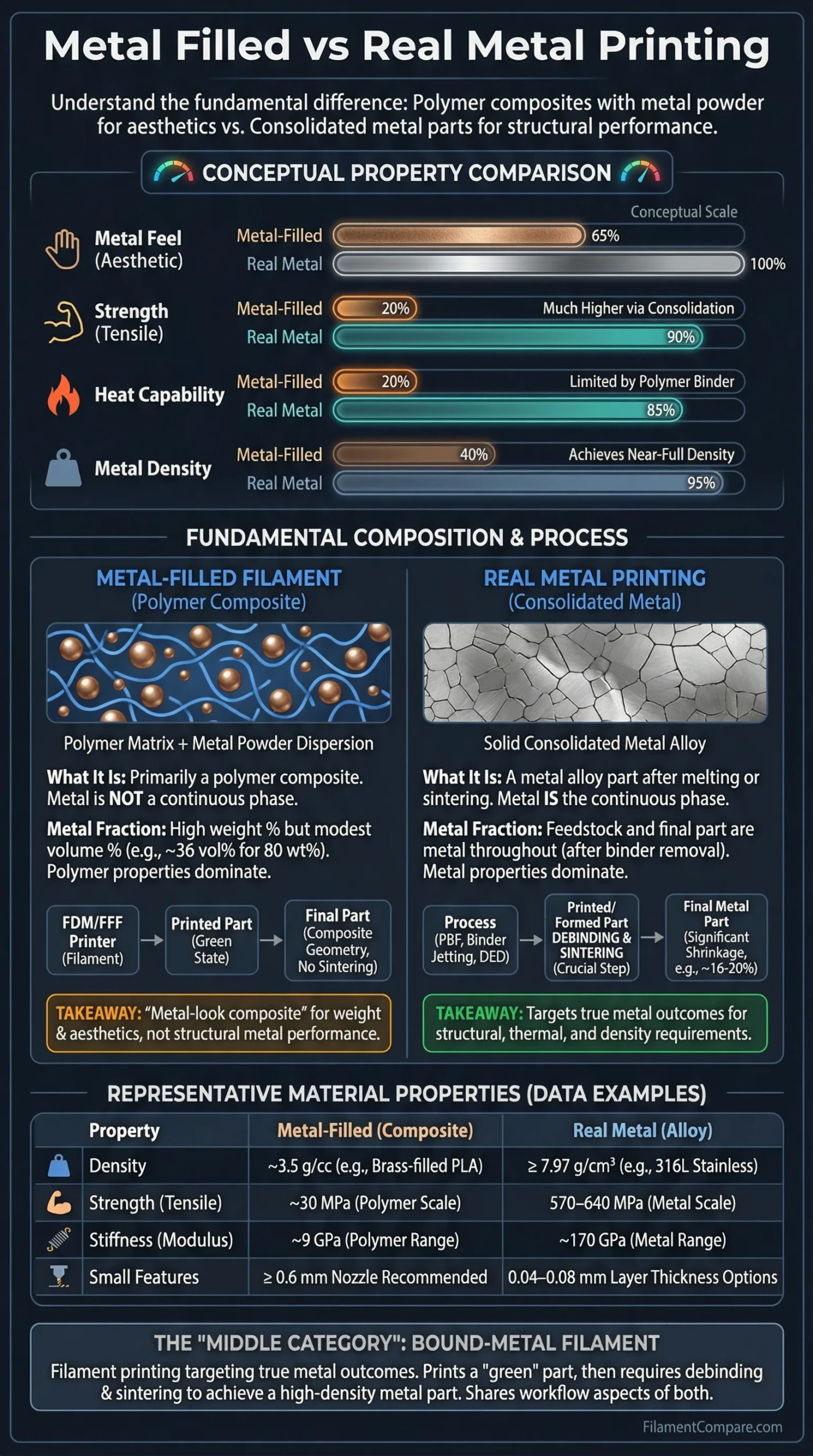
| Comparison Point | Metal-Filled Filament (Polymer + Metal Powder) | Real Metal Printing (Metal AM + Sinter-Based Metal Routes) |
|---|---|---|
| What the Part Mostly Is | Primarily a polymer composite; metal powder is dispersed in a plastic binder, so the metal is not a continuous phase.[j] | A metal alloy part after consolidation, rather than a decorative polymer-bound metal composite.[a] |
| Representative Metal Fraction | Metal percentage varies widely. One bronze-filled PLA sample measured ~80.35 wt% metal but only ~36.02 vol%, while current decorative products can use lower weight fractions.[j][k] | In melt-based routes, the built material is metal; bound-metal extrusion uses a temporary polymer binder that is removed before sintering.[i] |
| Density (Representative) | A current brass-filled PLA product lists 3.5 g/cc, about three times the density of ordinary PLA according to its manufacturer.[h] | A current EOS 316L PBF parameter set lists an average density of ≥ 7.97 g/cm³.[e] |
| Strength (Representative) | An older bronze-filled PLA technical dataset lists tensile strength around 30 MPa; composition and test method matter, so this is not a universal metal-filled PLA value.[g] | One current EOS M 290 40 µm 316L dataset lists tensile strength of 600 MPa vertically and 690 MPa horizontally as manufactured.[e] |
| Stiffness (Representative) | A bronze-filled PLA technical dataset lists flexural modulus around 9 GPa.[g] | A Markforged 17-4PH H900 dataset lists a tensile modulus of 170 GPa.[f] |
| Nozzle / Layer Example | Filled filaments can be abrasive. One brass-filled PLA product recommends a ≥ 0.6 mm hardened nozzle.[h] | One EOS M 290 316L process dataset uses a 40 µm (0.04 mm) layer thickness; this is machine- and parameter-set-specific.[e] |
| Dimensional Change After Consolidation | Decorative metal-filled PLA normally has no debinding or sintering stage; the finished geometry remains the printed polymer-composite part. | Bound-metal routes require shrink compensation. Ultrafuse 316L guidance gives approximate shrinkage of 16% in X/Y and 20% in Z for its workflow.[i] |
| Process Families You’ll See | Material extrusion (FDM/FFF) with metal particles dispersed through a polymer matrix.[h] | Common metal routes include Powder Bed Fusion, Binder Jetting, Directed Energy Deposition, and bound-metal extrusion followed by debinding and sintering.[a] |
| Emission / Exposure Focus | Filament feedstock avoids routine handling of a loose powder bed, but printing can still emit particles and VOCs. A September 2026 study measured these emissions from five unusually high-metal-loading composite filaments containing more than 90 wt% metal powder; its measurements should not be treated as universal values for ordinary decorative metal-filled PLA.[n] | Metal-powder AM adds powder-handling exposure. HSE measurements found generally low average airborne concentrations but short spikes during tasks such as manual cleaning, powder testing, and powder transfer.[l] |
| Shared Vocabulary and Standards | Separating metal-filled polymer from metal AM prevents material names from implying properties the printed part does not have. | NIST and ASTM use defined AM process families and standards covering metal processes, materials, design, and qualification.[m] |
This comparison of metal-filled filament and real metal printing uses manufacturer datasheets, published research, and institutional references. Numeric values are product- or process-specific examples rather than universal properties for every metal-filled filament or metal AM system.
“Metal-filled” and “real metal printing” sound similar, yet they produce very different materials. One usually leaves metal particles locked inside a polymer matrix for weight, texture, and surface appearance. The other produces a consolidated metal part through powder-bed fusion, binder jetting, directed energy deposition, or a debind-and-sinter workflow. Density, mechanical behavior, dimensional change, hardware requirements, and exposure controls differ accordingly.
- Metal-Filled Filament
- Metal Composite Filament
- Powder Bed Fusion
- Binder Jetting
- Directed Energy Deposition
- Debinding & Sintering
What “Metal-Filled” Really Means
A metal-filled filament is a polymer binder loaded with metal particles. Materials such as bronze-, copper-, brass-, or steel-filled blends are commonly sold among specialty 3D-printing filaments. In decorative grades, the binder still controls melting, extrusion, much of the layer bonding, and many in-use properties. Metal loading mainly changes density, texture, surface finish, and post-processing behavior.
Metal fraction also needs the correct unit. A percentage by weight can look very high because metals are much denser than PLA. In one published characterization, bronze-filled PLA contained about 80.35% metal by weight but 36.02% by volume; copper-filled PLA showed a similar relationship.[j] Current colorFabb information likewise describes bronzeFill, copperFill, and steelFill as roughly 80% metal by weight while stating that the polymer matrix remains dominant and the products are intended for aesthetics rather than sintering into solid metal.[k]
There is no single metal percentage that defines every product carrying a “metal-filled” label. FormFutura currently lists MetalFil Brass at approximately 60% brass by weight, for example, while other blends use higher loadings.[h] The exact formulation therefore matters whenever density, emissions, mechanical properties, or nozzle requirements are being compared.
Practical takeaway: Decorative metal-filled filament should be treated as a metal-particle/polymer composite unless the manufacturer explicitly specifies a debinding and sintering process that converts the printed green part into a consolidated metal component.
What Counts as Real Metal Printing
Real metal additive manufacturing produces a part whose functional material after processing is consolidated metal. The route used to get there varies. NIST separates additive manufacturing into process families including Powder Bed Fusion, Binder Jetting, Directed Energy Deposition, and Material Extrusion.[a]
In Powder Bed Fusion, a laser or electron beam melts and fuses selected regions of metal powder layer by layer. Unfused powder remains around the build until the part is removed and cleaned.[b]
In Binder Jetting, a binder selectively joins regions of a powder bed. Metal binder-jetted parts normally need later consolidation, commonly including curing, debinding, and sintering rather than becoming fully dense metal directly inside the printing stage.[c]
Directed Energy Deposition feeds material to a target while a directed energy source such as a laser melts it. The deposited material cools into a solid metal build or repair layer.[d]
The Bound-Metal Category Between the Two
Some filaments are designed specifically to produce real metal parts after post-processing. Bound-metal filament prints a polymer-bound green part, but that shape is only an intermediate stage. Debinding removes binder material, and sintering causes the remaining metal particles to coalesce. The part shrinks during this process, so dimensions must be compensated before printing.[i]
This is materially different from polishing a bronze-filled PLA figurine. A decorative metal-filled PLA print stays a polymer composite; a properly processed bound-metal system is intended to finish as a metal component.
Metal-Filled Filament Emissions and Ventilation
A study published on September 3, 2026 measured particles and volatile organic compounds released while material-extrusion printing five metal-composite filaments.[n] The material selection needs to be read carefully: the tested filaments contained more than 90% metal powder by weight according to their safety data sheets. They included copper and several steel or nickel-alloy formulations. These were unusually metal-rich feedstocks and are not representative of every decorative bronze-, copper-, brass-, or steel-filled PLA sold for ordinary FDM printing.
Across the five tested materials, measured particle-number emission rates ranged from about 8 × 10⁹ to 2 × 10¹¹ particles per hour, while particle mass emissions were roughly 200–1400 µg/h. More than 98% of emitted particles were below 1 µm. Manganese, copper, zinc, and selenium were detected in emitted particles, but total metals and metalloids represented only about 0.07–0.95% of emitted particle mass. The very high metal fraction in the raw filament therefore did not transfer proportionally into the airborne particle mass.[n]
The same tests detected VOCs including formaldehyde, benzaldehyde, acetaldehyde, naphthalene, trimethylbenzene, and other hydrocarbons, alcohols, aldehydes, and aromatic compounds. Overall VOC levels from the tested metal-composite filaments were lower than the researchers’ comparison data for conventional thermoplastic filaments, but the chemical mixture was different.[n]
Exposure modeling showed why room conditions matter. A worst-case scenario that placed a person close to an operating printer with low ventilation produced potential exceedances of several reference levels. In the study’s modeled ventilated office scenario, estimated exposure fell by as much as two orders of magnitude with the same emission source. The authors therefore recommend avoiding close proximity to an operating printer and increasing dilution through larger room volume and higher air-change rates.[n]
Scope of the 2026 emissions data: the measurements above apply to the five high-metal-loading composite filaments tested in that study. They should not be presented as emission rates for all metal-filled PLA. Decorative products can differ substantially in metal percentage, binder chemistry, additives, extrusion temperature, and particle formulation.[k][h][n]
For desktop printing, ventilation should therefore be based on the actual filament and workspace rather than the word “metal” on the spool. Use the manufacturer’s safety information, avoid placing an operating printer directly beside the breathing zone, and provide effective room ventilation or suitable source capture where the material or printing volume calls for it. Sanding, grinding, or polishing also creates a separate particulate exposure that is not represented by extrusion-emission measurements.
Material Properties That Change the Decision
Relative Comparison Meters (conceptual, not a test result)
Density and Weight
Metal-filled filaments are often chosen for weight per volume rather than metal-like structural performance. FormFutura MetalFil Brass, for example, is listed at 3.5 g/cc and roughly 300% of ordinary PLA’s weight for the same volume.[h] That extra mass can make props, handles, display objects, figurines, and decorative parts feel less like ordinary plastic.
Real metal printing reaches metal-class density. A current EOS StainlessSteel 316L-4404 dataset for a 40 µm M 290 process lists average density of at least 7.97 g/cm³.[e] That number belongs to the stated material, machine, and parameter set; other alloys and processes have their own density targets.
Strength and Stiffness
Adding dense particles does not turn PLA into a structural metal. Published work on metal-reinforced PLA found that the tested bronze- and copper-filled materials, each around 36 vol% metal, actually showed reduced tensile and fracture behavior compared with unfilled PLA under the reported conditions.[j] Particle loading, particle shape, interfacial bonding, print orientation, and the polymer matrix all affect the result.
The comparison with consolidated metal is on a different mechanical scale. The current EOS 316L example lists tensile strength of 600 MPa vertically and 690 MPa horizontally as manufactured.[e] A separate Markforged 17-4PH H900 dataset lists a tensile modulus of 170 GPa and ultimate tensile strength of 1230 MPa.[f] Those values should not be mixed into a single generic “metal 3D printing” specification because alloy, orientation, heat treatment, relative density, and process conditions differ.
Heat Behavior
Decorative metal-filled PLA remains strongly influenced by its polymer matrix when heated. Metal particles can change thermal conductivity and heat distribution, but they do not give the composite the service-temperature capability of stainless steel, tool steel, or nickel alloy. The safe operating temperature of a printed composite part should therefore come from the actual material data rather than from the melting point of the metal filler.
A consolidated metal part does not have a thermoplastic binder controlling its service behavior, but its temperature limits are still alloy- and condition-specific. Oxidation, creep, heat treatment, loading, and the surrounding environment still matter.
Printing Hardware and Post-Processing
Metal-Filled Polymer Filament
Decorative metal-filled filament can run on ordinary material-extrusion hardware when the printer meets the manufacturer’s requirements. The metal particles can accelerate nozzle wear, and larger particle-loaded formulations may need a wider nozzle. FormFutura’s current MetalFil Brass guidance specifies a ≥ 0.6 mm hardened nozzle and notes that its metal powder is abrasive.[h]
Post-processing is mainly cosmetic: sanding, polishing, tumbling, brushing, or patination can expose more metal at the surface and strengthen the visual effect. These operations can create dust, so extraction and suitable personal protection should be selected for the material and finishing method.
Powder-Bed and Directed-Energy Metal Systems
Powder Bed Fusion and Directed Energy Deposition are industrial processes rather than direct substitutes for desktop PLA printing. They add requirements for metal feedstock management, controlled process conditions, machine-specific parameters, part removal, and often heat treatment or machining. Powder handling also creates exposure-control tasks that do not exist in the same form when a user feeds a solid polymer filament into an FFF printer.[b][d][l]
Bound-Metal Filament
Bound-metal filament shifts some of the printing stage toward familiar material-extrusion hardware, but the process does not end when the green part leaves the build plate. Debinding and sintering are part of making the final metal component. Ultrafuse 316L guidance gives approximate shrinkage of 16% in X/Y and 20% in Z, corresponding to typical oversizing factors around 120% in X/Y and 126% in Z for that workflow.[i]
This shrinkage is one of the clearest practical distinctions between decorative metal-filled filament and sinterable metal filament. A polished decorative composite keeps essentially the printed geometry; a green bound-metal part is deliberately printed oversized because consolidation changes its dimensions.
Where Each Material Route Fits
| Use | Better-Fitting Route | Reason |
|---|---|---|
| Decorative bronze, copper, brass, or steel appearance | Metal-filled polymer filament | Simple material-extrusion workflow, high visual effect, extra weight, and polishable surfaces without metal-AM equipment. |
| Props and display objects that should feel heavier | Metal-filled polymer filament | Higher composite density provides more mass while retaining a polymer-based printing workflow. |
| Load-bearing metal component | Qualified metal AM or another metal manufacturing process | Decorative metal-filled PLA remains a polymer composite and should not be substituted for a metal alloy based on appearance or filler percentage. |
| Complex stainless-steel geometry using filament-style deposition | Bound-metal extrusion + debinding/sintering | The green part can be produced by extrusion, then converted into a metal component through controlled post-processing. |
| Industrial metal part with fine AM features | Powder Bed Fusion | Selective fusion of metal powder can produce dense metal parts with machine- and alloy-specific parameter sets. |
| Repair or addition of material onto an existing metal component | Directed Energy Deposition | Material is delivered and melted onto a target rather than requiring a complete powder bed.[d] |
Do Not Use Metal Percentage as a Strength Rating
A filament containing 60%, 80%, or more than 90% metal by weight can still behave very differently depending on whether the binder remains in the finished part. Decorative metal-filled PLA retains its polymer matrix. Sinterable feedstock intentionally removes much of that binder and consolidates the metal. Powder-bed fusion melts metal powder directly. Those routes cannot be ranked by metal percentage alone.
Technical Sources and Documentation
- [a] NIST — Additive Manufacturing Technologies (Process-family descriptions for Powder Bed Fusion, Directed Energy Deposition, Material Extrusion, and Binder Jetting.)
- [b] NIST — Powder Bed Fusion (Powder-bed process description and metal powder fusion workflow.)
- [c] NIST — Binder Jetting (Binder-jetting process description.)
- [d] NIST — Directed Energy Deposition (Directed-energy deposition process description.)
- [e] EOS StainlessSteel 316L-4404 for EOS M 290 — 40 µm Process Data Sheet (Used for layer thickness, density, and orientation-specific tensile data.)
- [f] Markforged 17-4PH Stainless Steel v2 Material Datasheet (Used for representative sintered 17-4PH modulus and tensile data.)
- [g] colorFabb bronzeFill Product Documentation (Product reference for bronze-filled PLA; mechanical values cited here are product-level technical data rather than a family-wide specification.)
- [h] FormFutura MetalFil Brass (Used for current brass loading, density, nozzle size, abrasiveness, and product positioning.)
- [i] BASF Ultrafuse 316L User Guidelines (Used for green-part processing, debinding/sintering, shrinkage, and oversizing examples.)
- [j] Vakharia et al. — Additive Manufacturing and Characterization of Metal Particulate Reinforced PLA Polymer Composites (Used for measured metal weight/volume fractions and polymer-composite mechanical context.)
- [k] colorFabb — Metal Percentage in steelFill, bronzeFill, and copperFill (Used to distinguish roughly 80 wt% decorative metal-filled products from sinterable metal feedstocks.)
- [l] UK Health and Safety Executive RR1195 — Exposure to Metal Powders in Additive Manufacturing (Used for powder-handling and workplace exposure observations.)
- [m] NIST — Additive Manufacturing Standards (Used for ASTM F42 and metal-AM standards context.)
- [n] Zhang et al. (2026) — Characterization of Particle and Volatile Organic Compound Emissions from Material Extrusion 3D Printing Using Metal Composite Filaments, Metals 16(9), 971, published September 3, 2026. DOI: 10.3390/met16090971. (Used for high-metal-loading filament particle emissions, VOCs, metal partitioning, exposure modeling, and ventilation findings.)
