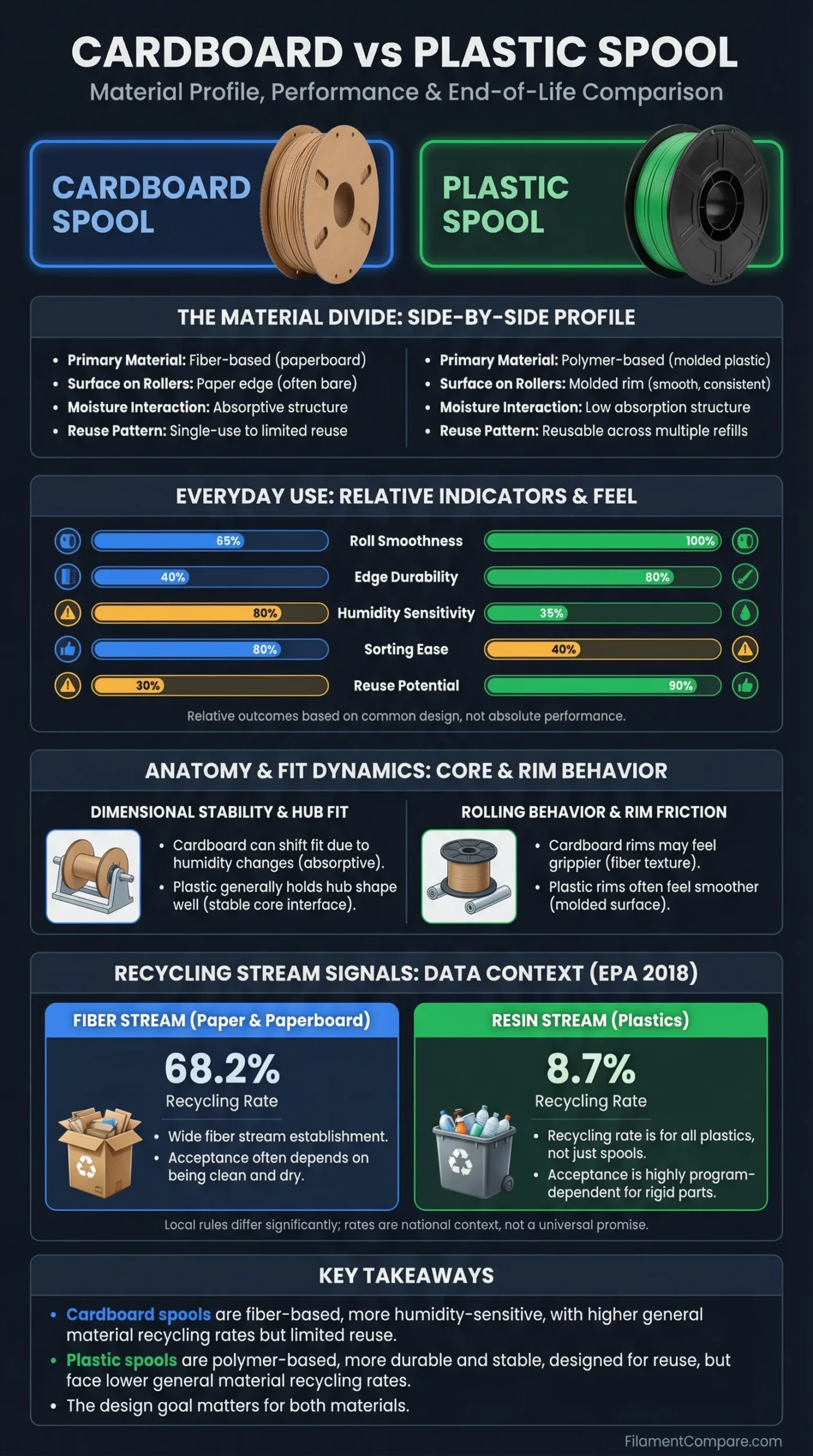
| Attribute | Cardboard Spool | Plastic Spool |
|---|---|---|
| Primary Material Family | Fiber-based (paperboard) | Polymer-based (molded plastic) |
| Surface On Rollers | Paper edge (often bare, sometimes sealed) | Molded rim (often smooth, consistent) |
| Moisture Interaction | Absorptive structure | Low absorption structure |
| Recycling Rate Context (MSW, 2018) | Paper & Paperboard: 68% | Plastics: 9% |
| Typical End-Of-Life Path | Fiber stream (if clean and accepted) | Resin stream (depends on local acceptance) |
| Common Reuse Pattern | Single-use to limited reuse | Reusable across multiple refills (design-dependent) |
Numbers in the table reflect EPA material recycling trends in municipal solid waste for 2018, shown as percentages in the national trend table. Local rules can differ a lot, so treat this as context, not a promise for every bin.✅Source
- Cardboard Spool Profile
- Plastic Spool Profile
- Spool Anatomy and Why It Matters
- Relative Characteristics and Everyday Feel
- Cardboard Construction and Plastic Construction
- Dimensional Stability and Fit
- Rolling Behavior and Feed Consistency
- Humidity, Storage, and Labeling
- Material Recycling and Recoverability
- What Programs Commonly Target
- Fiber Stream Signals: Paper and Paperboard Data
- Resin Stream Signals: Plastics Data
- Why Outcomes Differ Across Places
- Spool Reuse vs Spool Disposal
A cardboard spool and a plastic spool can hold the same filament, yet they behave differently in real-world handling. The spool affects rolling feel, fit on holders, and end-of-life sorting. This page compares spool materials with a data-first focus, so the difference is clear even before the first print.
- Spool Rims
- Core Fit
- Humidity Response
- Recycling Path
- Reuse Potential
Cardboard Spool Profile
- Fiber structure that feels slightly matte to the touch.
- Edges may be raw or sealed, depending on brand.
- Stiffness comes from layered paperboard geometry.
- Labeling often uses paper stickers that tear cleanly.
Plastic Spool Profile
- Molded geometry with consistent rim and hub surfaces.
- Durable edges that stay smooth under frequent rolling.
- Fit tends to be stable where holders rely on a tight core diameter.
- Reuse is common when the spool is designed for refills.
Spool Anatomy and Why It Matters
- Flange
- The two side plates that keep filament layers aligned. Flange stiffness influences how “true” the spool runs.
- Hub
- The center barrel that interfaces with holders. Hub diameter and roundness affect fit and wobble.
- Rim Surface
- The outer edge that touches rollers. A smoother rim surface typically means more consistent rolling.
Cardboard spools and plastic spools share the same basic anatomy, but their material behavior changes how those parts perform. The most noticeable differences usually come from rim contact, hub fit, and how the flange resists flex.
Relative Characteristics and Everyday Feel
Cardboard vs Plastic (relative indicators)
Note: These bars are relative and describe common outcomes seen across many brands; spool design can outweigh material in edge cases.
Cardboard Construction and Plastic Construction
A cardboard spool is usually built from layered paperboard with a formed core and two flanges. The edges may be left raw or finished with a thin sealing layer, which changes the rim texture and wear pattern.
A plastic spool is typically a molded part where the hub and flanges are made as one rigid structure. Because the surface is molded, the rim contact and roundness tend to be consistent from one spool to the next.
Dimensional Stability and Fit
Fit problems usually come from the hub diameter and how round it stays. Cardboard can show small changes when the fiber structure takes on or releases moisture, which shifts how tight the hub feels on certain holders. Plastic generally holds shape well, so the core interface stays predictable.
- Core roundness: affects wobble and rolling pressure.
- Flange flatness: affects how neatly the filament winds and unwinds.
- Rim edge finish: affects grip and noise on rollers.
Design Note: A well-designed cardboard spool can roll extremely cleanly, and a poorly designed plastic spool can feel rough. Material matters, but geometry and tolerances often decide the final experience.
Rolling Behavior and Feed Consistency
Rolling behavior is mostly a story of rim friction and roller contact. Cardboard rims can feel slightly grippier because of the fiber texture, while plastic rims often feel smoother due to a more uniform surface. Both can be stable when the spool is round and the filament is wound evenly.
Some setups are sensitive to fine particles created at the rim surface during long rolling sessions. This is not a “good vs bad” issue; it’s just a surface interaction between material and rollers. Sealed edges on cardboard or a clean molded rim on plastic can both keep that interaction smooth.
Humidity, Storage, and Labeling
Cardboard is a fiber material, so it naturally interacts with ambient humidity more than plastic. That can show up as a subtle change in feel, stiffness, or hub tightness. Plastic stays more consistent in the same room conditions, especially at the hub interface. Practical ways to manage humidity around filament and spools—such as sealed containers, desiccant use, and drying workflows—are explained in this guide to filament storage and drying.
Labeling is also different. A cardboard spool often uses paper labels that tear cleanly with the fiber, while a plastic spool may use stickers that leave adhesive depending on the material and finish. That matters if the spool is intended for reuse and needs a clean surface for the next label.
Material Recycling and Recoverability
When people say a spool is “recyclable,” they often mean two different things: recoverable in a real system, and compatible with a recognized recycling pathway. In standards language, material recycling describes requirements for packaging to be classified as recoverable through recycling and outlines assessment procedures.✅Source
Practical takeaway: The material and the local collection system both matter. A spool can be technically recyclable as a material, yet not be accepted everywhere.
What Programs Commonly Target
Many collection programs prioritize “commonly recycled materials” that have established processing routes. In EPA’s recycling infrastructure assessment scope, that common set includes paper, cardboard/boxboard, and plastics #1 & #2 among other core items, reflecting where existing systems and end markets are strongest.✅Source
- Cardboard spool acceptance often depends on whether it’s clean and treated as boxboard-like material.
- Plastic spool acceptance often depends on the resin type and whether the program targets rigid plastics.
- Mixed parts (labels, metal clips, composite inserts) can shift where the spool fits in sorting.
Fiber Stream Signals: Paper and Paperboard Data
For a broad benchmark, EPA reports that paper and paperboard had a 68.2% recycling rate in 2018 (about 46 million tons recycled). In the same material breakdown, corrugated boxes are listed with a much higher recycling rate, showing how strongly some fiber categories perform within the overall paper/paperboard family.✅Source
That does not automatically mean every cardboard spool will be processed the same way as a shipping box. Still, it explains why fiber-based materials often have a clear, mature path in many systems: the fiber stream is widely established and heavily used.
Resin Stream Signals: Plastics Data
For the plastics category overall, EPA reports that plastics had an 8.7% recycling rate in 2018 (about three million tons recycled). The same page highlights that some specific container types (like PET bottles and HDPE natural bottles) can have much higher recycling rates than plastics as a whole.✅Source
A plastic spool is a rigid plastic item, but it is not automatically the same as a bottle or jug. That’s why “plastic spool recycling” can be program-dependent, even when the spool looks like a clean, solid part.
Why Outcomes Differ Across Places
Recycling outcomes vary widely because programs differ in collection, sorting, and end markets. A federal technical report from NIST notes that recycling rates can vary significantly across regions and discusses how system design and market factors shape what gets collected and processed at scale.✅Source
Spool Reuse vs Spool Disposal
Plastic spools are often built with repeat handling in mind, which fits refill ecosystems and long-term storage. Cardboard spools can also be managed cleanly when they are kept dry and structurally intact, especially where fiber streams are strong. In both cases, the design goal matters: a spool made for reuse behaves differently than a spool made to be lightweight and simple.
