| Attribute | Dissolvable Supports | Breakaway Supports |
|---|---|---|
| Removal Mechanism | Material removal by dissolving (most commonly water-soluble support filaments). | Material removal by mechanical separation (supports are snapped, peeled, or clipped away). |
| Typical Support Materials | PVA, BVOH, and other water-soluble support filaments used alongside a separate build material. | Dedicated breakaway support filament on dual systems, or same-material supports on single-extrusion systems. |
| Where It Shines Most | Enclosed cavities, internal channels, lattices, and assemblies where direct tool access is limited. | Open, reachable supports where quick physical removal is practical and predictable. |
| Hardware Footprint | Usually tied to multi-material workflows (dual nozzle, dual extruder, or multi-material unit). | Works in multi-material workflows, and can also exist as same-material supports on single-extrusion setups. |
| Example Nozzle / Bed Window | PVA example profile: 215–225 °C nozzle, 60 °C bed (when printed as a single material). [Source-1✅] | — |
| Example Nozzle / Bed Window | — | Breakaway example profile: 215–230 °C nozzle, 60 °C bed (when printed as a single material). [Source-2✅] |
| Example Datasheet Snapshot | UltiMaker PVA TDS values: 2.85 ± 0.10 mm diameter; 1.23 g/cm³ specific gravity; 58.4 °C glass transition; 175.4 °C melting temperature; 17–21 g/10 min MFR. [Source-3✅] | — |
| Example Datasheet Snapshot | — | UltiMaker Breakaway TDS values: 2.85 ± 0.05 mm diameter; 1.22 g/cm³ specific gravity; 59.7 °C glass transition; 151.8 °C melting temperature; 3–6 g/10 min MFR. [Source-4✅] |
This comparison of dissolvable supports and breakaway supports is built from manufacturer datasheets plus other trusted technical references, so the values reflect common trends and standard comparisons while real-world outcomes can still vary by printer, profile, and geometry.
- Dissolvable Supports vs Breakaway Supports: What Changes In Practice
- Dissolvable Supports (Water-Soluble Filaments)
- Breakaway Supports (Mechanical Removal)
- Geometry Access: External Overhangs vs Internal Cavities
- Where Dissolvable Supports Usually Show Their Value
- Where Breakaway Supports Often Fit Naturally
- Surface Interaction: What The Supported Face “Remembers”
- Workflow Footprint: Time, Tools, And Consumables
- Dissolvable Support Workflow
- Breakaway Support Workflow
- Thermal Matching: Why Temperature Windows Matter
- Moisture Behavior: A Practical Reality For Water-Soluble Supports
- Suitability Snapshot (Relative Trend View)
- Comparison Dimensions People Actually Document
- Terms You’ll See In Filament And Support Specs
- Dissolvable = removal by dissolving
- Breakaway = removal by separation
- Support Interface drives surface feel
- Geometry Access is a core divider
- Moisture behavior matters for soluble filaments
Dissolvable Supports vs Breakaway Supports: What Changes In Practice
Both support types exist for the same reason: they hold up overhangs, bridges, and suspended features while the model is built layer by layer. The real split is the removal physics. Dissolvable supports leave the build by turning into a removable solution; breakaway supports leave the build by becoming a separate solid that’s detached from the part.
That single difference reshapes what people care about: access (can you reach the support), surface interaction (how the contact area looks and feels), and workflow footprint (time, materials, and handling). You can think of it as chemistry-first versus mechanics-first.
Dissolvable Supports (Water-Soluble Filaments)
- Removal path: support material is dissolved, which can clear channels and cavities without tool access.
- Contact behavior: the interface line is often designed for clean separation after dissolution.
- Common pairings: usually printed alongside a different build material in multi-material setups.
- Material handling: many soluble filaments are hygroscopic and are treated like “keep-it-dry” materials.
Breakaway Supports (Mechanical Removal)
- Removal path: supports are separated from the part by snapping, peeling, or clipping.
- Contact behavior: the support interface is tuned so it holds during printing and releases during removal.
- Common pairings: can be a dedicated breakaway filament in dual workflows, or same-material supports in single-extrusion prints.
- Material handling: storage is typically simpler than water-soluble support filaments, especially for day-to-day use.
Geometry Access: External Overhangs vs Internal Cavities
The biggest practical divider is whether the support is reachable. With breakaway supports, the “best-case” geometry is one where the support can be grabbed and separated cleanly. With dissolvable supports, the removal route doesn’t rely on tool access in the same way, so enclosed voids and internal pathways are often part of the use case.
Accessibility is the recurring theme: breakaway support behavior is strongly tied to reach and leverage, while dissolvable support behavior is strongly tied to fluid contact and the support’s chemistry.
Where Dissolvable Supports Usually Show Their Value
- Internal channels and labyrinth-like voids where physical removal is limited.
- Tight lattices and trapped structures where “pulling out” support is not realistic.
- Printed assemblies where support must disappear without forcing parts apart.
Where Breakaway Supports Often Fit Naturally
- Open overhangs and accessible undersides where manual separation is straightforward.
- Simple support trees that can be removed in larger pieces rather than fragments.
- Fast iteration cycles where the workflow favors minimal post-print setup.
Surface Interaction: What The Supported Face “Remembers”
Both approaches touch the model through a support interface. That interface can leave a signature: tiny witness lines, texture differences, or a slightly different sheen on the supported face. With dissolvable supports, the idea is often to make the contact region removable by chemistry. With breakaway supports, the idea is to make the contact region removable by controlled separation.
- Support Interface
- The thin region where support meets the model; it’s engineered to balance holding strength during printing with clean separation after printing.
- Contact Footprint
- The practical “touch map” on the model surface; larger footprints can mean stronger support, smaller footprints can mean easier cleanup.
- Release Behavior
- How the interface lets go—either by dissolving away or by breaking away in a controlled manner.
Workflow Footprint: Time, Tools, And Consumables
Dissolvable supports tend to shift effort into a removal period (dissolution time plus rinse/cleanup), while breakaway supports tend to shift effort into a manual separation period (detaching supports and cleaning small touch points). Neither is “better” in every case; they simply concentrate work in different places.
Dissolvable Support Workflow
- Setup footprint: container space and water handling are part of the process.
- Time footprint: removal commonly runs on a longer clock when supports are thick or abundant.
- Finish footprint: surfaces inside cavities can be cleared without physical contact points being “picked out.”
Breakaway Support Workflow
- Setup footprint: typically minimal—manual removal is the main requirement.
- Time footprint: removal can be quick when supports separate in larger, clean pieces.
- Finish footprint: cleanup focuses on the interface points where supports touched the model.
Thermal Matching: Why Temperature Windows Matter
Supports are printed through the same kind of hotend system as the build material, so temperature compatibility is always part of the story. In multi-material printing, people often talk about overlap: both materials should have workable extrusion conditions without pushing either one outside its comfortable range. This is one reason support filaments are commonly documented with clear nozzle and bed windows.
There’s also the interface itself: supports must adhere well enough to hold geometry, yet release reliably later. That balancing act shows up as material pairing, interface tuning, and consistent process stability. It’s less about one magic setting and more about how the pair behaves together across the whole print.
Moisture Behavior: A Practical Reality For Water-Soluble Supports
Water-soluble support filaments are often treated as moisture-sensitive. It’s not a minor detail; it affects extrusion consistency and the day-to-day predictability of dissolvable supports. Prusa’s technical note on soluble BVOH/PVA also gives a concrete solubility example for BVOH: about 1 g soluble in roughly 20 g of water, and it calls out that both BVOH and PVA are very hygroscopic. [Source-5✅]
Good To Know: breakaway supports typically remove the “water handling” part of the workflow, while dissolvable supports often remove the “tool access” requirement for internal features.
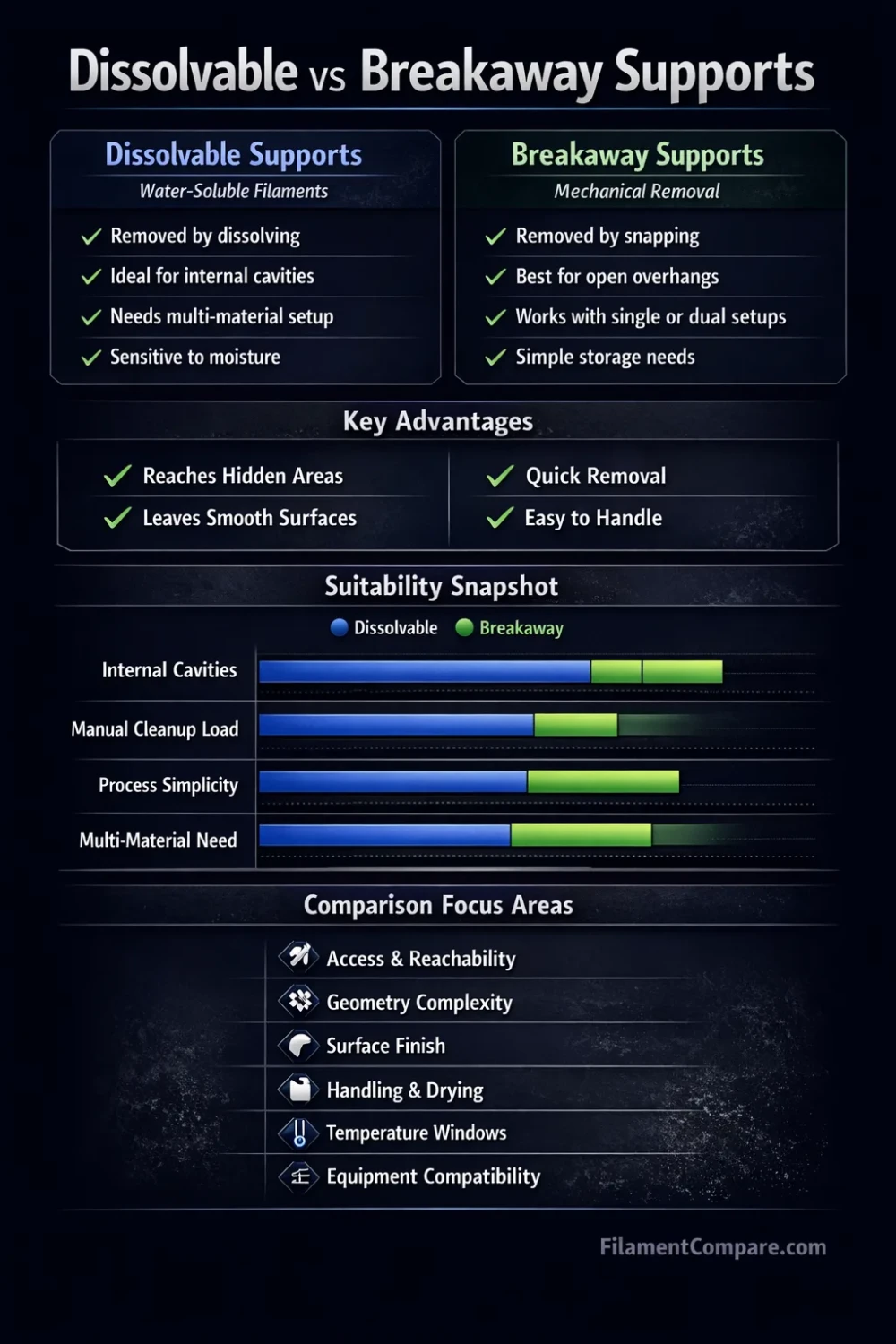
Suitability Snapshot (Relative Trend View)
The bars below show a typical pattern people report when comparing dissolvable supports and breakaway supports. They’re not a lab result; they’re a compact way to visualize common trade-offs.
Dissolvable (navy) Breakaway (green)
Comparison Dimensions People Actually Document
- Access: whether the support is reachable for mechanical separation.
- Geometry Complexity: presence of internal channels, enclosed voids, or trapped support zones.
- Surface Requirements: acceptable texture change or witness marks on supported faces.
- Handling Footprint: water handling and drying behavior versus manual separation effort.
- Hardware Fit: single-extrusion (same-material supports) versus dedicated multi-material support printing.
- Repeatability: how consistently the support interface behaves across different part shapes.
Terms You’ll See In Filament And Support Specs
- Water-Soluble Support Filament
- A support filament formulated to dissolve in water, commonly used as dissolvable supports in multi-material printing.
- Breakaway Support Filament
- A support filament tuned for mechanical separation after printing, often aiming for clean release at the interface.
- MFR (Melt Mass-Flow Rate)
- A thermal-flow indicator used in datasheets; it helps describe how a polymer flows under a defined load and temperature.
- Tg (Glass Transition)
- A temperature range where polymers shift in stiffness behavior; it can relate to handling, feel, and thermal response of supports.
- Tm (Melting Temperature)
- A thermal marker often listed for semi-crystalline behavior; it’s part of the datasheet “identity” for many support filaments.
