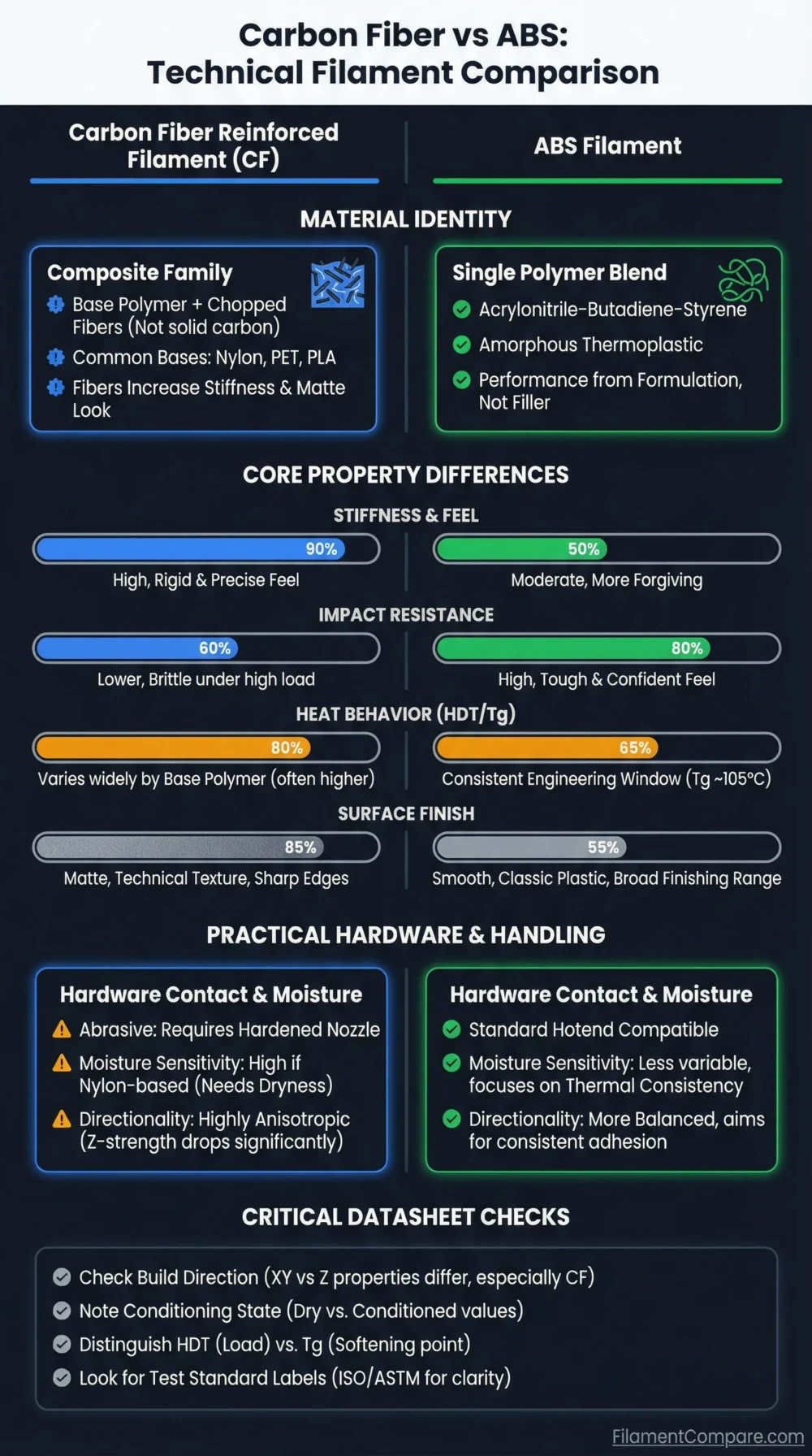
| What You’re Comparing | Carbon Fiber Reinforced Filament | ABS |
|---|---|---|
| Material Family | Composite (a base polymer + chopped carbon fibers) | Single Polymer Blend (Acrylonitrile–Butadiene–Styrene) |
| Typical Base Polymer | Often Nylon/Polyamide, PET-family, or PLA (depends on brand) | ABS (amorphous thermoplastic) |
| What The “Carbon Fiber” Label Means | Short fibers increase stiffness and give a matte look; it is not a “solid carbon” material | No fiber filler required; performance comes from the ABS formulation |
| Surface Character | Matte, “technical” texture is common; edges can look very crisp | Often smooth with a classic engineering-plastic look |
| Direction Sensitivity | Commonly more anisotropic (XY vs Z can separate a lot on many CF blends) | Still anisotropic in FFF, yet many ABS blends target consistent interlayer adhesion |
| Printer-Hardware Contact | Fiber-filled blends are often treated as abrasive to nozzles; datasheets commonly mention hardened nozzle options | Typically compatible with standard hotends; material choice is about temperature stability and part needs |
| Moisture Sensitivity | Many CF blends are polyamide-based, so you’ll see more dryness guidance on datasheets | Usually less moisture-driven variability than many nylon-based blends, while still benefiting from clean storage |
| ABS Glass Transition (Typical Polymer Value) ✅Source | Depends on the base polymer used in the CF blend | Often cited around 105 °C (polymer-level softening reference point) |
| Example Datasheet Numbers: Ultrafuse® PAHT CF15 ✅Source |
| Numbers vary by ABS brand, printer, and test method |
| Example Datasheet Numbers: UltiMaker ABS (Printed-Part Tests) ✅Source | Numbers vary by CF blend and base polymer |
|
Important framing: “Carbon fiber filament” is a label for a fiber-filled composite, not a single standardized material. ABS is a defined polymer family, but its 3D-print formulations can still differ a lot between brands.
- Material Identity and What You Are Really Comparing
- Carbon Fiber Reinforced Filament As A Category
- ABS As A Material Family
- Core Property Differences That Show Up on Real Parts
- Stiffness and Load Response
- Heat and Softening Behavior
- Impact Feel and Edge Durability
- Surface, Fit, and Aesthetic Signals
- What You Usually See With Carbon Fiber Reinforced
- What You Usually See With ABS
- Moisture, Storage, and Repeatability
- What Changes Most Between Brands
- Data Sheet Reading That Keeps Comparisons Honest
When someone says Carbon Fiber Filament, they’re usually talking about a thermoplastic composite where chopped fibers are mixed into a base plastic. ABS is different: it’s a single material family (Acrylonitrile–Butadiene–Styrene) with its own classic engineering behavior.
Material Identity and What You Are Really Comparing
- Composite
- Amorphous Polymer
- Chopped Fiber
- HDT / Tg
- Anisotropy
Carbon Fiber Reinforced Filament As A Category
Carbon fiber reinforced filament is a family label. The real identity comes from the base polymer (nylon, PET-family, PLA, or others) plus the fiber loading.
- Chopped fibers increase stiffness and often reduce the “rubbery” feel under load.
- A matte surface is common because fibers change how light scatters.
- Numbers can swing widely because polyamide-based CF and PLA-based CF behave like different materials.
ABS As A Material Family
ABS is an amorphous thermoplastic. It’s widely used in manufactured products because it balances toughness, heat behavior, and practical finishing options.
- Glass transition is a useful reference, but printed-part performance often tracks HDT and geometry.
- In FFF, ABS is often chosen when fit and impact feel matter.
- Formulations vary, yet ABS stays recognizable in how it responds to heat and load.
Core Property Differences That Show Up on Real Parts
Relative Feel On Common Prints: Carbon Fiber Reinforced vs ABS
Stiffness and Load Response
Carbon fiber reinforced filament is often picked because it feels stiffer at the same part thickness. That “stiff” feel usually comes from short fiber reinforcement, not from a dramatic jump in raw polymer strength. Many of these reinforcement effects are explained in broader carbon fiber filament guides, which look at how fiber loading, orientation, and base polymer choices shape stiffness and print behavior. ABS can still be strong, but its signature is a more forgiving response in many geometries.
Heat and Softening Behavior
Heat behavior is where comparisons get real: HDT tells you how a printed part holds shape under load as temperature climbs, while Tg is a polymer softening reference. Many CF blends are built on higher-temperature base polymers, and ABS stays popular because it provides a solid engineering window in everyday use.
Impact Feel and Edge Durability
ABS is widely associated with impact resistance in functional plastic parts, which can translate into a confident feel on clips, covers, and housings. Carbon fiber reinforced filament often feels very “locked in” under bending, and the best way to describe it is rigid and precise rather than soft.
Surface, Fit, and Aesthetic Signals
What You Usually See With Carbon Fiber Reinforced
- Matte surface that hides minor scuffs and fingerprints.
- Sharp edges and “technical” texture on flat faces.
- Many blends look consistent because the fiber speckle masks tiny layer variations.
Important detail: the look depends heavily on base polymer and fiber content, so “CF” isn’t one aesthetic.
What You Usually See With ABS
- Smooth faces that read like traditional molded plastic.
- Predictable appearance across colors and brands (with normal formulation variation).
- Finishing paths can be broad, which is why ABS is common in functional shells and enclosures.
Practical note: “ABS look” is often tied to how cleanly the material forms continuous outer skins.
Moisture, Storage, and Repeatability
Repeatability often tracks moisture more than people expect. Many carbon fiber reinforced products are polyamide-based and ship with explicit dryness language, while ABS typically focuses more on thermal consistency and controlled printing conditions than on moisture-driven swings.
What Changes Most Between Brands
- Base polymer under the “CF” label (nylon-CF vs PET-CF vs PLA-CF feels like different worlds).
- Fiber loading and fiber length distribution (it shapes stiffness and surface texture).
- Print orientation response (how sharply properties drop from XY to Z).
- ABS blend tuning (warping control, adhesion targets, and flow behavior).
- Thermal test method used on datasheets (HDT vs Tg vs brand-specific heat notes).
Data Sheet Reading That Keeps Comparisons Honest
- Build Direction (XY, XZ, Z)
- Carbon fiber reinforced materials can show big direction differences, while ABS often aims for balanced behavior. Always compare like-for-like directions.
- Conditioning State
- Some composites publish both dry and conditioned values. Those are not “good vs bad” numbers; they’re two different states of the same material.
- HDT vs Tg
- HDT is a shape-under-load indicator; Tg is a polymer softening reference. In real prints, part geometry and load decide which one matters more.
- Test Standard Label
- When a sheet lists ISO/ASTM-style test references, it’s signaling method clarity. Vocabulary standardization matters for consistent comparisons. ✅Source
Orientation is not a small detail in carbon fiber reinforced prints. Research on build orientation effects in FFF carbon-fiber composites shows measurable shifts in functional outcomes when the same material is printed in different orientations. That’s why a single “tensile strength” number can be misleading unless you know the direction. ✅Source
