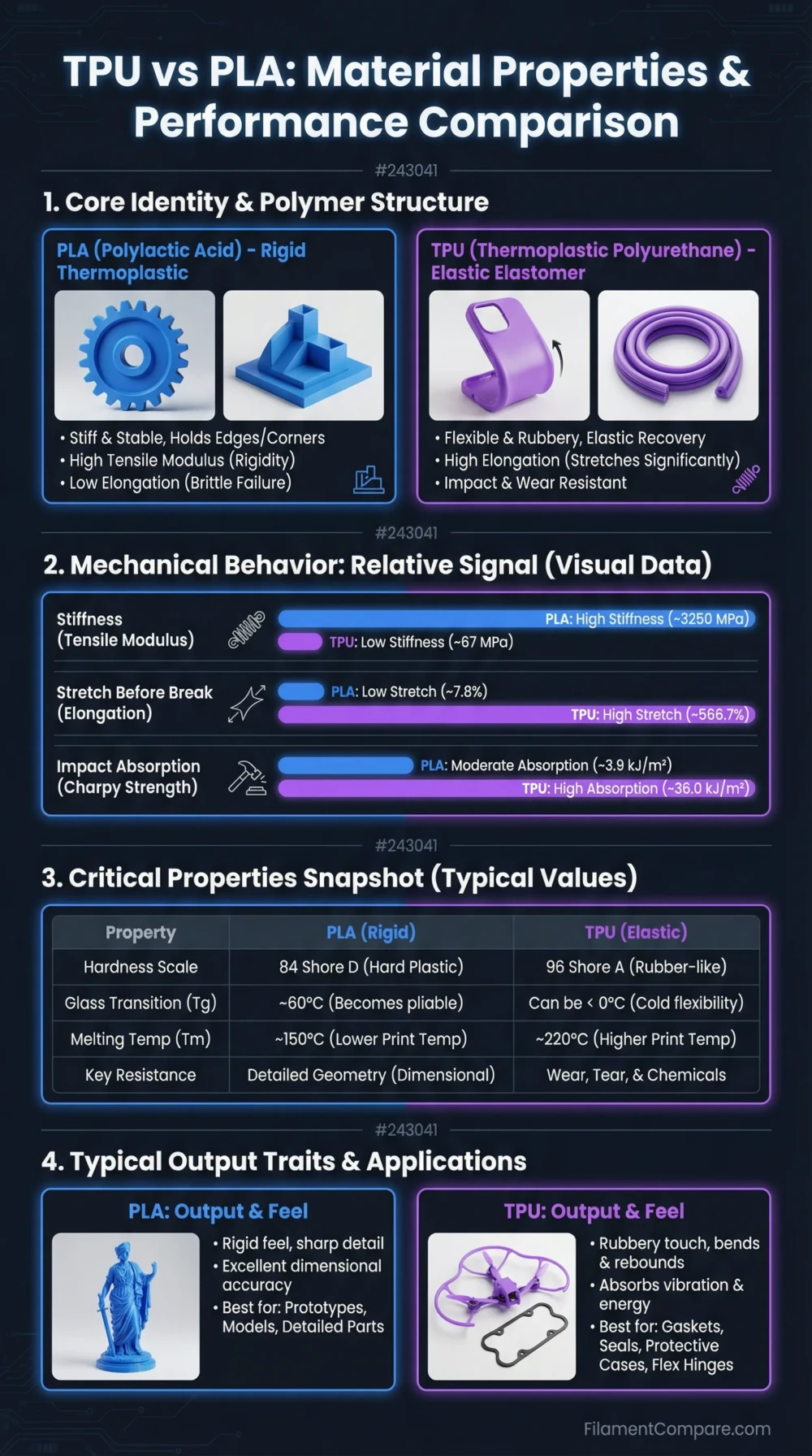
| Property | PLA Filament | TPU Filament | Context |
|---|---|---|---|
| Material Family | Thermoplastic (rigid polymer) | Thermoplastic (elastic polymer) | Both are FFF/FDM compatible materials. |
| Hardness (Durometer) | 84 Shore D | 96 Shore A | Different Shore scales are used for different softness ranges. |
| Tensile Modulus | 3250 MPa | 67 MPa | Indicative stiffness contrast (printed-part test data). |
| Tensile Stress at Break | 45.5 MPa | 23.7 MPa | Values depend on print profile and test orientation. |
| Elongation at Break | 7.8% | 566.7% | TPU grades can stretch dramatically; PLA stays more shape-stable. |
| Charpy Impact Strength (23°C) | 3.9 kJ/m² | 36.0 kJ/m² | Impact behavior changes with geometry and layer bonding. |
| Heat Deflection Temperature (0.455 MPa) | 58.8°C | 50.3°C | Measures deflection under load while heated (method-dependent). |
| Vicat Softening Temperature | 64.5°C | 115.7°C | Softening under a specified needle load (not the same as melting). |
| Glass Transition (Tg) | 59.1°C | Not listed | Tg can vary by TPU chemistry and hardness; some sheets omit it. |
| Melting Temperature (Tm) | 151.8°C | 216.8°C | Melting is often a range; datasheets may show a peak value. |
| Melt Mass-Flow Rate (MFR) | 6.1 g/10 min | 15.9 g/10 min | Reported at specific temperature/load conditions. |
| Specific Gravity | 1.24 | 1.22 | Material density proxy; exact value varies by formulation. |
| Filament Diameter Spec | 2.85 ± 0.05 mm | 2.85 ± 0.10 mm | Dimensional consistency affects feeding and extrusion stability. |
| Net Filament Weight | 750 g | 750 g | Common spool mass for many product lines. |
Where the numbers come from: PLA table values referenced from an UltiMaker PLA technical data sheet. ✅Source
- Material Identity and Polymer Structure
- PLA Filament
- TPU Filament
- Mechanical Behavior in Printed Parts
- What Those Numbers Usually Mean
- Thermal Behavior and Softening Window
- Hardness Scales: Why PLA and TPU Use Different Numbers
- Processing Notes in Datasheets
- PLA Printed-Test Context
- Surface, Feel, and Dimensional Tendencies
- PLA Filament: Typical Output Traits
- TPU Filament: Typical Output Traits
- Wear and Chemical Resistance Language
- Measurement Terms Seen in TPU vs PLA Tables
Where the numbers come from: TPU table values referenced from an UltiMaker TPU 95A technical data sheet. ✅Source
TPU and PLA live in very different corners of the filament world. TPU filament is built around elastic deformation and shape recovery, which is why it’s often discussed alongside other flexible 3D printing filaments. By contrast, PLA filament is built around rigidity and dimensional hold. The same printer can often run both, yet their mechanical behavior, thermal softening, and hardness scales read like two separate material families.
Material Identity and Polymer Structure
PLA Filament
PLA is commonly described as a stiff thermoplastic that tends to keep edges crisp and geometry stable. In printed parts, that stiffness shows up as a high tensile modulus and a relatively low elongation before breaking or yielding. For a broader overview of PLA variants used in 3D printing—including PLA+, HT-PLA, and other modified formulations—see the Ultimate PLA Filament Guide.
- Feel: more rigid, less elastic
- Typical geometry response: holds flatness and corners well
- Datasheet language: often emphasizes detail and resolution
TPU Filament
TPU (thermoplastic polyurethane) is widely treated as a thermoplastic elastomer in practice: it can flex, compress, and rebound. In printed parts, that often appears as very high elongation and a lower stiffness compared with rigid plastics.
- Feel: rubbery to semi-flexible (grade dependent)
- Typical geometry response: tolerates bending and impact well
- Datasheet language: often emphasizes wear and chemical resistance
Mechanical Behavior in Printed Parts
Stiffness (relative signal)
Stretch Before Break (relative signal)
Impact Absorption (relative signal)
What Those Numbers Usually Mean
- Tensile modulus tracks how “springy stiff” the part feels under small strain. PLA commonly reads higher than TPU in printed datasheets.
- Elongation at break tracks how far the material stretches before failure. Many TPU grades report values in the hundreds of percent.
- Impact strength reflects how the part handles sudden energy. Elastomeric behavior often shows up as higher impact absorption in comparable testing.
Thermal Behavior and Softening Window
- PLA Glass Transition (Tg)
- Tg near the 60°C zone often lines up with a noticeable change in stiffness.
- PLA Melting Range
- Some PLA DSC examples show a melting event spread across a range, with a clear peak inside it.
- PLA Load-Related Softening
- Measures like HDT and Vicat put numbers on deformation/softening under standardized load.
- TPU Melting Temperature
- TPU 95A datasheets often show a melting point around the ~220°C region (grade dependent).
- TPU Glass Transition (Example)
- Some TPU 95A sheets list a low Tg (below 0°C), aligning with cold flexibility.
- TPU Moisture Absorption (Example)
- Moisture uptake can be listed as a measurable percentage over a defined time window.
One published PLA DSC example reports a glass transition near 63°C and a melting event spanning roughly 130–180°C (with a peak around 158°C). ✅Source
An Ultimaker TPU 95A sheet (example grade) lists glass transition at -24°C, melting temperature around 220°C, and moisture absorption at 0.18% over a specified test duration. ✅Source
Hardness Scales: Why PLA and TPU Use Different Numbers
Shore hardness is measured with a durometer, but the scale matters. Softer rubber-like materials commonly use Shore A, while harder plastics often use Shore D. That’s why TPU and PLA can both have “high” values even though they feel completely different in hand. ✅Source
Processing Notes in Datasheets
Datasheets often include a test specimen recipe that clarifies how the numbers were produced. These are not universal rules; they’re measurement context that helps interpret modulus, strength, and impact values.
PLA Printed-Test Context
- Printer/profile reference: Cura profile naming and printer model can be stated.
- Nozzle and build plate temperatures: sometimes listed as part of the test description.
- Infill and orientation: often specified (for example, tensile bars printed in the XY plane).
One published PLA sheet states tensile specimens printed with a defined setup, including 210°C nozzle and 60°C build plate temperatures, along with infill and orientation notes. ✅Source
Surface, Feel, and Dimensional Tendencies
PLA Filament: Typical Output Traits
- Edge definition: often reads as sharp and clean in many profiles.
- Part feel: tends toward rigid with low elastic rebound.
- Geometry behavior: commonly favors dimensional hold on small-to-medium parts.
TPU Filament: Typical Output Traits
- Touch and compression: more elastic, often with noticeable return.
- Part feel: ranges from semi-flex to rubber-like depending on Shore A.
- Geometry behavior: bends and absorbs energy, which changes how walls and infill “feel” under load.
Wear and Chemical Resistance Language
TPU datasheets frequently highlight wear and tear resistance and compatibility with common oils and chemicals in industrial contexts, especially for tougher Shore A grades. ✅Source
Measurement Terms Seen in TPU vs PLA Tables
- Tg (glass transition): where stiffness and damping behavior shift noticeably.
- Tm (melting temperature): often reported as a peak, while real melting can span a range.
- HDT (heat deflection temperature): deformation under load while heated, based on test method.
- Vicat (softening temperature): needle penetration under load as temperature rises.
- MFR (melt flow rate): melt flow under defined temperature/load; useful for comparing flow behavior within a family.
