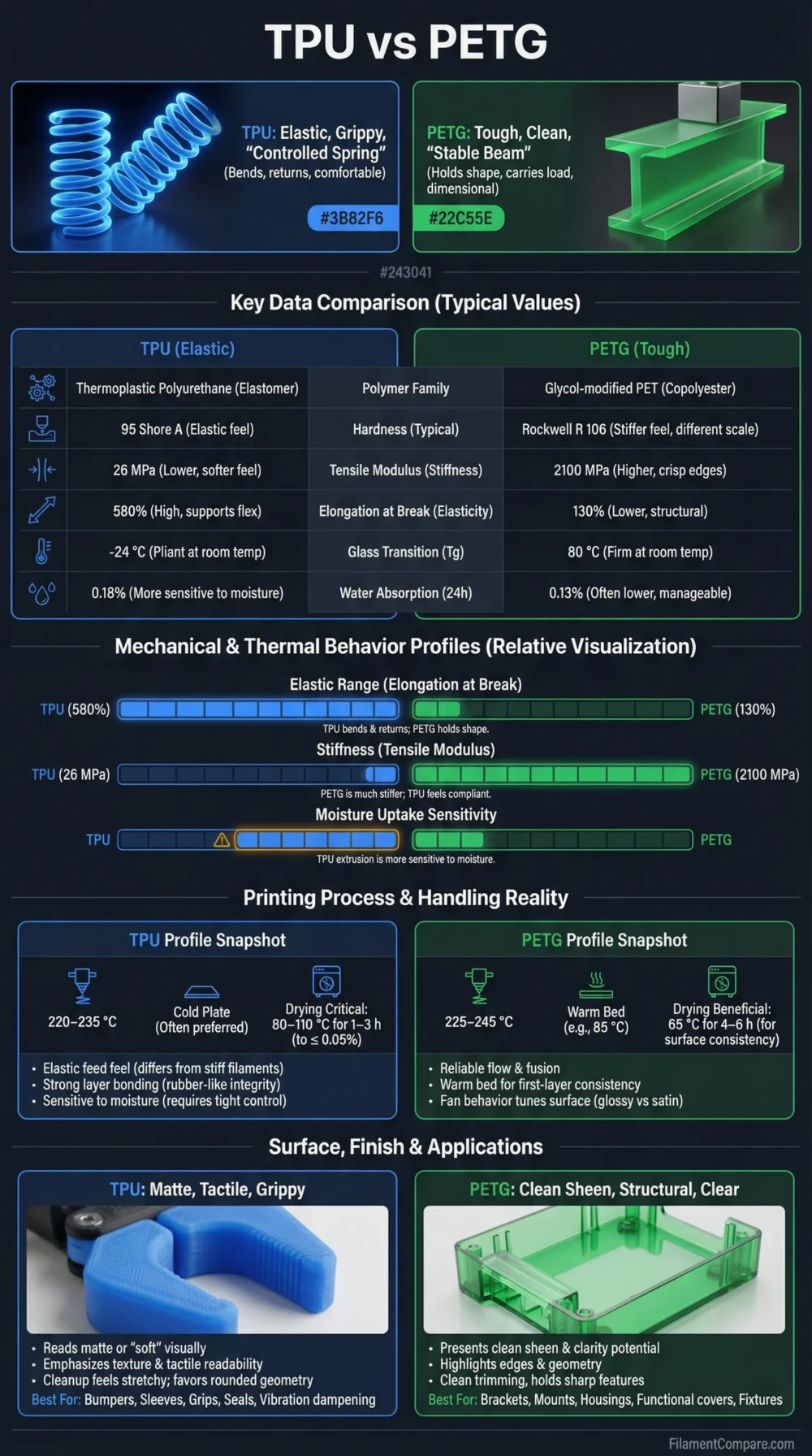
| Category | TPU | PETG |
|---|---|---|
| Polymer Family | Thermoplastic polyurethane (segment-based elastomer) | Glycol-modified PET (copolyester) |
| Hardness (typical) | 95 Shore A (elastic feel) | Rockwell R 106 (stiffer feel; different scale) |
| Tensile Modulus (typical) | 26 MPa | 2100 MPa |
| Elongation at Break (typical) | 580% | 130% |
| Glass Transition (Tg) | -24 °C | 80 °C |
| Heat Deflection (0.455 MPa) | 74 °C | 70 °C |
| Specific Gravity / Density | 1.22 | 1.27 g/cm³ |
| Water Absorption (24h) | 0.18% | 0.13% |
| Nozzle Temperature (common profiles) | 220–235 °C | 225–245 °C |
| Build Plate Temperature (common profiles) | Cold plate (profile-dependent) | 85 °C |
| Drying Guidance (typical) | 80–110 °C for 1–3 h (to low moisture) | 65 °C for 4–6 h |
TPU and PETG solve different “physics problems.” TPU filament behaves like a controlled spring: it bends, returns, and stays comfortable under repeated flex. PETG filament behaves like a stable beam: it holds shape, carries load, and keeps dimensions predictable across many parts.
- Where The Numbers Come From and Why They Matter
- Material Identity and Chemistry
- Mechanical Behavior Under Load
- TPU Loads: Flex, Return, Repeat
- PETG Loads: Hold Shape, Carry Stress
- Thermal Behavior and Dimensional Stability
- Process Window: Temperatures and Bed Behavior
- PETG Temperature Profile Snapshot
- TPU Temperature Profile Snapshot
- Moisture Sensitivity and Storage Reality
- Surface Finish and Visual Style
- Support Behavior and Post-Processing Notes
- Typical Matchups by Part Requirements
- Bonding and Multi-Material Context
Where The Numbers Come From and Why They Matter
Material Identity and Chemistry
TPU is built around flexible and rigid segments living in the same chain, which is why elastic recovery and hardness can be tuned across many grades. This segment-based structure is also why TPU is commonly grouped with other flexible filament materials used in FFF printing. Covestro describes this “alternating segments” structure as the core reason TPU can cover such a wide property span. ✅Source
PETG is a copolyester in the PET family, modified for processing behavior that suits extrusion and forming. In filament form, that maps to a familiar mix of toughness, clarity potential, and dimension-friendly stiffness.
Mechanical Behavior Under Load
TPU Loads: Flex, Return, Repeat
TPU filament shines when the part is asked to bend and keep its shape memory. The combination of 580% elongation at break and 95 Shore A hardness creates a “rubber-like” response with controlled structure.
- High elongation supports repeated flex zones and living-hinge-like behavior in many geometries.
- Lower modulus means the same shape can feel softer under hand pressure.
- Grip-friendly surface often reads as tactile rather than slick.
PETG Loads: Hold Shape, Carry Stress
PETG filament is a solid fit when you want stiffness with a tough response. A tensile modulus around 2100 MPa puts it in a different “feel class” than TPU, especially for brackets, housings, and snap-fit geometries tuned for controlled deflection.
- Higher stiffness supports consistent geometry and crisp edges.
- Tough fracture behavior often looks like bend-first rather than sudden failure in many part designs.
- Surface clarity potential can be strong with translucent colors and smooth extrusion.
Data-Based Profile Meters (relative visualization)
TPU 580% vs PETG 130% (elongation at break)
TPU 26 MPa vs PETG 2100 MPa (tensile modulus)
TPU 0.18% vs PETG 0.13% (24h water absorption)
Thermal Behavior and Dimensional Stability
PETG carries a higher glass transition (about 80 °C) than TPU, which helps explain why many room-temperature parts feel firm and stay shape-stable under light warmth.
TPU sits at a much lower Tg (around -24 °C in the referenced filament grade), so it stays pliant across typical indoor temperatures and remains bend-ready rather than turning glassy.
- Heat Deflection Temperature
- TPU and PETG can show similar HDT values at a defined load in specific datasheets, yet they still feel different because modulus and elastic recovery change the way the part carries stress.
- Vicat Softening
- PETG often reports a Vicat value (for Eastar 6763 it is listed as 85 °C), which is useful when you care about surface softening under warmth.
- Thermal Feel
- TPU tends to feel cushioned in hand, while PETG tends to feel structural, even before heat becomes a factor.
Process Window: Temperatures and Bed Behavior
PETG Temperature Profile Snapshot
One widely used reference set is UltiMaker PETG: nozzle 225–245 °C and build plate 85 °C, which matches PETG’s preference for a warm, stable base and reliable flow. ✅Source
- Warm bed supports first-layer consistency and repeatable footprints.
- Mid-high nozzle range supports strong fusion while keeping detail crisp.
- Fan behavior is commonly tuned per machine and geometry, so surface style can shift between glossy and satin.
TPU Temperature Profile Snapshot
For UltiMaker TPU 95A, a common reference is nozzle 220–235 °C, with profiles optimized for a cold build plate on supported machines. That lines up with TPU’s elastic nature and its tendency to lay down well without an aggressively heated base. ✅Source
- Stable extrusion depends heavily on the exact TPU hardness and the machine’s filament path geometry.
- Elastic feed feel is normal; TPU behaves differently than stiff filaments in drive systems.
- Layer bonding is often a strong point, giving parts a coherent, rubber-like integrity.
Moisture Sensitivity and Storage Reality
TPU is known to absorb moisture from air over time, and many industrial TPU processing references treat pre-drying as normal handling. Covestro’s TPU extrusion guidance describes drying to very low moisture (≤ 0.05%) and lists typical drying temperatures of 80–110 °C for 1–3 hours, depending on hardness. ✅Source
PETG also benefits from dry handling in many workflows, especially when surface consistency matters. Its published water absorption values are often lower than soft elastomers, and it tends to feel more dimension-consistent when kept in a stable environment.
Practical takeaway (neutral, data-first): If you compare 0.18% vs 0.13% 24h absorption from the referenced datasheets, both are manageable materials, yet TPU typically rewards tighter moisture control because its elastic extrusion is more sensitive to small changes in melt behavior.
Surface Finish and Visual Style
PETG often shows a clean sheen and can present clarity nicely in translucent colors, so it’s popular when the part should look polished without extra steps. TPU tends to read more matte or “soft” visually, which pairs naturally with grips, bumpers, and comfort-first surfaces.
- PETG highlights edges and geometry; gloss can make curves look smoother.
- TPU emphasizes texture and tactile readability; fine layers can feel “rubberized.”
- Color behavior is brand-dependent, yet the base material vibe still shows through: crisp vs soft-touch.
Support Behavior and Post-Processing Notes
PETG parts often allow clean trimming with a smooth edge, and surfaces can respond well to light finishing depending on the exact formulation. TPU tends to feel more stretchy during cleanup, so the “finish style” naturally leans toward functional edges and comfortable touch.
- Dimensional Detail
- PETG typically holds sharp features more readily due to higher stiffness, while TPU naturally favors rounded and compliant geometries.
- Touch and Function
- TPU often feels grippy and comfortable for human contact points, while PETG often feels solid and structurally confident for enclosures and fixtures.
Typical Matchups by Part Requirements
These pairings keep the focus on requirements, not hype. If the part’s defining word is flex, TPU tends to align. If the defining word is structure, PETG tends to align. Both can be excellent, just in different “load stories.”
- Elastic deformation + return-to-shape feel: bumpers, sleeves, grips, vibration-friendly parts.
- Rigid geometry + tough response: brackets, mounts, housings, functional covers.
- Snap interaction: PETG for crisp snaps; TPU for soft retention and compliant fit.
- Surface feel: TPU for grip; PETG for clean visual presentation.
Bonding and Multi-Material Context
TPU and PETG can be used in the same project for “soft + hard” assemblies, where comfort meets structure. The key idea is compatibility at the design level: a rigid core in PETG with a compliant interface in TPU can create parts that feel finished right off the printer.
