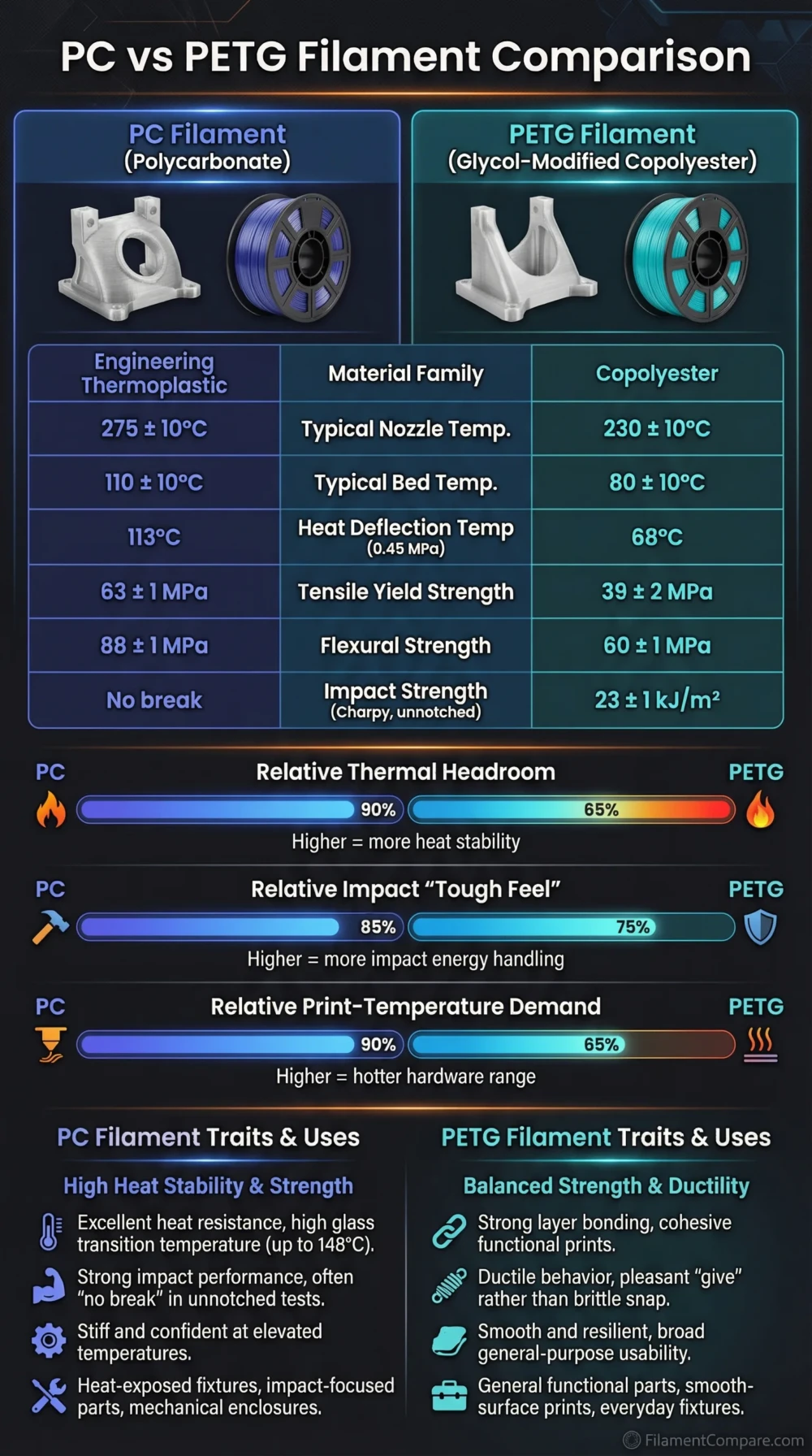
| Attribute | PC Filament (Polycarbonate) | PETG Filament (Glycol-Modified Copolyester) |
|---|---|---|
| Material Family | Polycarbonate (engineering thermoplastic) | Copolyester (PETG-type) |
| Typical Nozzle Temperature | 275 ± 10°C (published filament example) | 230 ± 10°C (published filament example) |
| Typical Bed Temperature | 110 ± 10°C (published filament example) | 80 ± 10°C (published filament example) |
| Density | 1.22 g/cm³ (published filament example) | 1.27 g/cm³ (published filament example) |
| Heat Deflection Temperature (0.45 MPa) | 113°C (published filament example) | 68°C (published filament example) |
| Tensile Yield Strength (3D printed specimen) | 63 ± 1 MPa (published filament example) | 39 ± 2 MPa (published filament example) |
| Tensile Modulus (3D printed specimen) | 1.9 ± 0.1 GPa (published filament example) | 1.7 ± 0.1 GPa (published filament example) |
| Flexural Strength (3D printed specimen) | 88 ± 1 MPa (published filament example) | 60 ± 1 MPa (published filament example) |
| Impact Strength (Charpy, unnotched) | No break (published filament example) | 23 ± 1 kJ/m² (published filament example) |
| Impact Strength (Charpy, notched) | 12 ± 1 kJ/m² (published filament example) | Not listed (published filament example) |
| Moisture Absorption (24h / 7d) | 0.13% / 0.15% (published filament example) | 0.13% / 0.19% (published filament example) |
| Typical “Heat Personality” | High heat stability, strong dimensional hold at elevated temps | Mid heat stability, comfortable working range for many functional parts |
| Typical Look | Clear to translucent options are common; surface finish varies by grade | Glossy and smooth options are common; clear grades can look very clean |
Published filament example values for PC Blend (nozzle, bed, density, HDT, tensile, flexural, impact, moisture) are taken from a manufacturer technical datasheet. ✅Source
- Material Identity and Polymer Structure
- Thermal Behavior and Heat Resistance
- Mechanical Behavior in Printed Parts
- PC Filament Traits Seen in Datasheets
- PETG Filament Traits Seen in Datasheets
- Surface Finish, Transparency, and Feel
- Moisture Sensitivity and Consistency
- Dimensional Stability Under Load
- Where Each Material Often Shows Up
- PC Filament Common Use Patterns
- PETG Filament Common Use Patterns
- Specs That Matter When Comparing Brands
Published filament example values for PETG (nozzle, bed, density, HDT, tensile, flexural, impact, moisture) are taken from a manufacturer technical datasheet. ✅Source
This comparison stays focused on what matters in real prints: PC filament behavior, PETG filament behavior, and the practical meaning of heat resistance, impact toughness, and dimensional stability. Both materials can produce durable, clean parts; they just arrive there with different thermal and mechanical “personalities.”
Material Identity and Polymer Structure
- PC (Polycarbonate)
- Engineering thermoplastic known for strong impact performance and very solid high-temperature shape holding in many grades.
- PETG (Glycol-Modified PET Copolyester)
- Amorphous copolyester family often associated with smooth surfaces, strong layer bonding, and broad general-purpose usability.
- Why Structure Matters
- Amorphous behavior (common in many PC and PETG formulations) can support clarity and predictable softening around glass transition, which shows up as heat tolerance and creep resistance differences.
Thermal Behavior and Heat Resistance
Polycarbonate is widely recognized for excellent heat resistance, with some commercial PC resin lines reporting a glass transition temperature up to 148°C. ✅Source
In the PETG family, a well-documented reference copolyester reports Tg around 80°C and a published density of 1.27 g/cm³ (typical resin reference data). ✅Source
Heat deflection temperature (HDT) and Tg often get mixed together in casual talk. They’re different. Tg signals when a polymer’s stiffness starts shifting faster with temperature, while HDT is a loaded deflection test point. For printed parts, both numbers help explain why PC filament can keep its shape at higher temperatures than many PETG filament prints.
Relative Thermal Headroom Higher = more heat stability
Relative Impact “Tough Feel” Higher = more impact energy handling
Relative Print-Temperature Demand Higher = hotter hardware range
Mechanical Behavior in Printed Parts
With FDM/FFF, material properties are always a mix of polymer capability and print-layer geometry. That’s why datasheets often separate filament values from 3D printed specimen values. It’s normal to see different strength and toughness depending on orientation; this is a layer-by-layer reality, not a flaw.
PC Filament Traits Seen in Datasheets
- Tensile yield and flexural strength often land in an “engineering” range for printed parts.
- Impact behavior is frequently a headline feature, especially in unnotched testing where “no break” results can appear.
- HDT advantage usually tracks with the broader high-temperature identity of PC.
PETG Filament Traits Seen in Datasheets
- Layer bonding is often strong, supporting functional prints that feel cohesive.
- Ductile behavior can show up as a pleasant “give” rather than brittle snap in many common grades.
- Thermal limits tend to be lower than PC, yet still practical for many real-world indoor uses.
Surface Finish, Transparency, and Feel
Both PC filament and PETG filament can deliver clean, glossy surfaces in many grades. In “clear” variants, the real-world look depends on optical formulation, print path, and internal geometry. When clarity matters, the useful comparison is haze and light transmission behavior, not just whether a spool is labeled “transparent.”
PC often reads as stiff and confident at elevated temperatures, while PETG often reads as smooth and resilient across a wide “everyday functional” range.
Moisture Sensitivity and Consistency
Both materials are commonly described as moisture sensitive, because moisture affects melt behavior and can change how a print looks and feels. Many filament datasheets publish moisture absorption numbers (like the 24-hour and 7-day values shown in the table), which helps explain why PC and PETG can show different day-to-day consistency when ambient humidity changes.
Dimensional Stability Under Load
For functional parts, it helps to separate instant strength from long-term shape holding. The HDT difference shown in the table is a strong clue: PC-based filaments typically hold geometry at higher temperatures under load than PETG-based filaments. Materials with this type of performance are often grouped among engineering-grade 3D printing filaments, where thermal stability and structural reliability are key design factors.
Where Each Material Often Shows Up
PC Filament Common Use Patterns
- Heat-exposed fixtures where elevated temperature stability matters.
- Impact-focused parts that benefit from a tough, energy-handling feel.
- Mechanical enclosures where rigidity and dimensional hold are valued.
PETG Filament Common Use Patterns
- General functional parts that need a balanced strength-and-ductility profile.
- Smooth-surface prints where finish and durability both matter.
- Everyday fixtures that benefit from solid layer bonding and practical performance.
Specs That Matter When Comparing Brands
If you compare different spools of PC filament or PETG filament, the most meaningful numbers are the ones tied to repeatable tests and clear methods. Standards bodies also publish guidance and standards for additive manufacturing, including polymer material extrusion topics and data reporting approaches. ✅Source
- Diameter tolerance and roundness (controls flow consistency and extrusion stability).
- Moisture condition (affects surface, strength feel, and consistency across time).
- HDT and thermal metrics (useful for heat-exposed parts and fixtures).
- Tensile and flexural values listed with clear specimen details (orientation and infill matter).
- Impact testing notes (notched vs unnotched results can tell different stories).
