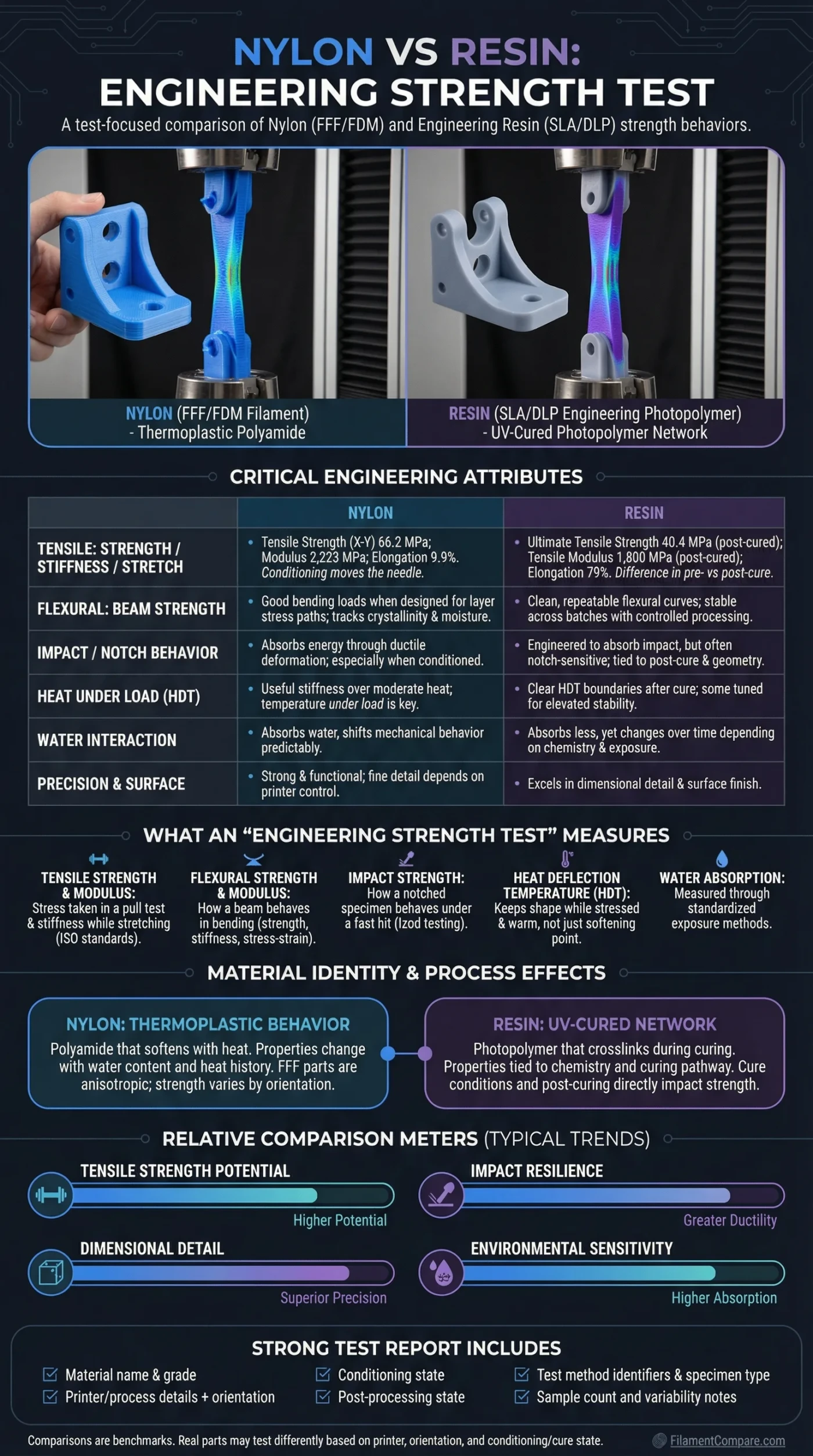
| Attribute | Nylon (FFF/FDM Nylon Filament) | Resin (SLA/DLP Engineering Photopolymer) |
|---|---|---|
| What It “Is” | A thermoplastic polyamide that softens with heat and can be re-melted; many nylon filaments are semi-crystalline and respond strongly to moisture conditioning. | A UV-cured photopolymer network that crosslinks during curing; strength and stiffness often track the degree of cure and post-processing. |
| Tensile: Strength / Stiffness / Stretch | Representative printed CoPA nylon filament data shows how much conditioning can move the needle: tensile strength (X-Y) 66.2 MPa with Young’s modulus 2,223 MPa and elongation at break 9.9% (reported set), while another reported set shows tensile strength (X-Y) 31.4 MPa with modulus 1,053 MPa and elongation 216.5%. These are not “contradictions” so much as different material states and test conditioning realities. [a] | A tough engineering resin can look very different pre- vs post-cure: Tough 2000 Resin V2 reports ultimate tensile strength 26.1 MPa (green) and 40.4 MPa (post-cured), tensile modulus 1,235 MPa (green) and 1,800 MPa (post-cured), and elongation at break 149% (green) and 79% (post-cured). [b] |
| Flexural: Beam Strength Under Load | Printed nylon can carry bending loads well when the part is designed for layer-friendly stress paths; bending modulus/strength often track crystallinity and moisture content. | Resins often show clean, repeatable flexural curves when post-cure is consistent; flexural stiffness can be very stable across batches with controlled processing. |
| Impact / Notch Behavior | Nylon commonly absorbs energy through ductile deformation (especially when conditioned), which can matter more than peak strength in real fixtures. | Tough resins are engineered to absorb impact, but impact results can be notch-sensitive and strongly tied to post-cure schedule and part geometry. |
| Heat Under Load (HDT Concept) | Many nylon filaments keep useful stiffness over moderate heat, but the meaningful question is “under what load?” not just a softening point. | Resins can show clear HDT boundaries after cure; some are tuned for elevated temperature stability, especially when fully post-cured. |
| Water Interaction | Nylon can absorb water and shift mechanical behavior in a predictable way; this is often part of “real-world strength,” not a flaw. | Many engineering resins absorb less water than nylon, yet still change over time depending on chemistry and exposure; reporting test conditioning keeps comparisons honest. |
| Precision and Surface | Nylon FFF parts can be strong and functional, while fine surface detail depends on nozzle, layer height, and shrink control. | SLA/DLP resin typically excels in dimensional detail and surface finish, which can improve fit and stress distribution in assemblies. |
| Where “Engineering Strength” Usually Shows Up | Brackets, hinges, wear-friendly interfaces, clips, and assemblies where toughness and resilience matter alongside stiffness. | Jigs/fixtures, housings, accurate mating parts, and designs that benefit from smooth surfaces and consistent thin-wall geometry. |
This Nylon vs Resin comparison is built from manufacturer datasheets and recognized test-standard references, so the figures act as trend benchmarks and real parts may test differently with printer, orientation, and conditioning.
- What an “Engineering Strength Test” Actually Measures
- Material Identity: Nylon vs UV Resin Is a Structure Difference
- Tensile and Flexural: Reading the Numbers Without Getting Tricked
- Why “One Tensile Strength” Isn’t Enough
- Impact and Notch Behavior: Toughness Feels Different in Each Material
- Heat Under Load: HDT Is the Test That Matches Real Fixtures
- Water and Time: Conditioning Is Part of the Strength Story
- Process Effects: Orientation and Settings Can Outweigh Material Choice
- What a Strong Test Report Usually Includes
- A Second Resin Reference Point: High-Toughness DLP Resin
- Relative Comparison Meters (Typical Trends)
- Resources Used
Engineering strength tests get messy fast because “strong” is not one number. Nylon filament and photopolymer resin can both produce serious functional parts, but they get there through different material physics. If your goal is a clean comparison, the smartest move is to read properties through standard test lenses (tensile, flexural, impact, thermal under load) and to keep conditioning and post-processing in the same frame.
- Tensile vs Toughness
- Moisture Conditioning
- Post-Cure Dependency
- Anisotropy Reporting
- HDT Under Load
What an “Engineering Strength Test” Actually Measures
- Tensile Strength & Modulus
- How much stress a material takes in a pull test and how stiff it is while stretching; commonly defined using ISO tensile principles. [f]
- Flexural Strength & Flexural Modulus
- How a beam behaves in bending (strength, stiffness, and the full stress–strain response in flexure). [g]
- Impact Strength
- How a notched specimen behaves under a fast hit; Izod-style testing is widely used for comparing brittleness and toughness trends. [j]
- Heat Deflection Temperature (HDT)
- A temperature-under-load concept that helps answer “does it keep shape while stressed and warm?” rather than “does it melt?”. [h]
- Water Absorption / Moisture Uptake
- Measured through standardized water or humidity exposure methods that help connect environment to mechanical behavior. [i]
Material Identity: Nylon vs UV Resin Is a Structure Difference
Nylon filaments are polyamides that behave like classic thermoplastics and are widely discussed among engineering-grade 3D printing filaments. Temperature and moisture change chain mobility, crystallinity, and how energy is absorbed in a load. That’s why two nylon parts printed from the same spool can feel “stiffer” or “more flexible” depending on their water content and heat history.
Engineering resins (SLA/DLP) cure into a crosslinked network, and the final part properties are tied to the chemistry and the curing pathway. Academic modeling work highlights how process parameters relate to crosslinking and the mechanical response of UV-cured polymers, which is a fancy way of saying: cure conditions show up in strength results. [k]
Tensile and Flexural: Reading the Numbers Without Getting Tricked
Why “One Tensile Strength” Isn’t Enough
For nylon, stiffness and strength can drop while ductility rises as the material picks up moisture; for resin, stiffness and strength often rise as cure completes, while elongation can shift in either direction depending on formulation. A fair read treats tensile results as a state-dependent snapshot, not a permanent truth.
Flexural testing adds another layer, because beam loading puts one side in tension and the other in compression. Nylon’s semi-crystalline nature can yield forgiving bending behavior, while many engineering resins show clean flexural curves that are easy to compare across batches when post-cure is consistent.
Impact and Notch Behavior: Toughness Feels Different in Each Material
In engineering use, “tough” often means “still works after a surprise load.” Nylon commonly dissipates energy by yielding and stretching, especially when conditioned. Resin toughness is more chemistry-driven; many “tough” resins are formulated to hold together under impact while keeping dimensional precision for fixtures and assemblies.
Heat Under Load: HDT Is the Test That Matches Real Fixtures
If you’ve ever seen a part look fine on the bench but sag once it’s warm and stressed, you’ve met the real value of HDT. ISO’s HDT method is built around deflection under a defined flexural stress, which aligns nicely with how brackets, clips, and jigs actually fail in practice. [h]
Neutral way to compare: if two materials list “high temperature,” translate that into HDT at a stated load and the conditioning/cure state used to measure it.
Water and Time: Conditioning Is Part of the Strength Story
Strength comparisons get unreliable when one sample was tested dry and another was tested after sitting in ambient humidity. ASTM’s conditioning practice explains why standardizing humidity and temperature before and during testing matters for reliable comparisons across materials and labs. [d]
ISO also defines standard atmospheres for conditioning and testing plastics, which is especially relevant for nylon because moisture uptake can be a design-relevant part of performance rather than a side note. [e]
Process Effects: Orientation and Settings Can Outweigh Material Choice
Nylon in FFF/FDM can be more anisotropic because bonding between layers differs from strength within a layer; resin parts can be more uniform, yet still show directionality depending on exposure strategy and geometry. Research on carbon-fiber reinforced nylon highlights how printing parameters influence mechanical outcomes, a reminder that “nylon strength” is often a blend of polymer and process. [l]
What a Strong Test Report Usually Includes
- Material name and grade (nylon type, resin family, and any reinforcement or “tough” modifier)
- Printer/process details (FFF vs SLA/DLP) plus orientation and build layout
- Conditioning state (dry, ambient, humidity-conditioned, or water-exposed)
- Post-processing state (annealed nylon, post-cured resin, cleaning method)
- Test method identifiers (tensile, flexural, impact, HDT) and specimen type
- Sample count and variability notes (averages without spread hide the real story)
A Second Resin Reference Point: High-Toughness DLP Resin
To avoid treating “resin” as one thing, it helps to look at another engineering resin profile. LOCTITE 3D 3843 HDT60 reports (post-processed) tensile stress at break 51 MPa, Young’s modulus 1,806 MPa, notched Izod impact 53 J/m, HDT at 0.455 MPa 63°C, and 24-hour water absorption 1.94%—a set that sits in a fixture-friendly zone of strength, toughness, and stability. [c]
Relative Comparison Meters (Typical Trends)
Tensile Strength Potential (trend view)
Impact Resilience (trend view)
Dimensional Detail (trend view)
Environmental Sensitivity (trend view)
Resources Used
- Polymaker — PolyMide™ CoPA Technical Data Sheet (PDF) ↩
- Formlabs — Tough 2000 Resin V2 Technical Data Sheet (PDF) ↩
- Henkel LOCTITE AM — LOCTITE 3D 3843 HDT60 Technical Data Sheet (PDF) ↩
- ASTM International — ASTM D618: Conditioning Plastics for Testing ↩
- ISO — ISO 291: Standard Atmospheres for Conditioning and Testing ↩
- ISO — ISO 527-1: Determination of Tensile Properties (General Principles) ↩
- ISO — ISO 178: Determination of Flexural Properties ↩
- ISO — ISO 75-1: Temperature of Deflection Under Load (General Test Method) ↩
- ISO — ISO 62: Determination of Water Absorption ↩
- ISO — ISO 180: Determination of Izod Impact Strength ↩
- University of Texas at Austin (hosted paper) — Material Modelling of Photopolymers for Additive Manufacturing (PDF) ↩
- DOI — Study on parameter influence in carbon-fiber-reinforced nylon printed by material extrusion (Engineering Failure Analysis) ↩
