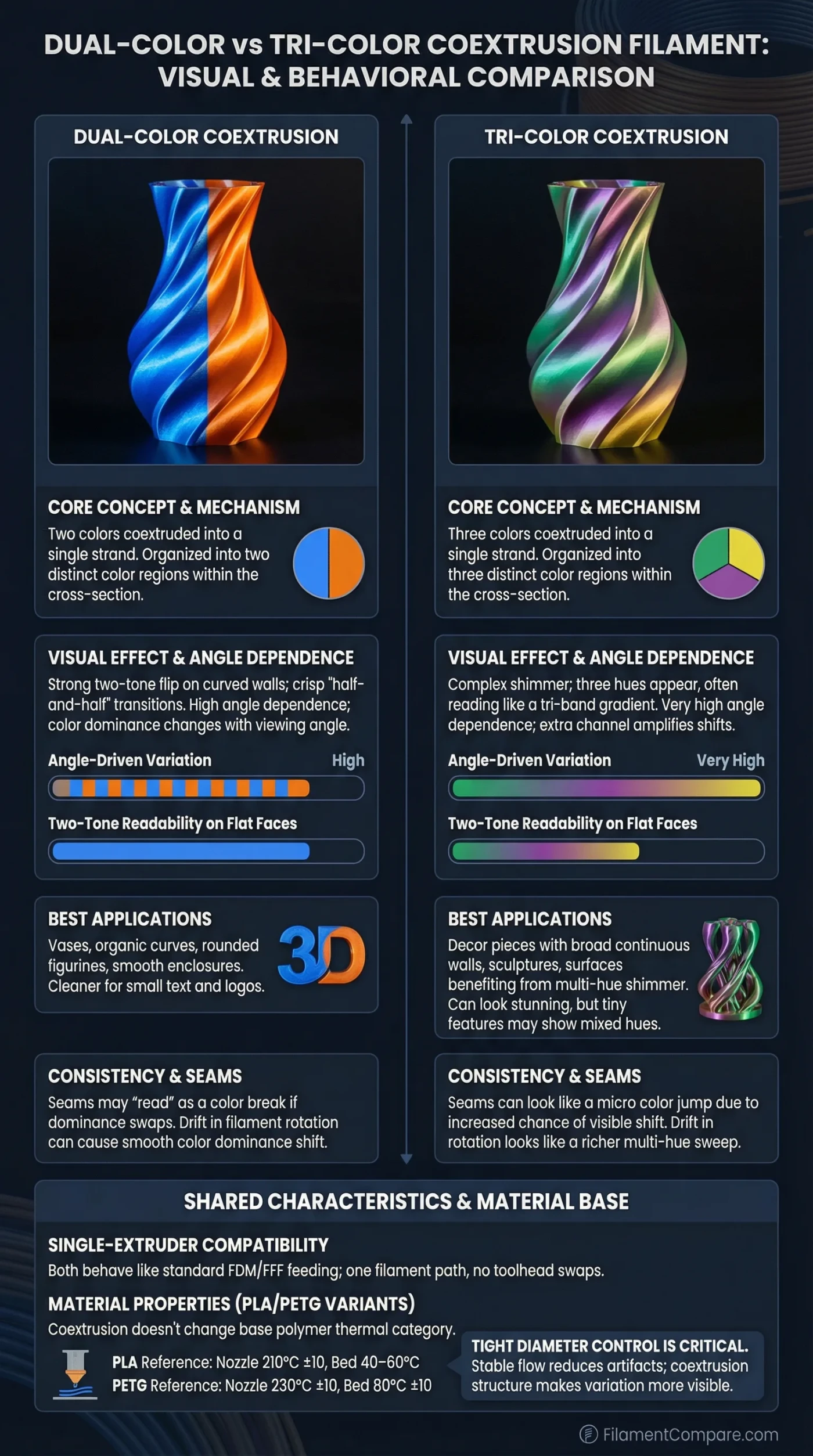
| Aspect | Dual-Color Coextrusion Filament | Tri-Color Coextrusion Filament |
|---|---|---|
| Core idea | Two colors are coextruded into a single strand, aiming for a split-tone look on the same surface. | Three colors are coextruded into a single strand, creating a richer, more “cycling” surface effect. |
| Typical visual result | Strong two-tone flip on curved walls; crisp “half-and-half” transitions are common on clean outer perimeters. | More complex shimmer: three hues can appear across the same wall, often reading like a tri-band gradient. |
| Angle dependence | High: color dominance can change with viewing angle and lighting direction. | Very high: the extra color channel tends to amplify angle-driven variation. |
| Predictability of “which color faces out” | Moderate: orientation is often controllable on steady, continuous walls, but the filament can rotate during feeding. | Moderate-to-low: with three channels, small rotation shifts can change which hues land on the visible edge. |
| Best-fitting geometry types | Vases, organic curves, rounded figurines, smooth enclosures, and single-direction perimeter “wraps.” | Decor pieces with broad continuous walls, sculptural shapes, and surfaces that benefit from multi-hue shimmer. |
| Small text and crisp logos | Often cleaner for legibility when a stable face-color is maintained (two channels simplify contrast). | Can look stunning, yet tiny features may show mixed hues more easily on sharp corners. |
| Seam visibility | Seams may “read” as a color break if the two channels swap dominance around that line. | Seams can look like a micro color jump because three channels raise the chance of a visible shift at that point. |
| Single-extruder compatibility | Yes. It remains one filament path, so it behaves like standard FDM/FFF feeding. | Yes. It remains one filament path, so it behaves like standard FDM/FFF feeding. |
| Reference dimensional tolerance (example) | High-precision filament examples target 1.75 mm ± 0.02 mm[e]. | Tri-color products also commonly target tight diameter control; check brand specs and winding quality. |
| Reference PLA print settings (example) | Nozzle 210 °C ± 10; bed 40–60 °C[e]. | Similar baselines when the base polymer is PLA; coextrusion mainly changes the look, not the core thermal category. |
| Reference PETG print settings (example) | Nozzle 230 °C ± 10; bed 80 °C ± 10[f]. | Comparable baselines when the base polymer is PETG; visual behavior stays angle-dependent. |
| Common “silk” range (brand example) | Nozzle 200–220 °C and 30–70 mm/s are listed for a silk PLA example[g]. | Tri-color is frequently sold as silk PLA; the same “silk” thermal window often applies by brand. |
For this comparison of Dual-Color Coextrusion Filament and Tri-Color Coextrusion Filament, the references come from datasheets and reliable technical sources, so the statements reflect common trends and standardized baselines while real prints can vary by machine, profile, and environment.
- What Coextrusion Means in Multi-Color Filament
- Dual-Color Coextrusion Filament: How the Look Is Created
- Tri-Color Coextrusion Filament: More Channels, More Visual States
- A Practical Way to Think About Tri-Color
- Where the Color Shift Really Comes From
- Consistency Signals That Matter More for Coextrusion
- Material Base: PLA, Silk PLA, and PETG Variants
- Why “Silk” Changes the Coextrusion Look
- Choosing Dual-Color vs Tri-Color by Surface and Intent
- Resources Used
Dual-color and tri-color coextrusion filaments are built for the same goal: a multi-color surface from a single nozzle, with no toolhead swaps and no purge towers. The difference is simple on paper (two pigments versus three), yet the real-world look depends on geometry, filament rotation, and how each extruded road exposes its cross-section to your eyes.
- Coextruded filament
- Dual color filament
- Tri color filament
- Silk PLA
- Angle-dependent color shift
- Single-extruder aesthetics
What Coextrusion Means in Multi-Color Filament
In polymer processing, coextrusion describes simultaneous melt flows through the same equipment to form one product with distinct layers or interfaces, rather than mixing everything into one uniform melt[a]. In the 3D-printing world, that idea is adapted into multicomponent filament where different colored streams remain “organized” inside the strand instead of blending into a single shade.
Standards bodies define additive manufacturing as building 3D geometries by successive addition of material, which is why single-strand innovations like coextruded filament matter: they change what each deposited road can visually do without changing the overall AM principle[h]. That’s the quiet charm of coextrusion filament: one spool, one nozzle, a noticeably richer surface.
- Dual-Color Coextrusion
- A filament cross-section organized into two color regions, typically producing a two-tone flip across curved walls and long perimeters.
- Tri-Color Coextrusion
- A filament cross-section organized into three color regions, typically producing a more complex cycling effect across the same wall.
- Not the Same as “Rainbow”
- Rainbow/gradient filament changes color along the length of the spool; coextrusion keeps multiple colors present in the same slice of filament.
Dual-Color Coextrusion Filament: How the Look Is Created
A widely used dual-color approach aims for an even split—two colors distributed on opposite sides of the strand—so the print can “flip” between them when the surface normal and your viewing angle change[c]. On continuous outer walls, this often reads as a clean two-tone stripe with a color-shift effect rather than a blended gradient.
Dual-color coextrusion tends to look especially consistent when the outer surface is dominated by long, uninterrupted perimeter lines. The reason is visual, not magical: each road is a flattened ribbon, and whichever color region is more exposed on the outer edge becomes the dominant hue. That’s why smooth curvature often shows a stronger two-tone flip than highly faceted geometry.
Design-language fit: Dual-color coextrusion often reads like a “split silk” finish on organic forms, while on sharp corners the shift can look like a deliberate two-tone highlight rather than a gradient.
- Two-tone clarity is typically strongest on continuous outer walls (vases, shells, rounded housings).
- Lighting direction matters because glossy or silk additives can boost specular reflections.
- When filament rotation in the feed path changes, the “dominant” face color can drift, which is normal for cross-section-based color.
Tri-Color Coextrusion Filament: More Channels, More Visual States
Tri-color coextrusion takes the same concept and adds a third pigment stream, creating a strand that can present three distinct hues across one surface depending on how the cross-section is exposed. Many consumer products describe this as “trichromatic coextruded” filament with three colors present along the whole spool rather than changing along length like a standard rainbow gradient[d].
With three channels, the surface can move between more visual “states” as curvature, perimeter direction, and local viewing angle change. This makes tri-color filaments feel livelier on sculptural prints, where each small change in surface normal can reveal a slightly different balance of hues.
A Practical Way to Think About Tri-Color
Tri-color coextrusion behaves like a color-availability system: at every point in the print, multiple hues are “available” inside the strand, and the visible color depends on how the extruded road presents its cross-section. That’s why the same model can look different under different lighting or camera angles.
Where the Color Shift Really Comes From
Most explanations stop at “it changes with angle,” but the more useful truth is that coextruded filament carries organized internal interfaces that can be deposited in different orientations as the printer feeds the strand. Patented 3D-printing input designs discuss filaments with materials separated into layers or cross-sections, prepared by coextrusion, precisely because that internal structure can be engineered rather than randomly mixed[b].
Once the filament melts, it becomes a road. That road is not a perfect cylinder; it flattens into a ribbon with rounded edges. This matters because the outer perimeter “edge” is often the most visible part of a print. As the line width and the local surface curvature change, the road can expose more of one color region than another, even if the filament cross-section is perfectly symmetric.
Angle-Driven Color Variation (Typical Visual Trend)
Two-Tone Readability on Flat Faces (Typical Visual Trend)
A small but important detail: filament can rotate as it travels through the path (especially with long routing, tight spools, or more friction). When that happens, the “which color is on the outside edge” can drift. In dual-color that drift often feels like a smooth swap; in tri-color it can look like a richer multi-hue sweep.
Consistency Signals That Matter More for Coextrusion
Coextrusion filaments are visually sensitive to small process variations. Tight diameter control helps keep flow stable, and some manufacturers publish this explicitly—for example, a PLA technical datasheet lists 1.75 mm ± 0.02 mm as the filament diameter target[e]. Even when two spools look similar online, the real separator is often manufacturing consistency.
- Diameter and ovality discipline: stable extrusion supports clean surface appearance and reduces “micro-pulsing” artifacts.
- Winding quality: consistent spooling reduces sudden tension changes that can encourage rotation drift on long prints.
- Moisture management: coextruded silk-style surfaces can highlight tiny bubbles or texture changes more than matte filaments.
- Thermal repeatability: coextrusion doesn’t remove the need for a stable melt zone; it can make variation more visible.
Moisture is worth treating as a measurable property rather than a vibe. A PLA datasheet lists moisture absorption values like 0.13% in 24 hours and 0.19% in 7 days under stated conditions[e]. A PETG datasheet can show comparable absorption figures under its stated conditions as well[f]. On glossy, color-shifting surfaces, subtle steam-bubble texture can be more noticeable than on plain matte colors.
Neutral limitation (visibility effect): When a filament’s internal color structure is the “feature,” any instability—diameter fluctuation, moisture texture, or tension changes—can become more visually obvious, even if the print is mechanically fine.
Material Base: PLA, Silk PLA, and PETG Variants
“Dual-color” and “tri-color” describe the color architecture, not the polymer family. Most consumer coextrusion spools are PLA-based (often in a silk-style blend), but PETG versions also exist. A PLA technical datasheet lists a nozzle temperature reference of 210 °C ± 10 and bed 40–60 °C, which is a useful baseline for PLA-family coextruded filament when a brand doesn’t provide its own values[e].
PETG-family coextruded filament tends to sit in a higher thermal band, and a PETG datasheet reference lists nozzle 230 °C ± 10 with a bed around 80 °C ± 10[f]. The bigger picture is that coextrusion doesn’t change the polymer’s category; it changes the surface presentation by preserving internal color regions.
Silk PLA is common in dual- and tri-color spools because higher gloss can amplify the “flip” effect. A silk PLA example datasheet lists 200–220 °C nozzle temperature and 30–70 mm/s print speed, which shows how brands may narrow settings compared to generic PLA profiles[g]. Treat those numbers as product-specific reference points, then map them to your own printer’s stable window.
Why “Silk” Changes the Coextrusion Look
Glossy additives can increase specular reflection, so the same two- or three-color layout appears more dramatic under directional light. That’s a visual benefit, not a new color mechanism—the internal coextruded structure is still doing the heavy lifting.
Choosing Dual-Color vs Tri-Color by Surface and Intent
If the goal is a clear, readable two-tone identity, dual-color coextrusion often feels more predictable because fewer channels compete on edges. If the goal is a richer shimmer that changes across a sculpture as you move around it, tri-color coextrusion tends to deliver more unique “moments” across the same geometry.
- Decorative vases and continuous walls: both work; tri-color often looks more dynamic across the curve.
- Brand marks, icons, and readable lettering: dual-color can keep a stronger two-tone story on the primary face.
- Complex surfaces with many small planes: tri-color can look lively, while dual-color may look cleaner on each facet.
- Camera-heavy display pieces: tri-color often benefits from changing angles; dual-color often benefits from controlled, consistent framing.
A useful mental model: dual-color is like a binary palette on the surface, while tri-color behaves like a three-state palette whose dominant hue can shift more frequently as the toolpath and curvature change. Neither is “better” in a universal sense; each one just expresses geometry differently.
Resources Used
- [a] MDPI (Polymers): “Investigation of the Polymer Coextrusion Process: A Review”
- [b] Google Patents: “Coextruded, multilayer and multicomponent 3D printing inputs” (US20160136887A1)
- [c] YOUSU Filament: Dual-Color Coextrusion PLA product description (50/50 distribution and angle effect)
- [d] Reprapper Tech: Triple Color (Trichromatic) Coextruded PLA product description
- [e] Prusament: PLA Technical Datasheet (diameter tolerance, print settings, moisture absorption)
- [f] Prusament: PETG V0 Technical Datasheet (print settings and properties)
- [g] Polymaker: PolyLite™ Silk PLA Technical Data Sheet (recommended nozzle temperature and speed)
- [h] ISO: ISO/ASTM 52900:2021 abstract page (AM fundamentals and vocabulary)
