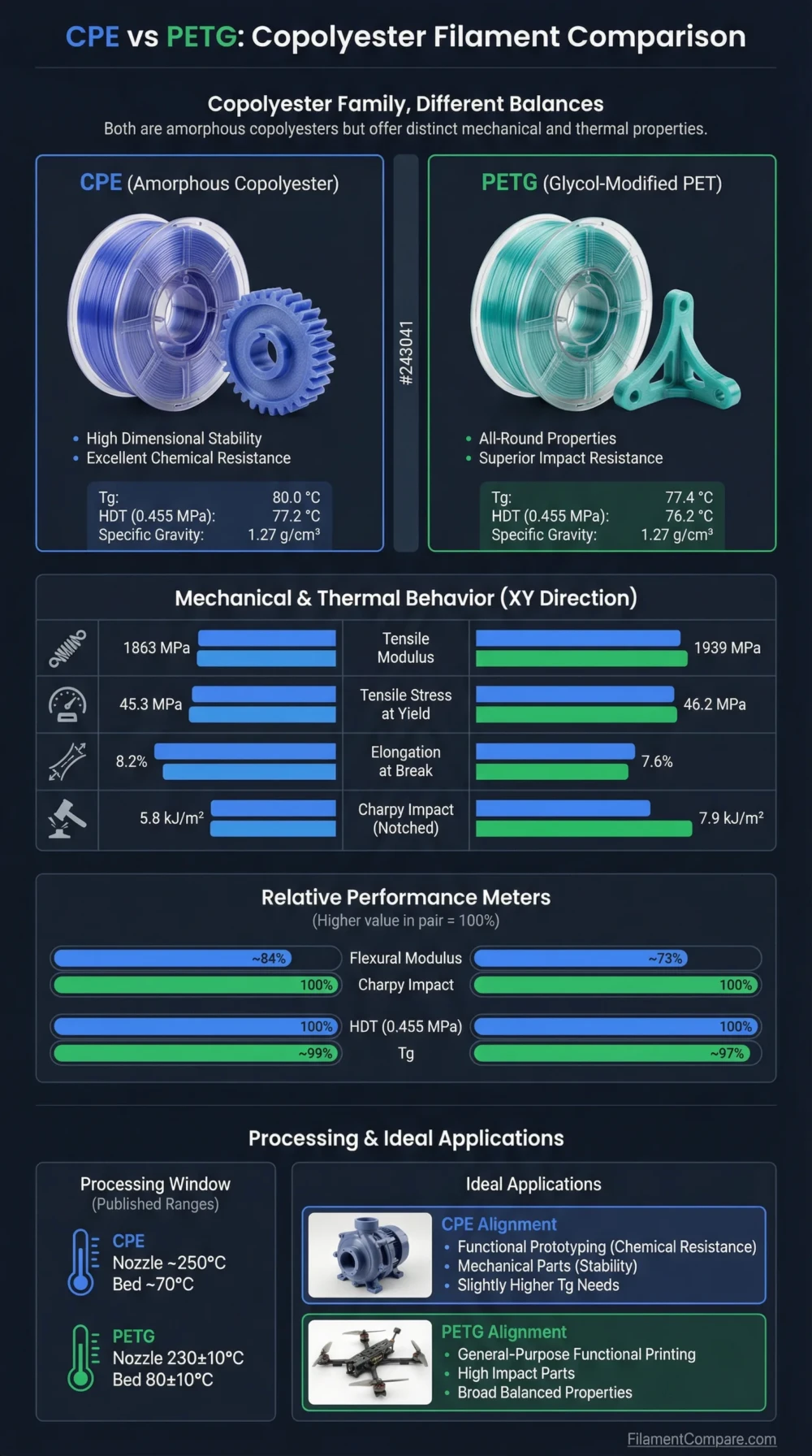
| Property | CPE (Co-Polyester Filament) | PETG (Glycol-Modified PET Filament) |
|---|---|---|
| Material Family | Amorphous copolyester (CPE) | Amorphous copolyester (PETG) |
| Filament Diameter (Spec) | 2.85 ± 0.05 mm | 2.85 ± 0.05 mm |
| Specific Gravity | 1.27 g/cm³ | 1.27 g/cm³ |
| Glass Transition (Tg) | 80.0 °C | 77.4 °C |
| Heat Deflection (0.455 MPa) | 77.2 ± 0.6 °C | 76.2 ± 0.8 °C |
| Vicat Softening | 83.4 ± 0.5 °C | 82.9 ± 0.4 °C |
| Tensile (Young’s) Modulus, XY | 1863 ± 46 MPa | 1939 ± 28 MPa |
| Tensile Stress at Yield, XY | 45.3 ± 1.5 MPa | 46.2 ± 0.8 MPa |
| Elongation at Break, XY | 8.2 ± 0.8% | 7.6 ± 0.2% |
| Charpy Impact (Notched, 23 °C) | 5.8 ± 0.8 kJ/m² | 7.9 ± 0.6 kJ/m² |
| Melt Flow (MFR) | 13.2 g/10 min (240 °C / 2.16 kg) | 6.4 g/10 min (190 °C / 2.16 kg) |
CPE and PETG live in the same copolyester family, yet their CPE filament and PETG filament datasheets can show slightly different mechanical and thermal balances.
- Material Identity and Naming
- What CPE Means in Filament
- What PETG Means in Filament
- Mechanical Behavior and Directionality
- Thermal Points That Matter in Real Parts
- Processing Window as Published by Manufacturers
- What to Compare When Print Profiles Differ
- Where Each Filament Usually Fits
- CPE Alignment
- PETG Alignment
The numbers in the table come from representative published filament datasheets, so you can compare like-for-like test formatting. Different brands, colors, and additives can shift Tg, HDT, and impact behavior.
Material Identity and Naming
What CPE Means in Filament
CPE in 3D printing usually means co-polyester, a tuned amorphous polyester blend designed for solid dimensional stability and chemical resistance. In one published set of values, its glass transition is 80.0 °C and its HDT at 0.455 MPa is 77.2 °C.✅Source
- Amorphous behavior (no melting peak listed in that dataset)
- 2.85 mm ecosystem focus in many vendor profiles
- Balanced stiffness and yield behavior in printed specimens
What PETG Means in Filament
PETG is a glycol-modified PET-based copolyester that commonly shows a stable all-round property set. In one published set of values, its glass transition is 77.4 °C, with Vicat softening at 82.9 °C and HDT at 76.2 °C (0.455 MPa).✅Source
- Copolyester with amorphous melting behavior listed
- Often positioned as a dependable functional filament
- Commonly paired with vendor support options in some ecosystems
- Glass Transition (Tg)
- Tg is where an amorphous plastic shifts from glassy to rubbery behavior; it strongly influences heat feel and stiffness near warm environments.
- HDT at a Given Load
- HDT is measured under a defined flexural load; values are only comparable when the load and method match.✅Source
- Amorphous Listing
- If a datasheet notes amorphous behavior, it often reports no clear melting peak; thermal transitions focus on Tg and softening points.
Mechanical Behavior and Directionality
When you compare 3D-printed test specimens, CPE and PETG can land very close in tensile numbers, while flex and impact can separate a bit more. It’s normal to see orientation effects, because layered parts behave differently in XY vs Z.
| Metric | CPE (XY) | PETG (XY) |
|---|---|---|
| Tensile (Young’s) Modulus | 1863 MPa | 1939 MPa |
| Tensile Stress at Yield | 45.3 MPa | 46.2 MPa |
| Elongation at Break | 8.2% | 7.6% |
| Charpy Impact (Notched, 23 °C) | 5.8 kJ/m² | 7.9 kJ/m² |
A clean comparison uses the same test layout and reporting style. If one datasheet uses ASTM specimens and another uses ISO specimens, you still learn a lot, but the most accurate read is within each datasheet’s own framework.
Thermal Points That Matter in Real Parts
For copolyester filaments, the warm-zone story is mostly about Tg, HDT, and Vicat. Materials like CPE and PETG are often discussed alongside other technical filaments used for engineering-grade prints because small differences in Tg and HDT can influence how parts behave in warm operating environments.
Relative Bars Based on the Two Published Values (Higher Value in This Pair = 100%)
Processing Window as Published by Manufacturers
Datasheets often publish recommended temperature ranges, and they can be surprisingly brand-specific even inside the same PET family. One published example for PETG filament lists a 230 ± 10 °C nozzle range and an 80 ± 10 °C heated bed range, with the rest of the profile tuned for high-speed FFF testing.✅Source
For CPE, some published testing notes explicitly list the conditions used to create measurement specimens. One example reports tensile bars printed at 250 °C nozzle temperature and a 70 °C build plate temperature, with the goal of consistent, repeatable test coupons rather than showcasing a universal profile.✅Source
What to Compare When Print Profiles Differ
- Thermal points: Tg, HDT, Vicat (same load/method whenever possible)
- Mechanical points: modulus, yield, break, and an impact test you trust
- Geometry sensitivity: look for any published XY vs Z reporting
- Moisture notes: absorption figures, storage claims, or drying guidance (if published)
Where Each Filament Usually Fits
CPE Alignment
- Functional prototyping where chemical resistance and shape stability matter
- Mechanical parts that benefit from a consistent copolyester feel
- Applications where a slightly higher Tg can be a helpful margin
PETG Alignment
- General-purpose functional printing with a familiar PETG filament supply chain
- Parts where the published dataset shows higher impact values in the same reporting format
- Use cases that value a broad set of balanced properties in the copolyester family
