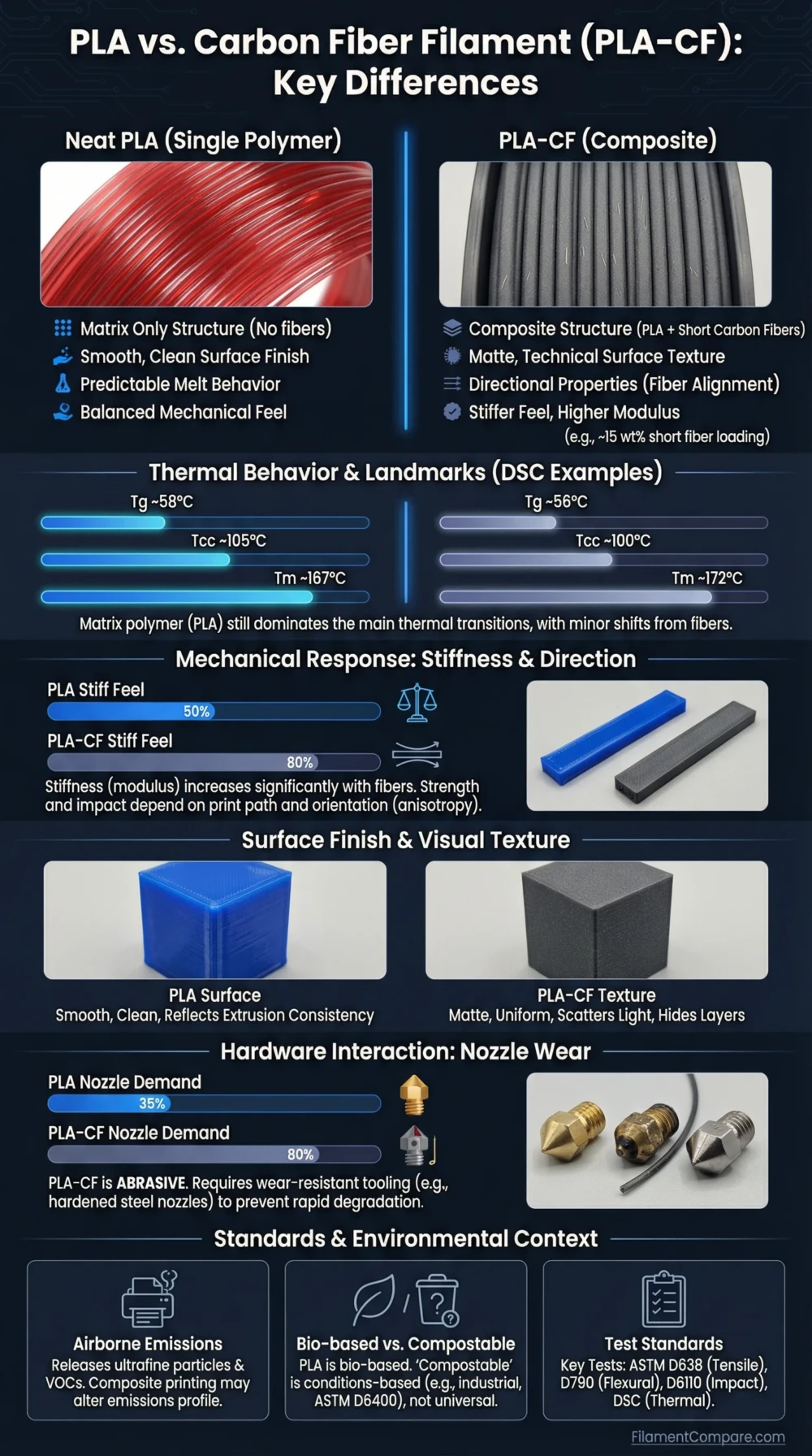
| Attribute | PLA | Carbon Fiber Filament | Source |
|---|---|---|---|
| Material Meaning | Neat PLA (single-polymer filament) | PLA + Carbon Fiber (often written as PLA-CF; typically short/chopped fibers in a PLA matrix) | ✅Source |
| Fiber Loading Example | 0% fiber | 15 wt% short carbon fiber (example study) + short fiber diameter 12 μm | ✅Source |
| Thermal Markers (DSC Example) | Tg 58°C, Tcc 105°C, Tm 167°C | Tg 56°C, Tcc 100°C, Tm 172°C | ✅Source |
| Density (Composite Examples) | ~1.24 g/cm³ (PLA reference) | ~1.27–1.28 g/cm³ for 5–10% CF composites (example) + carbon fiber density noted as 1.75 g/cm³ | ✅Source |
| Printed-Part Mechanical Snapshot | Example printed PLA: tensile strength 49 MPa, tensile modulus 3240 MPa, Izod 8.1 kJ/m² | PLA-CF values vary strongly by fiber % and print path; many datasets emphasize higher stiffness and a more technical surface texture | ✅Source |
| Thermal Decomposition Onset (Example) | ~245°C (example dataset) | ~255–265°C for 5–10% CF composites (example dataset) | ✅Source |
| Nozzle Interaction (Abrasiveness Evidence) | Standard PLA is widely paired with common nozzles | Carbon-fiber-filled filaments are frequently treated as abrasive materials in wear studies, so wear-resistant tooling is often discussed alongside them | ✅Source |
| Dimensional / Geometric Behavior (FFF Study) | PLA is frequently studied for dimensional accuracy in FFF | PLA-based composites (including CF-filled) are studied for geometric performance and print-path sensitivity | ✅Source |
Carbon Fiber in consumer filament talk usually means carbon-fiber-filled PLA (often PLA-CF), not “pure carbon fiber.” The PLA column describes neat PLA behavior, while the Carbon Fiber column focuses on PLA that contains short carbon fibers.
- Material Identity and What Carbon Fiber Means Here
- PLA As a “Neat” Polymer
- Carbon Fiber Filament As a Composite
- Thermal Behavior and Temperature Landmarks
- Mechanical Response: Stiffness vs Strength vs Impact Feel
- What Changes Most Often (Composite Logic)
- Surface Finish and Visual Texture
- PLA Surface Character
- Carbon Fiber Texture
- Dimensional Stability and Geometric Sensitivity
- Why “Same Model” Can Measure Differently
- Hardware Interaction: Nozzle Wear and Tooling Materials
- Airborne Emissions: What Research Tracks During Printing
- Material Origin and Compostability Standards Context
- Standards and Test Names You Will See in Filament Data
If you compare PLA and carbon-fiber-filled PLA, you are really comparing a single-polymer filament to a polymer composite. That one change—adding short carbon fibers—shifts how a part feels in the hand, how it reacts under load, and how consistent the surface looks from print to print.
Material Identity and What Carbon Fiber Means Here
PLA As a “Neat” Polymer
PLA is typically discussed as a neat thermoplastic in filament form: one main polymer phase, predictable melt behavior, and a familiar layer-to-layer bonding story. In many datasheets, PLA is presented with clear mechanical and thermal markers that help interpret performance without guessing. For a deeper overview of how PLA formulations differ in 3D printing—including PLA+, HT-PLA, and other modified versions—see the Ultimate PLA Filament Guide.
- Matrix Only structure (no reinforcing fibers)
- Surface Finish often looks smooth and clean
- Thermal Landmarks commonly used in material selection
Carbon Fiber Filament As a Composite
PLA-CF is a composite: a PLA matrix plus short carbon fibers. A published example uses 15 wt% fiber with short fiber diameter around 12 μm, which is a helpful mental model for why stiffness and surface texture often change together.✅Source
- Composite Structure (fiber + polymer)
- Directional Feel can show up due to fiber alignment
- Surface Texture often appears matte or technical
Thermal Behavior and Temperature Landmarks
- Glass Transition (Tg)
- PLA often sits near the upper-50°C range. In one DSC dataset, PLA is shown at 58°C, while PLA-CF is shown at 56°C.✅Source
- Cold Crystallization (Tcc)
- A reported example shows PLA at 105°C and PLA-CF at 100°C, which matters because crystallization behavior can shape how a printed part responds to heat.
- Melting Peak (Tm)
- The same dataset shows a melting peak shifting from 167°C (PLA) to 172°C (PLA-CF), showing that the matrix still dominates the melt story even when carbon fiber is present.
PLA thermal behavior is usually explained through Tg, crystallinity, and heat softening. Carbon fiber filling tends to change the way a part carries load at elevated temperatures by boosting stiffness, while the polymer still sets the key transition temperatures most people care about.
Mechanical Response: Stiffness vs Strength vs Impact Feel
- PLA balanced feel
- PLA-CF stiffer feel
- Layer Direction matters
- Infill changes outcomes
When people say carbon fiber filament feels “more rigid,” they are usually talking about stiffness (modulus) more than raw PLA strength. Short fibers can raise how strongly a part resists bending, while print path, porosity, and fiber orientation steer how that stiffness turns into real-world durability. These stiffness-driven differences are commonly explained in broader carbon fiber filament guides, where reinforcement behavior and print orientation are discussed together.
What Changes Most Often (Composite Logic)
- Stiffness tends to rise because fibers carry load efficiently along their length.
- Directional Behavior becomes more noticeable as fibers and extrusion lines align.
- PLA keeps a familiar “polymer” baseline, while PLA-CF adds a composite-style response.
Even within a single study, changing extrusion temperature can move results. One published dataset reports flexural strength shifting as extrusion temperature changes from 190°C to 230°C (example values shown as 59.06 down to 50.53 MPa in that test set), showing why PLA-CF is often discussed alongside bond quality and porosity rather than a single “one-number” claim.✅Source
Surface Finish and Visual Texture
PLA Surface Character
PLA often presents a smoother look, with clean edges and a finish that reflects extrusion consistency. That makes PLA a popular reference point for comparing how “different” a composite filament looks.
Carbon Fiber Texture
Carbon fiber filling commonly shifts the look toward a matte, “technical” finish. Many users notice layer lines appear different because the composite scatters light and the surface can look more uniform even when the geometry is the same.
Dimensional Stability and Geometric Sensitivity
PLA is widely used in FFF research for dimensional accuracy because it provides a stable baseline. PLA-based composites (including carbon-filled variants) are also studied for geometric performance, since fiber presence can interact with toolpath, cooling, and anisotropy in measurable ways.✅Source
Why “Same Model” Can Measure Differently
- Raster Angle changes the main load paths and can change shrink behavior along axes.
- Composite Fill can make results feel more direction-dependent, especially in thin walls.
- PLA stays a cleaner baseline for comparing geometry effects.
Hardware Interaction: Nozzle Wear and Tooling Materials
PLA is commonly paired with standard printer hardware, while carbon-fiber-filled filaments are often treated as abrasive in wear-focused research. In a published wear study using a carbon-fiber-reinforced filament, measurable nozzle wear is discussed as a real phenomenon when printing abrasive composites, which explains why wear-resistant tooling is part of the “carbon fiber filament” conversation.✅Source
Relative Feel Indicators (visual, not a lab scale)
Airborne Emissions: What Research Tracks During Printing
A U.S. NIOSH health hazard evaluation reports measuring particles and vapors from fused deposition printing, including printers running PLA. It’s a strong reference for understanding what researchers measure (VOCs and small particles) when they evaluate typical PLA-based workflows.✅Source
The U.S. EPA also summarizes ongoing research and notes that 3D printers can release ultrafine particles (often described in the 1–100 nm size range) alongside VOC emissions. That context matters when comparing PLA and PLA-CF, since composite printing often comes with different thermal histories and hardware choices.✅Source
Material Origin and Compostability Standards Context
PLA is commonly discussed as a bio-based polymer in consumer materials conversations, and the USDA BioPreferred program is a well-known U.S. framework around biobased content labeling. That helps separate “bio-based content” claims from unrelated performance claims when you compare PLA to carbon-filled PLA variants.✅Source
When “compostable” is discussed in a technical way, it is often tied to published requirements such as ASTM D6400 (labeling plastics designed to be aerobically composted in municipal or industrial facilities). That standard context is useful because it frames compostability as conditions-based, not a general synonym for “disappears anywhere.”✅Source
Standards and Test Names You Will See in Filament Data
Specs for PLA and PLA-CF are usually anchored to standard test methods so the numbers mean something. The exact value still depends on print geometry, toolpath, and conditioning, so the test name is often as important as the number.
- ASTM D638 (tensile testing of plastics)
- ASTM D790 (flexural properties)
- ASTM D6110 (impact resistance)
- DSC for Tg, Tcc, Tm (thermal transitions)
