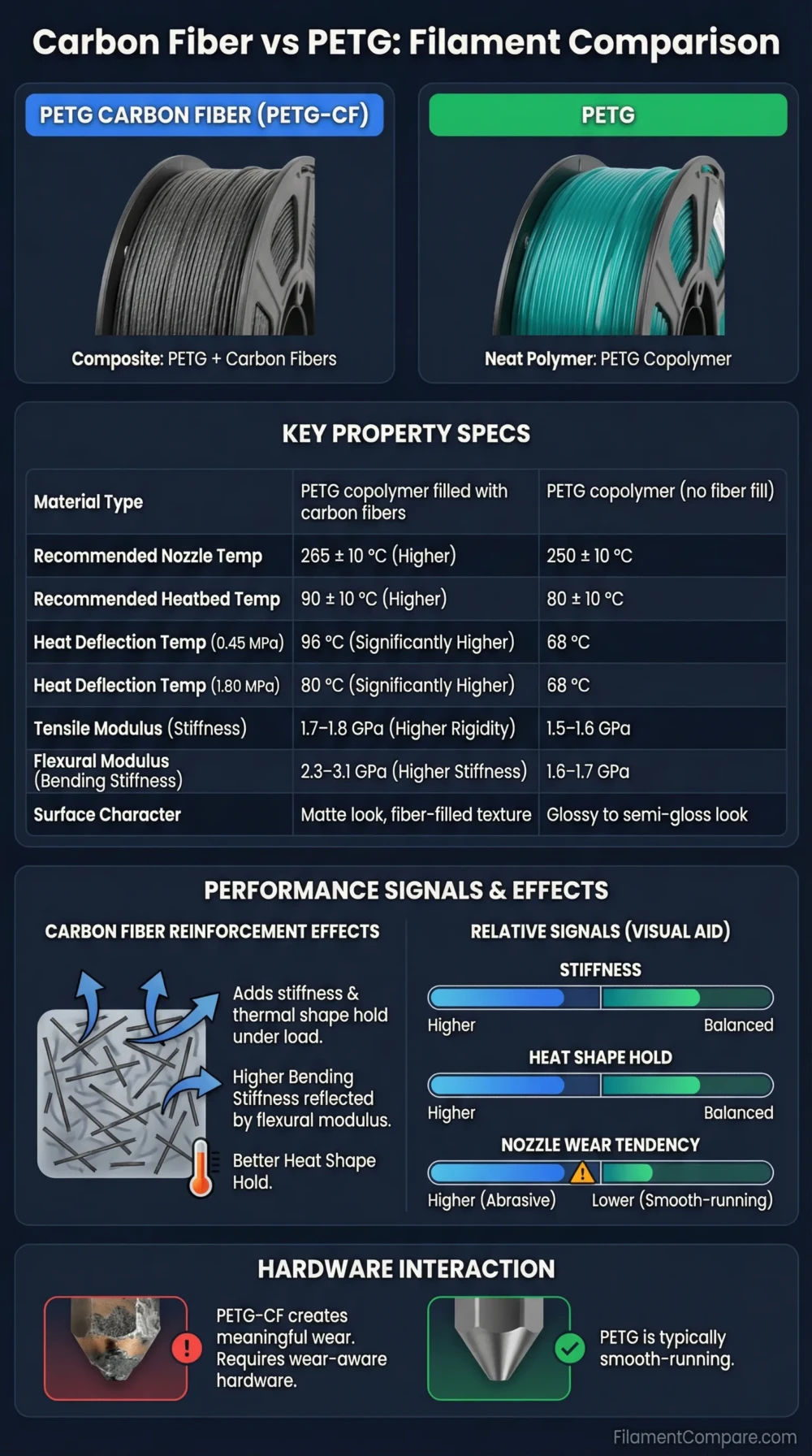
| Category | PETG Carbon Fiber (PETG-CF) | PETG |
|---|---|---|
| Material Type | PETG copolymer filled with carbon fibers | PETG copolymer (no fiber fill) |
| Recommended Nozzle Temperature | 265 ± 10 °C | 250 ± 10 °C |
| Recommended Heatbed Temperature | 90 ± 10 °C | 80 ± 10 °C |
| Density | 1.27 g/cm³ | 1.27 g/cm³ |
| Heat Deflection Temperature (0.45 MPa) | 96 °C | 68 °C |
| Heat Deflection Temperature (1.80 MPa) | 80 °C | 68 °C |
| Tensile Yield Strength (Filament) | 52 ± 1 MPa | 46 ± 1 MPa |
| Tensile Modulus (3D Printed, ISO 527-1) | 1.7–1.8 GPa | 1.5–1.6 GPa |
| Flexural Modulus (3D Printed, ISO 178) | 2.3–3.1 GPa | 1.6–1.7 GPa |
| Interlayer Adhesion | 18 ± 3 MPa | 18 ± 4 MPa |
| Moisture Absorption (24 Hours) | 0.07 % | 0.07 % |
| Moisture Absorption (7 Days) | 0.10 % | 0.10 % |
| Hardness | Shore D 77 (-) | Shore D 74 (-) |
| Surface Character | Matte look is common with fiber fill | Glossy to semi-gloss look is common |
| Mechanical Signal in Bending | Higher stiffness is reflected by the flexural modulus | Balanced stiffness is reflected by the flexural modulus |
PETG column values are from an official technical data sheet. ✅Source
Numbers are real test outputs, so they can shift with printer setup, geometry, and test method.
PETG Carbon Fiber column values are from an official technical data sheet. ✅Source
Carbon Fiber filament and PETG can look similar on a spool, yet they behave like two distinct material personalities. The key detail: most “carbon fiber” options are a composite—a base polymer (often PETG) plus chopped carbon fibers. That blend shifts stiffness and heat response in measurable ways.
- FFF / FDM context
- Composite vs Neat Polymer
- HDT shift
- Modulus shift
- ISO / ASTM test methods
Material Identity and Naming
What PETG Means Chemically
PETG is a modified polyester related to PET. In polymer chemistry, PETG is described as a modified PET made by partially replacing ethylene glycol groups with a cycloaliphatic diol (often CHDM), which changes chain regularity and can lower crystallization behavior. ✅Source
- Carbon Fiber Filled
- Short fibers are dispersed into a base polymer. The printed part is still the base polymer’s chemistry, with fiber-driven changes in stiffness and heat response.
- Neat PETG
- A single-polymer filament (no fiber fill) where strength and toughness come mainly from the polymer network and print bonding.
- HDT (Heat Deflection Temperature)
- A standardized temperature point tied to load (e.g., 0.45 MPa, 1.80 MPa) and test method, useful for comparing thermal shape resistance.
- Modulus
- A stiffness signal. Tensile modulus relates to stretching, flexural modulus relates to bending.
Polyester Family Context
PET is widely described as a thermoplastic polyester resin produced commercially from ethylene glycol and terephthalic acid (or dimethyl terephthalate). This matters because PETG sits in that same polyester “family,” even when it is tuned for different crystallization and processing behavior. ✅Source
Property Signals in One View
Relative Signals (visual aid, not a lab measurement)
Carbon Fiber Reinforcement Effects
When carbon fiber is added to a thermoplastic, the part often shows a clearer stiffness signature and a different thermal deformation profile under load. In additive manufacturing research, fiber-reinforced polymers are widely discussed for their ability to increase strength and stiffness and to open up more demanding application targets, with process behavior and anisotropy remaining important design realities. These reinforcement effects are also summarized in broader carbon fiber filament guides that examine how composite filaments behave in practical printing scenarios. ✅Source
- Bending stiffness tends to shift upward in many fiber-filled blends, matching what flexural modulus numbers often show.
- Thermal shape hold under load is frequently a focus point for carbon fiber composites.
- Neat PETG often remains the reference for a more classic polymer feel in printed parts.
Nozzle and Hardware Interaction
Carbon fiber filled filaments can create meaningful interaction with nozzle materials over long print hours. A peer-reviewed study on short carbon fiber reinforced filament processing discusses nozzle wear evolution and how wear can correlate with surface quality and mechanical outcomes across printing time. ✅Source
PETG is commonly described as a smooth-running material in many extrusion setups, while PETG-CF is often paired with more wear-aware hardware choices. Both can deliver clean output when the printer’s material path is consistent and the filament diameter stays stable.
Thermal Behavior and Mechanical Meaning
Why HDT and Modulus Belong Together
HDT is tied to load, and modulus is tied to stiffness. Reading them together creates a clearer picture of how a printed part may respond when warmed and stressed. That is why carbon fiber composites are often evaluated using both thermal and mechanical standards.
- Tensile modulus speaks to stretching stiffness; it often highlights how fiber content changes rigidity.
- Flexural modulus speaks to bending stiffness; it can be very revealing for carbon fiber blends.
- HDT adds the “under load” temperature perspective that pure melting or softening talk cannot replace.
