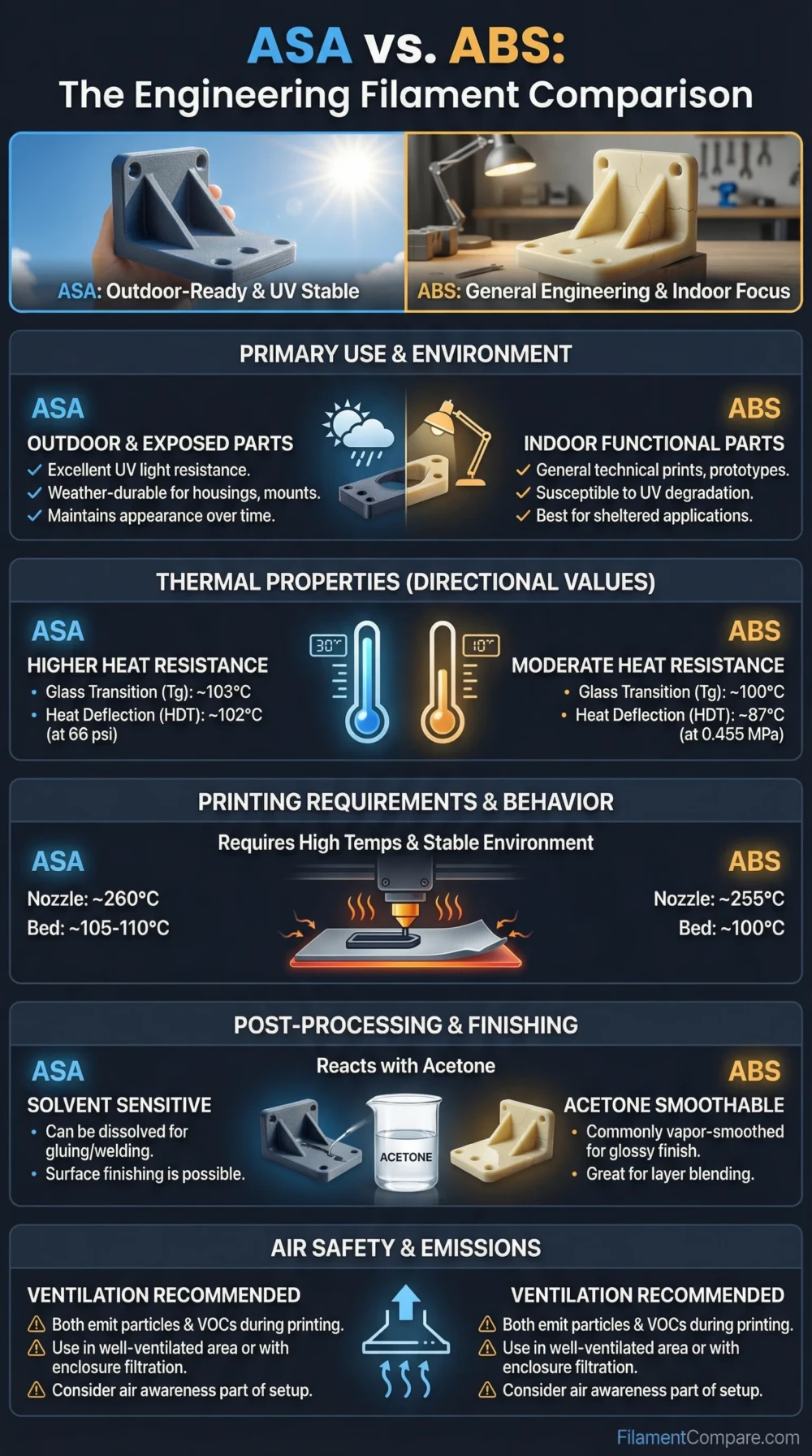
| Category | ASA Filament | ABS Filament | What It Tells You |
|---|---|---|---|
| Material Family | Acrylonitrile Styrene Acrylate (ASA) | Acrylonitrile Butadiene Styrene (ABS) | Both are engineering-style styrenic filaments, often compared for durability and heat behavior. |
| Outdoor / UV Focus | Commonly described as outdoor-suited with UV light resistance✅Source | Often used indoors; some product docs warn long-term UV exposure may affect printed-part properties✅Source | If sunlight and weathering are part of the story, ASA shows up a lot — especially when UV resistance becomes a key requirement. |
| Glass Transition (Tg) | 103.55 °C (example printed-filament datasheet)✅Source | 100.5 °C (example printed-filament datasheet)✅Source | Tg is where a polymer shifts from glassy to rubbery behavior. It’s a useful thermal marker, not a single “max temp.” |
| Heat Deflection (HDT) | 102.2 °C at 66 psi (example datasheet)✅Source | 86.6 °C at 0.455 MPa (example datasheet)✅Source | HDT relates to loaded parts under heat. Test standards differ, so treat this as directional, not absolute. |
| Specific Gravity | 1.08 (example datasheet value)✅Source | 1.1 g/cm³ (example datasheet value)✅Source | Helps estimate part weight for a given volume. Real spools vary by additives and pigment. |
| Typical Nozzle Temp | 260 °C (example profile guidance)✅Source | 255 °C (example profile guidance)✅Source | Both are commonly printed in the mid-to-high hotend range. Brand presets matter more than a single number. |
| Typical Bed Temp | 105 °C first layer, 110 °C after (example profile guidance)✅Source | 100 °C typical, often adjustable within 80–110 °C range (example guidance)✅Source | Bed temperature strongly affects dimensional stability during cooling, especially on larger parts. |
| Acetone Interaction | Commonly described as acetone-soluble in filament guides✅Source | Often described as suitable for acetone smoothing in material guides✅Source | Useful for understanding post-processing options and solvent sensitivity of finished parts. |
Note: The ASA and ABS numbers above are verified examples from specific product datasheets and profile guidance. Real-world results depend on brand formulation, print orientation, and printer setup. Keep the table as a reference frame, then confirm with your spool’s own spec sheet.
- What Changes When You Move From ABS To ASA
- ASA Material Profile
- ABS Material Profile
- Side-By-Side Signals You Feel In Real Prints
- Thermal Language: Tg, HDT, And What They Actually Mean
- Outdoor Exposure And ASA’s UV Reputation
- Cooling Behavior, Part Size, And Dimensional Expectations
- Surface Finish, Acetone, And Post-Processing Signals
- Mechanical Character: Strength, Stiffness, And Printed-Part Reality
- Air Emissions As A Practical Consideration (Neutral, Evidence-Based)
- Where You Commonly See ASA And ABS Mentioned
When people say ASA is “close to” ABS, they’re pointing at a real overlap: both are technical filaments with a familiar styrenic feel, and both show up in parts that want strength and heat awareness. The difference is not a tiny tweak—ASA is widely framed around outdoor durability and UV stability, while ABS remains a classic benchmark for general engineering prints.
What Changes When You Move From ABS To ASA
In everyday filament talk, ASA is often presented as a successor-like option to ABS because you can aim for a similar “engineering” result, then add a stronger focus on UV light resistance and outdoor use✅Source. That shows up in real product descriptions and in how makers label parts: enclosures, housings, brackets, mounts—places where shape and surface matter.
ASA Material Profile
- UV stability is a repeated theme in ASA material guides.
- Commonly tied to outdoor parts, where color and surface need consistency.
- Verified datasheet examples show Tg around 103.55 °C and HDT around 102.2 °C (example printed filament)✅Source.
- Thermal Markers
- Tg and HDT numbers can look strong on datasheets, especially when compared side-by-side with ABS.
- Surface & Solvent Clue
- Many guides mention acetone interaction for ASA, which matters for post-processing expectations.
ABS Material Profile
- ABS is widely treated as a baseline engineering filament for durable prints.
- Material guides often discuss acetone smoothing as a known property of ABS✅Source.
- Verified datasheet examples show Tg around 100.5 °C and HDT around 86.6 °C (example printed filament)✅Source.
- UV Context
- Some product docs explicitly note that long-term UV exposure can influence printed-part properties for ABS.
- Why It Stays Popular
- Availability, familiarity, and a long history in technical parts keep ABS in many comparisons.
Side-By-Side Signals You Feel In Real Prints
Think of the meters below as relative signals. ASA and ABS can both produce clean, functional parts, but they “lean” differently in UV exposure, cooling behavior, and surface expectations. The goal is clarity: what changes when the model size grows, or when the part lives near sunlight.
Outdoor / UV Confidence (relative)
Thermal Headroom Markers (Tg/HDT) (relative)
Dimensional Calm While Cooling (relative)
Thermal Language: Tg, HDT, And What They Actually Mean
Glass transition temperature (Tg) is a core polymer concept: it marks the shift where an amorphous polymer changes from glassy behavior toward a more rubbery response as temperature rises✅Source. That’s why both ASA and ABS get discussed in the same breath—both have Tg values around the 100 °C neighborhood in common datasheets.
Heat deflection temperature (HDT) tells a different story: it’s a loaded test, meant to reflect how a part behaves under stress while hot. In a verified ASA printed-filament datasheet, HDT at 66 psi is listed at 102.2 °C, while one verified ABS printed-filament datasheet reports 86.6 °C at 0.455 MPa (a closely related load unit) — different standards, still a useful directional comparison.
Outdoor Exposure And ASA’s UV Reputation
The simplest, most repeated contrast is this: ASA is frequently described as suited for outdoor use thanks to UV light resistance, while ABS is more often framed for general technical prints where direct weathering is not the main headline✅Source. That “UV story” is why ASA is commonly associated with exterior housings, exposed brackets, and parts that want stable appearance over time.
Some product documentation for ABS explicitly calls out long-term UV exposure as a condition that can affect printed-part properties, which helps explain why “UV stability” is not the default selling point in many ABS spool descriptions✅Source. In practice, that just means the environment becomes part of the material conversation.
Cooling Behavior, Part Size, And Dimensional Expectations
Both ASA and ABS are typically printed with a hot bed and a high nozzle temperature. Verified profile guidance lists ASA at 260 °C nozzle and 105/110 °C bed, while ABS is shown around 255 °C nozzle and 100 °C bed with an adjustable bed window depending on part size✅Source. Those numbers exist for a reason: they reflect how these polymers respond as layers cool and contract.
A clean way to think about it: as surface area and part footprint increase, the print is more sensitive to temperature gradients. That’s why the conversation around ASA and ABS often includes ambient stability and consistent heat—not as a “hack,” but as a basic property of how these materials cool.
Surface Finish, Acetone, And Post-Processing Signals
One reason ASA and ABS stay linked in comparisons is acetone interaction. Material guides commonly mention ABS can be acetone-smoothed, and they also note ASA can be dissolved in acetone as well✅Source. That matters for two user-facing facts: solvent sensitivity of a finished part, and the range of surface finishing discussions you’ll see around these filaments.
Mechanical Character: Strength, Stiffness, And Printed-Part Reality
Filament comparisons get more honest when they admit a key detail: printed parts are anisotropic. That means the same spool can show different strength depending on orientation and layer bonding. This behavior appears across many engineering-grade 3D printing filaments, where mechanical properties depend not only on the polymer itself but also on the way the part is printed. So the best way to read mechanical numbers is as reference landmarks rather than universal truth.
| Property | ASA (example) | ABS (example) | Why It’s Useful |
|---|---|---|---|
| Tensile Modulus | 2.14 GPa (example orientation) | 1.962 GPa (XY flat typical) | Higher modulus often feels “stiffer” in hand, though geometry and walls can dominate the feel. |
| Tensile Stress At Yield | 32.8 MPa (example orientation) | 38.1 MPa (XY flat typical) | Yield numbers give a rough idea of how a part behaves before permanent deformation. |
The ASA example values above come from a printed-filament datasheet that also lists Tg, HDT, and specific gravity, making it a strong single reference point for comparisons✅Source. The ABS example values are from a printed-filament technical data sheet that reports mechanical and thermal properties for printed samples under defined conditions✅Source.
Air Emissions As A Practical Consideration (Neutral, Evidence-Based)
FFF printing, including runs with ABS, has been studied for particle and VOC emissions in workplace-style evaluations. One U.S. NIOSH Health Hazard Evaluation specifically measured emissions and personal exposures while using printers with ABS and PLA thermoplastics✅Source. This doesn’t “label” a filament as good or bad—it simply explains why many people treat air awareness as part of the overall printing setup.
The U.S. EPA notes that published research linking 3D printer emissions to respiratory health effects is limited, and also states that 3D printing is increasingly used in educational and hobby settings✅Source. For a filament comparison site, this means acknowledging that emissions and related studies exist, and presenting the topic with clear wording and cited sources.
Where You Commonly See ASA And ABS Mentioned
- ASA: Outdoor-facing housings, brackets, covers, and parts where UV stability and appearance retention are frequently highlighted.
- ABS: General engineering prints, functional prototypes, and enclosures where toughness, heat awareness, and long-standing material familiarity are often the focus.
- ASA and ABS together: Projects that value durability, acetone-related finishing discussions, and a “technical” feel compared to beginner materials.
If you’re comparing ASA vs ABS for a specific project type, keep anchoring the decision in environment (UV exposure vs sheltered), thermal markers (Tg/HDT), and the profile temps your ecosystem documents. Those are the facts that stay stable across brands.
