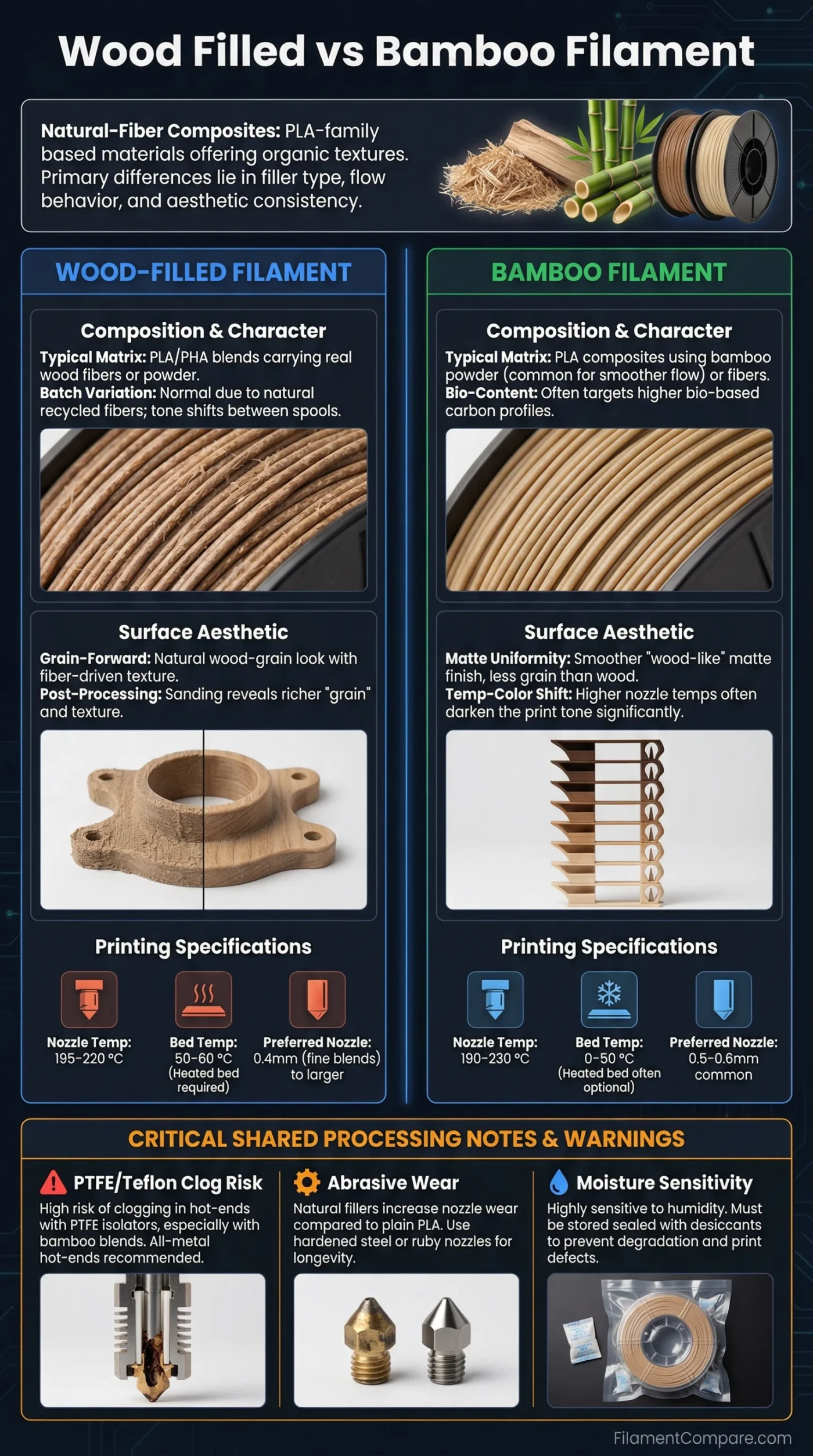
| Attribute | Wood-Filled Filament | Bamboo Filament |
|---|---|---|
| Typical polymer matrix | Commonly PLA-family composites; one widely documented example is a PLA/PHA blend with wood fibres[a] | Often PLA-family composites with bamboo powder or fibres; commercial naming varies by brand |
| Natural filler form | Wood fibres / wood powder (particle size depends on “fine” vs “coarse” style blends) | Bamboo powder or bamboo fibres; powder-based blends are common in FFF research |
| Nozzle temperature window | 195–220 °C (datasheet guideline)[a] | 190–230 °C (guide range for bamboo wood filament blends)[d] |
| Bed / platform temperature | 50–60 °C (datasheet guideline)[a] | 0–50 °C (guide range; heated bed often optional)[d] |
| Nozzle diameter trend | 0.4 mm works for many “fine” blends; larger nozzles are often used to reduce flow restriction | 0.5–0.6 mm is a common choice in bamboo-filled composite testing and user setups |
| Density (example reference) | 1.15 g/cm³ (injection molded reference dataset)[a] | Varies by formulation; many bamboo blends prioritize a wood-like look over a single fixed density |
| Mechanical snapshot (printed parts) | Tensile strength 28.36 MPa; tensile modulus 2478.86 MPa (ISO 527, printed specimen set)[a] | Ultimate tensile strength 29.21–32.50 MPa; modulus 2.36–2.63 GPa across raster orientations (published FFF tests)[c] |
| Thermal reference point | Melting temperature reported as >155 °C (reference dataset)[a] | PLA-family bamboo composites typically behave like PLA in heat response; exact limits depend on blend and test method |
| Surface character | Natural, wood-grain look with fibre-driven texture; sanding can reveal more “grain” | Often a smoother “wood-like” texture than heavy wood powders; bamboo powder can create a subtle matte finish |
| Color behavior | Batch-to-batch variation is normal for natural fibres; tone can shift slightly between spools | Some bamboo blends can darken at higher nozzle temperatures (temperature-linked tone shift) |
This wood-filled filament vs bamboo filament comparison is grounded in manufacturer datasheets and reputable technical references, so treat the figures as typical benchmarks—real prints can vary by machine, settings, and batch.
- Material Makeup and What “Wood-Like” Really Means
- Processing Behavior: Flow, Heat Window, and Consistency
- Nozzle Diameter, Particle Size, and Wear
- Mechanical Properties: What to Read (and What to Ignore)
- Surface Finish and Post-Processing Characteristics
- Moisture, Storage, and Long-Term Consistency
- Regulatory and Material Notes for Documentation
- Naming, Availability, and Why “Bamboo” Can Be Hard to Match
- Resources Used
Wood-filled and bamboo filaments sit in the same family: natural-fiber composite materials designed to give FFF/FDM prints a warm, organic surface without leaving the PLA-like workflow behind. The real differences show up in the filler (wood fibres vs bamboo powder/fibre), how the filament flows through the hot zone, and how predictable the “wood look” stays across settings and batches.
- Natural texture
- PLA-family processing
- Filler-driven flow
- Batch variation
- Nozzle choice matters
Material Makeup and What “Wood-Like” Really Means
“Wood-filled” usually means a PLA-family base polymer carrying real wood fibres or wood powder. Materials like wood-filled, bamboo, marble, or metal-filled blends are commonly discussed within specialty 3D-printing filaments because natural or mineral additives are used mainly to change surface texture, density, or visual character rather than the underlying polymer family. In one widely documented commercial example, wood fibres are blended into a PLA/PHA compound and the brand explicitly notes the use of recycled wood fibres, which explains why subtle shade differences can occur between batches[e].
“Bamboo filament” is less standardized as a label. Some products are bamboo fibres in a wood-polymer composite, others lean toward bamboo powder for a cleaner flow and finer texture. FKuR, for example, positions its bamboo option as a bamboo-fibre wood-polymer composite for 3D printing, targeting a bio-based material profile rather than a single cosmetic effect[j].
Processing Behavior: Flow, Heat Window, and Consistency
Both materials are often described as “PLA-like,” yet the filler changes how the melt moves. A wood powder PLA datasheet (Flashforge) reports a melt flow rate of 10–15 g/10 min (190 °C/2.16 kg) and water absorption below 0.6% (23 °C/24 h), plus a practical printing envelope with 190–220 °C nozzle temperatures and a platform range up to 60 °C[b].
- Wood-filled blends often reward a steady, even melt flow because fibres/powders can increase internal friction in the nozzle.
- Bamboo blends may feel slightly smoother in extrusion when the filler is fine powder, while fibre-heavy blends can behave closer to wood-filled materials.
- Cooling is commonly used at high levels for PLA-family composites, but the “best” fan balance depends on part geometry and the surface finish you want.
Compatibility note: A widely referenced bamboo wood filament guide warns that hot-ends using a PTFE/teflon isolator coupler may be more prone to clogging with bamboo-filled blends, even when the printer is otherwise PLA-capable[d].
Nozzle Diameter, Particle Size, and Wear
Natural fillers introduce a simple reality: the nozzle is now handling a polymer plus solid particles. That’s why “fine” vs “coarse” matters more here than it does with plain PLA. One manufacturer support note explains that a coarse woodFill variant historically required a 0.8 mm nozzle, and the product focus later shifted toward the easier-to-print fine version[i].
- Fine-style composites
- More likely to run comfortably on 0.4 mm nozzles, especially when the filler is smaller and more uniform.
- Coarse-style composites
- More likely to benefit from larger diameters (0.6–0.8 mm) to reduce restriction and particle bridging.
- Nozzle material
- Brass works for many users, but composite use can increase long-term wear compared to plain PLA—especially with frequent printing and high throughput.
Mechanical Properties: What to Read (and What to Ignore)
With composites, the test method matters as much as the number. Some datasheets show both injection molded and 3D printed datasets, and those can differ a lot because layer interfaces and raster orientation change the load path. When you compare brands, prioritize printed-part datasets (or at least confirm the test specimen type) before treating a tensile value as representative of your parts.
Published bamboo-filled PLA composite testing illustrates why: tensile results stay in a similar band across multiple raster orientations, but the modulus and elongation shift enough to influence how “stiff” or “forgiving” a part feels under load[c].
Relative Trend Indicators (typical, not absolute)
Surface Finish and Post-Processing Characteristics
Wood-filled prints are usually chosen for a grain-forward aesthetic: the filler can create tiny directional textures that look more like wood once the outer skin is refined. Bamboo blends tend to land on a “wood-like” matte appearance with a slightly cleaner, more uniform tone when the filler is finer.
- Sanding response: wood-filled blends can reveal richer texture as the surface is refined; bamboo blends may look smoother and more even.
- Staining and tinting: natural-fiber composites can accept surface coloration, though the final shade depends heavily on filler tone and print temperature history.
- Temperature-linked color shift: bamboo wood filament blends are often noted for lighter-to-darker shifts across a low-to-high nozzle temperature band.
Moisture, Storage, and Long-Term Consistency
Natural fibres can bring in more sensitivity to storage conditions than plain PLA. A wood powder PLA datasheet advises keeping packaging sealed to prevent moisture absorption and contamination, and notes that exposure to moisture, oxygen, and UV can accelerate aging—practical reasons why results may drift after a spool has been open for a while[b].
Expectation setting: If two prints look slightly different even with the same settings, it can be normal for natural-fiber composites because the filler itself is not a perfectly uniform industrial pigment.
Regulatory and Material Notes for Documentation
If you maintain a comparison database, it helps to separate “print profile facts” from “product documentation facts.” One product information sheet for a wood-filled filament states the product does not meet classification criteria as hazardous under CLP and notes REACH-related status details (including PBT/vPvB and candidate list statements)[g].
On the bio-based side, some bamboo-oriented material families also publish explicit bio-based carbon content. FKuR lists a bamboo option with a reported 75% bio-based carbon content and provides a melt flow rate value (4.5 g/10 min at 190 °C/2.16 kg) as part of its positioning for 3D printing applications[j].
Naming, Availability, and Why “Bamboo” Can Be Hard to Match
Wood-filled filament is broadly available across many brands, but bamboo-branded options can be more volatile. A manufacturer retrospective notes that after introducing woodFill, the company expanded into bambooFill and later discontinued it, while keeping other special materials in the lineup[f].
So if you’re comparing “wood-filled vs bamboo,” it’s smart to treat bamboo as a category rather than a single standardized recipe. Two spools labeled “bamboo” can differ in filler type (powder vs fibre), filler percentage, base polymer modifiers, and even the intended surface finish.
Resources Used
- [a] colorFabb: WoodFill Technical Datasheet (Oct 27, 2022)
- [e] colorFabb: woodFill Product Page (recycled wood fibres, PLA/PHA compound, batch variation note)
- [b] Flashforge: WOOD Filament Technical Data Sheet (PLA wood powder blend; properties and recommended conditions)
- [d] Adafruit Learning System: Usage Notes for Bamboo Wood Filament (temperature window, platform range, PTFE coupler warning)
- [c] MDPI (Journal of Composites Science): Mechanical Strength of Bamboo Filled PLA Composite Material in Fused Filament Fabrication (2020)
- [i] colorFabb Support: Woodfill – the original (fine vs coarse history and nozzle note)
- [g] colorFabb: WoodFill Product Information Sheet (REACH/CLP statements)
- [j] FKuR: Filaments from Bioplastics for 3D Printing (bio-based carbon content and melt flow reference)
- [f] colorFabb: 10 Years woodFill (mentions bambooFill as discontinued)
