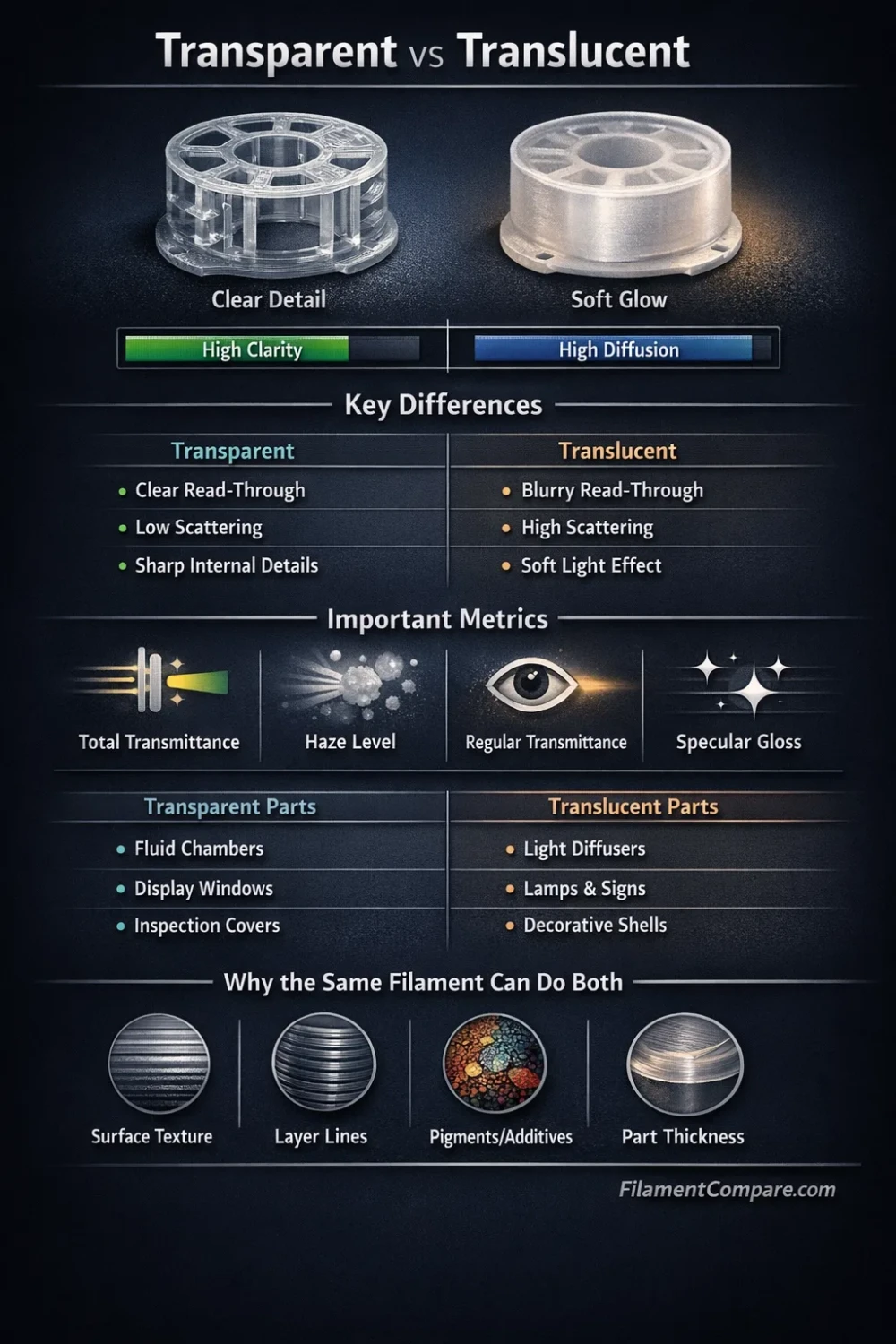
| Attribute | Transparent | Translucent |
|---|---|---|
| What You See | Clear read-through; edges and text behind the part can stay recognizable when scattering is low. | Soft read-through; shapes and light pass, but fine detail blurs as scattering increases. |
| Light Path Character | More straight-through transmission with limited forward scattering. | More diffuse transmission (forward scattering spreads light in many directions). |
| Transmission Metric Used In Standards | Total luminous transmittance is commonly used for “how much visible light gets through” in a standardized way; ISO 13468-1 applies this to transparent, substantially colorless plastics and notes use up to 10 mm thickness. [Source-6✅] | |
| Scattering Metric Used In Standards | Haze describes the relative amount of scattered light deviating by more than a spatial angle of 2.5° (a common definition tied to ASTM D1003 usage). [Source-3✅] | |
| Where “Diffusing” Starts In One Common Reference | In the ASTM D1003 scope text, a material with haze greater than 30% is treated as diffusing for a related practice reference in that context. [Source-4✅] | |
| “See-Through” Style Metric Often Named | Regular transmittance (Tr) is used in ASTM D1746 to measure transparency of plastic sheeting and is commonly associated with a “see-through” perception for nominally clear materials. [Source-5✅] | |
| Surface Appearance Metric That Often Matters | Specular gloss is commonly measured with glossmeter geometries of 60°, 20°, and 85° in ASTM D523; smoother surfaces often read “clearer” because less surface texture means less stray reflection. [Source-7✅] | |
| How Filament Labels Usually Sound | “Clear / Crystal / Transparent” tends to signal a goal of higher image clarity through the part. | “Translucent / Frosted / Milky / Diffused” tends to signal a glow-first look where detail is intentionally softened. |
| Typical Visual Outcome In Printed Parts | Detail visibility is the main vibe: inner structures, channels, and embedded items can remain more readable. | Light blending is the main vibe: internal shapes show as silhouettes, and illumination looks more even. |
This Transparent and Translucent comparison is built from material datasheets plus trusted standards and institutional references, so it reflects common measurement trends rather than guaranteed outcomes, and real printed results can shift with geometry, additives, and processing.
- Optical Meaning Of Transparent and Translucent
- A Simple Mental Model For Filament Prints
- Metrics Used To Describe Clarity and Diffusion
- What These Labels Mean In Transparent Filament and Translucent Filament Listings
- Transparent Signals
- Translucent Signals
- Why The Same Spool Can Look Transparent or Translucent
- Common Drivers Of Optical Differences In 3D Printed Filament Parts
- Where Each Look Commonly Shows Up In Printed Objects
- When People Want Transparent
- When People Want Translucent
Transparent and Translucent are not “marketing vibes” in a vacuum; they describe different ways light travels through a material. In filament prints, the same spool can look closer to either side depending on how much the part scatters light versus how much it simply transmits it.
Visual Read-Through (relative)
Light Diffusion “Glow” (relative)
Optical Meaning Of Transparent and Translucent
Transparent describes a material that transmits light with no appreciable scattering so objects behind it can be seen clearly; that “scattering” part is the key detail that separates true optical clarity from merely letting light through. [Source-1✅]
Translucent describes something that is not fully clear, yet still allows light to pass through; you typically get light and shadow more than crisp detail. [Source-2✅]
A Simple Mental Model For Filament Prints
- Transparent = low scatter, sharper view
- Translucent = more scatter, softer view
- Haze goes up as scattering goes up
- Gloss can change how “clear” a surface looks
Important nuance: a part can have high light transmission and still look “frosted” if scattering is high; it is still letting light through, just not in a straight, image-preserving way.
Metrics Used To Describe Clarity and Diffusion
Datasheets and lab reports often treat clarity as a combination of how much light passes and how much the material spreads that light. In practice, the words transparent and translucent map to different positions on those measured axes.
- Total Luminous Transmittance focuses on visible light passing through a specimen under defined conditions; it helps compare “how bright it looks through the material” in a controlled way.
- Regular Transmittance (Tr) is often discussed as a “see-through” style measure, since it targets the more straight-path component of transmission.
- Haze captures wide-angle forward scattering; higher haze generally means more blur and more “glow.”
- Specular Gloss describes how mirror-like a surface reflection is; it can affect perceived sharpness and “cleanliness” on the outside of a print.
- Transmission
- The portion of light energy that makes it through a part; in printed filament parts, both internal structure and surface finish influence what the eye perceives.
- Scattering
- Light being redirected by micro-texture, interfaces, pigments, or internal features; more scattering pushes appearance toward translucent even if the material itself is “clear.”
- Perceived Clarity
- The human-visible outcome: how sharp objects look through the part, not just whether light passes.
What These Labels Mean In Transparent Filament and Translucent Filament Listings
In online listings, transparent filament usually signals a target of higher image readability through a print, while translucent filament signals a target of more even diffusion. Both can be made from “clear” base polymers; the difference is often shaped by additives, pigmentation level, and how the final printed surface and interior scatter light.
Transparent Signals
- Lower haze look is the usual expectation, especially on thin sections.
- Sharper internal visibility is commonly associated with this label.
- Reflections and surface can become a bigger part of the visual, because the eye sees “through” the part and also “on” the surface.
Translucent Signals
- Diffused glow is the usual expectation, especially around edges and curves.
- Softer silhouettes are common; details become less crisp by design.
- Visual uniformity across small texture changes is often part of the appeal.
Why The Same Spool Can Look Transparent or Translucent
For filament prints, appearance is a teamwork situation: the polymer, the colorant package, and the printed micro-geometry all influence scattering. A part can slide toward translucent simply because light hits many internal boundaries (layer interfaces, tiny voids, texture), even when the raw material is marketed as transparent.
Material structure matters too. In polymer science, increased crystallinity is commonly linked with increased opacity due to light scattering, while amorphous domains are often associated with higher transparency. [Source-8✅]
Reading A Listing Without Guesswork: “Transparent” is a clarity intent, “Translucent” is a diffusion intent; the final look depends on how much the printed part scatters light.
Common Drivers Of Optical Differences In 3D Printed Filament Parts
The same label can land in slightly different visual territory across brands because “clear” formulations may still include stabilizers, impact modifiers, fillers, or tint systems. Those choices shift scatter and absorption, which shifts where the print sits between transparent and translucent.
- Surface micro-texture changes how much light is reflected and scattered at the outer skin, influencing perceived sharpness.
- Internal interfaces (layer boundaries, tiny gaps, infill walls) create many opportunities for forward scattering.
- Thickness changes the optical path length; longer paths generally raise absorption and increase the number of scattering events.
- Pigments and “frost” systems deliberately push light diffusion for a uniform glow.
- Polymer morphology (amorphous vs more crystalline regions) can shift transparency through refractive-index differences inside the material.
Where Each Look Commonly Shows Up In Printed Objects
Transparent visuals often appear in parts where internal features are meant to be seen with higher definition: fluid paths, small assemblies, display windows, or visual inspection covers. Translucent visuals often appear where the goal is light blending and soft silhouettes: lamp-style diffusers, backlit signs, and decorative shells that look evenly lit.
When People Want Transparent
- Readable internals (details, edges, channels).
- Higher contrast when looking through the wall.
- Clear branding language like “crystal” or “clear window.”
When People Want Translucent
- Even glow under lighting.
- Softer silhouettes and reduced visual harshness.
- Design language like “frosted” or “diffused.”
