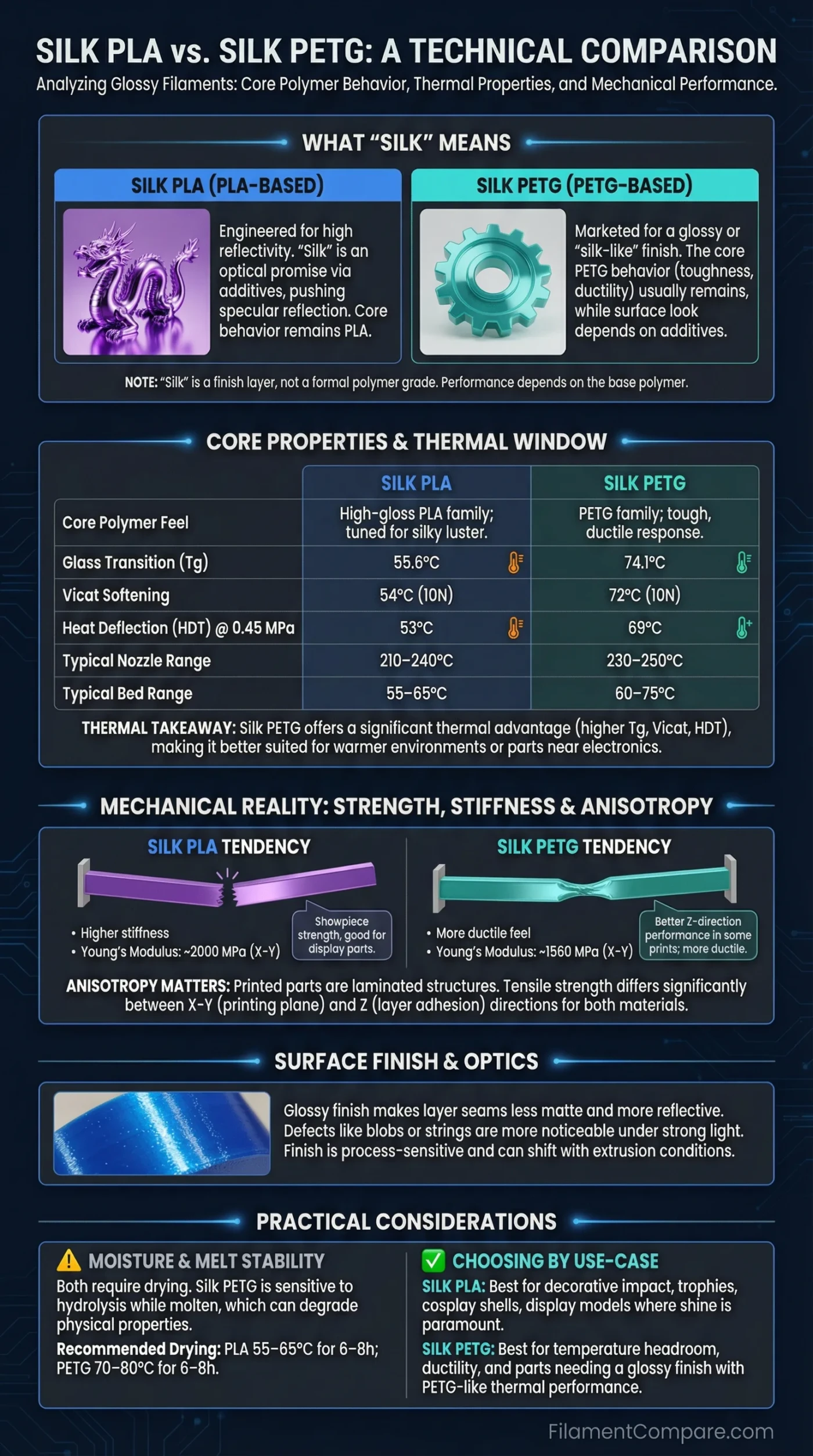
| Spec or Behavior | Silk PLA (PLA-Based) [a] | Silk PETG (PETG-Based Baseline) [b] |
|---|---|---|
| Core Polymer Feel | High-gloss PLA family; tuned for silky luster | PETG family; often chosen for tough, ductile response |
| Density (g/cm³) | 1.22 | 1.23 |
| Glass Transition, Tg (°C) | 55.6 | 74.1 |
| Vicat Softening (°C) | 54 (10N) | 72 |
| Heat Deflection (°C) | 53 @ 0.45 MPa | 69 @ 0.45 MPa; 66 @ 1.8 MPa |
| DSC Melting Peak (°C) | 164 | 225 |
| Tensile Strength (MPa) | 37±4 (X–Y); 12±4 (Z) | 34.4±2.7 (X–Y); 14±2.3 (Z) |
| Elongation at Break (%) | 28±5 (X–Y) | 30±5 (X–Y) |
| Young’s Modulus (MPa) | 2000±200 (X–Y) | 1560±180 (X–Y) |
| Izod Impact (kJ/m²) | 20±2 (X–Y) | 8.1±0.7 (X–Y) |
| Typical Nozzle Range (°C) | 210–240 | 230–250 |
| Typical Bed Range (°C) | 55–65 | 60–75 |
| Recommended Drying Window | 55–65°C for 6–8h | 70–80°C for 6–8h |
| Optical Character | Mirror-like sheen that can shift with extrusion conditions | Clear-to-glossy look; “silk” branding varies more by manufacturer |
This Silk PETG vs Silk PLA comparison follows datasheets and established polymer references, so it highlights typical trends rather than guaranteeing identical results across every brand, printer, or environment.
- What “Silk” Means in PLA and PETG
- Thermal Window and Heat-Related Metrics
- Why HDT and Vicat Get Mentioned So Often
- Strength, Stiffness, and Layer Adhesion Reality
- Silk PLA Tendency
- Silk PETG Tendency
- Surface Finish, Optics, and Dimensional Readability
- Moisture Sensitivity and Melt Stability
- Post-Processing and Compatibility Notes
- Choosing by Use-Case Signals
- How to Read the Numbers Without Over-Trusting Them
- Resources Used
What “Silk” Means in PLA and PETG
In FDM/FFF, “silk” is mostly an optical promise: additives and pigments are selected to push specular reflection so layer lines look more like brushed metal than matte plastic. It is not a formal polymer grade, which is why “Silk PETG” can mean different formulations between brands.
- Silk PLA Filament
- PLA-based filament engineered for high reflectivity; many datasheets explicitly treat the shine as a feature that can shift with extrusion conditions.
- Silk PETG Filament
- PETG-based filament marketed for a glossy or “silk-like” finish; the core PETG behavior usually remains, while the surface look depends on the additive package.
A practical takeaway: treat “silk” as a finish layer on top of the base polymer choice. If the job needs PETG-like softening behavior, chemical tolerance, or ductility, the “PETG” part matters most; if it needs a mirror sheen under indoor lighting, the additive system matters more than the label.
Thermal Window and Heat-Related Metrics
For many printed parts, Tg (glass transition) and Vicat softening are more predictive than “melting point.” Silk PLA in the referenced datasheet lists Tg around 55.6°C and Vicat at 54°C, while PETG shows Tg around 74.1°C with Vicat at 72°C, a meaningful gap when a part sits near warm electronics or inside a sunlit room.
Why HDT and Vicat Get Mentioned So Often
HDT and Vicat are standardized ways to describe when a polymer starts losing stiffness under load. They are not “a safe operating temperature,” yet they help compare materials under consistent test stress, especially across datasheets that quote ISO or ASTM methods.
PLA can also be engineered for higher heat performance through crystallization. NatureWorks’ Ingeo 3D850 datasheet explicitly notes that post-annealing (80–130°C) can promote crystallization and improve heat deflection temperature in 3D printed parts, alongside typical PLA ranges like Tg 55–60°C and melt peak 165–180°C. [d]
Strength, Stiffness, and Layer Adhesion Reality
Most filament comparisons skip the anisotropy that matters in real prints. Even in the same Silk PLA datasheet, tensile strength differs between X–Y (37±4 MPa) and Z (12±4 MPa), and PETG shows a different split (34.4±2.7 MPa X–Y; 14±2.3 MPa Z). These numbers underline a simple idea: printed parts behave like a laminated structure, not a uniform block.
Silk PLA Tendency
- Higher stiffness in many PLA-based builds (see modulus example values).
- Showpiece strength can be plenty for display parts and shells.
- Layer-direction strength remains the main design limiter.
Silk PETG Tendency
- More ductile feel is typical of PETG families, even when marketed as glossy.
- Z-direction performance can compare favorably in some prints.
- Surface gloss does not automatically mean weaker cores; it’s additive-dependent.
Impact numbers can also surprise. The referenced Silk PLA datasheet lists a higher Izod impact value than the referenced PETG datasheet, which is a reminder that brand formulation and test specimen details can outweigh assumptions. Use datasheets for comparison, then treat your own geometry and print orientation as the final judge.
Surface Finish, Optics, and Dimensional Readability
Silk filaments reward the eye, but they also change how defects “read.” A high-gloss surface often makes layer seams less matte and more reflective, so tiny changes in extrusion can appear as bright bands rather than dull steps. Some datasheets even call out the shine as tunable via temperature, confirming that finish is process-sensitive.
Relative Visual Emphasis (qualitative)
Reading tip: the first bar of each pair reflects Silk PLA, the second reflects Silk PETG.
There’s another subtle effect: glossy skins can make dimensional edges look sharper while also making tiny blobs or strings more noticeable under strong light. That “detail pop” is often why creators like Silk PLA for statues and display pieces, while glossy PETG variants can look especially clean on transparent or translucent styles.
Moisture Sensitivity and Melt Stability
Silk PLA datasheets may list moisture content and a suggested drying window, and PETG often does the same. Under the hood, many polyesters are sensitive to hydrolysis while molten: Eastman’s technical literature for a PETG-type copolyester explains that hydrolysis during processing can reduce molecular weight and lower physical properties, especially toughness, which is why drying guidance exists in the first place. [c]
Storage takeaway: moisture and surface finish interact. A glossy “silk” surface can make minor bubbling, haze, or stringing artifacts easier to spot, so consistency in material condition matters just as much as the base polymer choice.
Post-Processing and Compatibility Notes
Silk finishes change how a part responds to sanding and coatings, mainly because gloss reveals texture quickly. With either polymer, a uniform sheen usually depends on keeping surface texture consistent across the model; uneven texture tends to reflect light in patches.
For joining parts, it helps to separate polymer compatibility from surface finish. PETG-family materials generally resist more everyday chemicals than PLA-family materials, but bonding performance still depends on the exact formulation and the surface energy of the glossy skin.
Choosing by Use-Case Signals
If the goal is decorative impact, Silk PLA is often selected for trophies, figurines, cosplay shells, and display models where shine is part of the design language. The referenced datasheet’s relatively high Izod value also shows that “aesthetic filament” can still land in a respectable toughness range.
If the goal is temperature headroom and a more ductile feel, PETG-based options tend to offer higher Tg/Vicat and HDT values in datasheets. When the product is specifically labeled “Silk PETG,” it’s reasonable to expect a PETG-like thermal envelope with a finish tuned for shine rather than a totally different mechanical category.
How to Read the Numbers Without Over-Trusting Them
Datasheet values are most useful when treated as comparative signals. The same sheet may include separate X–Y and Z results, and many include disclaimers that printing conditions can shift outcomes; that’s a healthy reminder that geometry, load direction, and thermal environment shape the final performance as much as the material label.
