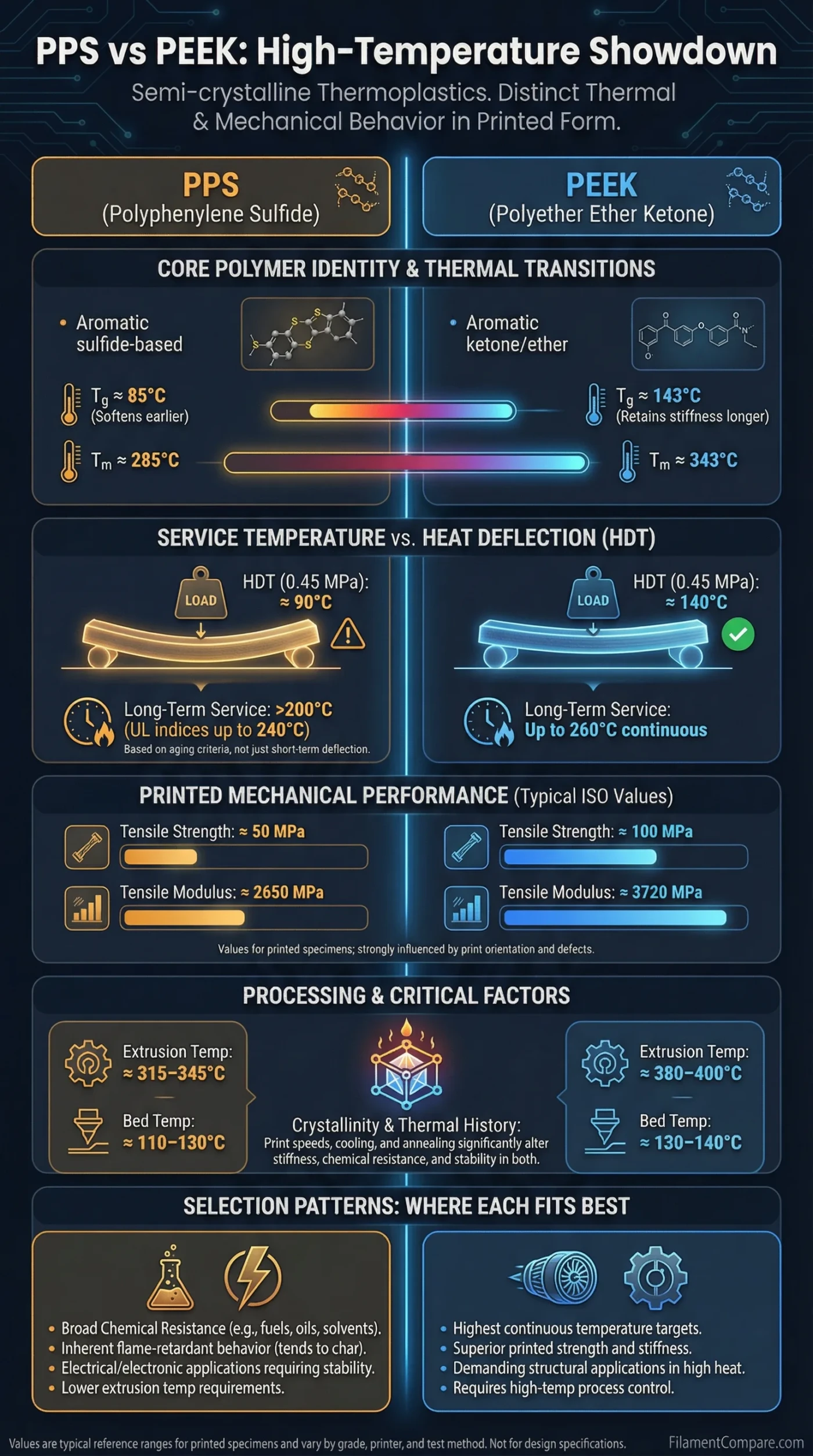
| Attribute | PPS (Polyphenylene Sulfide) | PEEK (Polyether Ether Ketone) |
|---|---|---|
| Polymer family | Semi-crystalline, aromatic sulfide-based thermoplastic | Semi-crystalline, aromatic ketone/ether thermoplastic |
| Thermal transitions (typical) | Tg ≈ 85°C, Tm ≈ 285°C [a] | Tg ≈ 143°C [c] Tm ≈ 343°C [f] |
| Long-term temperature capability (typical reference language) | Long-term range above 200°C; UL thermal indices reported up to 240°C [d] | Mechanical performance commonly described at continuous temperatures up to 260°C [e] |
| HDT / deflection temperature (printed ISO specimens, 0.45 MPa) | ≈ 90°C [b] | ≈ 140°C [c] |
| Density (typical) | ≈ 1.28 g/cc [b] | ≈ 1.30 g/cc [c] |
| Tensile strength (printed ISO specimens) | ≈ 50 MPa [b] | ≈ 100 MPa [c] |
| Tensile modulus (printed ISO specimens) | ≈ 2650 MPa [b] | ≈ 3720 MPa [c] |
| Flammability language commonly used on datasheets | UL 94 V-0 (base resin reference) [b] | UL 94 V-0 (base resin reference) [c] |
| Reported extrusion temperature range (filament product pages / datasheets) | ≈ 315–345°C [a] | ≈ 380–400°C [c] |
| Reported bed temperature range (filament datasheets) | ≈ 110–130°C [b] | ≈ 130–140°C [c] |
This PPS vs PEEK comparison blends manufacturer datasheets with trusted reference pages to show typical trend-level differences, while real results can shift with grade selection, printing setup, and test method.
- In This Comparison
- What PPS and PEEK Mean in Filament Form
- Thermal Transitions and Service Temperatures
- Why PPS Can Sound “200°C+” Yet Show a Much Lower HDT
- Crystallinity and Thermal History
- What Crystallinity Changes Tends to Influence
- Mechanical Behavior in Printed Parts
- PPS Filament Snapshot
- PEEK Filament Snapshot
- Chemical Resistance and Moisture Interaction
- Moisture: Two Different Questions That Get Mixed Up
- Flammability and Test Language
- Selection Patterns by Use Case
- Where PPS Often Fits
- Where PEEK Often Fits
- Resources Used
PPS and PEEK sit in the same high-temperature FFF filament neighborhood and are commonly grouped with other engineering-grade 3D printing filaments, yet they behave differently once heat, load, and environment show up at the same time. Both are semi-crystalline thermoplastics, so their “headline temperature” is never just one number: Tg, Tm, crystallinity, and the test method all matter.
In This Comparison
- What PPS and PEEK mean in filament form
- Thermal transitions vs service language (Tg, Tm, thermal indices)
- Crystallinity and thermal history (why printed results move)
- Mechanical behavior in printed parts (what datasheets do and don’t say)
- Chemical resistance and moisture interaction
- Flammability and test language (UL 94 context)
- Selection patterns by use case
- Resources used
- Tg (glass transition)
- Temperature zone where the polymer’s amorphous phase softens; for semi-crystalline materials, Tg often tracks the point where stiffness under load starts to shift.
- Tm (melting point)
- Temperature where crystalline regions melt; commonly reported from DSC measurements and used as a processing reference more than a service limit. [h]
- HDT (deflection temperature under load)
- Standardized way to compare “heat + load” deformation at a defined stress; it is a comparison tool, not a universal continuous-use rating. [g]
- Thermal index / long-term temperature language
- Manufacturers may describe long-term capability using thermal indices or continuous-use phrasing; these depend on the specific grade, aging criteria, and environment.
What PPS and PEEK Mean in Filament Form
In filament catalogs, PPS can mean neat PPS, mineral-filled PPS, or fiber-reinforced PPS blends; the same is true for PEEK filament. The polymer name is the starting point, but reinforcement (carbon fiber, glass fiber), additives, and how the filament is compounded can move stiffness, shrink behavior, and “as-printed” crystallinity.
- Semi-crystalline
- High-temp thermoplastic
- Grade-dependent properties
- Printed-part anisotropy
- Environment-sensitive performance
A good comparison keeps two ideas in the same frame: the base polymer identity (PPS vs PEEK) and the filament-grade reality (what a given datasheet measured on printed specimens). The numbers in the table above are from printed ISO specimens on filament datasheets, which helps you compare like-for-like within that context.
Thermal Transitions and Service Temperatures
People often line up materials by melting point, then stop. For PPS and PEEK, that shortcut hides the real story: Tg is where “load-bearing feel” starts to change, while service language usually comes from long-term aging criteria (and can differ from HDT).
Why PPS Can Sound “200°C+” Yet Show a Much Lower HDT
- HDT is a controlled “bend under stress” comparison; it can track Tg closely in many semi-crystalline plastics, especially when crystallinity or reinforcement differs.
- Long-term temperature capability is often expressed with thermal index language and depends on what “end of life” means in the referenced method.
- Datasheet values for printed specimens are strongly influenced by print-induced microstructure and orientation.
On trusted reference pages, Ryton® PPS is described with a long-term range above 200°C and UL thermal indices reported up to 240°C, plus short-term resistance up to 260°C [d]. PEEK is commonly described as maintaining mechanical performance up to 260°C continuous in manufacturer language [e].
Crystallinity and Thermal History
Many comparisons skip the quiet driver behind “why two prints from the same spool can feel different”: crystallinity. In semi-crystalline polymers, the amount and structure of crystallinity shifts stiffness, creep behavior, and dimensional stability in warm service.
In additive manufacturing literature, printed PEEK is often discussed as a material where thermal conditioning can raise crystallinity and alter final properties; the reported outcome is strongly tied to time-temperature history and specimen geometry [j].
What Crystallinity Changes Tends to Influence
- Heat stiffness under load (creep and deflection trends shift as crystalline regions grow).
- Dimensional stability (shrink behavior and residual stress balance can move).
- Layer-to-layer consistency (microstructure can differ across thick vs thin sections).
Mechanical Behavior in Printed Parts
Filament datasheets are useful because they ground claims in a defined specimen and method. Still, treat them as reference ranges, not universal constants: print path, void content, and orientation can move outcomes, even when the base polymer is the same.
Trend-Level Comparison (relative, not absolute)
Upper bar in each pair represents PPS, lower bar represents PEEK; these are conceptual trend bars aligned with the cited ranges and typical datasheet behavior.
Chemical Resistance and Moisture Interaction
PPS is widely recognized for chemical resistance, including “no known organic solvent under 200°C” language on trusted reference pages [d]. In practical terms, this pushes PPS into environments where fuels, oils, and process fluids are part of the design envelope.
PEEK is also positioned by manufacturers as having a broad chemical resistance profile alongside high temperature performance, with continuous temperature language commonly reaching 260°C on polymer reference pages [e].
Moisture: Two Different Questions That Get Mixed Up
- Moisture uptake: how much water the material absorbs over time (affects mass and sometimes dimensions).
- Hydrolytic stability: how well properties hold up when water and heat act together for long periods.
- Printer-to-printer variability: “as-printed” microstructure can change how fast moisture-related effects show up.
Flammability and Test Language
Datasheets often cite UL 94 ratings like V-0, which is a structured way to describe burning behavior under a defined test. UL also notes the standard is intended as a preliminary indication of acceptability with respect to flammability for an application [i].
PPS is known to char during combustion, which contributes to its flame-retardant performance; some references report a limiting oxygen index of around 50% for Ryton® PPS compounds [d]. PEEK filament datasheets also list UL 94 V-0 ratings for the base resin [c].
Selection Patterns by Use Case
When PPS and PEEK are compared fairly, the “winner” depends on which requirement is carrying the most weight: temperature headroom, chemical exposure, or the practical extrusion band a production setup can reliably hold.
Where PPS Often Fits
- Aggressive fluids at elevated temperatures where broad solvent resistance is the headline.
- Electrical/electronics contexts where stable behavior over temperature is part of the material story.
- High-temp applications where the extrusion band can stay below many PEEK-grade requirements.
Where PEEK Often Fits
- Highest continuous temperature targets inside polymer design space.
- Demanding strength and stiffness expectations, especially where printed-specimen data trends higher.
- Process windows that can support very high extrusion temperatures with consistent control.
Neutral reality check: “PPS” and “PEEK” are families, not single materials. Reinforcement level, crystallinity state, and the referenced standard behind each datapoint are what make two datasheets comparable.
Resources Used
- [a] 3DXTECH — ThermaX PPS product page
- [b] 3DXTECH — ThermaX PPS Technical Data Sheet (PDF)
- [c] 3DXTECH — ThermaX PEEK Technical Data Sheet (PDF)
- [d] Syensqo — Ryton® PPS Properties
- [e] Victrex — PEEK Polymers reference page
- [f] Victrex — VICTREX™ PEEK 450G product page
- [g] ISO — ISO 75-1 (deflection temperature under load)
- [h] ISO — ISO 11357-1 (DSC general principles)
- [i] UL Standards — UL 94 (tests for flammability of plastic materials)
- [j] OSTI (.gov) — Additive manufacturing study discussing crystallinity shifts in printed PEEK (PDF)
