| Attribute | PLA-ST (Super Tough PLA) | PLA Plus (PLA+) |
|---|---|---|
| What The Name Signals | PLA-based blend tuned for impact resistance and ductility | PLA-based “modified PLA” family; often tuned for strength + print friendliness |
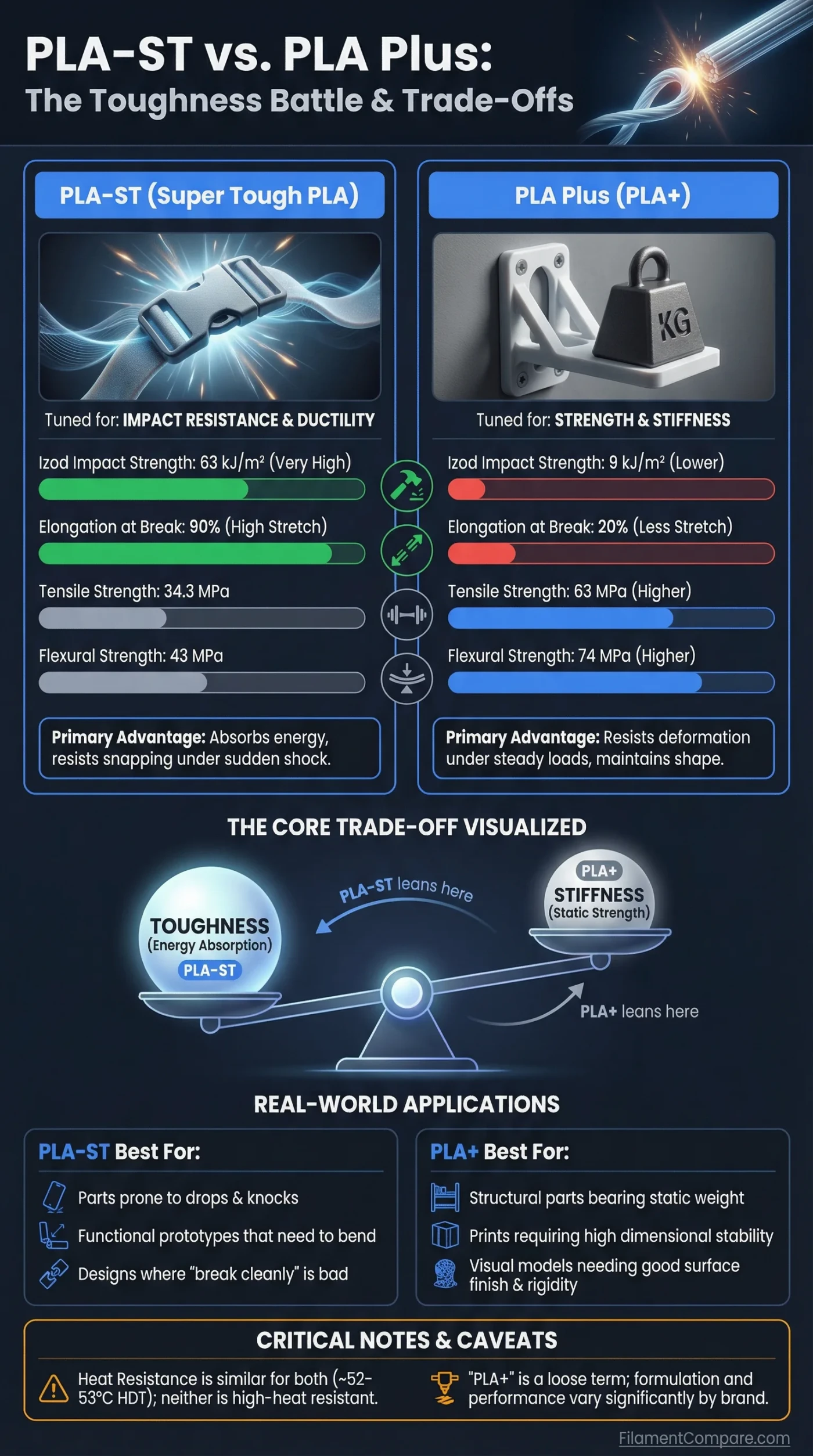
| Izod Impact Strength | 63 kJ/m² | 9 kJ/m² |
| Elongation at Break | 90% | 20% |
| Tensile Strength | 34.3 MPa | 63 MPa |
| Flexural Strength | 43 MPa | 74 MPa |
| Flexural Modulus | 1477 MPa | 1973 MPa |
| Heat Distortion Temperature (HDT) | 52 °C | 53 °C |
| Melt Flow Index (190°C / 2.16 kg) | 3.2 | 5 |
| Density | 1.25 g/cm³ | 1.23 g/cm³ |
| Typical Nozzle Temp Range | 200–230°C | 210–230°C |
| Typical Bed Temp Range | 45–60°C | 45–60°C |
This PLA-ST vs PLA Plus comparison leans on manufacturer datasheets and standard-test references to show typical performance trends, and real printed-part results can vary with printer, geometry, and settings.
- What PLA-ST and PLA Plus Usually Mean
- PLA-ST (Super Tough PLA)
- PLA Plus (PLA+)
- What “Tougher” Means in Measurable Terms
- So Which Is Tougher: PLA-ST or PLA Plus?
- A Practical Reading of the Spec Trade-Off
- Visual “Feel” Comparison Using Relative Meters
- Why Online “Toughness” Claims Often Get Messy
- If You Want a Clean Apples-to-Apples Comparison
- How the Numbers Map to Real Part Behavior
- PLA-ST: Toughness-First Parts
- PLA Plus: Strength/Stiffness-First Parts
- Resources Used
“Tougher” gets used loosely in 3D printing, so this comparison sticks to measurable signals like impact strength and elongation at break rather than vibes. PLA-ST and PLA Plus are both PLA-based blends, yet they’re tuned for different mechanical priorities—one leans into energy absorption, the other often leans into strength and stiffness. For a broader explanation of how PLA variants like PLA+, Meta PLA, and other modified PLA families fit into the overall material landscape, see the Ultimate PLA Filament Guide.
What PLA-ST and PLA Plus Usually Mean
PLA-ST (Super Tough PLA)
PLA-ST is typically a PLA-family recipe aimed at higher ductility and impact resistance, so parts are more willing to bend before breaking.
- Often shows much higher Izod impact values than standard PLA blends
- Frequently trades away some tensile and flexural strength for toughness
- Commonly marketed for functional parts where knocks and drops matter
PLA Plus (PLA+)
PLA Plus is not a single standardized polymer grade; it’s a modified PLA label used for blends that can shift layer adhesion, flow, strength, or brittleness depending on the brand.
- Often marketed as stronger or less brittle than “basic PLA”
- Can carry higher tensile/flexural numbers in some datasheets
- Formulations vary a lot, so “PLA+” can mean different things
Small but important: “Stronger” and “tougher” are not the same thing, and the difference is exactly why PLA-ST and PLA+ can look “better” in different spec rows.
What “Tougher” Means in Measurable Terms
- Toughness
- Energy a material can absorb before it fractures; in tensile testing it’s often described as the area under the stress–strain curve[c].
- Impact Toughness
- How a material behaves under a quick удар/strike; commonly compared with pendulum impact methods like Izod.
- Strength
- How much stress the material can take (tensile, flexural) before failure; this is not automatically the same as toughness.
- Stiffness
- Resistance to elastic bending; often summarized by a modulus value like flexural modulus.
When people ask “Which is tougher?”, they usually care about crack resistance and energy absorption—the kind of behavior that shows up strongly in Izod impact strength and in higher elongation at break.
So Which Is Tougher: PLA-ST or PLA Plus?
Based on the datasheet comparison above, PLA-ST is the toughness-leaning option: its Izod impact strength is dramatically higher (63 vs 9 kJ/m²), and its elongation at break is far higher (90% vs 20%), which together point to more ductile failure behavior.
PLA Plus, in that same brand-to-brand snapshot, leans into strength and stiffness—higher tensile strength and flexural values—while showing a lower impact number; that pattern is common when a blend is tuned for rigidity and load bearing rather than shock absorption.
A Practical Reading of the Spec Trade-Off
- Impact (drops, bumps, snaps): PLA-ST trends higher
- Bending stiffness: PLA+ trends higher
- Stretch before breaking: PLA-ST trends higher
- Load-bearing strength: PLA+ can trend higher
Visual “Feel” Comparison Using Relative Meters
Impact Toughness relative
Stiffness (Flexural Modulus) relative
Heat Deflection (HDT) relative
Why Online “Toughness” Claims Often Get Messy
One common mix-up is comparing a printed part result to an injection-molded datasheet number; many filament TDS tables are based on standardized specimens, while printed parts can behave differently because of anisotropy and interlayer bonding.
Another trap is treating “PLA+” as a single material grade. In practice it’s a label for blends, so the same name can represent very different combinations of ductility, stiffness, and flow behavior across brands.
If You Want a Clean Apples-to-Apples Comparison
- Check whether the impact number is Izod and which standard it tracks; ISO 180 is one widely used reference for Izod impact strength[d].
- Check that tensile values are based on a standard test method such as ISO 527, which is widely used for measuring tensile properties of plastics[f].
- Read HDT like a short-term deflection-under-load indicator, not a promise of “safe continuous use”; ISO 75-1 describes the deflection-under-load method behind HDT-style values[e].
How the Numbers Map to Real Part Behavior
PLA-ST: Toughness-First Parts
PLA-ST’s high impact figure and high elongation suggest a material that can absorb energy and reduce brittle snaps when a part sees sudden loads.
- Helpful when drop resistance matters
- Useful for parts that flex during use
- Often chosen when “break cleanly” is not the goal
PLA Plus: Strength/Stiffness-First Parts
PLA+ can show higher tensile and flexural values in some datasheets, which lines up with a more rigid feel and higher resistance to bending under steady loading.
- Useful where stiffness supports geometry
- Often chosen for parts that carry moderate static loads
- Common for prints where surface finish and general reliability matter
Heat note: In the compared datasheets, HDT values are close (about 52–53°C), so neither label automatically means high heat resistance; check the exact HDT method and loading if heat performance is important.
Resources Used
- [a] eSUN ePLA-ST (PLA-ST) Filament Technical Data Sheet (PDF)
- [b] eSUN PLA+ Filament Technical Data Sheet (PDF)
- [c] United States Naval Academy (USNA) Course Notes: Deformation and Toughness (PDF)
- [d] ISO 180: Plastics — Determination of Izod Impact Strength (Standard Page)
- [e] ISO 75-1: Plastics — Temperature of Deflection Under Load (Standard Page)
- [f] ISO 527-1: Plastics — Determination of Tensile Properties (Standard Page)
