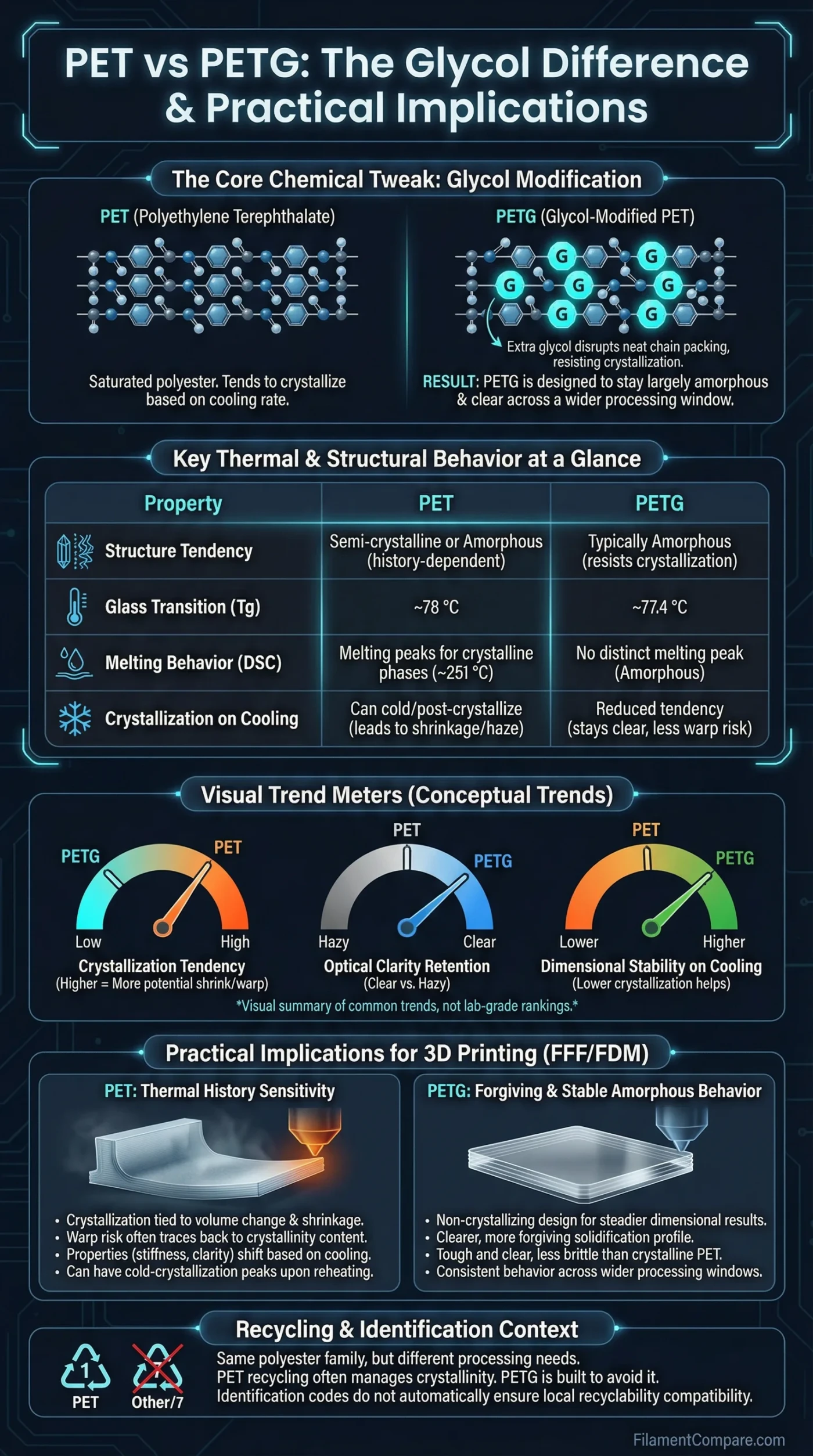
| Property | PET | PETG |
|---|---|---|
| Polymer Family | Saturated polyester (polyethylene terephthalate) | Glycol-modified PET copolyester; designed to resist crystallizing [a] |
| Typical Solid-State Structure | Can be amorphous or semi-crystalline depending on thermal history (cooling rate matters) [d] | Typically amorphous; no melting peak reported in DSC for the filament grade shown [b] |
| Glass Transition (DSC) | 78 °C (example DSC midpoint reported for PET) [d] | 77.4 °C (DSC) [b] |
| Cold/Post-Crystallization Example | Cold/post-crystallization around 137 °C (example) [c] | Reduced crystallization tendency (often stays clear instead of turning hazy) [a] |
| Melting Behavior | Melting of crystalline phases around 251 °C (example) [c] | “– (amorphous)” reported for melting temperature (DSC) [b] |
| Heat Resistance Indicators (Filament Example) | Highly grade-dependent; crystallinity strongly influences performance window [d] | HDT 76.2 °C; Vicat 82.9 °C (printed samples) [b] |
This PET vs PETG comparison blends manufacturer datasheets with reputable references, so the figures show typical trends rather than guaranteed results for every grade or process.
- What the “G” in PETG Really Means
- How Glycol Changes Structure: Crystallinity, Clarity, Shrinkage
- Relative Trend Meters (Conceptual)
- Thermal Behavior: Tg, Crystallization Peaks, and the “Melting Point” Trap
- Mechanical Personality: Same Family, Different Feel
- Why This Matters for Filament Use
- Recycling and Identification: Same “PET” Family, Not Always the Same Stream
- Resources Used
PET and PETG sit in the same polyester family, yet a small chemistry tweak—glycol modification—changes how the polymer packs, cools, and behaves as a filament material.
What the “G” in PETG Really Means
PET is built from terephthalate + ethylene glycol units; PETG is a copolyester where part of the glycol content is replaced by a bulkier glycol component, which is why many sources call it glycol-modified PET.
That extra glycol is not a marketing gimmick—it disrupts neat chain packing, so the material resists crystallization and tends to stay water-clear across a wider processing window.
- Glycol Modification
- Using an alternative glycol as a comonomer so the chain architecture becomes less “crystal-friendly,” shifting crystallization speed and final morphology.
- Copolyester
- A polyester made from more than one type of monomer (common in PETG and other specialty PET variants).
- Why CHDM Comes Up Often
- One widely used glycol modifier in polyester resin design is 1,4-cyclohexanedimethanol (CHDM), commonly described as a glycol modifier for polyester resins. [h]
How Glycol Changes Structure: Crystallinity, Clarity, Shrinkage
The big divider is crystallinity. PET can be pushed toward amorphous or toward more crystalline content based on cooling and reheating, and DSC examples show a glass transition near 78 °C with cold-crystallization and later melting peaks. [d]
PETG is tuned to stay largely amorphous; one practical sign is that DSC reports no melting temperature (listed as “amorphous”) for the PETG filament grade in a published technical data sheet. [b]
Relative Trend Meters (Conceptual)
Crystallization Tendency (higher tends to mean more shrink/warp during cooling)
Optical Clarity Retention (clear vs haze as structure changes)
Dimensional Stability on Cooling (lower crystallization typically helps)
Note: These bars are a visual summary of common trends, not lab-grade rankings.
Thermal Behavior: Tg, Crystallization Peaks, and the “Melting Point” Trap
When people compare PET vs PETG, they often treat both as if they have a single “melting point.” In reality, PET shows melting only when crystalline phases exist, and DSC examples report all crystalline phases melting around 251 °C. [c]
For PET, thermal analysis shows a glass transition at about 78 °C and cold-crystallization peaks (reported near 133 °C in one example). This indicates that the internal structure may continue to change after printing or reheating. [d]
PETG usually skips that crystallization story; the same kind of datasheet reporting can list a glass transition (for example, 77.4 °C) while calling melting temperature “amorphous,” which is a neat shorthand for “no melting peak to point at.” [b]
Mechanical Personality: Same Family, Different Feel
Because PET can crystallize, it often leans toward higher stiffness potential once crystalline content is present, while PETG is frequently described as tough and clear thanks to its non-crystallizing design.
A practical way to think about it: PETG aims for stable amorphous behavior, while PET can shift between amorphous and more crystalline states depending on how it cools and reheats—so you may see bigger swings in real-world outcomes.
- PET: thermal history sensitivity can influence stiffness, shrinkage, and clarity as crystallinity changes.
- PETG: reduced crystallization tendency helps keep behavior more consistent across processing windows.
- Both: grade, additives, and moisture history can shift results; numbers should be read as material-family tendencies.
Why This Matters for Filament Use
In FFF/FDM terms, the glycol difference shows up as cooling behavior. Within the broader landscape of engineering-grade 3D printing filaments, crystallization is tied to volume change and shrinkage in PET examples, which is why warp risk discussions often trace back to crystallinity rather than brand names. [c]
PETG’s “non-crystallizing” design pushes it toward a clearer, more forgiving solidification profile, which helps explain why many users associate it with steady dimensional results compared with more crystallization-prone polymers. [a]
Small but important nuance: “PET filament” is not always the same thing as a highly crystalline PET part—cooling rate and formulation can keep PET more amorphous, and that changes how it behaves. Thermal history is part of the material. [d]
Recycling and Identification: Same “PET” Family, Not Always the Same Stream
From a labeling perspective, the resin identification system is meant to identify plastic families, not to promise that an item is recyclable everywhere; ASTM’s guidance highlights that these codes don’t automatically equal recyclability. [g]
From a material science perspective, PET recycling often depends on controlling crystallinity and melt behavior, while PETG is intentionally built to avoid crystallizing—so sorting and compatibility questions are usually framed around that core crystallization difference.
- PET is frequently processed in ways that can build crystalline phases, and DSC profiles show crystallization/melting features. [d]
- PETG is commonly described as glycol-modified PET that “will not crystallize,” so its thermal signature and downstream behavior differ. [a]
- Identification codes help sort families, but local systems and end-uses still set what happens next. Always read the material context.
Resources Used
- [a] Eastman: Eastar GN007 Copolyester product description (glycol-modified PET; non-crystallizing)
- [b] Ultimaker: PETG Technical Data Sheet (Tg, HDT, Vicat, amorphous DSC note)
- [c] NETZSCH: PET thermal example (post-crystallization and melting behavior)
- [d] NETZSCH: Cooling-rate influence on PET (DSC glass transition and crystallization features)
- [g] ASTM: D7611/D7611M Resin Identification Coding System (identification vs recyclability)
- [h] Eastman: CHDM-D Technical Data Sheet (described as a glycol modifier for polyester resins)
