| Attribute | NylonG (Glass Fiber) [a] | NylonX (Carbon Fiber) [b] | What This Usually Signals |
|---|---|---|---|
| Base polymer | PA12 [e] | PA12 [d] | PA12 is a widely used engineering polyamide for functional parts. |
| Reinforcement | Chopped glass fiber | Chopped carbon fiber | Both are short-fiber reinforced nylon, so directionality can matter in real prints. |
| Approx. reinforcement content | ~20% by weight [c] | 20% chopped carbon fiber [d] | Higher fiber loading typically boosts stiffness and reduces warping trends. |
| Density | 1.00 g/cm³ | 1.00 g/cm³ | Close density means weight differences usually come more from part geometry than material choice. |
| Melting point | 180°C | 180°C | Similar melt point; practical differences come from reinforcement behavior and printer setup. |
| Tensile modulus (ISO 527) | 4000 MPa | 6000 MPa | Modulus is a strong proxy for stiffness under load. |
| Tensile strength (ISO 527) | 95 MPa | 100 MPa | Both are designed for functional parts; print orientation can affect actual test results. |
| Charpy impact strength (ISO 179) | 80 kJ/m² | 60 kJ/m² | Higher impact values often map to better energy absorption in shock-style loading. |
| Ball indentation hardness (ISO 2039-1) | 77 MPa | 110 MPa | Hardness relates to surface indentation resistance and often tracks with perceived rigidity. |
| HDT/A (ISO 75) | 160°C | 155°C | HDT is a standardized thermal-mechanical indicator, not a guaranteed “service temperature.” |
| Linear mould shrinkage | 0.5% | 0.3% | Lower shrink trend can support tighter dimensional stability targets. |
| Thermal expansion coefficient | 0.1 × 10⁻⁴/K | 0.2 × 10⁻⁴/K | Real printed CTE can be anisotropic; fiber orientation plays a role. |
| Max usage temperature (long term) | 90–120°C | 90–120°C | Long-term exposure should be treated as a design envelope, not a single fixed value. |
| Max usage temperature (short term) | 150°C | 150°C | Short excursions are typically tolerated better than sustained loads at heat. |
| Print temp window (nozzle) | 250–265°C | 250–265°C | Both sit in a similar processing band; hardware choices can still differ. |
| Bed temperature | 60–70°C | 60–70°C | Reinforcement often helps reduce warping compared to unfilled nylon. |
| Typical print speed reference | ~40 mm/s | ~35–45 mm/s | Speed interacts with melt flow, bonding, and surface finish on reinforced nylon. |
This NylonG vs NylonX comparison blends manufacturer data sheets with standards-based context; it highlights trend-level differences, while real printed results can vary with printer setup, orientation, and material conditioning.
- NylonG Material Profile
- NylonX Material Profile
- How Glass and Carbon Fiber Change Nylon
- Stiffness and Flex Under Load
- Impact and Energy Absorption
- Thermal Movement and Warping Tendencies
- Electrical Behavior: Conductive vs Insulating
- Mechanical Performance: Modulus, Strength, and Impact
- Thermal Behavior: HDT and Real Service Limits
- Dimensional Stability: Shrinkage, CTE, and Moisture
- Processing Window Notes From Manufacturer Guidance
- NylonG Reference Ranges
- NylonX Reference Ranges
- Hardware Wear and Nozzle Considerations
- Choosing by User Intent (Neutral Mapping)
- Resources Used
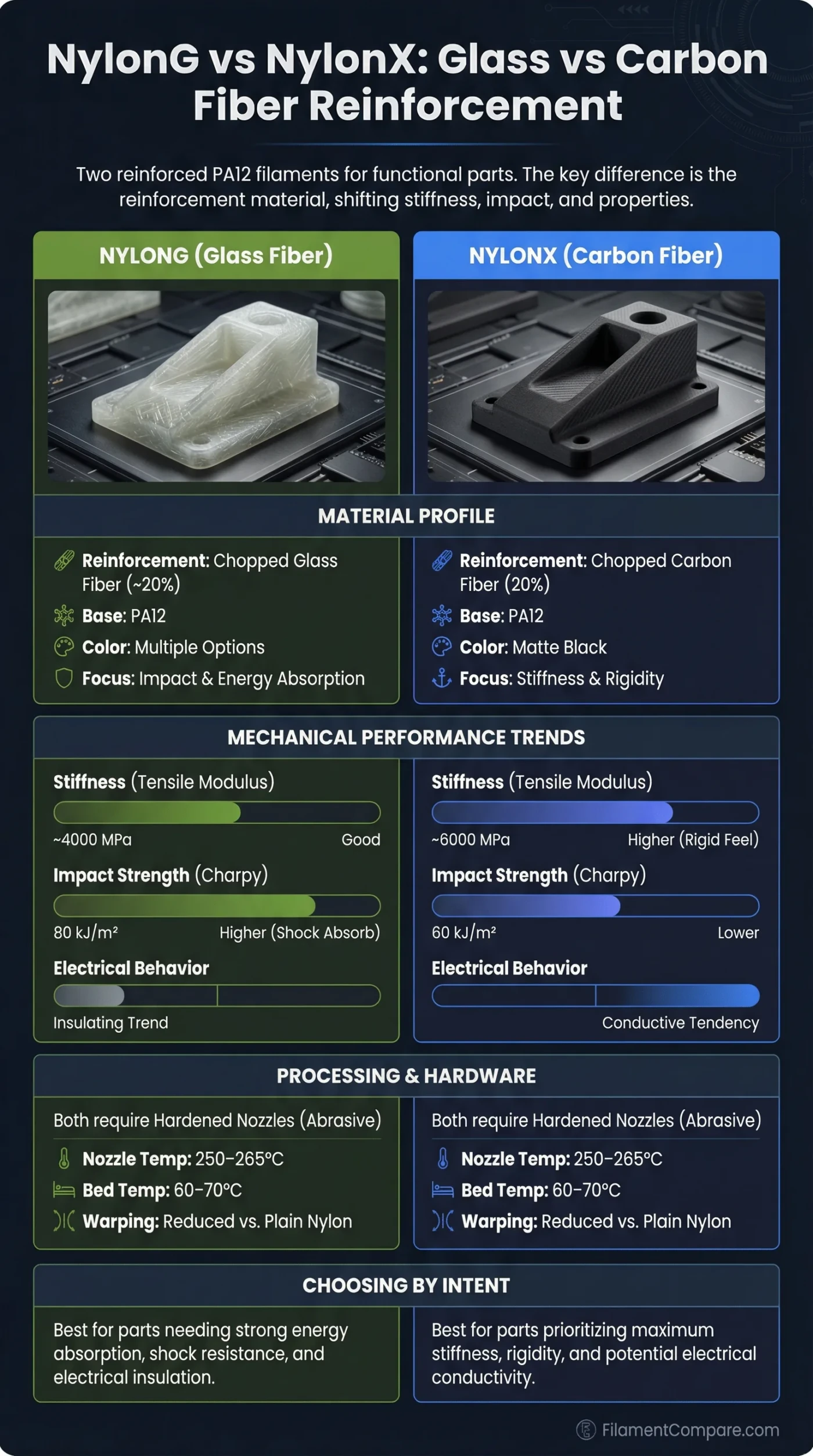
NylonG and NylonX are both reinforced PA12 filaments designed for functional parts where “plain nylon” may feel too flexible or too warp-prone. The big difference is the reinforcement: glass fiber in NylonG versus carbon fiber in NylonX. That single choice shifts stiffness, impact behavior, electrical properties, and even how your nozzle wears over time.
NylonG Material Profile
- Glass-fiber reinforced nylon tuned for rigidity with strong impact-style performance.
- Available in multiple colors on the product line, while keeping a clean, technical surface character [e].
- Datasheet impact strength value is higher than NylonX in the same family of tests [a].
- PA12 base
- ~20% GF (typ.)
- Higher impact trend
- Color options
NylonX Material Profile
- PA12 with 20% chopped carbon fiber for higher modulus and a very rigid feel in many designs [d].
- Matte black appearance is typical for carbon-filled filaments in this category [d].
- Datasheet tensile modulus is higher than NylonG, which often maps to stiffer printed parts [b].
- PA12 base
- 20% CF
- Higher stiffness trend
- Matte black
How Glass and Carbon Fiber Change Nylon
Stiffness Trend (Modulus-Driven)
Impact Energy Trend (Charpy Reference)
Electrical Behavior Tendency
Stiffness and Flex Under Load
On the datasheet, NylonX leads in tensile modulus (6000 MPa vs 4000 MPa), which is a direct reason many designers associate carbon-filled nylon with a more rigid “tooling-like” feel [b]. This stiffness bias is a common theme across many reinforced polymers discussed in broader carbon fiber filament guides. NylonG still sits firmly in the stiff engineering range, just with a different balance across impact and surface behavior [a].
- Carbon fiber reinforcement often prioritizes stiffness for brackets, mounts, and load-bearing housings.
- Glass fiber reinforcement can feel stiff too, while maintaining strong energy absorption behavior in shock-style loading.
Impact and Energy Absorption
In the provided Charpy data, NylonG shows a higher impact strength (80 kJ/m² vs 60 kJ/m²) [a]. If your parts see repeated knocks, drops, or vibration-driven hits, that tilt toward impact performance can be a meaningful design lever without turning the material choice into a gamble.
Thermal Movement and Warping Tendencies
Reinforcement is one reason both lines are described as more stable than unfilled nylon in everyday printing contexts [d]. Still, the thermal story isn’t just one number: shrinkage, CTE, and how fibers align during extrusion all influence the final geometry.
Electrical Behavior: Conductive vs Insulating
Carbon fiber composites are widely studied for their electrical conductivity, and carbon reinforcement can make a polymer system measurably more conductive depending on fiber networks and orientation [g]. Glass fiber reinforced systems are commonly used where electrical insulation is desirable, since glass fiber composites can maintain insulating behavior in many applications [h].
Practical note: NylonX may show lower electrical resistance than glass-filled nylon, but real-world behavior depends on print orientation, fiber content, and surface contact area.
Mechanical Performance: Modulus, Strength, and Impact
The datasheet numbers are strong reference points because they come from standardized methods, yet a printed part is not a molded test bar. Treat the table as material direction, then validate against your part’s geometry and load case.
- Test method matters: tensile values are reported using ISO tensile testing frameworks, which standardize specimen geometry and loading rate [k].
- Printed parts can be anisotropic: fiber alignment and layer stacking can shift stiffness and strength depending on load direction.
- Conditioning changes nylon: polyamide is hygroscopic, and moisture uptake can alter stiffness and time-dependent response [i].
Design-friendly framing: If you need more rigidity, NylonX’s higher modulus is a straightforward signal [b]. If you need stronger shock-style energy absorption, NylonG’s higher impact figure is the cleaner signal [a].
Thermal Behavior: HDT and Real Service Limits
Both materials list similar melting points and similar “max usage temperature” bands [a]. The most misread number is often HDT: it is a standardized deflection-under-load indicator, not a blanket promise that every printed shape will hold its dimensions at that temperature.
- HDT (Heat Deflection Temperature)
- Measured under a defined flexural load and heating rate, helping compare materials on a consistent basis [l].
- Long-Term vs Short-Term Exposure
- Datasheets often separate “long term” from “short term” temperature guidance; the difference is about time at load, not just peak temperature [b].
Dimensional Stability: Shrinkage, CTE, and Moisture
NylonX reports lower linear mould shrinkage than NylonG in the given data (0.3% vs 0.5%) [b]. That aligns with a common expectation for carbon-filled systems, though geometry and print strategy still drive the final outcome.
Moisture is another key factor: polyamide absorbs moisture from the air, and this absorbed water affects polymer mobility [i]. When comparing parts over time, labs often use a water absorption standard such as ISO 62 to ensure consistent results [j].
- CTE and shrinkage influence fit; moisture can add another layer by subtly shifting dimensions.
- Reinforcement helps stabilize nylon trends, but does not fully remove humidity sensitivity.
- For tight-tolerance assemblies, measure parts in the same conditioning state you expect in real use.
Processing Window Notes From Manufacturer Guidance
Both materials sit in similar temperature ranges, yet the reinforcement affects flow feel and hardware wear. The manufacturer lists nozzle temperature ranges and surface recommendations for each product line [d].
Hardware Wear and Nozzle Considerations
Short-fiber composites are commonly treated as abrasive filaments because the added fibers can accelerate wear on soft metal components over time [f]. That’s why many printer manufacturers and filament guides emphasize hardened pathways when carbon fiber or glass fiber is in the mix.
- NylonX often pairs with hardened nozzles and durable feeder components for consistent long-run results.
- NylonG follows the same logic; it’s still a fiber-filled nylon even if the fiber family is different.
Choosing by User Intent (Neutral Mapping)
If you’re comparing these materials for a filament knowledge base, the cleanest way is to tie each to an intent: rigidity-first, impact-first, electrical behavior, and finishing needs. Both are engineered for functional parts; you’re mainly choosing which reinforcement “bias” you want inside the nylon.
- Rigidity-first designs: NylonX is supported by higher tensile modulus in the published data [b].
- Shock and repeated impact designs: NylonG shows a higher Charpy impact figure in the published reference values [a].
- Electrical behavior sensitivity: carbon reinforcement is studied for conductivity trends in composites [g].
- Insulation-friendly bias: glass fiber reinforced systems are widely used where insulating behavior is needed [h].
Resources Used
- [a] — MatterHackers NylonG Technical Data Sheet (PDF)
- [b] — MatterHackers NylonX Technical Data Sheet (PDF)
- [c] — UltiMaker Marketplace: NylonG Material Profile (mentions approx. fiber content)
- [d] — MatterHackers NylonX Product Page (PA12, 20% CF, processing guidance)
- [e] — MatterHackers NylonG Product Page (PA12, processing guidance)
- [f] — Bambu Lab Wiki: Abrasive Filaments and Hardened Steel Components
- [g] — MDPI Applied Sciences: Review on Electrical Resistance/Conductivity of CFRP
- [h] — OSTI (U.S. DOE): Electrical Insulation Characteristics of Glass Fiber Reinforced Resins
- [i] — Springer: Moisture Transport in Polyamide and Effects on Properties (PDF)
- [j] — ISO 62: Plastics — Determination of Water Absorption
- [k] — ISO 527-1: Plastics — Determination of Tensile Properties
- [l] — ISO 75-1: Plastics — Temperature of Deflection Under Load (HDT)
