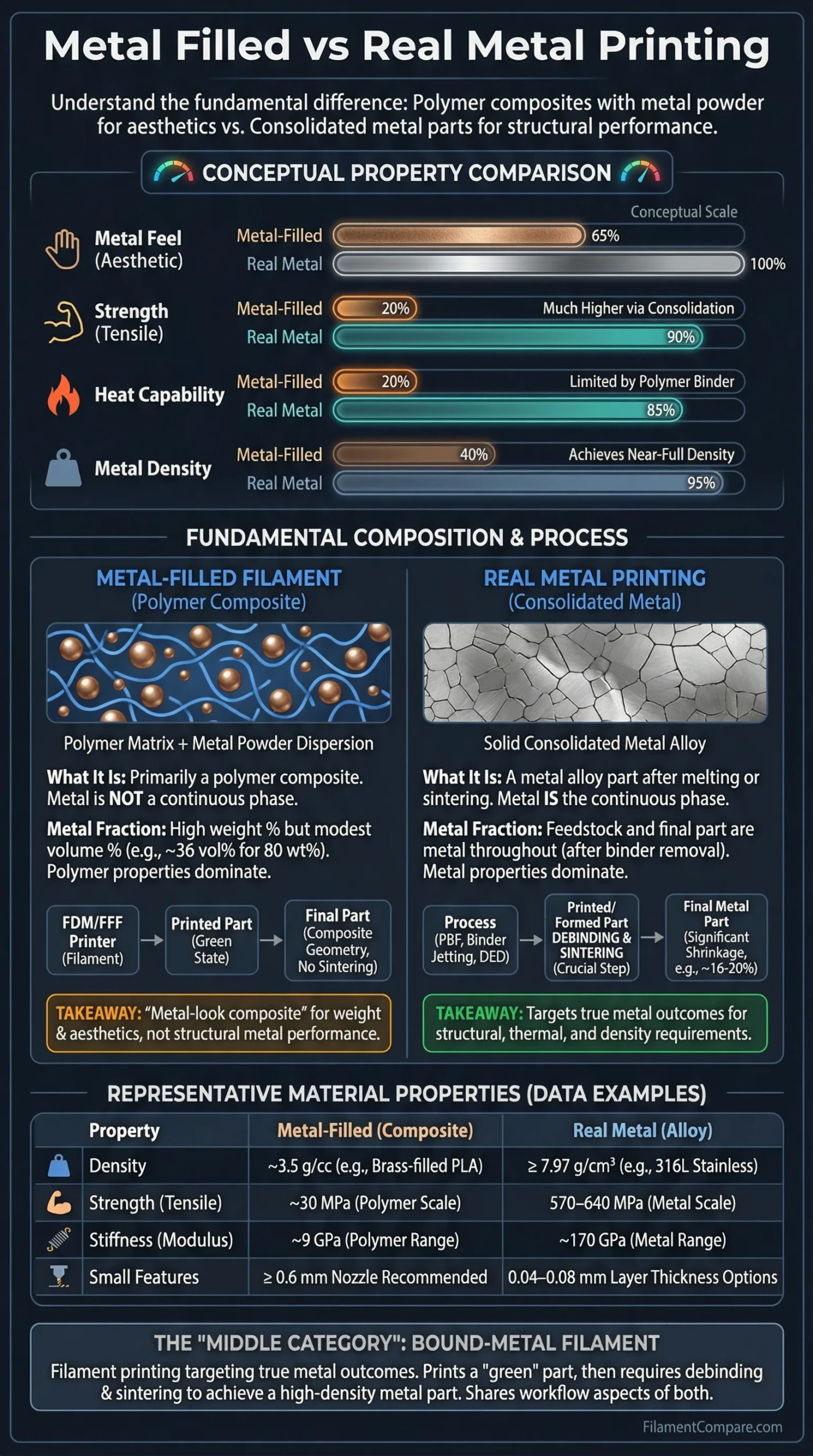
| Comparison Point | Metal-Filled Filament (Polymer + Metal Powder) | Real Metal Printing (Metal AM + Sinter-Based Metal Routes) |
|---|---|---|
| What the Part Mostly Is | Primarily a polymer composite; metal powder is dispersed in a plastic binder, so the “metal” is not a continuous phase.[j] | A metal alloy part after consolidation (melted or sintered), rather than a polymer-bound composite.[a] |
| Representative Metal Fraction | Example data shows high wt% can still mean modest vol% (e.g., ~80.35 wt% but ~36.02 vol% in a bronze-filled PLA sample).[j] | In melt-based routes, the feedstock and final are metal throughout; in sinter-based routes, the metal fraction becomes dominant after debinding/sintering.[b] |
| Density (Representative) | Often around 3.5 g/cc for brass-filled PLA composites (about “300% heavier than PLA” per one manufacturer).[h] | Stainless steel PBF data lists density of ≥ 7.97 g/cm³ for a 316L example dataset.[e] |
| Strength (Representative) | A bronze-filled PLA technical data sheet lists tensile strength ~30 MPa (polymer-composite scale).[g] | Metal AM 316L example data lists tensile strength 570–640 MPa (metal scale).[e] |
| Stiffness (Representative) | Bronze-filled PLA data lists flexural modulus ~9,000 MPa (≈ 9 GPa).[g] | A 17-4PH sintered metal dataset lists modulus ~170 GPa (metal range).[f] |
| Small-Feature Limits (Typical) | Manufacturers commonly recommend ≥ 0.6 mm hardened nozzles for metal-filled composites due to particle loading and abrasion behavior.[h] | Example PBF parameter sets list 0.04 mm or 0.08 mm layer thickness options for 316L datasets (system/material dependent).[e] |
| Dimensional Change After Consolidation | No sintering shrink step; final dimensions are mainly the printed polymer-composite geometry. | Sinter-based routes can require scaling: one guideline notes ~16% shrink in X/Y and ~20% in Z for a 316L bound-metal filament workflow.[i] |
| Process Families You’ll See | Material extrusion (FDM/FFF) with a metal-powder-filled polymer matrix.[h] | Common “real metal” families include Powder Bed Fusion, Binder Jetting, and Directed Energy Deposition (plus sinter-based bound-metal extrusion).[c] |
| Workplace Exposure Focus | Less loose powder handling, yet sanding/polishing can generate fine particulate; composite behavior is still tied to the binder phase.[j] | Studies of metal-powder AM note generally low average airborne levels with spikes during tasks like manual cleaning and powder transfer; powder migration can occur beyond powder rooms.[l] |
| Shared Vocabulary and Standards | Clear terminology reduces confusion between “metal-filled” and “metal AM” categories across datasheets and procurement.[a] | ASTM’s additive manufacturing committee structure supports standards across materials, processes, and qualification topics used in real metal production ecosystems.[m] |
This comparison of metal-filled filament and real metal printing is built from manufacturer datasheets and high-reliability institutional sources, so it reflects common specs and standard trends while real-world outcomes can vary by machine, geometry, and post-processing.
- What “Metal-Filled” Really Means
- What Counts as Real Metal Printing
- The “Middle Category” Many People Miss
- Material Properties That Actually Change the Decision
- Density and Weight
- What “Metal-Filled” Really Means
- What Counts as Real Metal Printing
- The “Middle Category” Many People Miss
- Material Properties That Actually Change the Decision
- Density and Weight
“Metal-filled” and “real metal printing” sound similar, yet they deliver very different materials in your hands. One is a polymer filament with metal powder for weight and aesthetics; the other produces consolidated metal parts via powder-bed fusion, binder jetting, directed energy deposition, or sinter-based metal workflows. The differences show up in density, mechanical behavior, dimensional change, and the kind of production environment each approach fits.
- Metal-Filled Filament
- Metal Composite Filament
- Powder Bed Fusion
- Binder Jetting
- Directed Energy Deposition
- Debinding & Sintering
What “Metal-Filled” Really Means
A metal-filled filament is a polymer binder loaded with metal powder. Materials like metal-filled, wood-filled, marble, or glow filaments are often grouped within specialty 3D-printing filaments because additives are used mainly to change appearance, density, or tactile feel rather than the base polymer family itself. The binder still governs melt flow, layer bonding, and most in-use behavior, while the metal changes weight, texture, and surface appearance. This is why metal-filled parts feel “cold” and hefty, yet they don’t behave like a solid metal coupon in structural testing.[h]
A detail that gets overlooked: metal fraction looks huge by weight, but volume fraction can be much lower. One NASA characterization example reported ~80.35% metal by weight but ~36.02% by volume for a bronze-filled PLA sample, which helps explain why polymer-composite mechanics still dominate.[j]
Practical takeaway: “Metal-filled” usually means “metal-look composite,” not a part that matches steel or bronze properties across heat, strength, and stiffness.
What Counts as Real Metal Printing
Real metal printing is about producing a part whose load-bearing material is consolidated metal. ISO/ASTM terminology treats additive manufacturing as joining materials to make parts from 3D model data, with process families and definitions that help distinguish composite printing from metal-part production.[a]
In Powder Bed Fusion, a thermal energy source selectively fuses regions in a powder bed to build a solid metal part layer-by-layer, with unused powder surrounding the build during processing.[b]
In Binder Jetting, powdered material is fused by a binder to create a “printed” form that is typically consolidated later (often via sintering), which makes it distinct from melt-based metal fusion even though both can end in metal parts.[c]
Directed Energy Deposition builds up material as a nozzle deposits and melts material onto a target using a directed energy beam (such as laser or electron beam), then solidifies into a part as it cools.[d]
The “Middle Category” Many People Miss
There’s also a route that looks like filament printing but targets true metal outcomes: bound-metal filaments that print a “green” part, then go through debinding and sintering. One guideline highlights a high 90% metal content in the filament and notes that immobilizing particles in a binder matrix can reduce hazards versus handling loose metal powders in some melt-based or powder-based routes.[i]
Material Properties That Actually Change the Decision
Relative Comparison Meters (conceptual, not a test result)
Density and Weight
Metal-filled filaments are chosen for weight per volume more than for metal-like structural performance. A brass-filled PLA composite example lists density around 3.5 g/cc, which is dramatically heavier than standard PLA, yet still far below typical steels.[h]
Real metal printing reaches metal-class density. A stainless steel 316L dataset for PBF lists density ≥ 7.97 g/cm³, which tracks closely with the expectation of
| Comparison Point | Metal-Filled Filament (Polymer + Metal Powder) | Real Metal Printing (Metal AM + Sinter-Based Metal Routes) |
|---|---|---|
| What the Part Mostly Is | Primarily a polymer composite; metal powder is dispersed in a plastic binder, so the “metal” is not a continuous phase.[j] | A metal alloy part after consolidation (melted or sintered), rather than a polymer-bound composite.[a] |
| Representative Metal Fraction | Example data shows high wt% can still mean modest vol% (e.g., ~80.35 wt% but ~36.02 vol% in a bronze-filled PLA sample).[j] | In melt-based routes, the feedstock and final are metal throughout; in sinter-based routes, the metal fraction becomes dominant after debinding/sintering.[b] |
| Density (Representative) | Often around 3.5 g/cc for brass-filled PLA composites (about “300% heavier than PLA” per one manufacturer).[h] | Stainless steel PBF data lists density of ≥ 7.97 g/cm³ for a 316L example dataset.[e] |
| Strength (Representative) | A bronze-filled PLA technical data sheet lists tensile strength ~30 MPa (polymer-composite scale).[g] | Metal AM 316L example data lists tensile strength 570–640 MPa (metal scale).[e] |
| Stiffness (Representative) | Bronze-filled PLA data lists flexural modulus ~9,000 MPa (≈ 9 GPa).[g] | A 17-4PH sintered metal dataset lists modulus ~170 GPa (metal range).[f] |
| Small-Feature Limits (Typical) | Manufacturers commonly recommend ≥ 0.6 mm hardened nozzles for metal-filled composites due to particle loading and abrasion behavior.[h] | Example PBF parameter sets list 0.04 mm or 0.08 mm layer thickness options for 316L datasets (system/material dependent).[e] |
| Dimensional Change After Consolidation | No sintering shrink step; final dimensions are mainly the printed polymer-composite geometry. | Sinter-based routes can require scaling: one guideline notes ~16% shrink in X/Y and ~20% in Z for a 316L bound-metal filament workflow.[i] |
| Process Families You’ll See | Material extrusion (FDM/FFF) with a metal-powder-filled polymer matrix.[h] | Common “real metal” families include Powder Bed Fusion, Binder Jetting, and Directed Energy Deposition (plus sinter-based bound-metal extrusion).[c] |
| Workplace Exposure Focus | Less loose powder handling, yet sanding/polishing can generate fine particulate; composite behavior is still tied to the binder phase.[j] | Studies of metal-powder AM note generally low average airborne levels with spikes during tasks like manual cleaning and powder transfer; powder migration can occur beyond powder rooms.[l] |
| Shared Vocabulary and Standards | Clear terminology reduces confusion between “metal-filled” and “metal AM” categories across datasheets and procurement.[a] | ASTM’s additive manufacturing committee structure supports standards across materials, processes, and qualification topics used in real metal production ecosystems.[m] |
This comparison of metal-filled filament and real metal printing is built from manufacturer datasheets and high-reliability institutional sources, so it reflects common specs and standard trends while real-world outcomes can vary by machine, geometry, and post-processing.
“Metal-filled” and “real metal printing” sound similar, yet they deliver very different materials in your hands. One is a polymer filament with metal powder for weight and aesthetics; the other produces consolidated metal parts via powder-bed fusion, binder jetting, directed energy deposition, or sinter-based metal workflows. The differences show up in density, mechanical behavior, dimensional change, and the kind of production environment each approach fits.
- Metal-Filled Filament
- Metal Composite Filament
- Powder Bed Fusion
- Binder Jetting
- Directed Energy Deposition
- Debinding & Sintering
What “Metal-Filled” Really Means
A metal-filled filament is a polymer binder loaded with metal powder. The binder still governs melt flow, layer bonding, and most in-use behavior, while the metal changes weight, texture, and surface appearance. This is why metal-filled parts feel “cold” and hefty, yet they don’t behave like a solid metal coupon in structural testing.[h]
A detail that gets overlooked: metal fraction looks huge by weight, but volume fraction can be much lower. One NASA characterization example reported ~80.35% metal by weight but ~36.02% by volume for a bronze-filled PLA sample, which helps explain why polymer-composite mechanics still dominate.[j]
Practical takeaway: “Metal-filled” usually means “metal-look composite,” not a part that matches steel or bronze properties across heat, strength, and stiffness.
What Counts as Real Metal Printing
Real metal printing is about producing a part whose load-bearing material is consolidated metal. ISO/ASTM terminology treats additive manufacturing as joining materials to make parts from 3D model data, with process families and definitions that help distinguish composite printing from metal-part production.[a]
In Powder Bed Fusion, a thermal energy source selectively fuses regions in a powder bed to build a solid metal part layer-by-layer, with unused powder surrounding the build during processing.[b]
In Binder Jetting, powdered material is fused by a binder to create a “printed” form that is typically consolidated later (often via sintering), which makes it distinct from melt-based metal fusion even though both can end in metal parts.[c]
Directed Energy Deposition builds up material as a nozzle deposits and melts material onto a target using a directed energy beam (such as laser or electron beam), then solidifies into a part as it cools.[d]
The “Middle Category” Many People Miss
There’s also a route that looks like filament printing but targets true metal outcomes: bound-metal filaments that print a “green” part, then go through debinding and sintering. One guideline highlights a high 90% metal content in the filament and notes that immobilizing particles in a binder matrix can reduce hazards versus handling loose metal powders in some melt-based or powder-based routes.[i]
Material Properties That Actually Change the Decision
Relative Comparison Meters (conceptual, not a test result)
Density and Weight
Metal-filled filaments are chosen for weight per volume more than for metal-like structural performance. A brass-filled PLA composite example lists density around 3.5 g/cc, which is dramatically heavier than standard PLA, yet still far below typical steels.[h]
Real metal printing reaches metal-class density. A stainless steel 316L dataset for PBF lists density ≥ 7.97 g/cm³, which tracks closely with the expectation of
